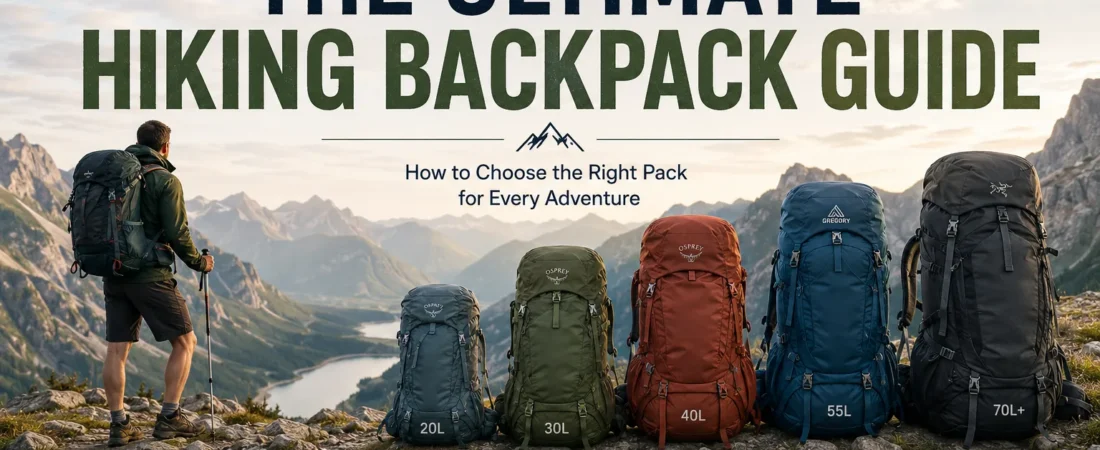
Understanding Backpack Capacity
If there’s one specification that confuses buyers more than any other, it’s capacity.
20 liters.
30 liters.
45 liters.
65 liters.
80 liters.
At first glance, these numbers don’t mean very much.
Many first-time buyers simply assume that larger is better.
Experienced hikers usually think the opposite.
The goal isn’t to carry more.
It’s to carry only what you actually need.
Choosing the correct backpack size is one of the biggest factors affecting comfort on the trail.
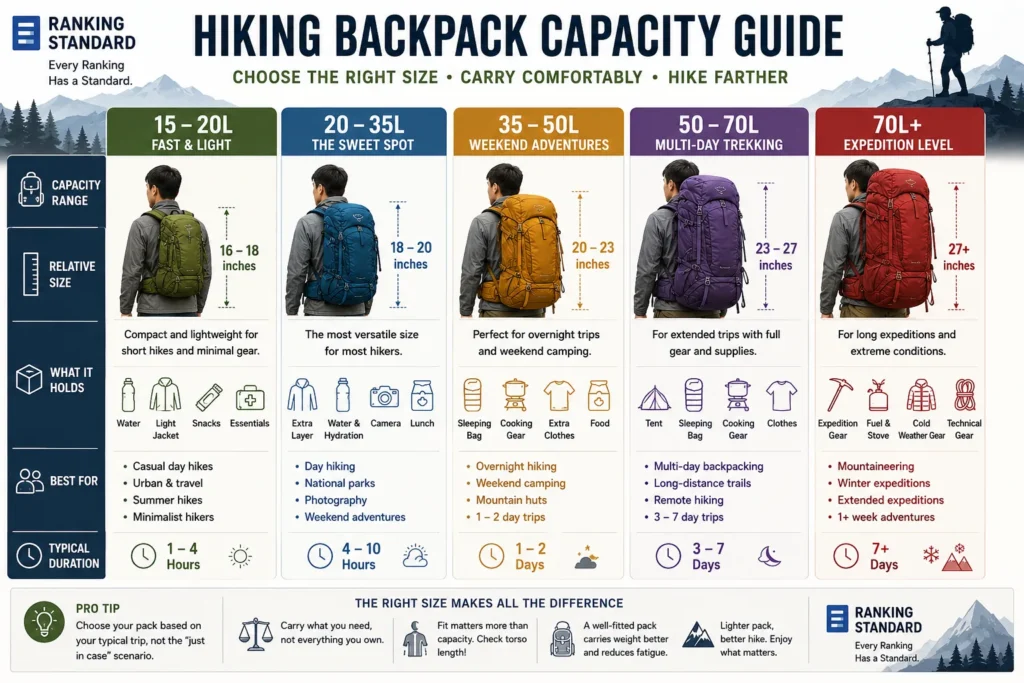
15–20L: Fast & Light
This is the smallest category of hiking backpacks.
These packs are designed for short outdoor adventures where you carry only the essentials.
Typical gear includes:
- Water bottle
- Snacks
- Lightweight jacket
- First-aid kit
- Phone
- Camera
They’re ideal for morning hikes, city parks, and fast-paced mountain walks.
Because they’re compact, they also work well as travel daypacks.
If your hikes usually last only a few hours, carrying anything larger often means carrying unnecessary weight.
Best for
- Casual hiking
- Urban exploration
- Travel day trips
- Summer walks
20–35L: The Sweet Spot
For most hikers, this is the ideal range.
In fact, if you’re buying your first hiking backpack, there’s a good chance this is the category you actually need.
These packs comfortably hold:
- Extra clothing
- Rain gear
- Lunch
- Water reservoir
- Camera equipment
- Emergency supplies
Without becoming unnecessarily heavy.
This category offers the best balance between versatility and comfort.
Many experienced hikers own multiple backpacks—but their 25–30L pack often becomes the one they use most frequently.
Best for
- Day hiking
- National parks
- Photography
- Most weekend adventures
35–50L: Weekend Adventures
Planning to spend a night outdoors?
This is where larger backpacks begin to make sense.
You’ll have enough space for:
- Sleeping bag
- Cooking equipment
- Additional food
- Warm clothing
- Shelter
The backpack also becomes much heavier.
That means suspension systems, hip belts, and load distribution become significantly more important than they are with smaller packs.
Comfort now matters just as much as storage.
Best for
- Overnight hiking
- Weekend camping
- Mountain huts
- Lightweight backpacking
50–70L: Multi-Day Trekking
Long-distance hiking changes everything.
Food.
Extra clothing.
Shelter.
Cooking gear.
Water filtration.
The amount of equipment increases dramatically.
At this point, your backpack isn’t simply carrying gear.
It’s carrying your entire outdoor lifestyle.
This category requires excellent suspension systems and careful weight distribution.
Choosing the wrong backpack here can quickly turn an enjoyable trek into an exhausting experience.
Best for
- Multi-day backpacking
- Long-distance trails
- Wild camping
- International trekking
70L and Above: Expedition Packs
These are specialized backpacks.
Most hikers will never need one.
They’re designed for extended expeditions where carrying large amounts of equipment is unavoidable.
Mountaineering.
Winter expeditions.
Remote wilderness travel.
Professional guiding.
For everyday hiking, these packs are usually too large.
Buying one “just in case” often leads to carrying unnecessary weight.
Internal Frame vs External Frame
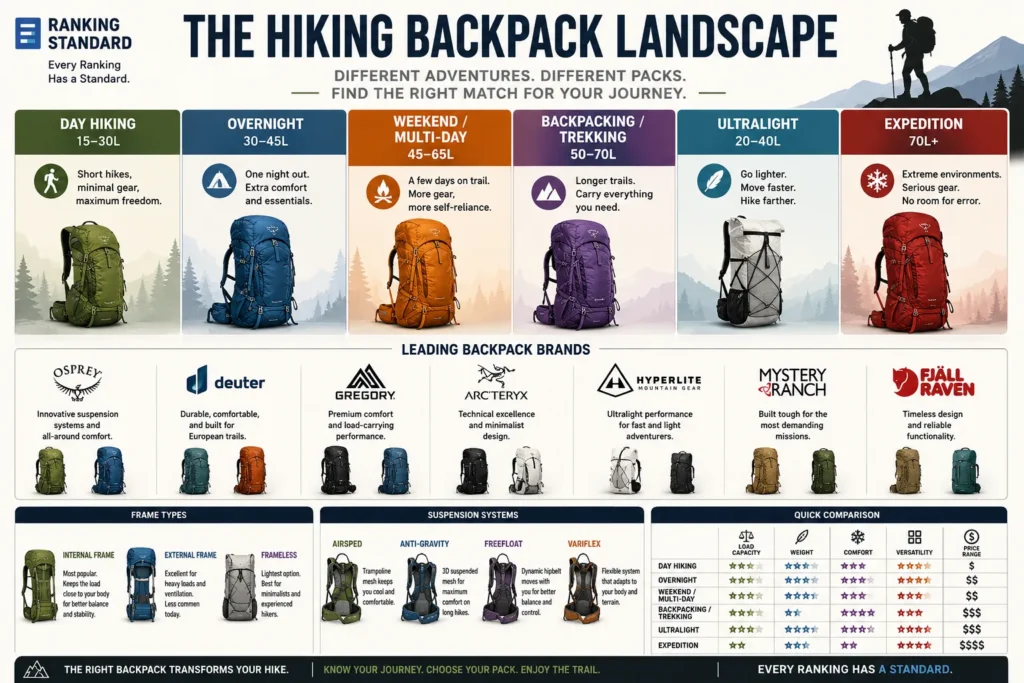
Capacity isn’t the only decision.
The frame matters just as much.
Internal Frame
Today’s most popular design.
The frame sits inside the backpack, keeping the load close to your body.
Advantages:
- Better balance
- Greater stability
- Easier movement
- More comfortable on uneven terrain
For most hikers, this is the right choice.
External Frame
Less common today but still useful in certain situations.
These backpacks carry heavy loads exceptionally well and provide excellent ventilation.
They’re often used for specialized outdoor activities rather than everyday hiking.
Frameless Backpacks
Favored by ultralight hikers.
They save weight by removing the frame entirely.
The trade-off?
Less structure and reduced comfort with heavier loads.
They’re excellent for experienced backpackers carrying minimal gear—but rarely the best choice for beginners.
Backpack Weight Matters
Many buyers compare carrying capacity.
Experienced hikers often compare empty weight.
Imagine carrying a backpack for eight hours.
Now imagine that backpack weighs one kilogram less.
That difference becomes surprisingly noticeable before the day is over.
A lighter backpack usually means less fatigue.
However, the lightest backpack isn’t always the most comfortable.
Well-designed suspension systems often matter more than saving a few hundred grams.
The goal is balance—not simply reducing weight at all costs.
What We’ve Learned
Choosing the right hiking backpack starts with understanding your trips—not your favorite brand.
Most hikers don’t need a 65-liter expedition pack.
Likewise, a minimalist 18-liter daypack isn’t suitable for multi-day trekking.
The best backpack is the one that matches the distance you hike, the equipment you carry, and the way you enjoy the outdoors.
Now that we’ve identified the different backpack categories, the next step is comparing the world’s leading backpack brands and discovering which companies consistently build the best packs for every type of adventure.
Ranking Standard Recommendation Matrix
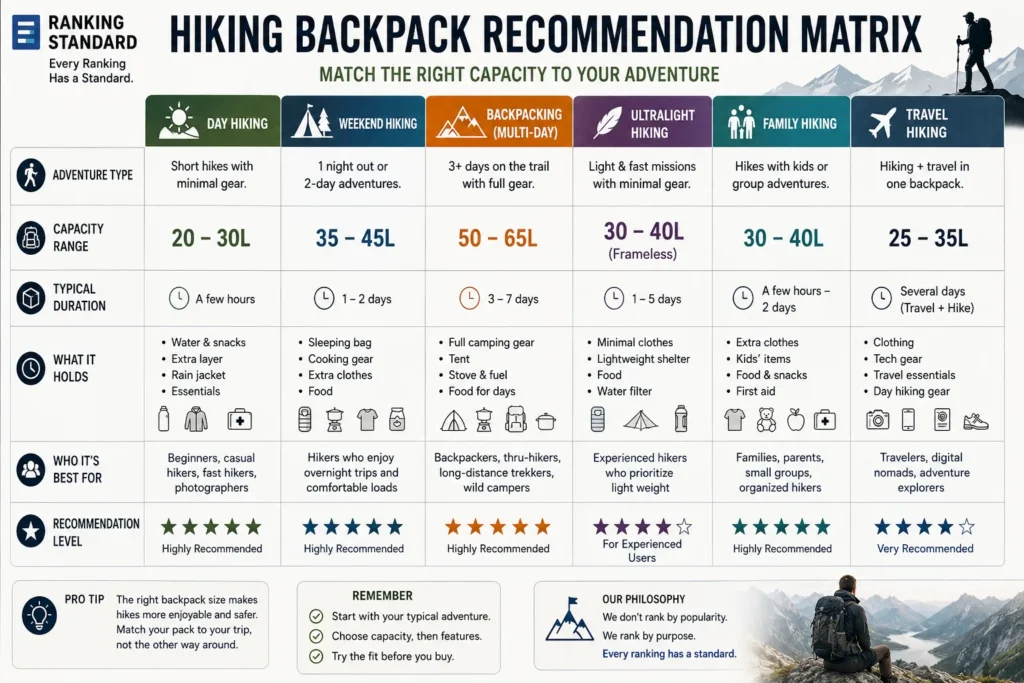
After understanding backpack capacity, one important idea becomes clear.
The perfect hiking backpack doesn’t exist.
The perfect backpack for your adventure does.
That’s why Ranking Standard doesn’t recommend one universal winner.
Instead, we recommend backpacks based on the type of hiking you actually do.
🏆 Best for Day Hiking
20–30L
If most of your adventures last only a few hours, this is the category to start with.
You’ll have enough space for water, snacks, an extra layer, a rain jacket, and emergency essentials without carrying unnecessary weight.
For the majority of hikers, this is the most versatile backpack size available.
Ideal for
- National parks
- Forest trails
- Mountain day hikes
- Photography
- Weekend outings
🏆 Best for Weekend Trips
35–45L
Planning to stay overnight?
A backpack in this range provides enough room for sleeping gear, extra clothing, food, and cooking equipment while remaining comfortable enough for long walks.
This category offers an excellent balance between capacity and mobility.
Ideal for
- Overnight hiking
- Mountain huts
- Weekend camping
- Lightweight backpacking
🏆 Best for Multi-Day Trekking
50–65L
Once your trip extends beyond two or three days, carrying comfort becomes more important than storage capacity.
A well-designed suspension system and supportive hip belt matter far more than an extra pocket or zipper.
The goal is to carry weight efficiently—not simply carry more.
Ideal for
- Multi-day trails
- Backpacking
- International trekking
- Remote hiking
🏆 Best for Ultralight Hiking
Frameless 30–40L
Experienced hikers often discover that reducing pack weight improves the entire hiking experience.
Frameless backpacks remove unnecessary structure, encouraging a lighter packing style.
They’re not designed for everyone.
But for hikers carrying minimal gear, they’re remarkably efficient.
Ideal for
- Ultralight backpacking
- Experienced hikers
- Long-distance trails
🏆 Best for Family Adventures
30–40L
Parents often carry much more than their own equipment.
Extra water.
Children’s clothing.
Snacks.
First-aid supplies.
Choosing a slightly larger backpack with excellent organization usually makes family hikes much easier.
Comfort matters more than chasing the lowest possible weight.
🏆 Best Travel Backpack
25–35L
Many travelers want one backpack that works both on hiking trails and in airports.
This category combines outdoor comfort with travel-friendly organization.
If your adventures regularly include trains, flights, and walking through cities before reaching nature, this is often the smartest compromise.
Which Hiking Backpack Fits You?
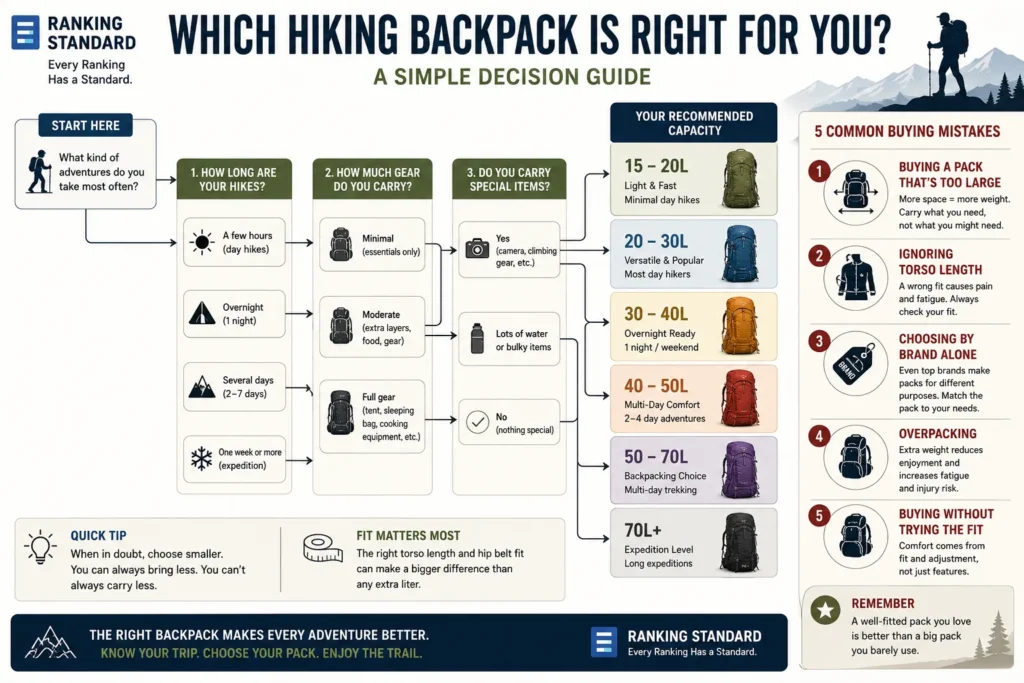
If you’re still unsure, begin here.
Choose 20–30L if you…
- Mostly hike for a few hours
- Carry minimal equipment
- Want one versatile everyday backpack
Choose 35–45L if you…
- Frequently stay overnight
- Carry cooking equipment
- Need additional clothing
Choose 50–65L if you…
- Go backpacking
- Spend several days on the trail
- Carry your entire camping setup
Choose a frameless backpack if you…
- Already have hiking experience
- Keep your equipment lightweight
- Prioritize efficiency over extra comfort
Choose a travel hiking backpack if you…
- Frequently combine hiking and travel
- Want one backpack for multiple purposes
- Prefer flexibility over specialization
Common Buying Mistakes
After reading thousands of hiking reviews, the same mistakes appear again and again.
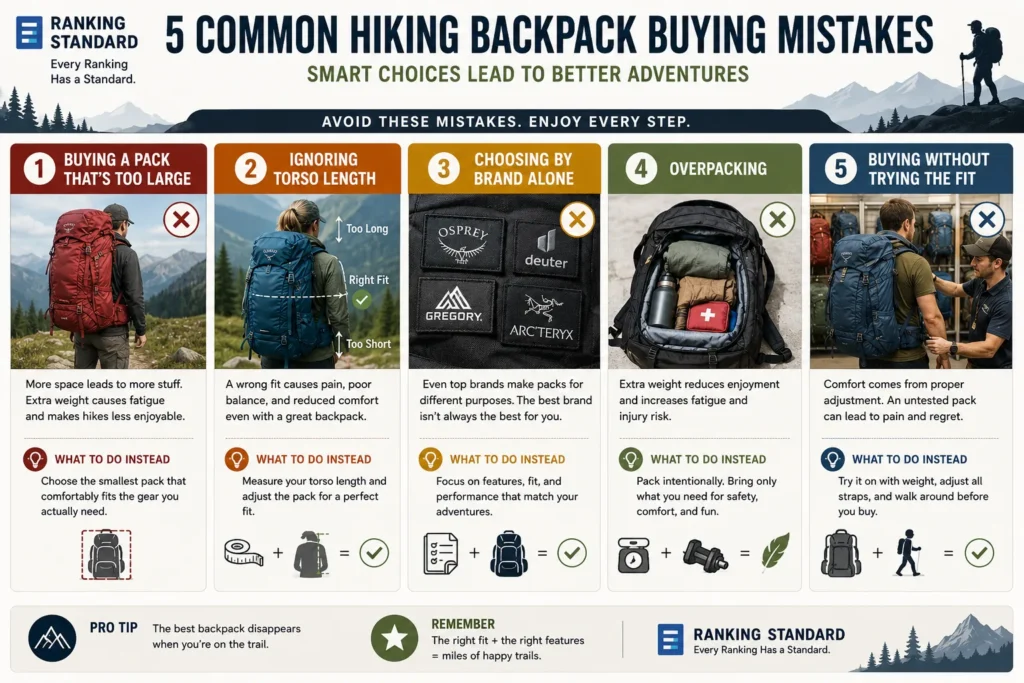
Buying a backpack that’s too large
Extra space usually leads to extra weight.
Carry what you need—not everything you own.
Choosing a backpack based only on brand
Even the best backpack brand builds models for completely different purposes.
Always choose the backpack first.
The logo comes second.
Ignoring torso length
Two hikers of the same height may require different backpack sizes.
A properly fitted suspension system often matters more than the backpack itself.
Whenever possible, adjust or try the fit before making your final decision.
Focusing only on empty weight
A lighter backpack isn’t automatically more comfortable.
The best suspension systems often weigh slightly more—but carry heavy loads much better.
Think about total comfort rather than numbers on a specification sheet.
Buying for the trip you might take someday
Many people buy a 65-liter backpack because they dream of a future expedition.
If most of your hikes are day trips, you’ll probably enjoy a smaller backpack much more.
Buy for the adventures you actually take—not the ones you imagine.
Final Verdict
A hiking backpack is unlike almost any other piece of outdoor equipment.
You don’t simply carry it.
You wear it for hours.
Sometimes for days.
The best backpack isn’t determined by the biggest capacity or the most expensive brand.
It’s determined by how naturally it disappears while you’re hiking.
When the fit is right…
When the weight feels balanced…
When you stop thinking about the backpack and start enjoying the trail…
You’ve chosen well.
At Ranking Standard, we don’t rank backpacks based on popularity.
We evaluate them based on how well they solve real problems for real hikers.
Because every adventure is different.
Every trail is different.
And every ranking should have a standard.
Continue Exploring
Continue building your outdoor gear knowledge with these upcoming guides:
- Best Hiking Backpack Brands
- Best 20L Hiking Backpacks
- Best 30L Hiking Backpacks
- Best 40L Hiking Backpacks
- Best Backpacking Packs
- Osprey vs Deuter
- Best Ultralight Backpacks
- Hiking Backpack Buying Mistakes Explained