There is a moment every backpacker remembers.
The first few kilometers feel easy.
The weather is perfect, your energy is high, and the trail seems almost effortless.
Then, somewhere around the fourth or fifth hour, reality begins to set in.
Your shoulders start to ache.
Your lower back becomes stiff.
The backpack shifts with every step, forcing you to constantly readjust the straps.
By the end of the day, the scenery is no longer your biggest challenge.
Your backpack is.
That is why choosing a backpacking pack is fundamentally different from choosing a day hiking backpack.
A day pack is designed to disappear for a few hours.
A backpacking pack must continue performing after eight hours of climbing, descending, river crossings, changing weather, and 20 kilograms of gear.
The wrong pack doesn’t simply make your trip less enjoyable.
It can shorten your hiking days, increase fatigue, and even lead to injury.
At Ranking Standard, we believe a great backpacking backpack isn’t defined by its capacity.
It is defined by how comfortably it carries weight over long distances.
That’s the standard used throughout this ranking.
How We Ranked These Backpacks
Unlike our Day Hiking Backpack ranking, this guide places much greater emphasis on carrying performance under heavy loads.
Many lightweight backpacks feel comfortable with ten kilograms.
Far fewer remain comfortable when carrying food, water, camping equipment, extra clothing, cooking gear, and emergency supplies for several days.
Every backpack in this ranking was evaluated using the same methodology.
Ranking Standard Evaluation Criteria
| Category | Weight |
|---|---|
| Carrying Comfort | 30% |
| Load Transfer & Stability | 20% |
| Suspension System | 15% |
| Durability | 15% |
| Weight | 10% |
| Storage & Accessibility | 5% |
| Value for Money | 5% |
Rather than chasing the newest releases, we focused on proven performance.
Our evaluation combines long-term owner experiences, independent outdoor testing, backpacking publications, and extensive field reviews from experienced hikers across different environments.
Some models have remained on the market for years.
There is a reason.
The best backpacking backpacks don’t become outdated simply because a new color or updated zipper is released.
True performance stands the test of time.
Editor’s Awards
Before revealing the full Top 15, these models stood out in their respective categories.
🏆 Best Overall
Osprey Atmos AG 65
The most complete backpacking backpack currently available.
🏆 Best Heavy Load Carrier
Gregory Baltoro 65
Outstanding comfort when carrying heavy loads.
🏆 Best Lightweight Backpacking Pack
Hyperlite Mountain Gear Southwest 55
Exceptional performance with minimal weight.
🏆 Best Premium Choice
Arc’teryx Bora 65
Premium craftsmanship built for demanding adventures.
🏆 Best Value
Granite Gear Blaze 60
Outstanding performance without a premium price tag.
Ranking Standard Top 15
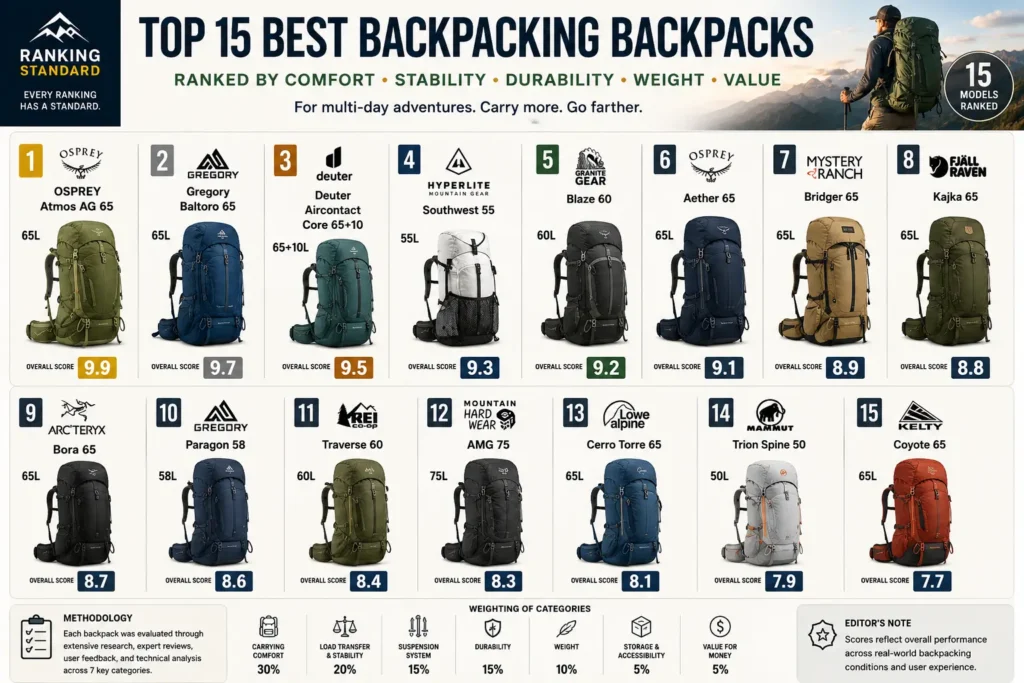
🥇 1. Osprey Atmos AG 65
Overall Score: 9.9 / 10
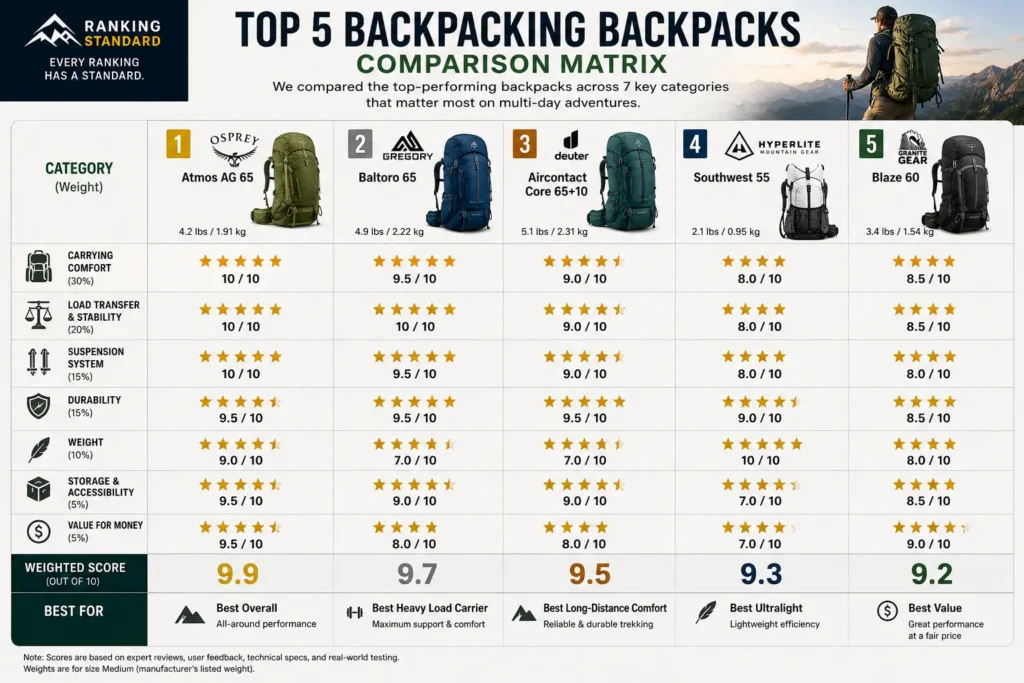
| Category | Score |
|---|---|
| Carrying Comfort | 10 / 10 |
| Load Transfer | 10 / 10 |
| Suspension | 10 / 10 |
| Durability | 9.5 / 10 |
| Weight | 9.0 / 10 |
| Storage | 9.5 / 10 |
| Value | 9.5 / 10 |
Why It Ranked #1
For more than a decade, the Osprey Atmos series has set the benchmark for modern backpacking backpacks.
Its Anti-Gravity suspension system remains one of the most effective designs ever developed for long-distance hiking.
Instead of concentrating weight on a few pressure points, the suspended mesh back panel distributes the load across a much larger surface area.
The result is immediately noticeable.
Even after carrying a fully loaded pack for an entire day, shoulder fatigue is significantly reduced compared with many competitors.
Load transfer is equally impressive.
The Fit-on-the-Fly hip belt allows fine adjustments while hiking, keeping the backpack stable across uneven terrain without restricting movement.
Storage is intelligently designed rather than excessive.
Every pocket serves a purpose, and essential gear remains easy to access without unpacking the entire bag.
What impressed us most, however, was consistency.
The Atmos AG 65 performs well whether you’re carrying 12 kilograms on a weekend trip or nearly 20 kilograms during a week-long expedition.
Very few backpacks manage that balance.
That versatility is exactly why it earns the top position in this year’s ranking.
Best For
- Multi-day backpacking
- Long-distance trekking
- Mountain expeditions
- Thru-hiking beginners and experienced backpackers alike
Pros
- Industry-leading carrying comfort
- Outstanding suspension system
- Excellent ventilation
- Stable under heavy loads
- Highly adjustable fit
Cons
- Premium price
- Slightly heavier than ultralight alternatives
Editor’s Verdict
★★★★★
The backpacking backpack every competitor is measured against.
🥈 2. Gregory Baltoro 65
Overall Score: 9.7 / 10
There is one area where the Gregory Baltoro 65 may actually outperform the Atmos AG 65.
Heavy loads.
When your backpack weighs 20 kilograms or more, carrying comfort becomes less about ventilation and more about how efficiently the weight transfers to your hips.
That is where the Baltoro has built its reputation.
Its Response A3 suspension system moves naturally with your body while maintaining exceptional stability, making it one of the most comfortable backpacks available for extended expeditions.
Professional guides and experienced backpackers have trusted this platform for years because it remains remarkably comfortable even after consecutive days on the trail.
Best For
- Multi-day expeditions
- Heavy gear
- Winter backpacking
Pros
- Exceptional heavy-load comfort
- Outstanding suspension
- Premium build quality
- Highly adjustable fit
Cons
- Heavier than many competitors
- Premium price
Editor’s Verdict
★★★★★
The best backpack for carrying heavy loads.
🥉 3. Deuter Aircontact Core 65+10
Overall Score: 9.5 / 10
Deuter has been producing trekking backpacks for decades, and the Aircontact Core demonstrates why the brand continues to earn the trust of serious hikers.
Unlike backpacks designed around lightweight performance, the Aircontact focuses on durability, load control, and long-term comfort.
The adjustable torso length and supportive hip belt make it particularly suitable for hikers who struggle to achieve a perfect fit with other brands.
For long European trekking routes such as the Tour du Mont Blanc or Alta Via, few backpacks inspire more confidence.
Best For
- Long-distance trekking
- European mountain trails
- Backpackers carrying medium to heavy loads
Editor’s Verdict
★★★★☆
One of the most dependable trekking backpacks ever made.
4. Hyperlite Mountain Gear Southwest 55
Overall Score: 9.3 / 10
Ultralight backpacking has changed dramatically over the past decade, and Hyperlite Mountain Gear has been one of the brands leading that movement.
The Southwest 55 is built using Dyneema Composite Fabric, delivering exceptional durability while remaining dramatically lighter than traditional backpacking packs.
It isn’t designed for carrying extremely heavy loads.
Instead, it rewards hikers who have already reduced the weight of the rest of their gear.
For experienced backpackers pursuing efficiency rather than luxury, it remains one of the most desirable backpacks on the market.
Best For
- Ultralight backpacking
- Long-distance thru-hikes
- Experienced hikers
Editor’s Verdict
★★★★☆
The benchmark for ultralight backpacking.
5. Granite Gear Blaze 60
Overall Score: 9.2 / 10
The Granite Gear Blaze 60 continues to be one of the smartest recommendations for hikers seeking premium performance without paying premium prices.
Its carrying comfort rivals backpacks that cost significantly more, while its weight remains surprisingly low for a fully featured trekking pack.
For many hikers, it represents the best balance between price and performance.
Best For
- Budget-conscious backpackers
- Weekend trekking
- Multi-day hiking
Editor’s Verdict
★★★★☆
Outstanding value for serious backpackers.
The Rest of the Top 15
| Rank | Model | Editor’s Award |
|---|---|---|
| 6 | Osprey Aether 65 | Best Custom Fit |
| 7 | Mystery Ranch Bridger 65 | Best Durability |
| 8 | Fjällräven Kajka 65 | Best Scandinavian Design |
| 9 | Arc’teryx Bora 65 | Best Premium Construction |
| 10 | Gregory Paragon 58 | Best Midweight Choice |
| 11 | REI Traverse 60 | Best Value Alternative |
| 12 | Mountain Hardwear AMG 75 | Best Expedition Pack |
| 13 | Lowe Alpine Cerro Torre 65 | Best Traditional Trekking Pack |
| 14 | Mammut Trion Spine 50 | Best Alpine Backpack |
| 15 | Kelty Coyote 65 | Best Entry-Level Backpacking Pack |
Which Backpack Should You Buy?
Buying a backpacking backpack isn’t about finding the highest-ranked model.
It’s about finding the model that matches how you travel and how much you carry.
Buy the Osprey Atmos AG 65 if…
You want the best overall backpacking experience with exceptional comfort, ventilation, and versatility.
Buy the Gregory Baltoro 65 if…
Your trips involve heavy food loads, winter equipment, or extended expeditions where carrying comfort matters more than weight.
Buy the Deuter Aircontact Core if…
You prioritize durability, stability, and reliable long-term performance over chasing the lightest gear.
Buy the Hyperlite Mountain Gear Southwest 55 if…
You’ve already invested in ultralight equipment and want to reduce every unnecessary gram without sacrificing durability.
Buy the Granite Gear Blaze 60 if…
You want premium-level performance while staying within a more reasonable budget.
Final Verdict
A backpacking backpack is one of the few outdoor purchases that can completely change the quality of your trip.
The difference between an average backpack and an outstanding one isn’t measured at the checkout counter.
It’s measured on the third day of a trek, when your shoulders are still comfortable, your hips aren’t bruised, and you still have enough energy to enjoy the landscape around you.
After evaluating today’s leading backpacking packs, one model continues to set the standard.
The Osprey Atmos AG 65 isn’t simply the most popular choice.
It remains the most complete backpacking backpack currently available.
Its balance of comfort, suspension, ventilation, durability, and long-distance performance makes it the benchmark against which every other backpack in this category is measured.
Ranking Standard Editor’s Choice
🏆 Best Overall
Osprey Atmos AG 65
🏆 Best Heavy Load Carrier
Gregory Baltoro 65
🏆 Best Ultralight
Hyperlite Mountain Gear Southwest 55
🏆 Best Value
Granite Gear Blaze 60
🏆 Best Long-Distance Comfort
Deuter Aircontact Core 65+10
Editor’s Note
The best backpacking backpack isn’t the lightest.
It isn’t the most expensive.
And it certainly isn’t the one with the longest feature list.
The best backpack is the one you stop thinking about after ten hours on the trail.
When all your attention is on the mountains instead of the weight on your back, you’ve chosen the right backpack.
That is the standard behind every ranking we publish at Ranking Standard.
Buying Mistakes Most Backpackers Make
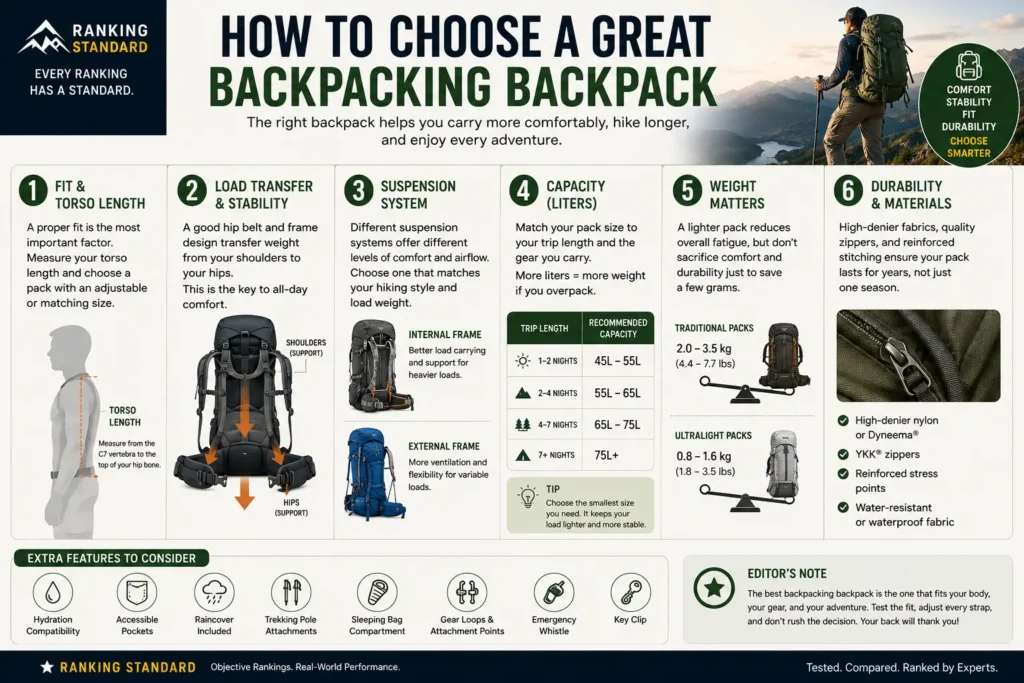
After reviewing hundreds of backpacks and thousands of long-term user experiences, one pattern became impossible to ignore.
Most people don’t buy the wrong backpack because they choose a bad brand.
They buy the wrong backpack because they focus on the wrong features.
Here are the five mistakes we see most often.
Mistake #1
Buying a Backpack That’s Too Large
One of the biggest misconceptions among beginners is that more capacity is always better.
It isn’t.
Extra space usually encourages people to pack unnecessary gear.
The result is a heavier backpack, increased fatigue, and a less enjoyable hiking experience.
For most overnight trips, a properly packed 55–65L backpack is more than enough.
Bigger isn’t automatically better.
Smarter packing almost always wins.
Mistake #2
Choosing the Lightest Backpack Instead of the Most Comfortable One
Ultralight backpacks are incredibly popular.
However, lightweight only becomes an advantage when the rest of your gear is also lightweight.
A one-kilogram backpack carrying twenty kilograms rarely feels comfortable.
A backpack that weighs a few hundred grams more but transfers weight efficiently will usually feel much lighter after a full day of hiking.
Comfort should always come before weight.
Mistake #3
Ignoring Torso Length
Many buyers pay close attention to capacity but completely overlook torso length.
Unfortunately, this is one of the most important factors affecting comfort.
Even the highest-ranked backpack can become uncomfortable if the frame doesn’t match your body.
Before comparing brands, make sure the backpack actually fits you.
Fit matters more than price.
Mistake #4
Paying for Features You’ll Never Use
Ice axe loops.
Helmet holders.
Multiple sleeping bag compartments.
Detachable lids.
Not every backpacker needs these features.
Buying equipment based on marketing instead of actual use often means carrying unnecessary weight.
Choose features that match your adventures—not someone else’s.
Mistake #5
Buying a Brand Instead of Buying the Right Model
This is perhaps the most common mistake of all.
People often say,
“I want an Osprey.”
or
“I only buy Gregory.”
The truth is that no brand makes the best backpack for every type of user.
Every manufacturer has outstanding models, average models, and products designed for completely different purposes.
The smartest buyers don’t shop by logo.
They shop by model.
That’s exactly why Ranking Standard focuses on products rather than brands.
Our Buying Recommendations
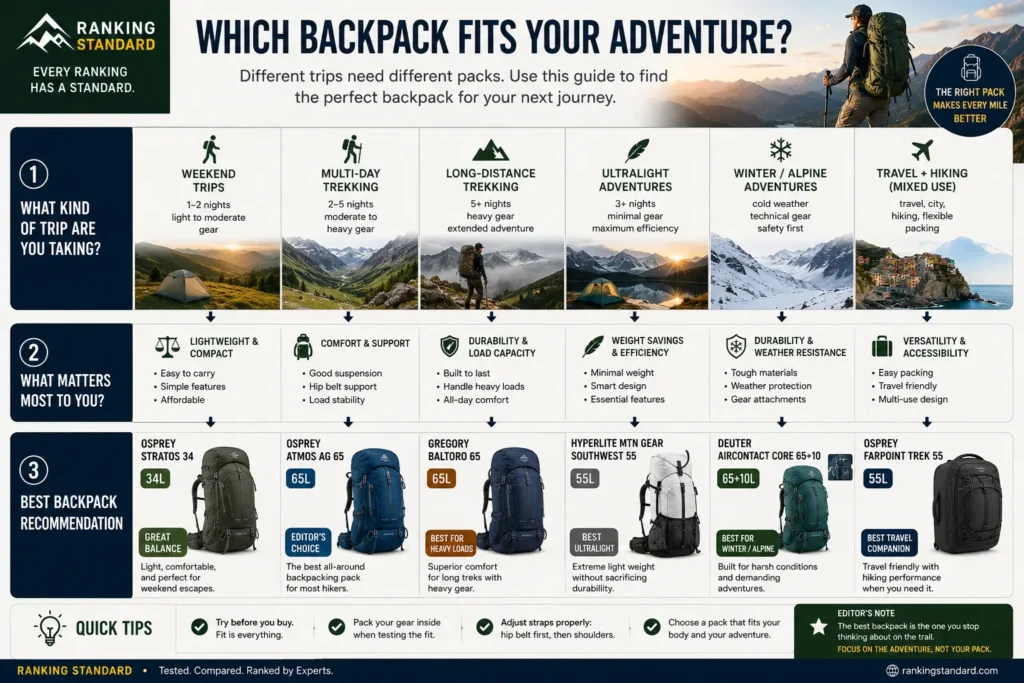
If you only remember one section from this guide, let it be this one.
Choose the Osprey Atmos AG 65 if…
You want the most complete backpacking backpack currently available.
It offers the best balance of comfort, support, ventilation, durability, and versatility.
Choose the Gregory Baltoro 65 if…
Heavy loads are part of every adventure.
This is the backpack we’d trust for demanding expeditions.
Choose the Deuter Aircontact Core if…
You value reliability above everything else.
It may not be the lightest, but few backpacks inspire more confidence on long trekking routes.
Choose the Hyperlite Mountain Gear Southwest 55 if…
You’ve already embraced ultralight backpacking and want to reduce every unnecessary gram.
Choose the Granite Gear Blaze 60 if…
You want outstanding performance without paying flagship prices.
Final Thoughts
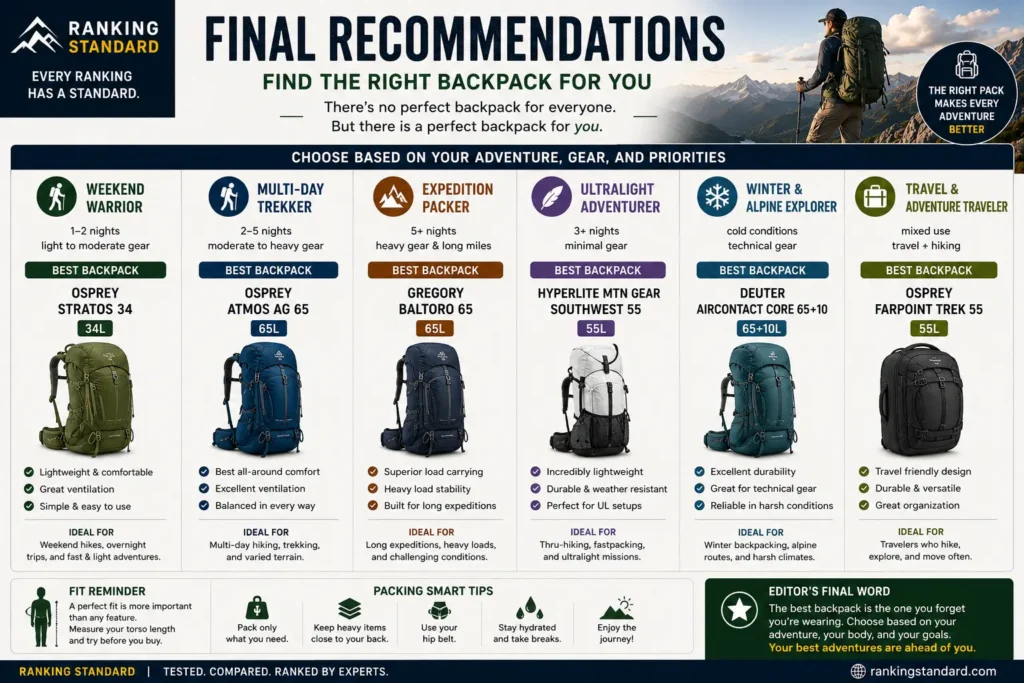
Backpacking backpacks are among the few outdoor products that can completely transform your experience on the trail.
The right backpack doesn’t make the mountains easier.
It makes carrying everything you need feel effortless.
After comparing today’s leading models, one conclusion stood above all others.
The best backpack isn’t defined by capacity.
It isn’t defined by price.
And it certainly isn’t defined by the logo on the front.
It is defined by how confidently it carries your gear when the trail becomes difficult.
That is why the Osprey Atmos AG 65 earns our highest recommendation.
Not because it is perfect.
But because, for most backpackers, it comes closer to perfection than anything else currently available.
Editor’s Closing Note
At Ranking Standard, we don’t rank products based on popularity.
We rank them based on one simple question:
If this were our own money, which model would we buy today?
Every recommendation in this guide is built around that principle.
Because every ranking should help someone make a better decision.
Every Ranking Has a Standard.
FAQ
What size backpack is best for backpacking?
Most multi-day backpacking trips are best suited to backpacks between 55L and 65L, depending on trip length, season, and equipment.
Which backpack is best for heavy loads?
The Gregory Baltoro 65 is one of the strongest performers when carrying heavy loads over long distances.
Is the Osprey Atmos AG 65 worth it?
Yes. It remains one of the most balanced backpacking backpacks available, offering outstanding comfort, ventilation, and load transfer.
Are lightweight backpacks good for beginners?
Not always. Ultralight backpacks are most effective when paired with lightweight gear and are generally better suited to experienced backpackers.
How should a backpacking backpack fit?
A backpack should match your torso length, transfer most of the weight to your hips, and remain stable without creating pressure points on your shoulders.