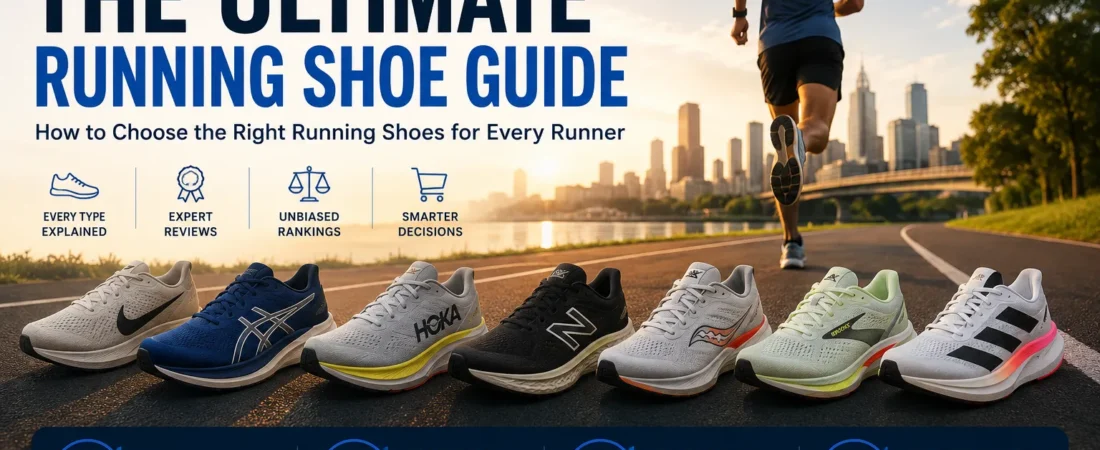
How to Choose the Right Running Shoes for Every Runner
“The right running shoe won’t make you a faster runner overnight. But the wrong one can stop you from running altogether.”
Walk into any running store or browse an online shop, and you’ll quickly realize one thing: choosing running shoes has become surprisingly complicated.
Daily trainers, stability shoes, max-cushion models, carbon-plated racers, trail shoes—every brand claims to have the best technology, the softest foam, or the fastest ride. Add dozens of brands and hundreds of models to the mix, and even experienced runners can struggle to decide.
The biggest mistake most people make is assuming there is one “best” running shoe.
There isn’t.
The best running shoe is simply the one that fits your body, your running style, your goals, and your budget.
That’s why this guide isn’t another “Top 10 Running Shoes” article.
Instead, it’s designed to help you understand the entire running shoe market so you can confidently choose the right shoe—not just today, but every time you buy your next pair.
Why Choosing the Right Running Shoe Matters
Running is one of the simplest sports in the world.
You don’t need expensive equipment.
You don’t need a gym membership.
But there is one piece of equipment that matters more than anything else:
Your shoes.
Every step you take sends forces several times your body weight through your feet, ankles, knees, and hips. During a typical 10 km run, your feet strike the ground roughly 8,000 to 10,000 times.
That means even a small mismatch between your shoe and your running style is repeated thousands of times in a single workout.
The right shoe won’t magically eliminate injuries, but it can improve comfort, reduce fatigue, and make running far more enjoyable.
More importantly, the right shoe helps you stay consistent—and consistency is what ultimately makes runners faster and healthier.
Running Shoes Have Changed Dramatically
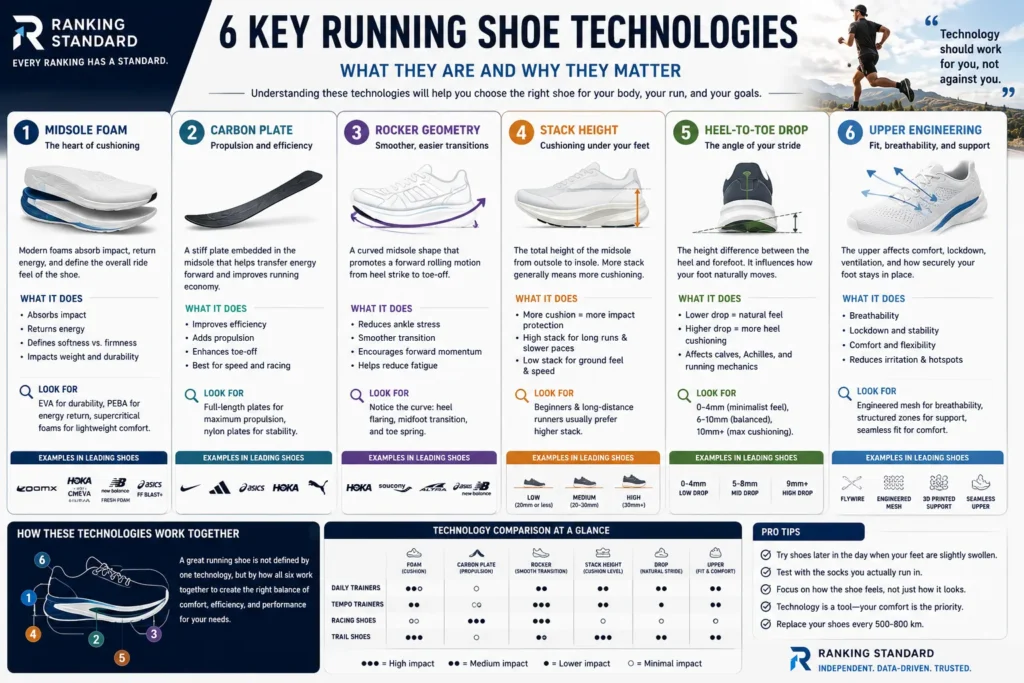
If you haven’t bought running shoes in the last five or six years, today’s market may look completely different.
Modern running shoes are no longer just rubber soles with a bit of cushioning.
Today’s innovations include:
- Lightweight nitrogen-infused foams
- Carbon fiber propulsion plates
- Rocker-shaped midsoles
- Highly engineered mesh uppers
- Data-driven cushioning systems
- Specialized shoes for nearly every type of runner
Some models are designed to maximize comfort over long distances.
Others prioritize speed.
Some focus on stability for runners who need extra support.
Others are built specifically for muddy mountain trails or technical terrain.
In other words, the market has evolved from “one shoe fits all” to “every runner has a different solution.”
The Biggest Myth About Running Shoes
One of the most common questions people ask is:
“What’s the best running shoe?”
The honest answer is:
There isn’t one.
A shoe that feels incredible to a marathon runner may feel uncomfortable to a beginner.
A lightweight racer that wins elite competitions may actually increase fatigue during everyday training.
Likewise, the softest shoe on the shelf isn’t automatically the healthiest choice.
Every runner has different priorities:
- Daily comfort
- Injury prevention
- Race performance
- Speed training
- Long-distance endurance
- Trail running
- Walking and casual fitness
Understanding what kind of runner you are is far more important than choosing the most popular model.
The Ranking Standard Philosophy
At Ranking Standard, we don’t believe in declaring a single universal winner.
Instead, we evaluate products based on one simple principle:
The best product is the one that best matches its intended purpose.
Rather than asking:
“Which running shoe is No.1?”
We ask:
- Which shoe is best for beginners?
- Which shoe offers the best value?
- Which shoe is ideal for marathon training?
- Which shoe is best for heavier runners?
- Which shoe is built for speed?
- Which shoe performs best on trails?
Because buying decisions should always be based on context—not popularity.
That philosophy will guide every recommendation throughout this guide and every future running shoe review published by Ranking Standard.
Understanding the Running Shoe Market
If you’ve ever searched for running shoes online, you’ve probably seen terms like daily trainer, stability shoe, max cushion, tempo trainer, and carbon racer.
For beginners, these names can feel confusing.
In reality, they’re much simpler than they appear.
Think of running shoes the same way you think about cars.
You wouldn’t use a Formula One car to drive to work every day.
Likewise, you wouldn’t choose a heavy SUV for a professional race track.
Running shoes work the same way.
Different shoes exist because different runners have different jobs for them to do.
Understanding these categories is the first step toward making a smart purchase.
The Six Main Types of Running Shoes
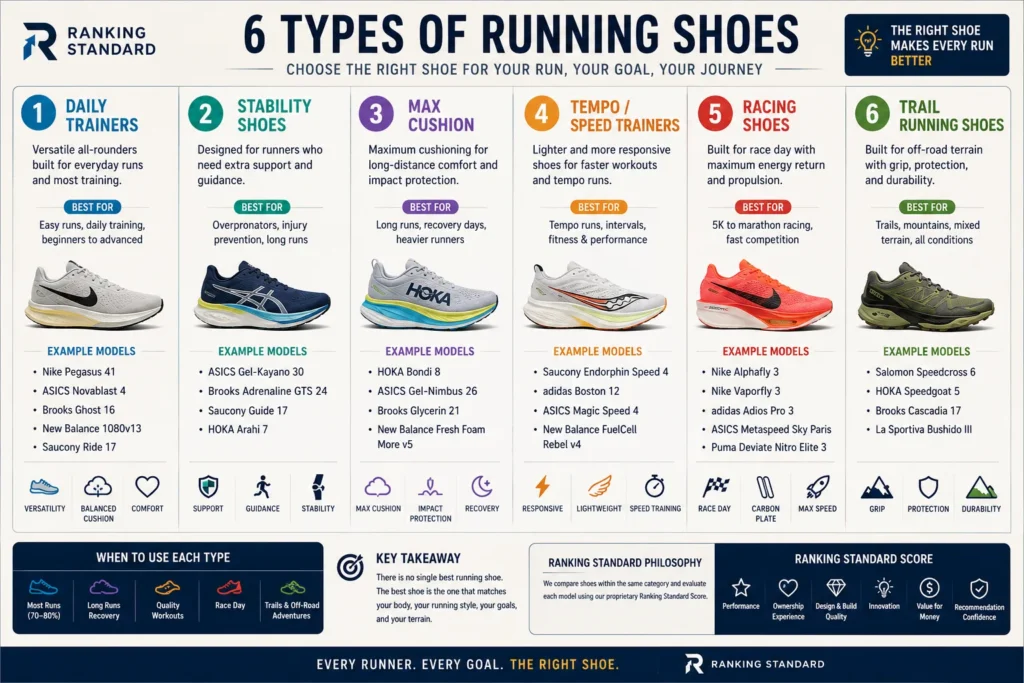
Instead of memorizing dozens of model names, start by understanding the six major categories that define today’s running shoe market.
1. Daily Trainers
Daily trainers are the most versatile running shoes available.
They’re designed for everyday runs, easy training sessions, and general fitness.
If someone asked us to recommend one type of shoe without knowing anything about them, this would almost always be our starting point.
Typical examples include:
- Nike Pegasus
- ASICS Novablast
- Brooks Ghost
- New Balance 1080
- Saucony Ride
For most recreational runners, a quality daily trainer is all they’ll ever need.
2. Stability Shoes
Some runners naturally roll their feet inward more than others while running.
For these runners, additional guidance and support may improve comfort.
Modern stability shoes no longer rely on stiff, heavy construction.
Instead, many use subtle guidance systems that feel surprisingly natural.
Popular examples include:
- ASICS Gel-Kayano
- Brooks Adrenaline GTS
- HOKA Arahi
- Saucony Guide
It’s important to remember that not everyone needs a stability shoe.
Buying one simply because someone else recommends it isn’t always the right decision.
3. Max Cushion Shoes
Comfort has become one of the biggest trends in running.
Max cushion shoes use thick midsoles and advanced foams to absorb impact over long distances.
These shoes are popular among:
- Marathon runners
- Recovery runners
- Heavier runners
- Runners prioritizing comfort over speed
Examples include:
- HOKA Bondi
- ASICS Gel-Nimbus
- Brooks Glycerin
- New Balance More
Maximum cushioning doesn’t automatically mean better performance—but it often means a more comfortable experience.
4. Tempo Trainers
Tempo shoes bridge the gap between everyday trainers and racing shoes.
They’re lighter, more responsive, and designed for faster workouts.
Many runners use them for:
- Interval sessions
- Tempo runs
- Half-marathon preparation
Examples include:
- Saucony Endorphin Speed
- Adidas Boston
- ASICS Magic Speed
Think of them as performance training tools rather than everyday shoes.
5. Racing Shoes
Modern racing shoes have transformed competitive running.
Most feature lightweight foams combined with carbon fiber plates that improve running efficiency.
These are designed for race day—not daily training.
Popular models include:
- Nike Alphafly
- Nike Vaporfly
- Adidas Adios Pro
- ASICS Metaspeed
- HOKA Cielo X
They’re incredibly fast—but they’re also expensive and typically less durable than everyday trainers.
6. Trail Running Shoes
Road running and trail running demand completely different footwear.
Trail shoes prioritize:
- Grip
- Stability
- Protection
- Durability
Whether you’re running through forests, mountains, or muddy paths, trail-specific shoes provide significantly better traction than road shoes.
Leading models include:
- Salomon Speedcross
- HOKA Speedgoat
- Brooks Cascadia
- Nike Zegama
If your runs regularly leave the pavement, investing in trail shoes is well worth considering.
Running Shoe Market Map
One mistake many buyers make is comparing shoes from completely different categories.
For example, comparing a carbon-plated marathon racer with a max-cushion recovery shoe doesn’t make much sense.
Each serves a different purpose.
That’s why Ranking Standard first places every shoe into its proper category before comparing models.
Our philosophy is simple:
Compare similar shoes performing similar jobs.
Only then can rankings truly be fair.
In the next chapter, we’ll introduce the Running Shoe Market Map, a visual framework that organizes every major running shoe brand and model into their proper categories.
Rather than asking,
“Which shoe is best?”
You’ll begin asking,
“Which shoe is best for me?”
And that’s the question that leads to better decisions.
Understanding the Running Shoe Market Map
By now, you’ve probably realized something important.
Running shoes aren’t simply ranked from best to worst.
They’re designed for different purposes.
A carbon-plated marathon racer isn’t “better” than a daily trainer.
A trail shoe isn’t “worse” than a racing shoe.
They’re built to solve completely different problems.
That’s why Ranking Standard doesn’t compare every running shoe in one giant list.
Instead, we organize the market first.
Only after understanding the market can we fairly compare products.
The Running Shoe Market Is Bigger Than Most People Think
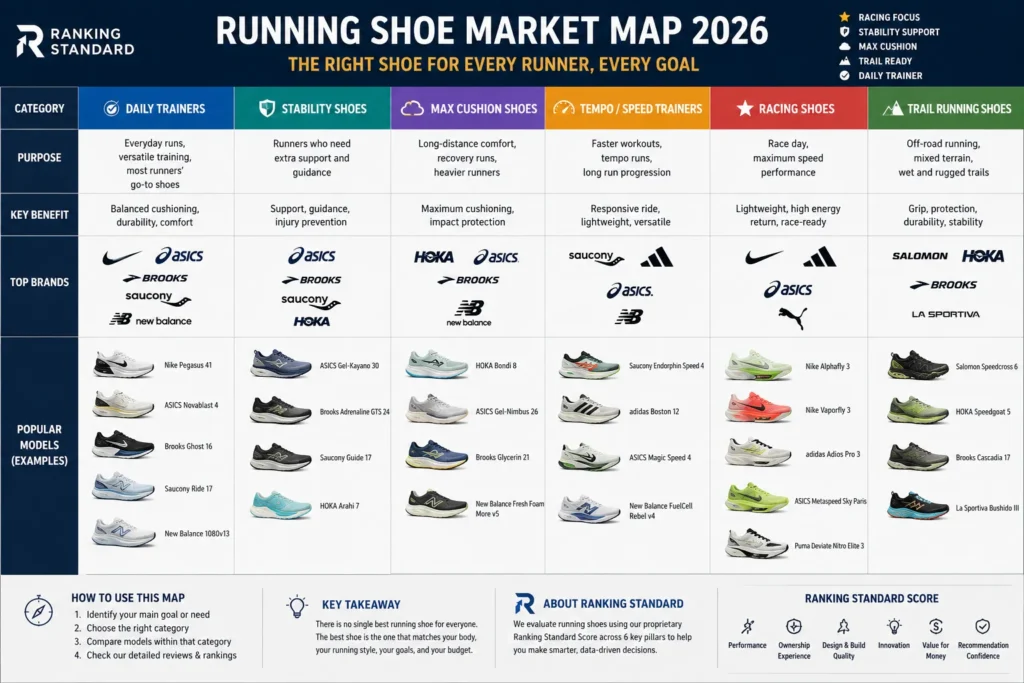
Many people assume there are only a handful of major brands.
In reality, today’s running shoe market is one of the most competitive industries in sports.
Some companies focus on speed.
Others prioritize comfort.
Some build shoes for elite marathon runners.
Others specialize in beginners taking their very first jog.
This diversity is exactly why choosing the right shoe has become more challenging—and more important—than ever before.
The Ranking Standard Market Map
Rather than separating brands by popularity, we classify them by purpose and market position.
A simplified version looks like this:
| Category | Leading Brands | Typical Strength |
|---|---|---|
| Daily Trainers | Nike, ASICS, Brooks, Saucony, New Balance | Everyday comfort and versatility |
| Max Cushion | HOKA, ASICS, Brooks, New Balance | Long-distance comfort |
| Stability | ASICS, Brooks, Saucony, HOKA | Extra support and guidance |
| Racing | Nike, Adidas, ASICS, Puma | Maximum speed and race performance |
| Trail Running | Salomon, HOKA, Brooks, La Sportiva | Grip and technical terrain |
Notice something?
Many brands appear in more than one category.
That’s because great brands build complete ecosystems rather than relying on a single successful shoe.
For example, Nike produces everything from beginner-friendly daily trainers to Olympic-level racing shoes.
The same is true for ASICS, HOKA, Adidas, Brooks, Saucony, and New Balance.
The goal isn’t to find the “best brand.”
The goal is to find the best shoe within the category that matches your needs.
Why We Don’t Believe in One Universal Ranking
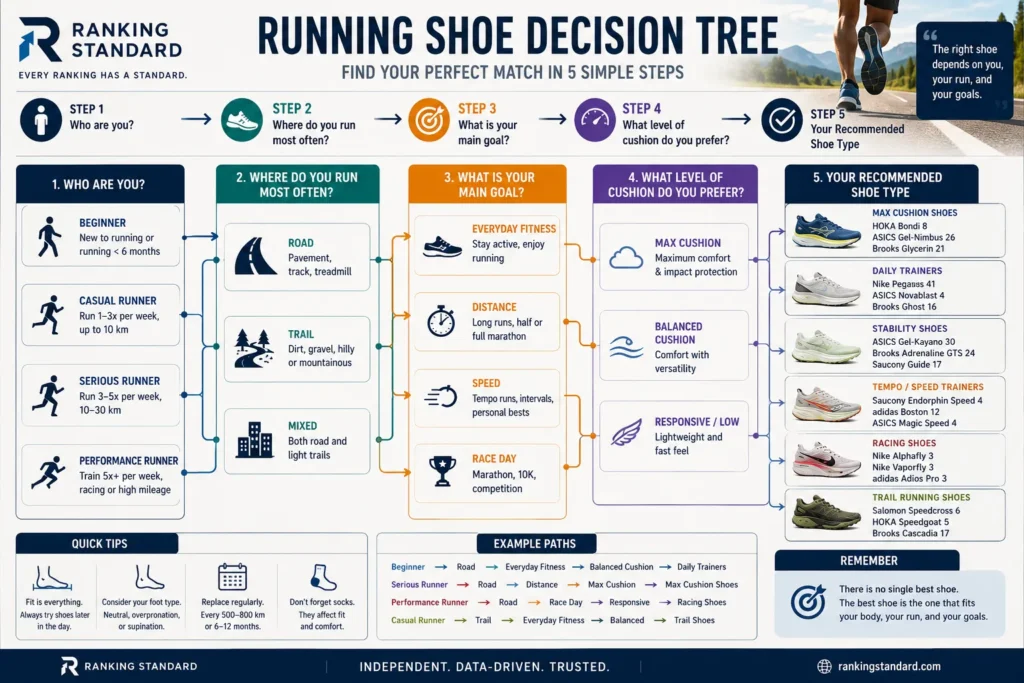
Many websites publish articles like:
“The 20 Best Running Shoes.”
While these lists are useful, they often compare products that shouldn’t be competing with each other.
Imagine ranking:
- A family SUV
- A Formula One race car
- A pickup truck
- A luxury limousine
in the same list.
It wouldn’t make much sense.
Running shoes deserve the same level of context.
That’s why Ranking Standard compares:
- Daily trainers against daily trainers.
- Racing shoes against racing shoes.
- Trail shoes against trail shoes.
Only after category rankings are complete do we identify the strongest overall recommendations.
Introducing the Ranking Standard Tier Philosophy
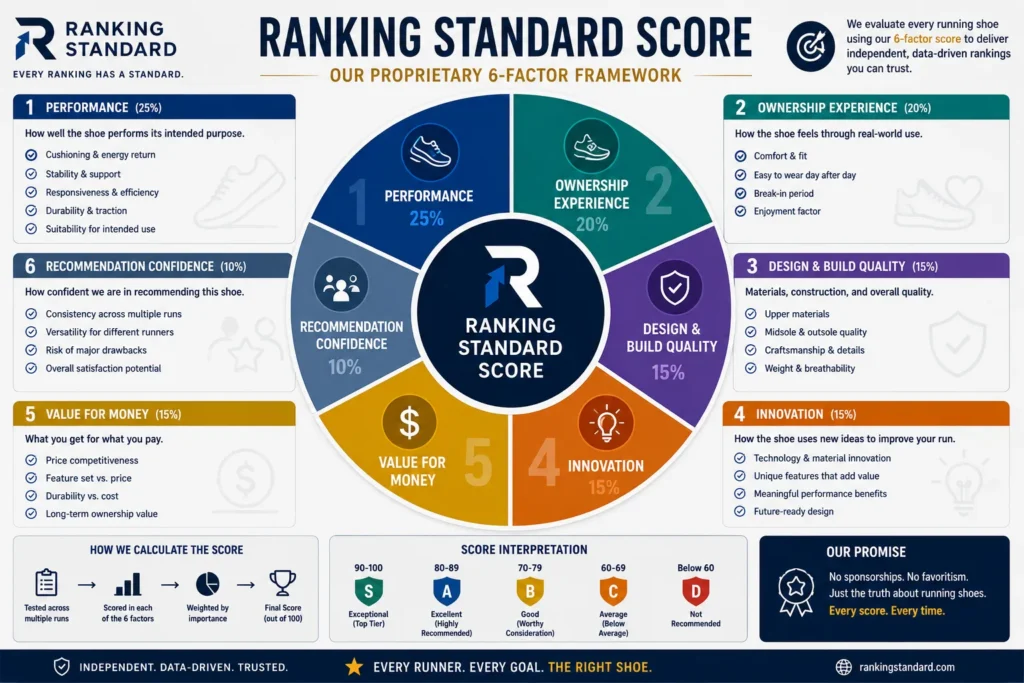
Unlike traditional rankings, our tier system isn’t based on brand reputation alone.
Every product is evaluated using the Ranking Standard Score, which considers:
- Performance
- Ownership Experience
- Design & Build Quality
- Innovation
- Value for Money
- Recommendation Confidence
A shoe earns its place because it consistently performs well across these criteria—not because it’s the newest or most heavily advertised.
That means an outstanding mid-priced shoe can outrank a premium model if it delivers a better overall ownership experience.
One Brand Can Have Multiple Tiers
Another important principle:
We never assign a single tier to an entire brand.
Brands don’t make one shoe.
They make dozens.
For example:
- Nike Pegasus may deserve one tier.
- Nike Alphafly another.
- Nike Structure another.
The same applies to every manufacturer.
Our rankings are built around individual products, not logos.
Looking Ahead
Now that you understand how the running shoe market is organized, it’s time to move from theory to real buying decisions.
In the next section, we’ll identify the best running shoes for different types of runners—from beginners and daily runners to marathon racers and trail enthusiasts—using the Ranking Standard evaluation framework.