
“You spend about one-third of your life in bed. Choosing the right mattress isn’t a luxury—it’s one of the most important investments in your health.”
Buying a mattress should be simple.
Yet for many people, it’s one of the most confusing purchases they’ll ever make.
Memory foam or innerspring?
Hybrid or latex?
Soft, medium, or firm?
Why does one mattress cost a few hundred dollars while another costs several thousand?
The modern mattress industry offers hundreds of options, each claiming to provide better comfort, healthier sleep, or superior support.
For many buyers, the result is decision fatigue.
Instead of feeling more confident, they become overwhelmed by marketing terms, technical specifications, and conflicting reviews.
That’s exactly why this guide exists.
Rather than telling you which mattress is “the best,” we’ll help you understand how the mattress market works and, more importantly, how to choose the mattress that’s best for you.
Why Your Mattress Matters
A mattress isn’t simply another piece of furniture.
It’s something your body depends on every single night.
While many people spend eight or more hours each day sitting in an office chair, they spend a similar amount of time sleeping.
That means your mattress supports your body for nearly one-third of your life.
The right mattress can improve:
- Sleep quality
- Pressure relief
- Spinal alignment
- Recovery after exercise
- Overall comfort throughout the night
The wrong mattress, on the other hand, may contribute to:
- Poor sleep
- Back discomfort
- Shoulder or hip pressure
- Frequent tossing and turning
- Feeling tired even after a full night’s sleep
Although no mattress can cure medical conditions, choosing one that matches your body and sleeping habits can make a significant difference to everyday comfort.
The Mattress Market Has Changed
Not long ago, buying a mattress meant choosing between a few spring models at a local furniture store.
Today’s market is completely different.
Modern mattresses now include:
- Memory foam
- Pocket springs
- Hybrid construction
- Natural latex
- Cooling materials
- Zoned support systems
- Adjustable firmness
- Smart sleep technologies
Manufacturers have also begun designing mattresses for specific sleeping positions, body weights, and temperature preferences.
The result is a market offering more choice than ever before—but also far more complexity.
The Biggest Mistake Buyers Make
One of the most common questions people ask is:
“What’s the best mattress?”
The honest answer is exactly the same as with running shoes, coffee machines, and office chairs.
There isn’t one.
A mattress that feels perfect to a side sleeper may feel too soft for someone who sleeps on their stomach.
A heavier person may require more support than someone who weighs significantly less.
Likewise, a couple may have completely different comfort preferences from someone sleeping alone.
The best mattress isn’t the one with the highest rating.
It’s the one that matches your body, your sleeping position, your comfort preference, and your lifestyle.
The Ranking Standard Philosophy
At Ranking Standard, we don’t rank mattresses based on marketing claims or luxury branding.
Instead, we begin with a simple question:
Who is this mattress actually designed for?
Some mattresses prioritize pressure relief.
Others focus on cooling.
Some are built for heavier sleepers.
Others are designed for couples who want better motion isolation.
Every mattress solves a different problem.
Understanding that purpose comes before comparing brands, prices, or features.
Because the smartest buying decision isn’t choosing the mattress with the most advertisements.
It’s choosing the mattress that helps you wake up feeling well rested every morning.
What You’ll Learn In This Guide
By the end of this guide, you’ll understand:
- The major mattress types
- Which mattress suits different sleeping positions
- The features that genuinely improve sleep quality
- Common buying mistakes
- How Ranking Standard evaluates mattresses
- Why the most expensive mattress isn’t always the best choice
Most importantly, you’ll learn how to choose a mattress based on how you actually sleep, not simply what advertisements promise.
Understanding the Mattress Market
Walk into any mattress store or browse online, and you’ll quickly notice one thing.
Almost every mattress claims to provide the perfect night’s sleep.
Some promise pressure relief.
Others advertise cooling technology.
Many claim to be the best mattress for back pain, side sleepers, or athletes.
The problem is that these claims often make different types of mattresses sound interchangeable.
They aren’t.
Just like running shoes, coffee machines, and office chairs, mattresses are designed for different people with different needs.
Understanding those categories is the first step toward making the right buying decision.
The Five Main Types of Mattresses
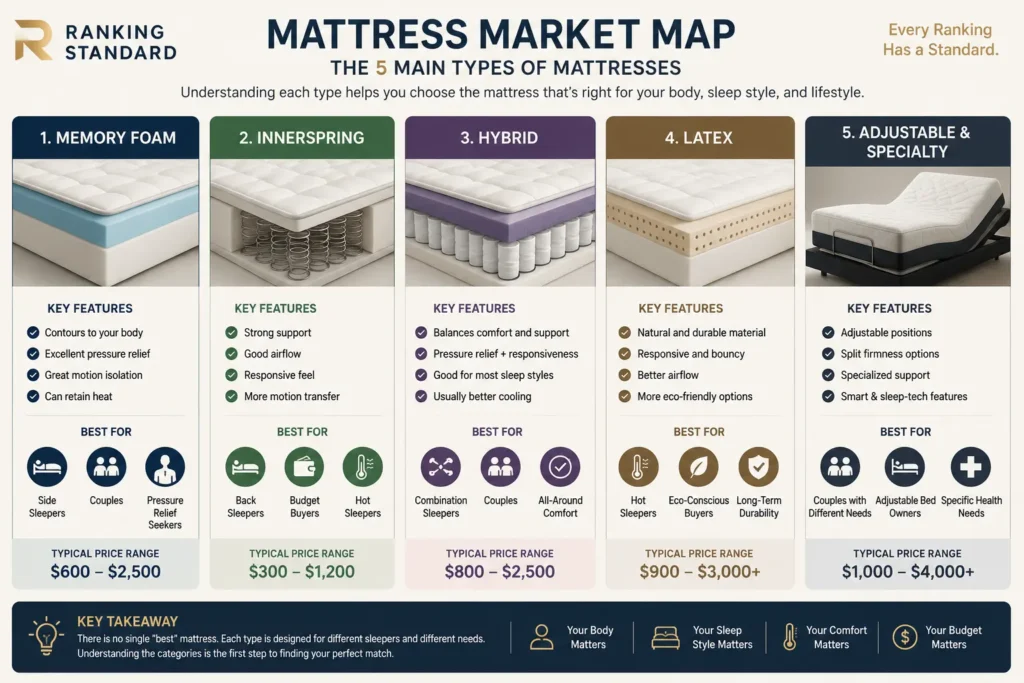
Rather than comparing hundreds of individual models, start by understanding the five major mattress categories that dominate today’s market.
Once you know which type fits your body and sleeping habits, narrowing your options becomes much easier.
1. Memory Foam Mattresses
Memory foam mattresses are designed to contour closely to the body.
They distribute body weight evenly and help reduce pressure on areas such as the shoulders and hips.
Typical advantages include:
- Excellent pressure relief
- Strong motion isolation
- Quiet sleeping surface
Potential drawbacks include:
- Some models retain heat
- Less responsive than spring mattresses
Best for:
- Side sleepers
- Couples
- People who prefer a hugging sensation
2. Innerspring Mattresses
Innerspring mattresses rely on steel coils to provide support.
They’ve been around for decades and remain one of the most widely used mattress types.
Advantages include:
- Strong support
- Good airflow
- Responsive feel
- Usually more affordable
However, lower-end models may transfer movement more easily between sleeping partners.
Best for:
- Back sleepers
- Budget-conscious buyers
- People who prefer a traditional mattress feel
3. Hybrid Mattresses
Hybrid mattresses combine multiple technologies.
Most feature:
- Pocket springs
- Memory foam
- Comfort foam
- Reinforced support layers
The goal is simple:
Deliver the pressure relief of foam while maintaining the support and responsiveness of springs.
Because they balance comfort and support, hybrids have become one of the fastest-growing mattress categories worldwide.
Best for:
- Combination sleepers
- Couples
- Buyers wanting an all-around solution
4. Latex Mattresses
Latex mattresses use natural or synthetic latex instead of memory foam.
They’re known for:
- Excellent durability
- Responsive support
- Better airflow
- Natural elasticity
Unlike memory foam, latex doesn’t create the same sinking sensation.
Many eco-conscious buyers also prefer natural latex because of its renewable materials.
Best for:
- Hot sleepers
- Environmentally conscious buyers
- People wanting long-term durability
5. Adjustable & Specialty Mattresses
Some mattresses are designed for very specific needs.
These include:
- Adjustable mattresses
- Medical support mattresses
- Split firmness mattresses
- Smart mattresses with sleep tracking
While these products aren’t necessary for everyone, they can provide meaningful benefits for users with unique health or lifestyle requirements.
Best for:
- Couples with different firmness preferences
- Adjustable bed owners
- Specialized sleep needs
Why Comparing Different Mattress Types Doesn’t Work
One of the biggest mistakes buyers make is comparing mattresses designed for completely different purposes.
For example:
Should a memory foam mattress compete directly with a latex mattress?
Not necessarily.
Each category prioritizes different characteristics.
Memory foam focuses on pressure relief.
Latex emphasizes responsiveness.
Hybrid mattresses balance multiple strengths.
At Ranking Standard, we believe products should first compete within their own category before being compared across the broader market.
Only then can recommendations remain fair and meaningful.
Mattress Market Map
Instead of organizing mattresses by price, Ranking Standard first organizes them by primary purpose.
| Category | Primary Strength | Best For |
|---|---|---|
| Memory Foam | Pressure Relief | Side sleepers & couples |
| Innerspring | Support & Airflow | Back sleepers & budget buyers |
| Hybrid | Balanced Comfort | Most sleepers |
| Latex | Durability & Cooling | Hot sleepers & eco-conscious buyers |
| Adjustable & Specialty | Personalization | Specialized sleep needs |
Notice something important.
No mattress type is universally “better.”
Each is optimized for a different sleeping experience.
That’s why the smartest purchase begins by choosing the right category—not the most heavily advertised model.
Choosing the Right Mattress Starts With You
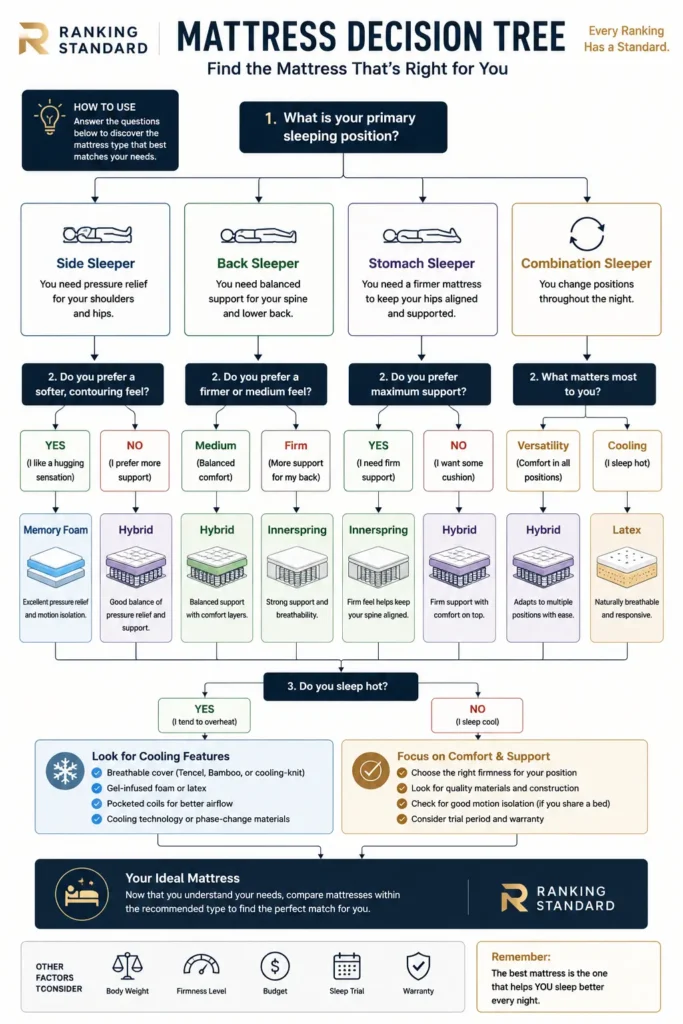
Many buyers ask:
“Which mattress brand should I buy?”
But that’s actually the second question.
The first question should always be:
“How do I sleep?”
Your sleeping position.
Your body weight.
Your preferred firmness.
Your temperature during the night.
These factors influence your comfort far more than the logo printed on the mattress.
Once you’ve identified the right category, comparing brands becomes much easier—and far more meaningful.
How Ranking Standard Evaluates Mattresses
By now, one thing should be clear.
There is no mattress that is perfect for everyone.
Some mattresses prioritize pressure relief.
Others focus on cooling.
Some are designed for heavier sleepers.
Others are built specifically for couples who want minimal motion transfer.
That’s why Ranking Standard never asks:
“Which mattress is the best?”
Instead, we ask:
“Which mattress is the best for the way you sleep?”
That difference completely changes how we evaluate every mattress.
The Mattress Positioning Map
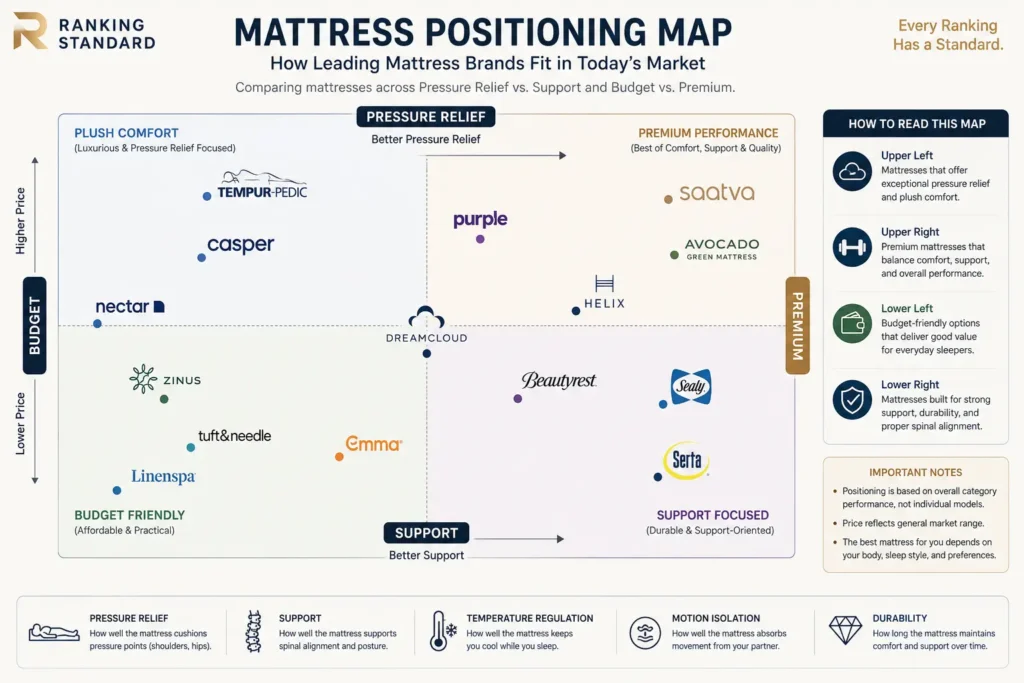
Rather than organizing mattresses purely by price, Ranking Standard first positions every mattress according to two factors that matter most in real-world use.
Pressure Relief
↓
Overall Support
The second dimension compares:
Temperature Regulation
↓
Motion Isolation
Some mattresses excel at keeping sleepers cool throughout the night.
Others focus on reducing movement so one partner isn’t disturbed when the other turns or gets out of bed.
Neither approach is automatically better.
The right balance depends entirely on how you sleep.
Understanding where a mattress sits within the market is often more valuable than simply knowing its price.
Why Expensive Doesn’t Always Mean Better
One of the biggest misconceptions in the mattress industry is that a higher price automatically guarantees better sleep.
In reality, price often reflects factors such as:
- Premium materials
- Manufacturing techniques
- Brand positioning
- Longer warranties
- Luxury finishes
These can certainly add value.
But they don’t guarantee that the mattress is the right match for your body.
For example, an expensive extra-soft memory foam mattress may feel wonderful to a side sleeper but uncomfortable to someone who sleeps on their stomach.
Likewise, a well-designed mid-range hybrid mattress may provide better long-term comfort than a luxury mattress that simply doesn’t suit your sleeping style.
The best mattress is never determined by price alone.
The Ranking Standard Score
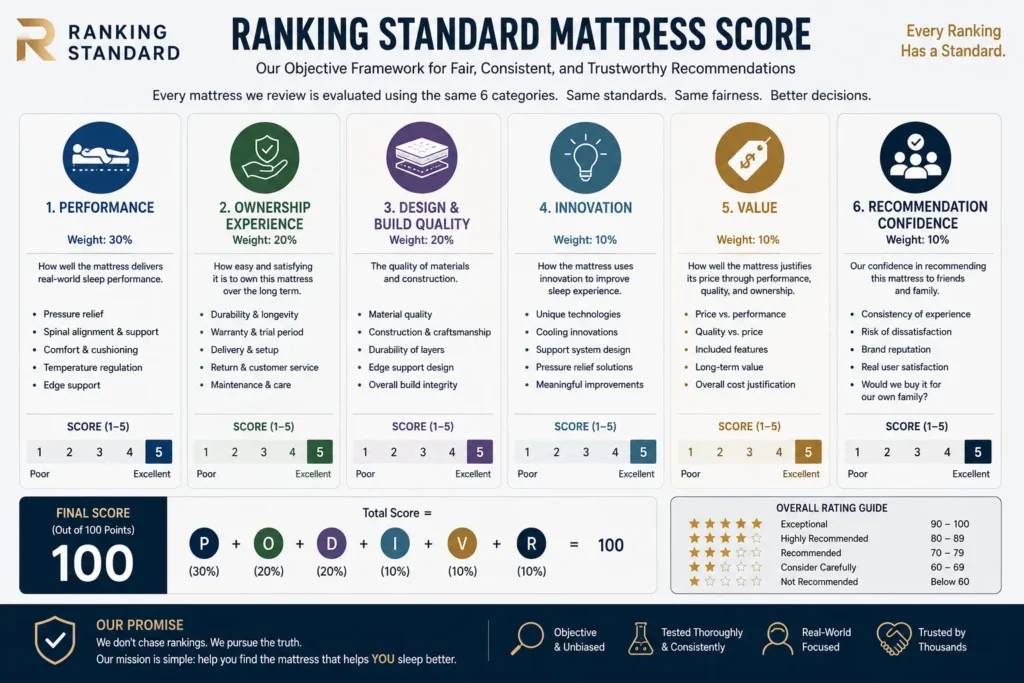
Every mattress is evaluated using the same objective framework.
Performance
Does the mattress provide consistent support throughout the night?
Does it maintain comfort after years of regular use?
Ownership Experience
How easy is long-term ownership?
Does the mattress retain its shape?
Is the warranty reliable?
How practical is delivery, setup, and maintenance?
Design & Build Quality
We examine:
- Material quality
- Construction
- Edge support
- Durability
- Overall craftsmanship
A mattress should perform not only during the first month but for many years.
Innovation
Innovation isn’t about adding more layers.
It’s about improving sleep.
Cooling technologies, zoned support systems, pressure-relief foams, and advanced spring designs are evaluated based on real benefits rather than marketing claims.
Value
A mattress should justify its price through comfort, durability, and long-term ownership.
Sometimes a mid-range mattress delivers outstanding value compared with premium competitors.
Recommendation Confidence
Finally, we ask one simple question:
If we were buying this mattress for our own bedroom today, would we confidently recommend it to a family member?
That answer carries just as much weight as laboratory testing or technical specifications.
Who Should Invest in a Premium Mattress?
Premium mattresses aren’t necessary for everyone.
However, they often make sense if you:
- Sleep seven to nine hours every night.
- Wake up with discomfort on your current mattress.
- Plan to keep the mattress for eight years or longer.
- View sleep as an investment in long-term health and recovery.
For many people, a mattress becomes one of the most frequently used products they own.
Choosing the right one can improve thousands of nights over its lifetime.
Final Thoughts
A mattress isn’t simply a place to sleep.
It’s where your body recovers.
It’s where your muscles relax.
It’s where tomorrow begins.
The smartest buying decision isn’t choosing the mattress with the highest price or the loudest advertising campaign.
It’s choosing the mattress that quietly gives you better sleep night after night.
That’s exactly what Ranking Standard is designed to help you find.
Because the best mattress isn’t the one everyone else recommends.
It’s the one that helps you wake up feeling rested.
✍️ Editor Alter’s Note
This guide is designed to become the foundation of the Mattress category within Ranking Standard.
From here, we’ll expand naturally into:
- Best Mattress Brands
- Best Memory Foam Mattresses
- Best Hybrid Mattresses
- Best Mattresses for Side Sleepers
- Memory Foam vs Hybrid
- Latex vs Memory Foam
- Best Mattresses for Back Pain
- Best Cooling Mattresses
Each of those articles will link back to this guide, making it the central Pillar of the mattress category.