
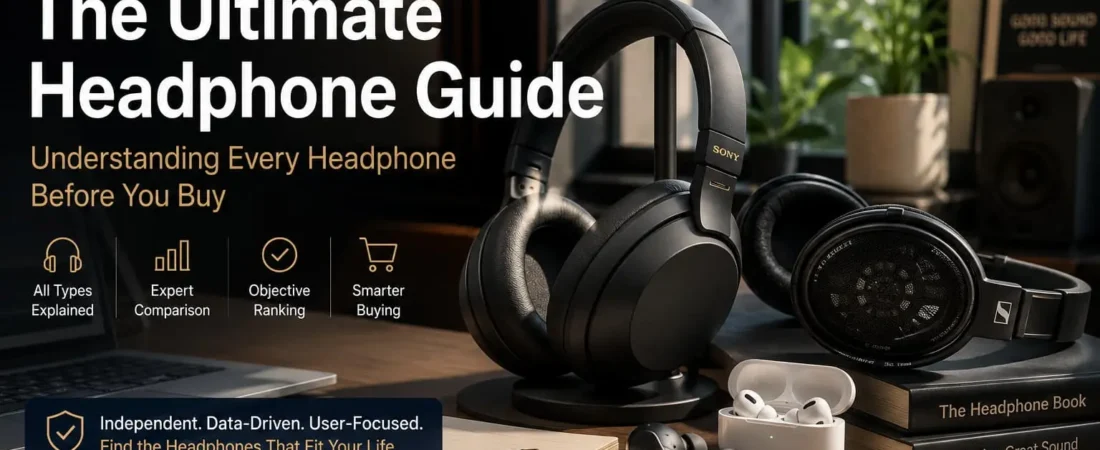
“The best headphones aren’t the ones with the highest price or the loudest marketing. They’re the ones that make your everyday listening more enjoyable.”
Buying headphones has never been more complicated.
Not long ago, the decision was relatively simple.
You chose between wired or wireless, on-ear or over-ear, and that was about it.
Today, the market looks completely different.
Noise cancellation.
Open-back.
Closed-back.
Studio headphones.
Gaming headsets.
Audiophile headphones.
True wireless earbuds.
Spatial audio.
High-resolution codecs.
The number of choices has exploded, making it easier than ever to buy headphones—but much harder to buy the right ones.
That’s exactly why this guide exists.
Instead of asking which headphones are “the best,” we’ll help you understand how the entire headphone market works so you can choose the pair that fits your listening habits, your lifestyle, and your budget.
Why Choosing the Right Headphones Matters
Headphones have become one of the most frequently used pieces of technology in modern life.
People wear them while:
- Working
- Commuting
- Exercising
- Gaming
- Traveling
- Studying
- Relaxing at home
For many users, headphones are worn for several hours every single day.
That means comfort is just as important as sound quality.
Excellent sound doesn’t matter if your ears hurt after thirty minutes.
Likewise, the most comfortable headphones won’t satisfy you if they don’t deliver the listening experience you’re looking for.
The right headphones should disappear while you’re wearing them.
You should notice the music—not the headphones.
The Headphone Market Has Changed
A decade ago, most headphones simply played music.
Today’s premium headphones do much more.
Modern models may include:
- Active Noise Cancellation (ANC)
- Transparency Mode
- Adaptive audio
- High-resolution wireless codecs
- Spatial audio
- Multipoint Bluetooth connectivity
- AI-powered call noise reduction
- Personalized sound profiles
Manufacturers now design products for very specific users.
Some headphones are built for travelers.
Others are designed for professional audio production.
Some focus on competitive gaming.
Others prioritize comfort during long work sessions.
The result is a market offering incredible choice—but also increasing confusion.
The Biggest Mistake Buyers Make
One of the most common questions people ask is:
“What’s the best pair of headphones?”
Just like running shoes, coffee machines, office chairs, and mattresses, the answer is surprisingly simple.
There isn’t one.
The best headphones for a music producer may be completely different from the best headphones for someone commuting to work every day.
A traveler may value noise cancellation above everything else.
A gamer may prioritize positional audio and microphone quality.
An audiophile may care only about sound accuracy.
Every listener has different priorities.
Choosing the right category is far more important than choosing the most expensive product.
The Ranking Standard Philosophy
At Ranking Standard, we never begin with brands.
Instead, we begin with one question:
What do you actually use your headphones for?
Listening to music.
Working from home.
Traveling.
Gaming.
Editing audio.
Watching movies.
Each activity places different demands on a pair of headphones.
That’s why every recommendation in this guide is built around real-world use, not marketing claims or popularity.
Because the best headphones aren’t the ones with the highest review score.
They’re the ones that make your everyday listening experience better.
What You’ll Learn In This Guide
By the end of this guide, you’ll understand:
- The major types of headphones
- Which headphones match different lifestyles
- The features that genuinely improve listening
- Common buying mistakes
- How Ranking Standard evaluates headphones
- Why expensive doesn’t always mean better
Most importantly, you’ll learn how to choose headphones based on how you actually listen, rather than simply following trends.
Understanding the Headphone Market
Walk into an electronics store or browse an online retailer, and you’ll quickly discover that “headphones” is no longer a single product category.
Some headphones are designed for travel.
Others are built for professional music production.
Some prioritize comfort during long workdays.
Others focus entirely on competitive gaming.
The biggest mistake buyers make is assuming they can compare all headphones using the same criteria.
They can’t.
Every category exists because different listeners have different priorities.
Before comparing brands or models, it’s important to understand how today’s headphone market is organized.
The Five Main Types of Headphones
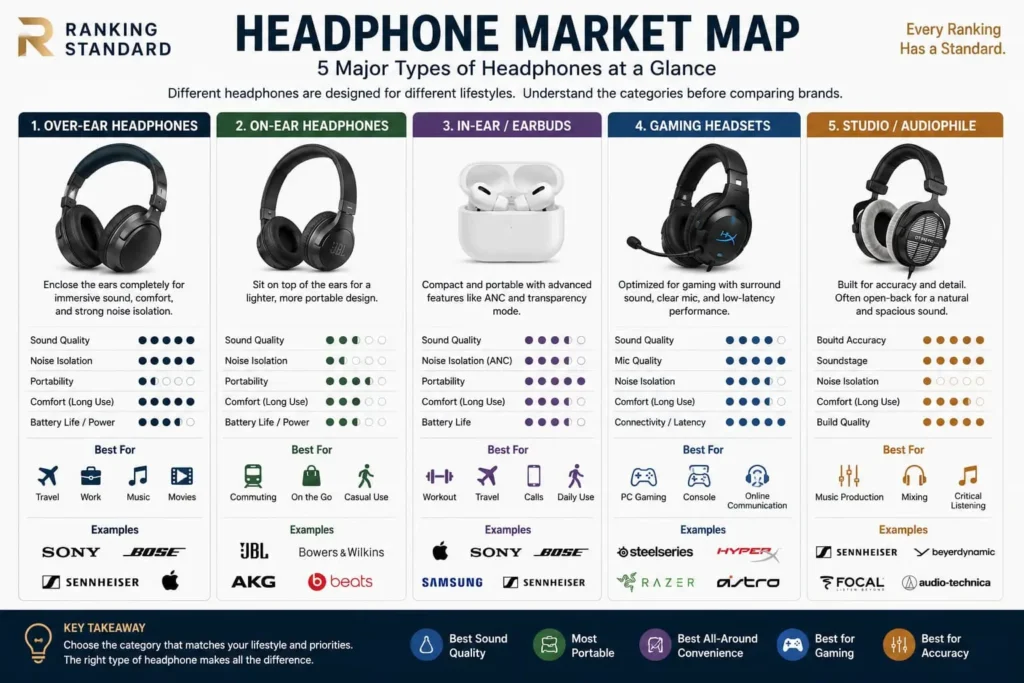
Instead of comparing hundreds of products individually, start by understanding the five major categories that define today’s market.
Once you identify the category that fits your lifestyle, choosing the right model becomes much easier.
1. Over-Ear Headphones
Over-ear headphones surround the ears completely.
Because of their larger drivers and spacious ear cups, they often provide the best balance of comfort, sound quality, and noise isolation.
Many premium models also include industry-leading active noise cancellation.
Best for:
- Music lovers
- Frequent travelers
- Office workers
- Movie enthusiasts
Typical examples include:
- Sony WH-1000XM Series
- Bose QuietComfort
- Apple AirPods Max
- Sennheiser Momentum
2. On-Ear Headphones
On-ear headphones rest directly on the ears rather than surrounding them.
They are generally lighter and more portable than over-ear models.
However, because they press against the ears, long listening sessions may be less comfortable for some users.
Best for:
- Casual listening
- Commuting
- Portable everyday use
3. In-Ear Earphones & True Wireless Earbuds
This has become one of the fastest-growing categories.
Modern earbuds now offer:
- Active Noise Cancellation
- Transparency Mode
- Multipoint Bluetooth
- Water resistance
- Excellent microphone quality
Their greatest advantage is portability.
Many people carry them all day without even noticing.
Best for:
- Everyday use
- Exercise
- Travel
- Phone calls
Popular examples include:
- Apple AirPods Pro
- Sony WF-1000X Series
- Bose QuietComfort Ultra Earbuds
- Samsung Galaxy Buds
4. Gaming Headsets
Gaming headsets are optimized for communication and positional audio.
Many include:
- Low-latency wireless connections
- Surround sound technologies
- Noise-reducing microphones
- Long-wearing comfort
While they can also play music, their primary purpose is interactive entertainment.
Best for:
- PC gaming
- Console gaming
- Online multiplayer
5. Studio & Audiophile Headphones
These headphones are built for accuracy rather than excitement.
Instead of emphasizing bass or creating dramatic sound effects, they aim to reproduce recordings as faithfully as possible.
Many are open-back designs that create a wider, more natural soundstage.
Best for:
- Music production
- Mixing
- Critical listening
- Audiophiles
Examples include:
- Sennheiser HD 600
- Beyerdynamic DT Series
- Audio-Technica ATH-R Series
- Focal Professional
Why Comparing Different Categories Doesn’t Work
Should a gaming headset compete directly with a studio headphone?
Not really.
One prioritizes communication and positional awareness.
The other prioritizes sonic accuracy.
Likewise, comparing compact wireless earbuds with premium over-ear headphones often ignores the fact that they solve completely different problems.
At Ranking Standard, we believe products should first compete within their own category before being compared across the wider market.
Only then can recommendations remain fair and genuinely useful.
Headphone Market Map
Instead of organizing headphones by price alone, Ranking Standard organizes them by primary purpose.
| Category | Primary Strength | Best For |
|---|---|---|
| Over-Ear | Comfort & Immersive Sound | Music, travel, work |
| On-Ear | Portability | Everyday casual listening |
| In-Ear / Earbuds | Convenience | Daily use, commuting, fitness |
| Gaming Headsets | Communication & Positional Audio | Gaming |
| Studio / Audiophile | Sound Accuracy | Music production & critical listening |
Notice something important.
No category is universally superior.
Each is optimized for a different listening experience.
Choosing the correct category is often more important than choosing the most expensive model.
Choosing the Right Headphones Starts With Your Lifestyle
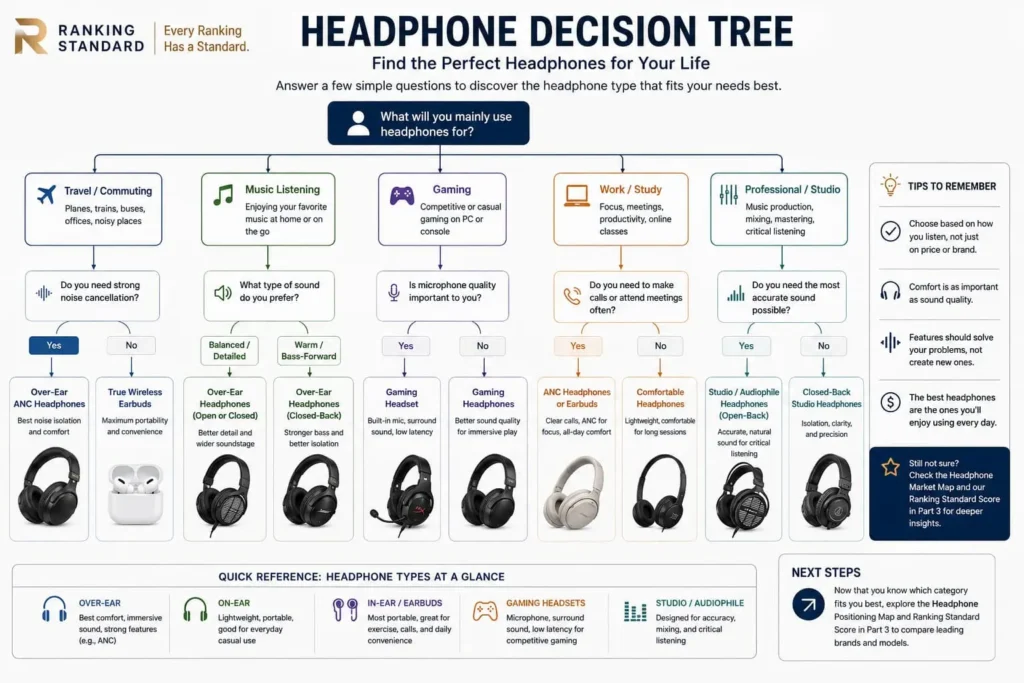
Many buyers immediately ask,
“Which headphone brand is the best?”
But that’s actually the second question.
The first question should always be:
“How do I actually use my headphones?”
Do you travel frequently?
Do you work in noisy offices?
Do you play competitive games?
Do you mix music professionally?
Your answers determine the category that fits your needs far more accurately than any marketing slogan.
Once you’ve identified the right category, comparing brands becomes much easier—and much more meaningful.
How Ranking Standard Evaluates Headphones
By now, one thing should be clear.
There is no single pair of headphones that is perfect for everyone.
Some headphones are designed for travel.
Others are built for professional music production.
Some focus on blocking outside noise.
Others aim to reproduce music as accurately as possible.
That’s why Ranking Standard never asks:
“Which headphones are the best?”
Instead, we ask:
“Which headphones are the best for the way you listen?”
That simple question changes how every product should be evaluated.
The Headphone Positioning Map
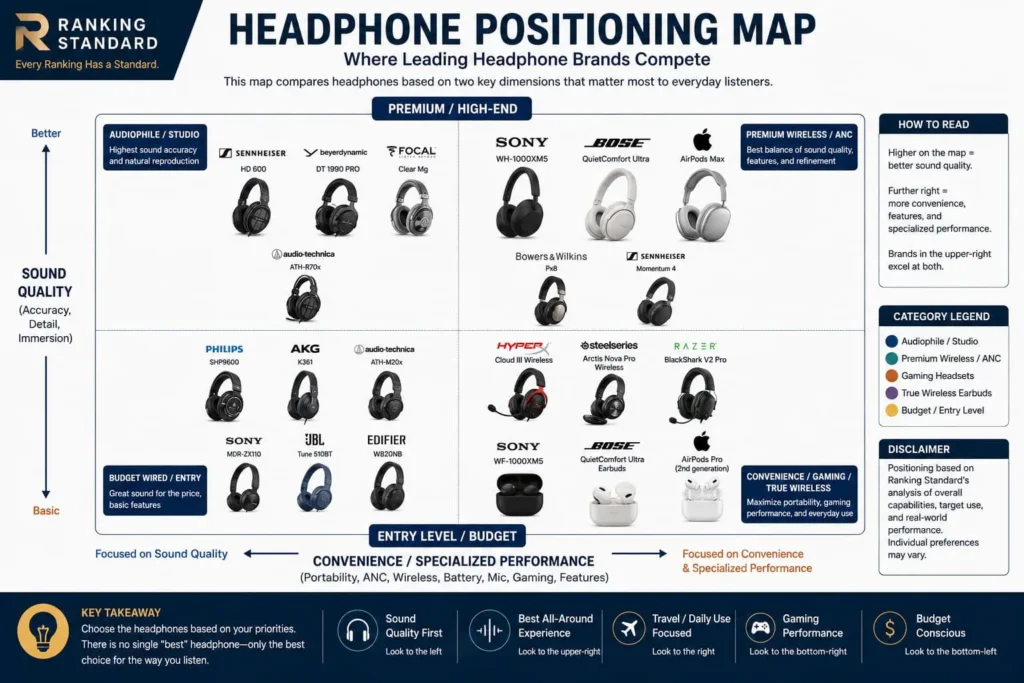
Rather than organizing headphones by price alone, Ranking Standard positions every product according to two characteristics that matter most in everyday use.
Sound Quality
↓
Comfort
The second dimension compares:
Convenience
↓
Specialized Performance
Some headphones are designed to deliver the best possible sound.
Others prioritize portability, battery life, or active noise cancellation.
Some excel in gaming.
Others are intended for studio monitoring.
No headphone can maximize every category at the same time.
Understanding where a product sits within the market is far more useful than simply comparing prices.
Why Expensive Doesn’t Always Mean Better
One of the biggest misconceptions in the headphone market is that higher prices automatically guarantee better listening experiences.
Premium models often include:
- Better materials
- Larger drivers
- Advanced wireless technology
- Superior noise cancellation
- Longer battery life
These features certainly add value.
However, they don’t automatically make a pair of headphones the right choice.
For example, a studio headphone costing hundreds of dollars may perform poorly during a noisy flight because it wasn’t designed for travel.
Likewise, premium noise-cancelling headphones may not satisfy someone who wants perfectly neutral sound for audio production.
The right headphones always depend on how they’ll be used.
The Ranking Standard Score
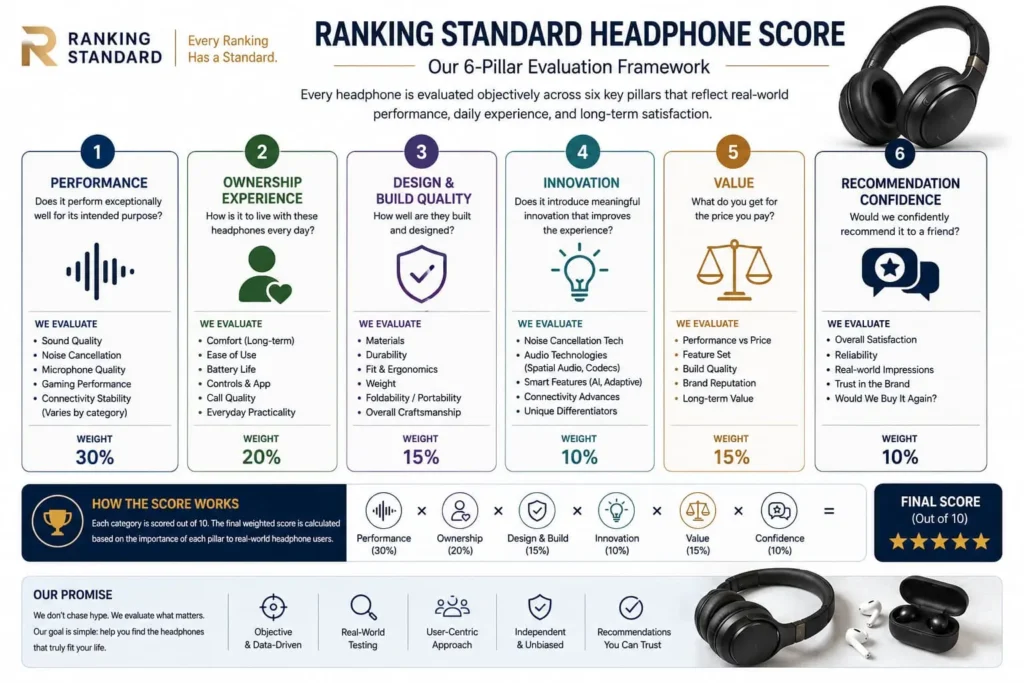
Every pair of headphones is evaluated using the same six objective criteria.
Performance
Does the product perform exceptionally well for its intended purpose?
Sound quality, noise cancellation, microphone performance, or gaming performance are all considered depending on the category.
Ownership Experience
How comfortable are the headphones during long listening sessions?
How reliable is the wireless connection?
How practical are battery life, charging, controls, and everyday usability?
Design & Build Quality
We evaluate:
- Materials
- Durability
- Comfort
- Weight
- Foldability
- Overall craftsmanship
A great pair of headphones should feel as good after years of use as it did on the first day.
Innovation
Meaningful innovation matters.
Features such as adaptive noise cancellation, spatial audio, AI-enhanced microphones, or advanced Bluetooth codecs are evaluated only when they genuinely improve the listening experience.
Technology should solve problems—not simply create marketing headlines.
Value
The best value isn’t always the least expensive option.
A mid-range model that delivers outstanding comfort and sound quality may outperform premium competitors in overall value.
Recommendation Confidence
Finally, we ask one simple question.
If we were spending our own money today, would we confidently recommend these headphones to a friend with similar listening habits?
That answer often says more than pages of technical specifications.
Who Should Invest in Premium Headphones?
Premium headphones are worth considering if you:
- Listen to music every day.
- Travel frequently.
- Work remotely.
- Play competitive games.
- Produce or edit audio professionally.
- Want long-term comfort during extended listening sessions.
For many people, headphones become one of the most frequently used electronic devices they own.
Choosing the right pair can improve every commute, every meeting, every workout, and every playlist.
Final Thoughts
Headphones are more than audio equipment.
They shape how you experience music, movies, games, work, and even silence.
The smartest buying decision isn’t choosing the headphones with the highest price or the longest specification sheet.
It’s choosing the pair you’ll genuinely enjoy wearing every single day.
That’s exactly what Ranking Standard is designed to help you find.
Because the best headphones aren’t the ones everyone else recommends.
They’re the ones that disappear the moment your favorite music begins.
✍️ Editor Alter’s Note
This guide serves as the foundation of the Headphone category within Ranking Standard.
From here, we’ll naturally expand into:
- Best Headphone Brands
- Best Over-Ear Headphones
- Best Wireless Earbuds
- Best Noise Cancelling Headphones
- Best Gaming Headsets
- Best Studio Headphones
- Open-Back vs Closed-Back Headphones
- Wired vs Wireless Headphones
Each of these articles will link back to this guide, making it the central Pillar of the headphone category and creating a strong, interconnected topic cluster that reinforces Ranking Standard’s authority.