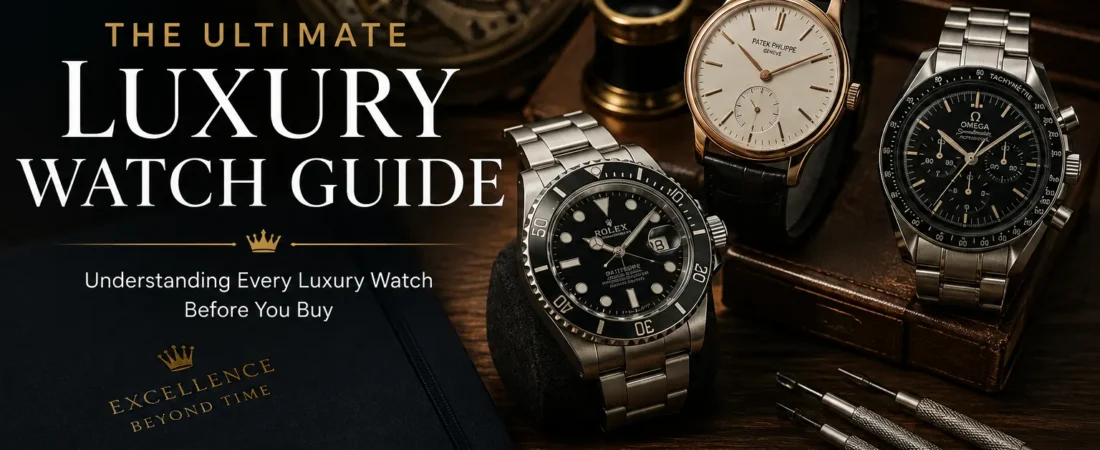
“A luxury watch doesn’t simply tell time. It tells a story—about craftsmanship, engineering, heritage, and sometimes even the person wearing it.”
Buying a luxury watch is very different from buying most consumer products.
When people purchase running shoes, refrigerators, or headphones, they’re usually solving a practical problem.
A luxury watch is different.
It represents craftsmanship.
It represents tradition.
For some buyers, it’s an achievement.
For others, it’s an investment, a family heirloom, or simply an appreciation for mechanical engineering.
That’s why choosing a luxury watch is rarely about finding the cheapest option—or even the one with the most features.
It’s about finding the watch that best reflects your priorities.
This guide is designed to help you understand the luxury watch market before comparing individual brands or models.
Rather than focusing on hype, waiting lists, or internet popularity, we’ll examine what truly makes one luxury watch different from another.
Why Luxury Watches Matter
Unlike smartphones, luxury watches rarely become obsolete.
A mechanical watch built today may still be functioning fifty—or even one hundred—years from now with proper servicing.
Some are passed from one generation to the next.
Others become collectible pieces whose value increases over time.
For many enthusiasts, a luxury watch represents one of the few modern products that combines:
- Mechanical engineering
- Traditional craftsmanship
- Functional design
- Artistic finishing
- Long-term ownership
It’s one of the rare products people buy expecting to keep for decades rather than replace after a few years.
The Luxury Watch Market Has Changed
A generation ago, luxury watches were primarily associated with formal occasions.
Today, the market is far more diverse.
Modern collectors buy watches for:
- Daily wear
- Business
- Diving
- Travel
- Motorsport
- Aviation
- Investment
- Collecting
Manufacturers now produce watches designed for highly specific lifestyles.
Some prioritize robustness.
Others focus on elegance.
Some are built for professional divers.
Others celebrate centuries of traditional watchmaking.
The luxury watch market has become one of the most fascinating intersections of engineering, design, and culture.
The Biggest Mistake Buyers Make
One of the most common questions people ask is:
“What’s the best luxury watch brand?”
The honest answer is exactly the same as with running shoes, coffee machines, office chairs, mattresses, headphones, and refrigerators.
There isn’t one.
A Rolex Submariner serves a very different purpose from a Patek Philippe Calatrava.
An Omega Speedmaster tells a different story than a Cartier Tank.
Even among brands at similar price levels, their philosophies can be completely different.
The best luxury watch is simply the one that matches your lifestyle, your taste, and your reasons for buying it.
The Ranking Standard Philosophy
At Ranking Standard, we don’t evaluate watches based only on prestige or resale value.
Instead, we begin with one question:
What was this watch designed to represent?
Some watches prioritize technical innovation.
Others preserve centuries-old traditions.
Some focus on everyday durability.
Others emphasize artistic finishing or exclusivity.
Every great watch solves a different problem—or tells a different story.
Understanding that purpose comes before comparing prices, waiting lists, or celebrity endorsements.
Because the smartest buying decision isn’t purchasing the watch everyone else wants.
It’s choosing the watch you’ll still admire every time you look at your wrist ten years from now.
What You’ll Learn In This Guide
By the end of this guide, you’ll understand:
- The major categories of luxury watches
- The differences between leading watch brands
- The features that genuinely matter
- Common buying mistakes
- How Ranking Standard evaluates luxury watches
- Why prestige alone doesn’t determine quality
Most importantly, you’ll learn how to choose a luxury watch based on what you value most, rather than simply following trends or internet rankings.
Understanding the Luxury Watch Market
Walk into a luxury watch boutique, and you’ll quickly realize something.
Not every luxury watch is built for the same purpose.
Some are designed for professional diving.
Others celebrate elegant dress styling.
Some focus on aviation.
Others are inspired by motorsport, travel, or scientific exploration.
Yet many first-time buyers compare them as if they’re all trying to achieve the same goal.
They aren’t.
Every category exists because different collectors value different things.
Before comparing brands or individual models, it’s essential to understand how today’s luxury watch market is organized.
The Five Main Categories of Luxury Watches
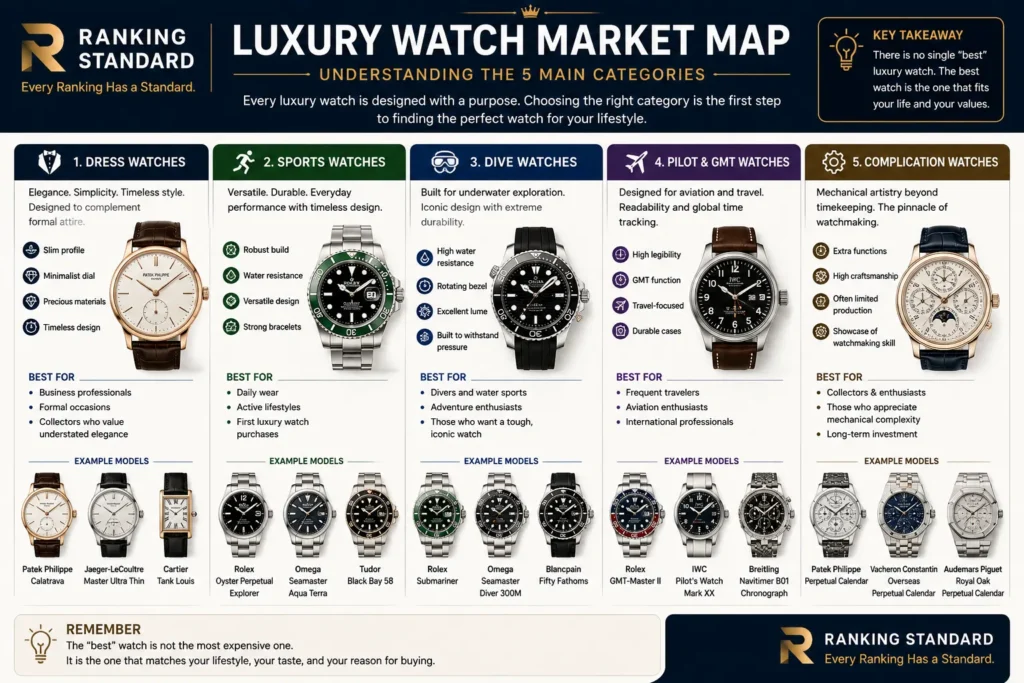
Rather than comparing hundreds of individual watches, begin by understanding the five major categories that define today’s luxury watch market.
Once you know which category fits your lifestyle, choosing the right watch becomes much easier.
1. Dress Watches
Dress watches are built around simplicity and elegance.
They’re typically:
- Slim
- Lightweight
- Minimalist
- Easy to wear with formal clothing
Rather than attracting attention, they complement the wearer.
Classic examples include:
- Patek Philippe Calatrava
- Jaeger-LeCoultre Master Ultra Thin
- Cartier Tank
Best for:
- Business professionals
- Formal occasions
- Collectors who appreciate timeless design
2. Sports Watches
Sports watches have become the largest category in luxury watchmaking.
They’re designed to be versatile enough for everyday use while remaining durable.
Many include:
- Water resistance
- Strong cases
- Luminous dials
- Robust bracelets
Examples include:
- Rolex Submariner
- Omega Seamaster
- Tudor Black Bay
Best for:
- Daily wear
- Active lifestyles
- First luxury watch purchases
3. Dive Watches
Originally developed for professional divers, dive watches have evolved into one of the most recognizable watch categories.
Typical features include:
- Rotating bezels
- High water resistance
- Strong lume
- Excellent durability
Ironically, most owners never take them diving.
Instead, buyers appreciate their practicality and iconic design.
4. Pilot & GMT Watches
Travel and aviation created another important category.
Pilot watches emphasize readability.
GMT watches allow wearers to track multiple time zones.
These models appeal to:
- Frequent travelers
- Aviation enthusiasts
- International business professionals
Popular examples include:
- Rolex GMT-Master II
- IWC Pilot’s Watch
- Breitling Navitimer
5. Complication Watches
Some luxury watches focus less on sport and more on mechanical achievement.
These watches include additional functions beyond simple timekeeping.
Examples include:
- Perpetual Calendars
- Moon Phases
- Annual Calendars
- World Timers
- Minute Repeaters
- Tourbillons
These aren’t necessarily more practical.
Instead, they demonstrate extraordinary watchmaking craftsmanship.
For many collectors, complications represent the highest level of mechanical artistry.
Why Comparing Different Categories Doesn’t Work
One of the biggest mistakes buyers make is comparing watches designed for completely different purposes.
Should a dress watch compete directly with a dive watch?
Not really.
One emphasizes elegance.
The other prioritizes durability.
Likewise, comparing a travel-focused GMT watch with a perpetual calendar misses the point.
Each serves a different purpose.
At Ranking Standard, watches first compete within their own category before being compared across the broader luxury market.
Only then can recommendations remain objective.
Luxury Watch Market Map
Instead of organizing watches by price alone, Ranking Standard first organizes them by purpose.
| Category | Primary Strength | Best For |
|---|---|---|
| Dress Watches | Elegance | Formal occasions |
| Sports Watches | Everyday versatility | Daily wear |
| Dive Watches | Durability | Active lifestyles |
| Pilot & GMT Watches | Travel functionality | Frequent travelers |
| Complication Watches | Mechanical artistry | Enthusiasts & collectors |
Notice something important.
No category is universally superior.
Each represents a different philosophy of watchmaking.
Choosing the correct category is often more important than choosing the most famous brand.
Choosing the Right Watch Starts With Your Lifestyle
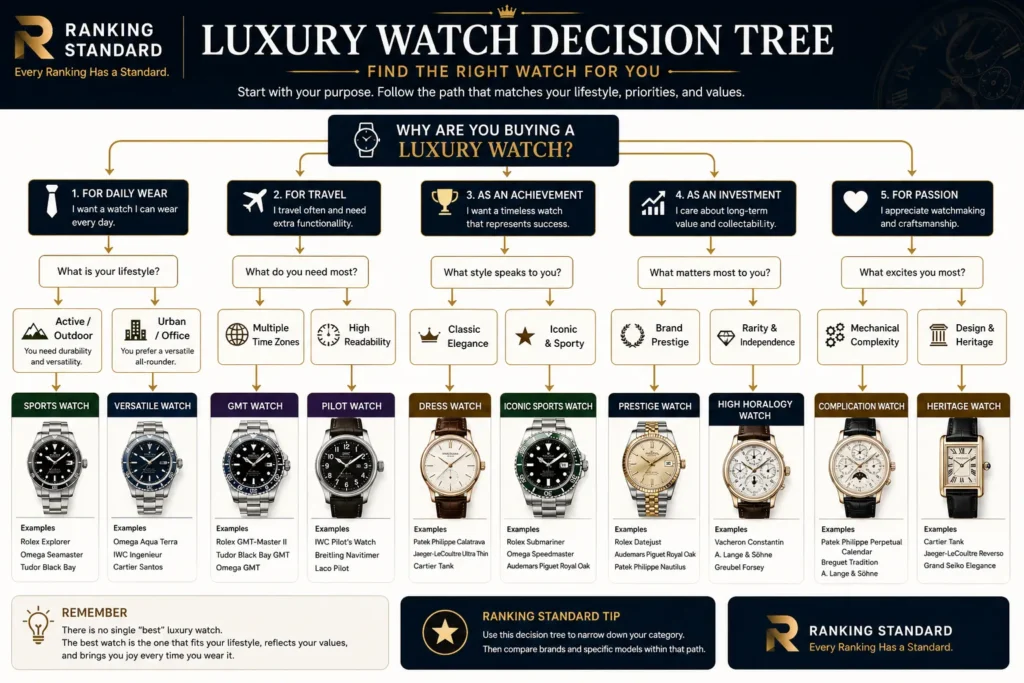
Many buyers immediately ask:
“Should I buy Rolex or Omega?”
But that’s actually the second question.
The first question should always be:
“What kind of watch fits the way I live?”
Do you wear a suit every day?
Do you travel internationally?
Do you spend weekends outdoors?
Are you fascinated by mechanical engineering?
The answers to those questions matter far more than internet popularity rankings.
Once you’ve identified the right category, comparing brands becomes far easier—and far more meaningful.
How Ranking Standard Evaluates Luxury Watches
By now, one thing should be clear.
Luxury watches cannot be judged by price alone.
Nor can they be judged simply by popularity.
A mechanical masterpiece from one manufacturer may cost less than another watch that owes much of its value to brand recognition.
Likewise, a watch with exceptional finishing may not hold its value as well as a simpler model from another brand.
That’s why Ranking Standard never asks:
“Which luxury watch is the best?”
Instead, we ask:
“Which luxury watch delivers the greatest long-term ownership experience for the person buying it?”
Luxury is not defined by price.
Luxury is defined by purpose, craftsmanship, heritage, and lasting value.
The Luxury Watch Pyramid
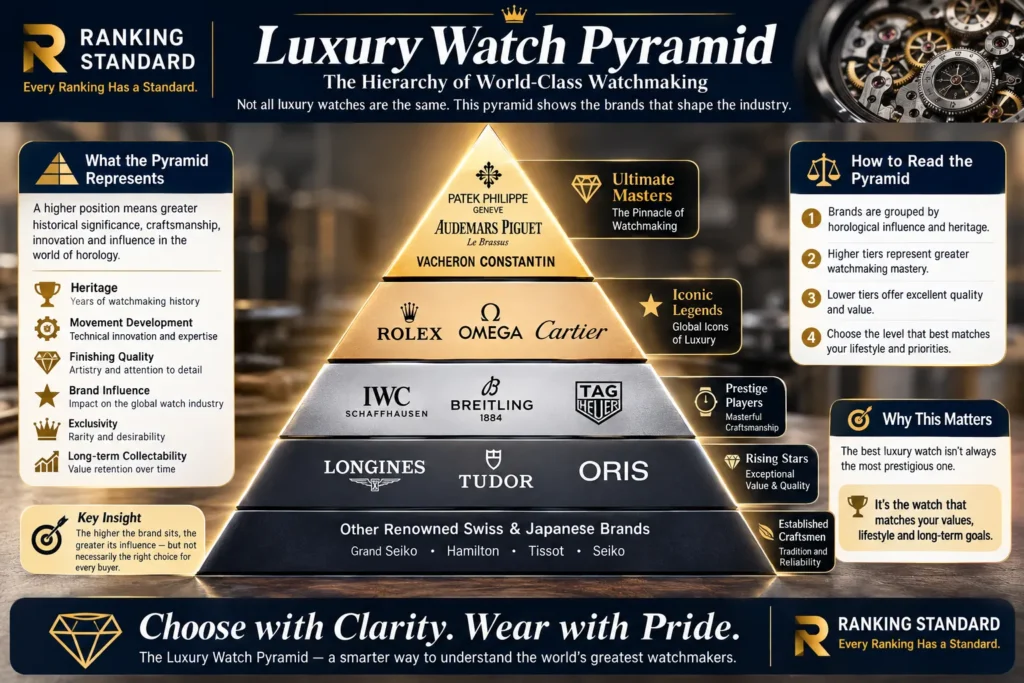
Unlike most product categories, luxury watches are strongly influenced by brand heritage.
For that reason, Ranking Standard introduces a different visual framework.
Instead of a market map, we use a Luxury Pyramid.
The pyramid reflects several factors working together:
- Watchmaking heritage
- Movement development
- Finishing quality
- Innovation
- Exclusivity
- Brand influence
- Long-term collectability
The higher a brand sits within the pyramid, the greater its historical significance and influence on the watch industry.
However, this is not a simple “better or worse” ranking.
A watch in a lower tier may still be the smarter purchase for many buyers depending on budget, lifestyle, and ownership goals.
The pyramid represents prestige—not personal suitability.
Why Prestige Doesn’t Always Mean Better
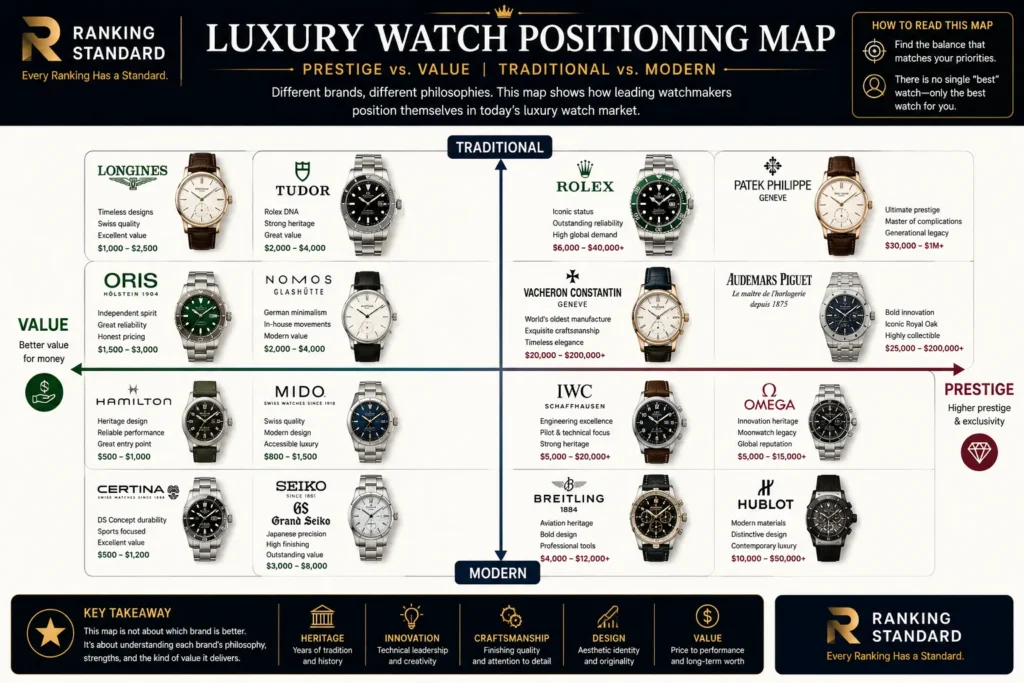
One of the biggest misconceptions among first-time buyers is believing that the most prestigious watch is automatically the best purchase.
In reality, prestige is only one part of ownership.
A highly collectible watch may require years on a waiting list.
A complicated movement may cost significantly more to service.
An ultra-exclusive brand may be difficult to maintain depending on where you live.
Meanwhile, a less prestigious watch may deliver:
- Outstanding reliability
- Exceptional finishing
- Easier servicing
- Better everyday versatility
- Excellent long-term value
Luxury should always be evaluated in context.
The smartest purchase is rarely determined by prestige alone.
The Ranking Standard Score
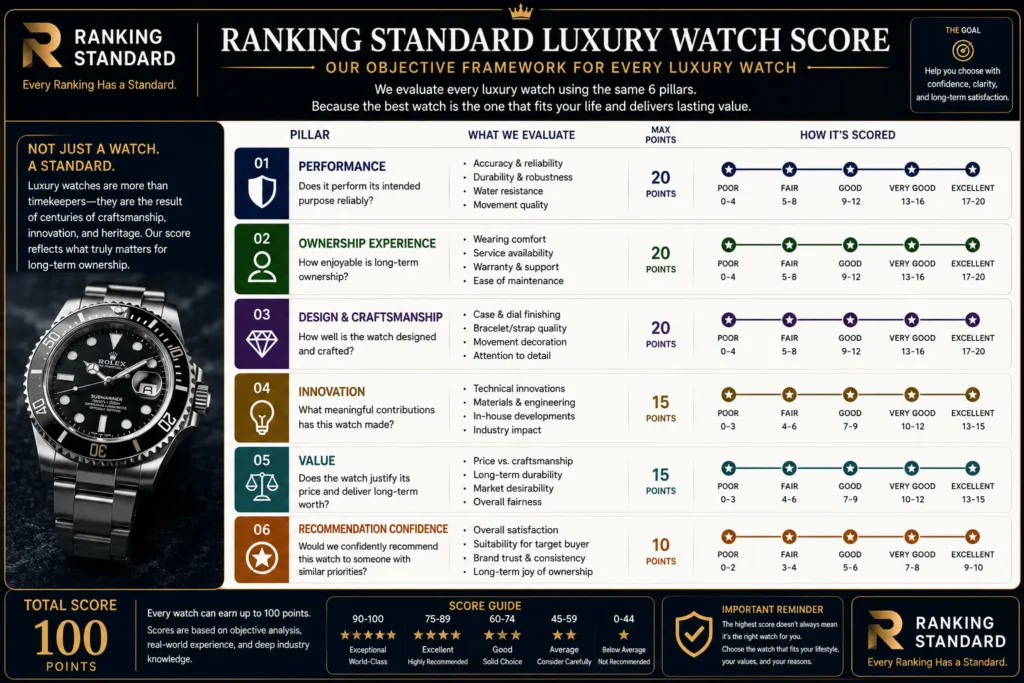
Every luxury watch is evaluated using the same objective framework.
Performance
Does the watch perform its intended purpose reliably?
Accuracy, durability, water resistance, and movement quality are all considered.
Ownership Experience
How enjoyable is long-term ownership?
We consider:
- Wearing comfort
- Service availability
- Warranty
- Ease of maintenance
- Daily practicality
Luxury ownership should remain enjoyable long after the purchase.
Design & Craftsmanship
Luxury watches are works of industrial art.
We evaluate:
- Case finishing
- Dial execution
- Bracelet quality
- Movement decoration
- Overall attention to detail
Craftsmanship remains one of the defining characteristics of true luxury watchmaking.
Innovation
Innovation is measured through meaningful contributions to horology.
Examples include:
- New escapement technologies
- Advanced materials
- Improved power reserves
- Anti-magnetic movements
- Engineering breakthroughs
Marketing alone never earns innovation points.
Value
Luxury does not eliminate the importance of value.
We evaluate whether a watch justifies its price through craftsmanship, ownership experience, durability, and long-term desirability.
Some watches provide extraordinary value despite sitting below the industry’s most prestigious brands.
Recommendation Confidence
Finally, we ask one simple question.
If we were spending our own money today, would we confidently recommend this watch to someone with similar priorities and expectations?
That answer often reveals far more than resale charts or internet hype.
Who Should Buy a Luxury Watch?
Luxury watches aren’t purchased for the same reasons by every owner.
Some buyers value:
- Heritage
- Engineering
- Investment potential
- Daily wear
- Collectability
- Personal achievement
There is no universally correct reason.
The important question is whether the watch reflects what you value most.
Choosing with clarity almost always leads to greater satisfaction than following trends.
Final Thoughts
A luxury watch is one of the few products that can continue serving its owner for generations.
It measures time.
It preserves craftsmanship.
It tells history.
And in many cases, it becomes part of a family’s story.
The smartest buying decision isn’t choosing the watch with the longest waiting list or the highest resale premium.
It’s choosing the watch you’ll still be proud to wear twenty years from now.
That’s exactly what Ranking Standard is designed to help you do.
Because the best luxury watch isn’t simply the most prestigious one.
It’s the one that continues to bring satisfaction every time you look at your wrist.