
The best washing machines aren’t necessarily the biggest, smartest, or most expensive. Choosing the right one starts with understanding your household, laundry habits, and space.
It isn’t.
Walk into an appliance store and you’ll find machines that look remarkably similar but operate in fundamentally different ways.
Front load or top load?
Agitator or impeller?
4.5 cubic feet or 5.5?
Standard washer or all-in-one washer-dryer?
Then come the features: automatic detergent dispensers, steam cycles, Wi-Fi controls, specialized stain programs, high-speed spin cycles, AI-assisted washing, and dozens of settings most households may rarely use.
Prices can range from relatively affordable basic machines to premium washers costing well over $1,000.
The difficult question isn’t whether the expensive machine has more features.
It usually does.
The real question is:
Which differences will actually make your laundry easier for the next several years?
That’s where a better buying decision begins.
A Washing Machine Is a Long-Term Purchase
Most people don’t replace a washer because they suddenly want the newest technology.
They replace one because the old machine stops working, becomes unreliable, no longer fits their household, or costs too much to repair.
That makes washing machines very different from many consumer electronics.
You’re not buying primarily for novelty.
You’re buying an appliance that may perform hundreds of cycles every year.
Over time, seemingly small differences become important.
How easily can you load it?
How much laundry fits comfortably?
How long do cycles take?
How much water does it use?
How effectively does it remove water before clothes enter the dryer?
How much maintenance does it require?
And when something eventually breaks, can it be repaired economically?
A washer should therefore be evaluated as an ownership decision, not simply as a collection of specifications.
Start With Your Household, Not the Brand
It’s easy to begin with:
Samsung or LG?
GE or Whirlpool?
But that’s several decisions too early.
Imagine three households.
The first is a single person living in a small apartment who washes several modest loads each week.
The second is a family of five constantly washing school clothes, towels, sportswear, and bedding.
The third is an older couple who dislike bending down to load a front-loading machine and value simple controls more than advanced technology.
The same washer shouldn’t automatically be recommended to all three.
The apartment resident may prioritize dimensions, noise, and installation flexibility.
The family may value capacity, cycle throughput, stain performance, and reliability.
The older couple may care most about accessibility, straightforward controls, and comfortable loading height.
Before asking which washing machine is best, ask:
What does my household actually need this machine to do?
The Major Types of Washing Machines
Most buyers can narrow the market dramatically by understanding the main washer categories.
Front-Load Washers
Front-load machines use a horizontally mounted drum that tumbles clothing through a relatively small amount of water.
They’ve become popular because they can combine strong cleaning performance with efficient water use and high spin speeds.
Why Buyers Choose Them
Front loaders commonly offer:
- Strong cleaning performance
- Efficient water use
- High spin speeds
- Large usable capacity
- Stackable configurations
- Gentle fabric handling
Higher spin speeds can also remove more water from clothing before drying, potentially reducing dryer workload.
But there are trade-offs.
The door seal and enclosed design require appropriate care. Leaving moisture trapped inside can contribute to odors or residue over time.
Loading also requires bending unless the machine is installed on a pedestal.
A front loader can be an excellent choice.
But it isn’t automatically the right washer for every household.
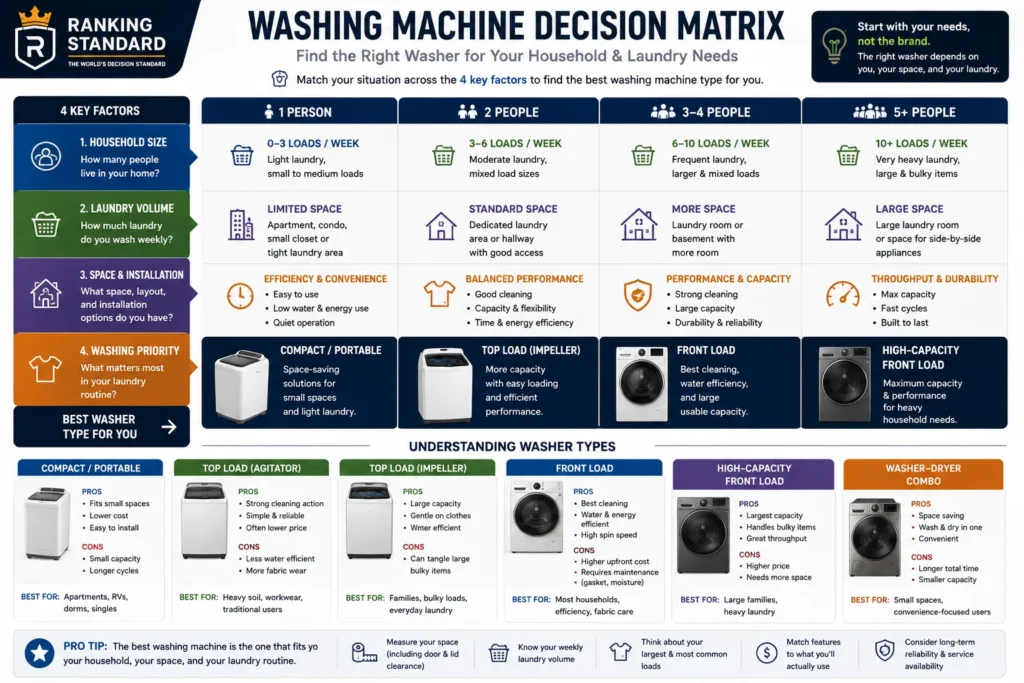
Top-Load Washers With an Agitator
Traditional top-load washers use a central agitator that moves clothing through the wash.
For many buyers, this remains the most familiar washer design.
Why Buyers Choose Them
Common advantages include:
- Straightforward operation
- Easy loading from above
- Familiar washing action
- Often shorter cycle options
- Wide availability
An agitator can provide vigorous mechanical action, which some households appreciate for heavily soiled laundry.
However, the central column occupies drum space and can be harder on certain fabrics than gentler washing systems.
The important question isn’t whether agitators are “old technology.”
It’s whether their characteristics fit your laundry.
Top-Load Impeller Washers
High-efficiency top loaders often replace the tall central agitator with a low-profile impeller or wash plate.
This creates more open space inside the basket.
Potential Advantages
- Larger unobstructed interior
- Easier loading of bulky items
- Reduced water use compared with many traditional designs
- Less aggressive fabric movement
But loading a large basket doesn’t guarantee better cleaning.
Clothes still need enough room to move properly, and performance depends heavily on wash programming, water distribution, and how the machine is loaded.
This is a recurring lesson in appliance shopping:
More capacity isn’t useful if you routinely overload it.
Compact Washing Machines
Compact washers solve a space problem.
They’re commonly considered for:
- Apartments
- Condominiums
- Small laundry closets
- Kitchens
- Secondary laundry areas
Their smaller dimensions can make installation possible where a full-size washer simply won’t fit.
The obvious compromise is capacity.
A smaller drum may mean more frequent loads for larger households.
For one or two people, that trade-off may be completely reasonable.
For a family generating large volumes of laundry, it can become frustrating very quickly.
All-in-One Washer-Dryer Combos
Washer-dryer combinations perform both washing and drying in one machine.
The appeal is obvious.
Put dirty laundry in.
Take clean, dry laundry out.
No transfer between appliances.
Modern heat-pump-based systems have made this category considerably more interesting, particularly for households with limited space or buyers who value automation.
But convenience comes with trade-offs.
Depending on the machine and load, complete wash-and-dry cycles can take considerably longer than using separate appliances.
And if your household generates several loads in succession, one machine has to complete both processes before the next load can begin.
That’s why an all-in-one machine can be brilliant for one household and frustrating for another.
Convenience per load and total household laundry throughput are not the same thing.
Capacity: Bigger Isn’t Automatically Better
Washer capacity is typically expressed in cubic feet in the U.S. market.
It’s tempting to assume that bigger is always better.
But capacity should match laundry volume.
A very large machine may make sense if you regularly wash:
- Large family loads
- Bedding
- Comforters
- Towels
- Sports clothing
- Bulky items
But larger washers generally require more physical space and may cost more.
More importantly, advertised drum capacity doesn’t tell you how effectively every type of load will move and clean inside that space.
Rather than chasing the largest number available, think about your largest regular load.
That’s a much better starting point.
Think in Loads per Week, Not Just Family Size
Household size is useful.
Laundry behavior is better.
Two families of four can generate dramatically different amounts of laundry.
One might wash four loads each week.
Another may have children playing sports, frequent bedding changes, work uniforms, pets, and towels that push the total into double digits.
Ask yourself:
How many loads do we actually wash in a normal week?
Then consider whether your current washer feels:
- Too small
- About right
- Larger than necessary
That real-world information is often more useful than a generic capacity chart.
Don’t Forget the Dryer
A washing machine doesn’t operate in isolation.
It’s part of a laundry system.
If you’re keeping your existing dryer, make sure the washer’s capacity and throughput make sense alongside it.
A huge washer paired with a much smaller dryer may force you to divide washed loads before drying.
Spin performance matters too.
A washer that extracts more water during the final spin sends less moisture into the dryer.
That can influence:
- Drying time
- Energy consumption
- Laundry throughput
The best washing-machine decision therefore sometimes requires looking at the entire laundry process, not just the washer.
Measure the Space Before Shopping
This sounds obvious.
It’s one of the easiest mistakes to make.
Don’t measure only the empty opening where the washer will sit.
Consider:
- Machine width
- Machine depth
- Machine height
- Door clearance
- Lid clearance
- Hose connections
- Ventilation requirements where relevant
- Pedestal height
- Cabinet clearance
- Walking space
Front-loading doors need room to open.
Top-loading lids need vertical clearance.
Large-capacity machines can also be surprisingly deep.
And there’s another measurement people forget:
the route into the laundry room.
Doorways, hallways, staircases, elevators, and tight corners all matter.
A washing machine that fits the laundry space is useless if it can’t reach it.
Cleaning Performance Is More Than One Feature
Manufacturers may promote steam, special stain cycles, AI washing, extra rinses, or proprietary drum technologies.
Some can be useful.
But cleaning performance comes from a combination of factors:
- Mechanical action
- Detergent distribution
- Water temperature
- Water volume
- Cycle duration
- Load movement
- Rinsing
- Programming
No single feature guarantees superior results.
Even detergent choice, dosage, water conditions, and loading habits can affect performance.
That’s why Ranking Standard evaluates the complete washing system rather than rewarding a machine for one heavily marketed technology.
Faster Isn’t Always Better
Cycle time matters, especially in busy households.
But a short cycle isn’t automatically equivalent to a full normal cycle.
Different programs may change:
- Mechanical action
- Water use
- Temperature
- Rinsing
- Spin behavior
- Recommended load size
Quick cycles can be extremely useful for smaller, lightly soiled loads.
They shouldn’t necessarily become the standard by which every wash program is judged.
The more useful question is:
Does this washer provide the right balance of cleaning quality and cycle time for the way my household actually does laundry?
Efficiency Has More Than One Meaning
Efficiency often gets reduced to water or electricity consumption.
Those matter.
But household efficiency can also mean:
- Fewer loads because of appropriate capacity
- Less drying because of stronger water extraction
- Less rewashing because clothes were cleaned properly
- Less time spent managing laundry
- Appropriate automatic detergent dosing
- Reliable cycles that don’t need intervention
A machine that looks efficient on one metric may not create the most efficient laundry routine for every household.
Where available, standardized efficiency labels and certification programs can provide useful comparison information, but they should be interpreted alongside real household needs.
Reliability Matters More Than Novelty
Smart features are increasingly common.
Depending on the machine, you may find:
- Wi-Fi
- Remote notifications
- Downloadable cycles
- Automatic detergent dispensing
- Load sensing
- Maintenance alerts
- App diagnostics
- AI-assisted cycle selection
Some of these features can genuinely improve convenience.
But a washing machine has one primary job:
Wash clothes reliably.
A sophisticated app doesn’t compensate for poor cleaning, excessive vibration, difficult maintenance, or questionable long-term support.
When evaluating premium features, Ranking Standard asks:
Will this feature meaningfully improve ownership—or does it simply make the specification list longer?
Repairability Belongs in the Buying Decision
This is one of the factors buyers often consider only after something breaks.
It should be considered before purchase.
Modern washing machines can contain:
- Electronic control boards
- Pumps
- Sensors
- Motors
- Valves
- Door locks
- Suspension systems
- Displays
- Connectivity modules
Eventually, any appliance can require service.
Before buying, it’s worth considering:
- Warranty coverage
- Local service availability
- Parts availability
- Manufacturer support
- Expected repair costs
- Complexity of the machine
A washer isn’t truly inexpensive if one failed proprietary component makes an otherwise functional appliance uneconomical to repair.
Purchase price and ownership value are not the same thing.
The Ranking Standard Philosophy
Most washing-machine rankings begin with products.
We begin with the laundry room.
First determine:
Who is doing the laundry?
Then:
How much laundry is being washed?
Then:
What space and installation constraints exist?
Then:
Which washer architecture best solves those problems?
Only after that should the decision move toward specifications, brands, and individual models.
That changes the buying process from:
Samsung vs. LG vs. GE vs. Whirlpool
into:
Which type of washer does my household actually need?
Once that question is answered, brand comparisons become far more useful.
What You’ll Learn
In the rest of this guide, we’ll examine:
- Front load vs. top load in practical terms
- Agitator vs. impeller designs
- How much washer capacity you actually need
- Which households benefit from washer-dryer combos
- Why spin speed matters
- When steam and specialty cycles are useful
- Which smart features may justify paying more
- How to think about noise and vibration
- Maintenance and odor prevention
- Reliability and repairability
- What additional spending should actually buy
- How Ranking Standard evaluates washing machines
By the end, you shouldn’t simply have a list of popular washers.
You should understand which washing-machine category fits your household—and why.
That’s where a smarter purchase begins.
Understanding Washing Machine Technology Before Choosing a Brand
Once you know how much laundry your household generates and how much space you have, the next step is understanding what the different washer designs actually change.
This is where specification sheets can become distracting.
More cycles.
More capacity.
Higher spin speeds.
Steam.
Wi-Fi.
Automatic detergent dispensing.
Some features can meaningfully improve everyday laundry. Others may add cost without solving a problem you actually have.
The goal isn’t to buy the washer with the most technology.
It’s to understand which technology improves your laundry routine.
Step 1: Front Load vs. Top Load
This is usually the most important architectural decision.
Neither design is universally superior.
They simply have different strengths.
Front-Load Washers
Front loaders tumble laundry through the drum rather than using a central vertical washing mechanism.
This architecture can provide strong cleaning performance while using relatively little water.
Front Load Makes Sense If You Prioritize:
- Water efficiency
- Strong cleaning performance
- High spin speeds
- Stackability
- Fabric care
- Large usable drum space
They’re particularly attractive when the washer and dryer need to be stacked.
But ownership requires appropriate habits.
The door gasket and detergent dispenser should be kept reasonably clean, and allowing the interior to dry between loads can help prevent unwanted odors.
For buyers unwilling to perform even basic moisture management, that maintenance requirement deserves consideration.
Top-Load Washers
Top loaders provide access from above.
This seemingly simple difference can dramatically change the ownership experience.
Top Load Makes Sense If You Prioritize:
- Easy loading
- Less bending
- Familiar controls
- Straightforward maintenance
- Convenient access to the drum
Some buyers simply prefer the physical experience of using one.
That preference is legitimate.
A washer that performs exceptionally in laboratory testing but is uncomfortable for you to load every day may not be the better appliance for your household.
Step 2: Agitator vs. Impeller
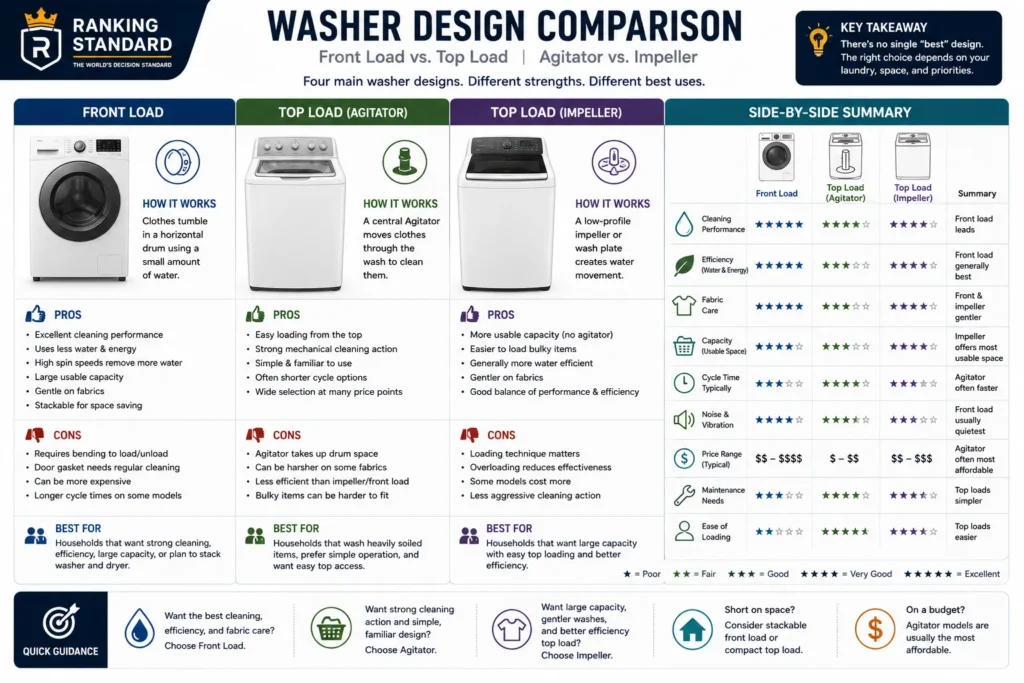
Choosing a top loader creates another decision.
Do you want a traditional central agitator or a low-profile impeller?
Agitator
The agitator physically moves laundry through the wash.
Its more aggressive mechanical action can be useful for certain heavily soiled loads.
Strengths
- Familiar washing action
- Straightforward operation
- Effective mechanical movement
- Often available at accessible prices
Trade-Offs
- Central column occupies basket space
- Can create more fabric interaction
- Bulky items may be harder to arrange
Agitators can make particular sense for households regularly washing durable, heavily soiled clothing.
Impeller
An impeller sits lower in the wash basket and moves laundry using a different combination of water flow and fabric-to-fabric interaction.
Removing the central agitator creates a more open basket.
Strengths
- More usable interior space
- Easier loading of bulky items
- Often gentler fabric movement
- Common in high-efficiency designs
Trade-Offs
- Correct loading becomes important
- Overloading can reduce effective movement
- Some users may prefer the washing action of an agitator
The open drum may look enormous in a showroom.
That doesn’t mean you should fill every available inch with clothing.
Laundry still needs room to move.
Step 3: How Much Capacity Do You Actually Need?
Capacity numbers are useful, but they shouldn’t become a competition.
For many full-size U.S. washers, capacity falls roughly within the 4-to-5-plus-cubic-foot range, while compact and specialized models may fall outside it.
Rather than treating one exact number as universally ideal, divide the market by household need.
Lower-Capacity Machines
Often suitable for:
- One or two people
- Apartments
- Smaller laundry spaces
- Frequent smaller loads
Mainstream Full-Size Capacity
Often works well for:
- Couples
- Small-to-medium families
- Typical mixed laundry
- Regular bedding
High-Capacity Machines
Become more useful for:
- Larger families
- Large bedding
- Frequent towels
- Sports uniforms
- Bulky loads
- High weekly laundry volume
But remember:
A bigger drum does not make overloading good practice.
Buying enough capacity is smart.
Buying unused capacity simply because the specification looks impressive may not be.
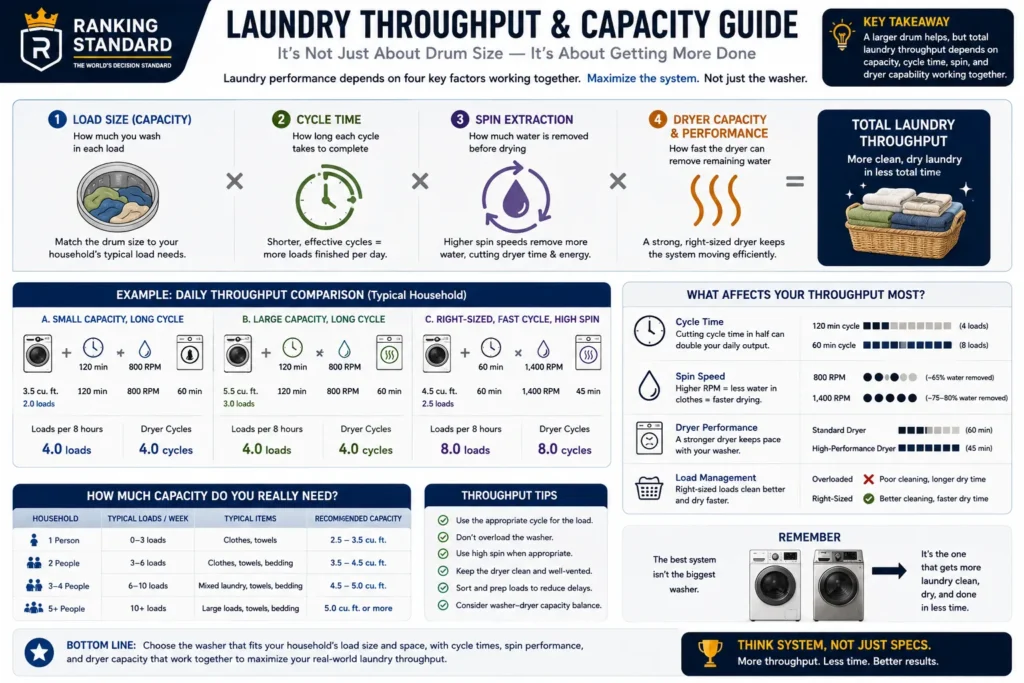
Step 4: Consider Throughput, Not Just Capacity
This is particularly important for large families.
Imagine two machines.
Washer A has an enormous drum but very long normal cycles.
Washer B has slightly less capacity but completes typical household loads substantially faster.
Which one handles more laundry during a busy Saturday?
The answer isn’t necessarily Washer A.
Household laundry productivity depends on:
Load Size × Cycle Time × Drying Time
That’s why Ranking Standard evaluates laundry throughput, not capacity alone.
For households washing one load every few days, the difference may be irrelevant.
For households processing multiple consecutive loads, it can matter enormously.
Step 5: Why Spin Speed Matters
After washing and rinsing, the washer spins the drum to remove water from the clothes.
Higher spin speeds can generally extract more moisture.
That matters because the dryer then has less water to remove.
Potential benefits include:
- Shorter drying times
- Reduced dryer workload
- Faster laundry turnaround
But maximum spin speed isn’t always appropriate for every fabric.
Delicate items may benefit from gentler settings, and poorly balanced machines can produce noticeable vibration during aggressive spins.
So again, the largest number isn’t automatically the best.
Effective extraction with good balance and control is what matters.
Step 6: Noise and Vibration Deserve More Attention
A loud washing machine in a basement may not bother anyone.
Put the same machine beside a bedroom, home office, or open-plan kitchen and the ownership experience changes completely.
Noise becomes particularly important for:
- Apartments
- Condominiums
- Upstairs laundry rooms
- Open-plan homes
- Nighttime washing
- Home offices
Vibration matters too.
Installation quality plays a major role.
A washer should be level and installed on a suitable surface.
But machine design, suspension, load balancing, and spin control also influence how calmly it operates.
Don’t treat quiet operation as a luxury feature if your laundry room is close to your living space.
Step 7: Steam — Useful or Marketing?
Steam appears frequently on premium washers.
It can be useful in certain cycles for stain treatment, sanitation-oriented programs, or fabric care depending on how the manufacturer implements it.
But it isn’t a reason by itself to buy an expensive washer.
Ask:
Will I actually use the cycles that employ steam?
If your laundry consists primarily of ordinary everyday clothing, the answer may be rarely.
If your household regularly deals with specific stains, bedding, workwear, or other loads that benefit from specialized programs, the feature may be more valuable.
Features should be judged by frequency of use.
Step 8: Automatic Detergent Dispensing Can Be More Useful Than It Sounds
This is one premium feature we shouldn’t dismiss as a gimmick.
Automatic dispensers store detergent and release an appropriate amount during each cycle according to the machine’s system and settings.
Potential benefits include:
- Less measuring
- Reduced risk of routinely using excessive detergent
- Faster cycle preparation
- More consistent dosing
Why does this matter?
Using too much detergent doesn’t necessarily make clothes cleaner.
Excess detergent can contribute to residue and may make rinsing more difficult.
For households running frequent loads, automatic dispensing can turn into a meaningful everyday convenience.
For someone washing once or twice a week, it may matter much less.
Step 9: Smart Features — Which Ones Actually Matter?
Connected washers may offer features such as:
- Cycle-completion notifications
- Remote monitoring
- Maintenance alerts
- Diagnostic assistance
- Downloadable cycles
- Energy monitoring
- Dryer coordination
The most useful feature may be one of the simplest:
Your phone tells you the laundry is finished.
That can prevent wet clothes from sitting forgotten in the drum.
Remote start sounds impressive, but its usefulness can be limited by the fact that someone still has to physically load the machine.
When evaluating smart features, ask whether they remove an actual friction point from your routine.
Connectivity should improve the appliance.
It shouldn’t become the reason you buy it.
Step 10: Washer-Dryer Combos Need a Different Evaluation
All-in-one machines shouldn’t simply be compared with conventional washers.
They’re solving a different problem.
Their biggest advantage is process automation.
You can potentially load laundry once and return later to clean, dry clothes.
That’s powerful for:
- Apartments
- Small homes
- Limited laundry spaces
- Households prioritizing convenience
- Users who dislike transferring laundry
But there is an important trade-off.
With separate appliances, Washer Load #2 can begin while Dryer Load #1 is drying.
With an all-in-one system, the same machine remains occupied throughout both processes.
This makes throughput especially important.
A Combo May Be Excellent If:
- You wash relatively few loads
- Space is limited
- You value hands-off operation
- You don’t regularly process several loads consecutively
Separate Machines May Be Better If:
- You have a large family
- You wash many loads each week
- Fast throughput matters
- You have sufficient installation space
The best solution depends on the laundry workflow, not simply the technology.
Step 11: Don’t Ignore the Door and Controls
These sound like minor details.
You interact with them every time you wash clothes.
Check:
- Door opening direction
- Door diameter
- Lid clearance
- Control-panel angle
- Display readability
- Button responsiveness
- Cycle-selection logic
If you’re shopping in person, physically use the controls.
Open the door.
Reach into the drum.
Try selecting a cycle.
A beautifully designed appliance can become irritating if everyday interaction is awkward.
Step 12: Maintenance Should Be Easy Enough That You’ll Actually Do It
Every washer needs some maintenance.
Front loaders may require attention to:
- Door gasket
- Detergent drawer
- Drain-pump filter where user-accessible
- Drum moisture
- Cleaning cycles
Top loaders may require:
- Dispenser cleaning
- Basket cleaning
- Periodic cleaning cycles
The manual for the specific machine should always guide maintenance.
But from a buying perspective, consider whether routine maintenance points are accessible and understandable.
A feature isn’t truly user-friendly if basic upkeep requires unnecessary difficulty.
Step 13: Why Front Loaders Can Develop Odors
This deserves explanation because it’s one of the most common objections to front-load machines.
Front loaders use a watertight door and gasket.
After washing, residual moisture can remain inside the drum, gasket, or dispenser area.
Combine moisture with detergent residue and limited airflow, and odors can develop.
This isn’t inevitable.
Useful habits can include:
- Allowing the interior to dry after use
- Cleaning the gasket as recommended
- Avoiding excessive detergent
- Cleaning dispensers
- Running manufacturer-recommended cleaning cycles
Some modern washers also include ventilation or other odor-management systems.
When comparing front loaders, maintenance design deserves attention alongside cleaning performance.
Step 14: Energy and Water Efficiency
Efficiency can create long-term savings, especially in households that wash frequently.
When comparing models in the United States, standardized information such as the EnergyGuide label can help buyers compare estimated energy use and operating cost under standardized assumptions.
Programs such as ENERGY STAR can also identify qualifying efficient models.
But don’t stop at the label.
Consider the entire laundry system.
A washer that removes more water during spinning may reduce dryer workload.
A correctly sized machine may reduce unnecessary cycles.
And a machine that cleans effectively the first time reduces rewashing.
Ranking Standard therefore considers system efficiency, not one isolated number.
Step 15: What Should You Spend?
Washing-machine prices vary substantially by size, configuration, retailer, promotions, and features.
Instead of anchoring the buying decision to exact prices that can change quickly, it’s more useful to understand what moving upmarket should deliver.
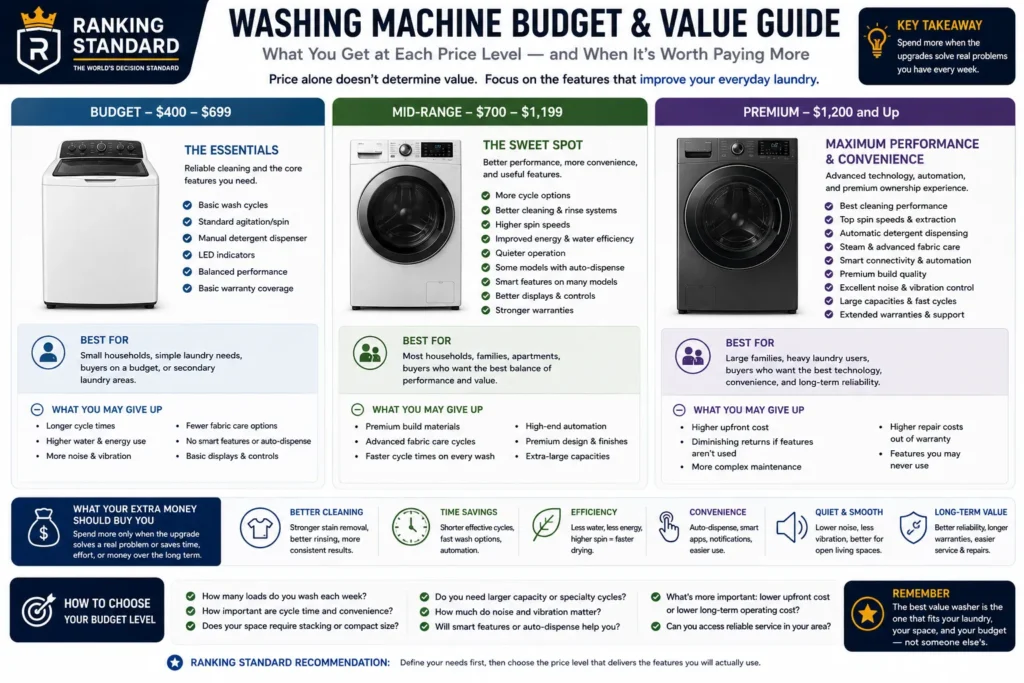
Budget Segment
Expect an emphasis on the essentials:
- Core wash cycles
- Simpler controls
- Fewer convenience features
- More basic finishes
A good budget washer should still clean reliably.
Basic doesn’t mean bad.
Mid-Range Segment
For many households, this is the sweet spot.
Additional spending may bring:
- Better noise and vibration control
- More useful cycle options
- Improved efficiency
- Larger capacities
- Better controls
- Automatic dispensing on some models
- Connectivity
This is often where features begin improving ownership rather than merely expanding the specification sheet.
Premium Segment
Premium machines should justify their price through meaningful improvements such as:
- Refined washing performance
- Excellent noise control
- Sophisticated automatic dosing
- Advanced fabric-care options
- Better user interfaces
- High-quality construction
- Strong ecosystem integration
- Specialized convenience features
A touchscreen alone isn’t enough.
At premium prices, the entire ownership experience should improve.
Step 16: Reliability Is More Complicated Than Brand Reputation
Buyers naturally want to know which brand lasts longest.
That’s a reasonable question.
It’s also difficult to answer with one universal ranking.
Reliability can vary between:
- Product lines
- Specific models
- Generations
- Components
- Usage patterns
Service availability also varies geographically.
That’s why Ranking Standard doesn’t treat a brand name as a guarantee.
Instead, when evaluating individual washers, we look for evidence around:
- Model-specific reliability
- Warranty coverage
- Parts availability
- Local service
- Repair complexity
- Manufacturer support
Buy the machine, not just the badge on the front.
Step 17: Think About the Next Repair Before You Buy
No washer is guaranteed never to fail.
A more useful question is:
What happens if it does?
Before purchasing, particularly an expensive model, investigate:
- Who provides warranty service?
- Are technicians available in your area?
- Are common replacement parts obtainable?
- How long is the standard warranty?
- Are important components covered differently?
- Is the machine designed in a way that allows reasonable service access?
This isn’t exciting research.
It can become extremely important several years later.
The Ranking Standard Household & Laundry Matrix
Before comparing brands, place your household into a use case.
| Household Situation | Prioritize | Usually Less Important |
|---|---|---|
| Single / couple | Right-sized capacity, efficiency, simplicity | Maximum drum size |
| Apartment / condo | Dimensions, noise, vibration, installation | Extreme capacity |
| Large family | Capacity, throughput, reliability, spin performance | Minimalist size |
| Heavy soil / workwear | Cleaning action, useful intensive cycles, durability | Decorative smart features |
| Frequent bedding | Usable capacity, drum access, balance | Compact dimensions |
| Accessibility needs | Loading height, controls, door/lid access | Maximum feature count |
| Limited laundry space | Stackability, compact design, combo options | Oversized drums |
| Smart-home household | Notifications, diagnostics, automation | Connectivity with no practical use |
Notice what’s missing from the first column.
Brands.
That’s intentional.
Ranking Standard’s Key Takeaway
Don’t compare washing machines by asking:
Which one has the biggest drum, the most cycles, or the smartest app?
Ask:
- How much laundry do we actually produce?
- How many loads do we wash each week?
- How much installation space do we have?
- Front load or top load—which fits how we use the machine?
- If top load, agitator or impeller?
- How important are cycle time and household throughput?
- How much do noise and vibration matter?
- Which convenience features would we genuinely use?
- How easy is the machine to maintain?
- Can it be serviced where we live?
- What happens when it eventually needs a repair?
Once those questions are answered, comparing Samsung, LG, GE Appliances, Whirlpool, Maytag, Electrolux, Speed Queen, and other manufacturers becomes much more meaningful.
The Ranking Standard Washing Machine Evaluation Framework
How Ranking Standard Evaluates Washing Machines
A washing machine can look impressive in a showroom.
It can have a huge drum, dozens of cycles, Wi-Fi connectivity, automatic detergent dispensing, steam, and an elegant control panel.
None of those things proves that it’s a great washer.
At Ranking Standard, we evaluate washing machines around a more practical question:
How well does this machine perform the job its intended household needs it to perform—over years of ownership?
That requires looking beyond the first wash.
A great washing machine should clean effectively, treat clothing appropriately, fit naturally into the household’s laundry routine, operate efficiently, remain manageable to maintain, and provide reasonable long-term ownership value.
Our standard therefore uses seven major evaluation categories.
1. Cleaning Performance – 25%
Cleaning is the primary purpose of a washing machine, so it receives the largest individual weighting.
But we don’t judge cleaning performance by whether a machine offers a cycle called “Heavy Duty” or “Stain Removal.”
We care about results.
Important factors include:
- Everyday soil removal
- Stain performance
- Detergent distribution
- Rinsing effectiveness
- Load movement
- Performance across different load sizes
- Consistency between cycles
- Specialized-cycle effectiveness where relevant
A washer should also perform well without requiring the user to constantly compensate for poor design through unusually small loads, excessive detergent, or repeated washing.
One spectacular specialty cycle doesn’t make a great washing machine.
Consistent everyday cleaning matters more.
2. Fabric Care & Wash Control – 15%
Cleaning clothes aggressively is easy.
Cleaning them while treating fabrics appropriately is harder.
We consider how effectively a washer balances cleaning action with fabric care.
That includes:
- Mechanical action
- Cycle control
- Water-temperature management
- Spin options
- Delicate-cycle behavior
- Load sensing
- Rinse options
- User control over washing intensity
The ideal balance depends partly on the household.
Someone regularly washing rugged workwear may prioritize stronger mechanical action.
A household washing delicate clothing may value gentler treatment.
This is one reason Ranking Standard doesn’t declare one washer architecture universally superior.
Good fabric care means providing the appropriate treatment for the load—not simply being gentle all the time.
3. Capacity & Laundry Throughput – 15%
Capacity matters, but the advertised cubic-foot figure tells only part of the story.
We evaluate:
- Usable drum space
- Ability to accommodate bulky loads
- Load accessibility
- Cycle duration
- Spin extraction
- Load-to-load turnaround
- Interaction with the dryer
- Overall household throughput
This distinction becomes particularly important for large families.
A very large washer isn’t necessarily more productive if its most useful cycles take substantially longer.
Likewise, an all-in-one washer-dryer may offer exceptional convenience while processing consecutive family loads more slowly than separate appliances.
We therefore ask:
How effectively can this machine process the amount of laundry its target household actually generates?
4. Efficiency & Spin Performance – 10%
Efficiency is broader than the amount of water used during one cycle.
We consider:
- Water consumption
- Electricity consumption
- Spin extraction
- Appropriate load sensing
- Detergent management
- Rewashing risk
- Dryer implications
A washer that leaves substantially more water in clothing may shift part of its energy burden to the dryer.
A machine that doses detergent effectively may reduce unnecessary product use and residue.
And a machine that cleans properly on the first attempt avoids the inefficiency of repeating a cycle.
Where standardized efficiency information is available, it can provide useful evidence.
But Ranking Standard evaluates the laundry system, not just one efficiency claim.
5. Usability & Everyday Ownership – 15%
Some appliance frustrations don’t appear on specification sheets.
You discover them after living with the machine.
That’s why everyday usability receives significant weight.
We evaluate:
- Loading comfort
- Door or lid design
- Control layout
- Display readability
- Cycle selection
- Remaining-time information
- Noise
- Vibration
- Detergent loading
- Automatic dispensing where available
- App usefulness where available
- Cleaning and maintenance access
A washing machine may perform brilliantly and still be unpleasant to own if its controls are confusing or basic maintenance is unnecessarily difficult.
Small inconveniences become much larger when repeated hundreds of times.
6. Reliability, Repairability & Service – 10%
Reliability is one of the most important—and most difficult—parts of appliance evaluation.
No responsible evaluation should promise that a particular washer will last an exact number of years.
Instead, we consider the evidence available around the complete ownership ecosystem.
That includes:
- Warranty coverage
- Service availability
- Parts availability
- Repair accessibility
- Component complexity
- Manufacturer support
- Model-specific reliability evidence where available
- Long-term ownership considerations
This category also prevents an important distortion.
A washer shouldn’t receive an exceptional score simply because it performs brilliantly when new if keeping it operational later could be unusually difficult or expensive.
A durable buying decision includes the possibility of repair.
7. Value for Money – 10%
Value is not the same thing as low price.
A basic washer can provide excellent value if it performs its essential functions reliably without unnecessary complexity.
A premium washer can also provide excellent value if its additional cost produces meaningful improvements that the buyer will actually use.
We evaluate whether the price is justified by improvements in areas such as:
- Cleaning
- Capacity
- Noise control
- Build quality
- Automation
- Fabric care
- Efficiency
- Convenience
- Service support
We do not award meaningful extra credit simply because a machine includes more features.
The question is:
What does the buyer receive for the additional money?
The Ranking Standard Washing Machine Score
Our general-purpose evaluation framework is:
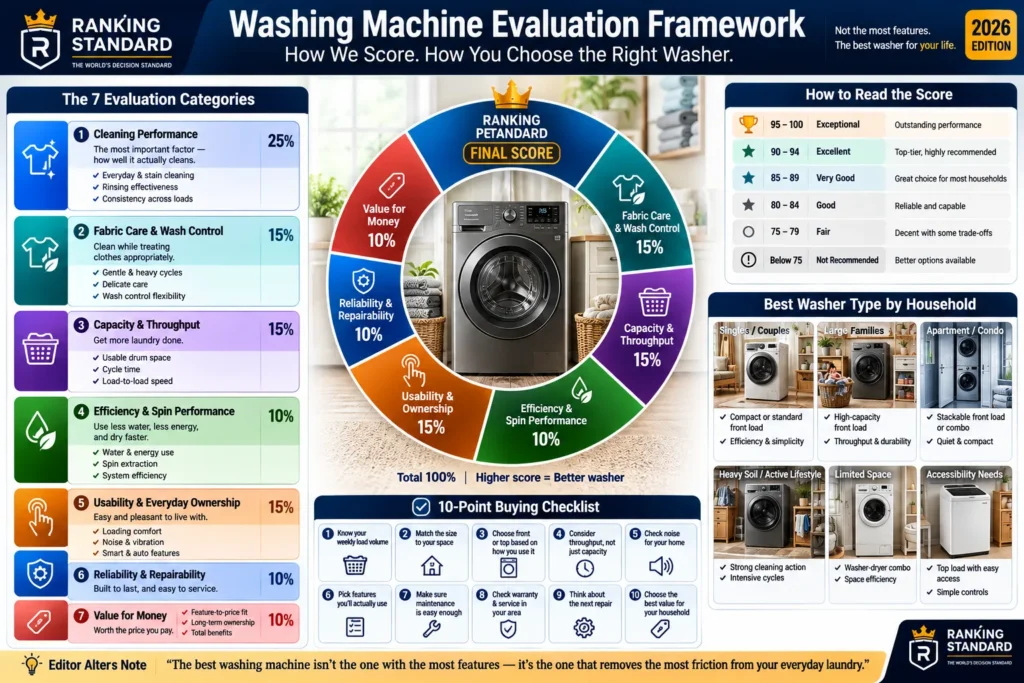
| Evaluation Category | Weight |
|---|---|
| Cleaning Performance | 25% |
| Fabric Care & Wash Control | 15% |
| Capacity & Laundry Throughput | 15% |
| Efficiency & Spin Performance | 10% |
| Usability & Everyday Ownership | 15% |
| Reliability, Repairability & Service | 10% |
| Value for Money | 10% |
| Total | 100% |
This creates a consistent baseline.
But it isn’t applied blindly.
The weighting should reflect what each washer is designed to accomplish.
Why We Adjust the Weighting by Buyer
A washing machine recommendation becomes more useful when the evaluation changes with the household.
Large Families
We increase the importance of:
- Capacity
- Throughput
- Reliability
- Spin extraction
- Cycle flexibility
A family processing ten or more loads during a busy week has different priorities from someone doing two.
Apartment and Condo Residents
We place greater emphasis on:
- Dimensions
- Noise
- Vibration
- Installation flexibility
- Stackability
- Usability
A machine that shakes aggressively during high-speed spinning may be much more problematic here than in a detached basement laundry room.
Heavy-Soil Households
For workwear, sports clothing, outdoor activities, or other demanding laundry, we emphasize:
- Cleaning performance
- Wash control
- Rinsing
- Useful intensive cycles
- Durability
Buyers With Limited Space
Compact and all-in-one systems require different priorities.
We increase the importance of:
- Space efficiency
- Installation flexibility
- Process automation
- Capacity relative to size
- Total wash-and-dry time for combo machines
A combo shouldn’t lose simply because it can’t match the throughput of two separate appliances.
It should be judged according to the problem it exists to solve.
Specifications We Refuse to Judge in Isolation
Certain specifications are useful.
They become misleading when treated as rankings by themselves.
Drum Capacity
A larger drum isn’t automatically better if the household never uses it effectively.
Number of Cycles
Twenty-five cycles aren’t automatically better than twelve.
The useful question is how many solve a real laundry need.
Spin RPM
Higher maximum speed can improve extraction, but balance, fabric suitability, and actual cycle behavior matter too.
Smart Features
Wi-Fi doesn’t make clothes cleaner.
Connectivity receives credit when it improves actual ownership.
Steam
Steam can be useful.
Its presence alone does not make a washer premium.
AI Features
An AI label isn’t an evaluation category.
If automated sensing or cycle adjustment produces a measurable or practical benefit, we evaluate that benefit.
We don’t reward the marketing term.
The Feature Frequency Test
Ranking Standard applies a simple test to optional features:
How often will the target buyer realistically use this?
Imagine two premium features.
Feature A saves 30 seconds every time you wash clothes.
Feature B is impressive but gets used twice a year.
For a household washing eight loads each week, Feature A could affect the ownership experience hundreds of times annually.
That’s why features such as automatic detergent dispensing may sometimes deserve more attention than visually impressive specialty modes.
The value of a feature is:
Benefit × Frequency of Use
Not how prominently it appears in an advertisement.
The Laundry Bottleneck Test
We also evaluate where a household’s laundry process slows down.
The bottleneck may be:
- Washer capacity
- Wash-cycle duration
- Spin extraction
- Dryer capacity
- Drying speed
- Folding and handling
- A combo machine completing both processes
Buying a larger washer won’t necessarily solve a dryer bottleneck.
Buying a faster washer may not help if clothes emerge much wetter.
This is why Ranking Standard treats the washer as part of a laundry system.
The best appliance purchase improves the entire workflow.
The Maintenance Friction Test
Maintenance instructions are easy to write.
The better question is whether owners are realistically likely to follow them.
We consider:
- How easily the gasket can be cleaned
- Whether dispensers are accessible
- Whether filters are user-accessible where applicable
- How clearly cleaning cycles are communicated
- Whether moisture management is straightforward
- Whether the machine provides useful maintenance alerts
Maintenance that takes a few simple minutes is very different from maintenance that requires awkward disassembly.
The easier routine care becomes, the more likely it is to happen.
That can influence the ownership experience over years.
The Repair Scenario
Before awarding a strong long-term ownership score, we imagine something less exciting than a new-machine test:
The washer is four years old and something fails. What happens next?
Can the owner identify a service provider?
Can the technician obtain the component?
Is the machine worth repairing?
Is the failed component accessible?
Does the manufacturer still support the model?
Not every answer can be known in advance.
But asking these questions produces a better evaluation than assuming that today’s performance represents the entire ownership experience.
The Biggest Washing Machine Buying Mistakes
Buying the Largest Washer Available
Capacity should solve actual laundry volume.
Unused capacity isn’t automatically valuable.
Assuming Front Load Is Always Better
Front loaders offer important advantages, but accessibility, maintenance habits, space, and personal preference still matter.
Assuming an Agitator Is Outdated
For some households, its characteristics remain useful.
Technology should be judged by results, not age.
Paying for Dozens of Cycles
Most households repeatedly use a relatively small number of programs.
Useful cycles matter more than total cycle count.
Ignoring Noise Until Installation Day
Laundry-room location should influence the purchase.
Buying Smart Features Instead of a Better Washer
Connectivity is secondary to cleaning, usability, and reliability.
Ignoring Dryer Compatibility
The washer is only half of the laundry process.
Forgetting Maintenance
Especially with front loaders, ownership habits matter.
Assuming Brand Reputation Guarantees Reliability
Specific product design, service availability, and model history matter too.
Shopping for the Purchase Day Instead of Year Five
Long-term parts and service can matter more than showroom features.
Who Should Spend More?
Moving into a higher price tier can make sense if your household:
- Washes frequently
- Generates large volumes of laundry
- Needs excellent noise control
- Values automatic detergent dispensing
- Regularly washes specialized fabrics
- Wants advanced automation
- Needs stronger capacity or throughput
- Places significant value on refined controls and usability
For these buyers, a feature used several times every week can justify its cost over years.
Who Probably Doesn’t Need a Premium Washer?
You may not need to spend heavily if you:
- Wash relatively few loads
- Primarily use basic cycles
- Have straightforward laundry needs
- Don’t care about app connectivity
- Have a separate laundry room where noise is less important
- Prefer simple controls
- Don’t need unusually large capacity
A well-designed basic or mid-range washer can be the smarter purchase.
That’s not buying less.
It’s avoiding features that don’t improve your life.
Final Thoughts
A washing machine is easy to underestimate.
It sits in the background of the home and performs essentially the same task week after week.
But that’s exactly why the purchase matters.
A small inconvenience repeated once may be irrelevant.
Repeated across hundreds of loads, it becomes part of everyday life.
The right washing machine should fit the household’s laundry volume, physical space, accessibility needs, workflow, maintenance habits, and budget.
Only then should brand and model enter the decision.
A large family may need capacity and throughput.
An apartment resident may need quiet operation and compact dimensions.
Another buyer may simply want a straightforward top loader that’s comfortable to use and easy to understand.
All three can make excellent purchases.
They just shouldn’t buy the same machine for the same reasons.
Editor Alter’s Note
Washing machines are a perfect example of how specifications can distract us from the actual buying decision.
A showroom encourages comparison:
5.0 cubic feet versus 5.5.
Twelve cycles versus twenty-four.
Standard dispensing versus automatic dispensing.
Connected versus non-connected.
But five years after purchase, those aren’t necessarily the things an owner remembers.
They remember whether clothes came out clean.
Whether the machine shook the floor.
Whether the door gasket became annoying to maintain.
Whether they could fit the family’s bedding.
Whether Saturday laundry took all day.
And whether someone could repair the washer when something eventually went wrong.
That’s why Ranking Standard doesn’t ask which washing machine has the most.
We ask:
Which machine removes the most friction from the way this household actually does laundry?
The specification sheet describes the appliance.
The standard should describe what it’s like to live with it.