

The best carry-on luggage isn’t necessarily the biggest suitcase you can squeeze into an overhead bin.
It isn’t necessarily the lightest.
And it certainly isn’t automatically the most expensive.
A great carry-on solves a more complicated equation:
It gives you enough usable packing space while remaining easy to move, durable enough for the way you travel, and compatible with the airlines you actually fly.
That last point changes everything.
Unlike ordinary luggage, a carry-on operates inside a physical constraint.
Make it larger and you may gain packing capacity.
Make it too large and it may no longer qualify as cabin baggage for your flight.
Add thicker construction, larger wheels, stronger handles, and more internal organization and the suitcase may become better built—but heavier and potentially less space-efficient.
That’s why buying carry-on luggage is fundamentally a trade-off decision.
The goal isn’t maximum everything.
It’s finding the right balance.
Why Carry-On Luggage Is Surprisingly Difficult to Compare
Suitcases look simple.
A box.
A handle.
Four wheels.
A zipper.
But nearly every part of that design affects another part.
Consider wheels.
Larger, robust wheels can improve maneuverability.
But wheels occupy part of the suitcase’s overall dimensions.
Consider a rigid shell.
It can protect the contents and provide structure.
But some shell designs offer less flexibility when you’re trying to squeeze in one final item.
Consider an expandable suitcase.
Expansion creates additional capacity.
But using that expansion may change the exterior dimensions enough to affect whether the bag still meets a particular airline’s carry-on requirements.
Even weight creates a trade-off.
A heavier suitcase may feel exceptionally substantial and durable.
But if your airline imposes a cabin-baggage weight limit, every pound of suitcase is one less pound available for your belongings.
Specifications can’t be evaluated independently.
A carry-on is a system operating inside a size—and sometimes weight—limit.
Start With How You Fly
Most luggage guides begin with brands.
Ranking Standard begins with your trips.
Ask yourself:
- Which airlines do I fly most often?
- Domestic or international?
- Full-service or low-cost carriers?
- How long are my typical trips?
- Do I usually check another bag?
- Do I travel for business or leisure?
- How much do I pack?
- Do I regularly use trains or public transportation?
- Do I need to carry the suitcase up stairs?
These questions matter because there is no universal carry-on specification that fits every traveler and every airline.
Cabin-baggage rules can vary between airlines and ticket types, and airlines can change their policies.
Some emphasize exterior dimensions.
Some impose meaningful weight restrictions.
Personal-item allowances can also differ.
Before buying luggage specifically for a particular carrier or route, verify the airline’s current baggage policy directly.
That leads to our first rule:
Buy for the airlines you actually fly—not for an imaginary universal carry-on standard.
The Major Types of Carry-On Luggage
Once you understand how you travel, the market becomes easier to navigate.
Hard-Shell Carry-Ons
Hard-shell luggage has become extremely popular.
Common materials include various plastics and composites, with polycarbonate frequently appearing in higher-quality consumer luggage.
Why Travelers Choose Hard Shell
Potential advantages include:
- Structured protection
- Easy-to-clean exterior surfaces
- Modern appearance
- Good resistance to certain impacts
- Less tendency to bulge unpredictably
Hard shells can be particularly attractive for travelers carrying items that benefit from a more structured case.
But rigidity creates trade-offs.
You can’t always squeeze a rigid suitcase into an awkward space the way you might with a softer bag.
Surface scratches can also become visible depending on the material and finish.
A hard shell isn’t inherently better.
It’s a different solution.
Softside Carry-Ons
Softside luggage remains extremely practical.
These bags typically use woven textile exteriors and may provide exterior pockets that hard-shell cases often lack.
Why Travelers Choose Softside
Potential advantages include:
- Exterior organization
- Flexible packing
- Easier access to travel documents or electronics
- Some ability to accommodate irregularly shaped contents
- Familiar luggage design
For business travelers who frequently need quick access to documents, chargers, or a laptop, exterior pockets can be extremely useful.
The trade-off is structure.
Softside luggage may offer less rigid protection, and overpacking can cause the bag to bulge beyond its intended dimensions.
Again, neither construction wins universally.
Two Wheels vs. Four Wheels
Wheel configuration dramatically changes how luggage moves.
Two-Wheel Rollaboards
Traditional two-wheel luggage is pulled behind the traveler.
Because the wheels are typically more recessed into the bag’s structure, the design can offer certain advantages in durability and usable internal geometry.
Two-wheel bags can also perform well on:
- Uneven pavement
- Curbs
- Rougher surfaces
This is one reason traditional rollaboards have remained popular among some frequent travelers.
But they must generally be tilted and pulled.
That puts more of the bag’s weight into the traveler’s arm.
Four-Wheel Spinners
Spinner luggage can roll upright in multiple directions.
This makes it extremely convenient in:
- Airports
- Hotel corridors
- Smooth train stations
- Security lines
- Tight indoor spaces
You can push the bag beside you rather than constantly pulling it behind you.
The trade-off is that external spinner wheels contribute to the suitcase’s overall dimensions and can be more exposed to impacts.
For many travelers, the maneuverability advantage easily outweighs that compromise.
For others, particularly those frequently navigating rough streets, a robust two-wheel design may still make more sense.
The Hidden Problem With Carry-On Dimensions
A luggage listing may provide dimensions for the body of the suitcase.
An airline cares about the entire bag.
That can include:
- Wheels
- Handles
- Exterior structures
- Side components
This distinction matters.
A suitcase with an impressively large interior may achieve that capacity partly by pushing its external dimensions close to—or beyond—the limits accepted by some airlines.
That’s why Ranking Standard considers external dimensions and usable internal capacity together.
Neither number tells the whole story by itself.
Bigger Isn’t Always More Efficient
Imagine two carry-ons with similar exterior dimensions.
Suitcase A has:
- Thick shell construction
- Large wheel housings
- Bulky internal handle channels
- Extensive dividers
Suitcase B has:
- Efficient shell geometry
- Compact wheel integration
- Slim internal structures
- Simple organization
Suitcase A might look more premium.
Suitcase B might actually hold more.
This leads to an important Ranking Standard concept:
Packing Efficiency
We define it conceptually as:
Useful Packing Space ÷ External Luggage Footprint
We’re not pretending every suitcase manufacturer provides enough standardized information to calculate a perfect universal ratio.
The concept matters because it forces us to ask a better question.
Not:
How big is this suitcase?
But:
How efficiently does it use the space it’s allowed to occupy?
Weight Matters More for Some Travelers Than Others
In markets where carry-on weight limits are generous or not routinely restrictive, suitcase weight may feel secondary.
On routes or airlines with stricter cabin-baggage weight policies, it can become one of the most important specifications.
Imagine two suitcases.
One weighs several pounds more before you’ve packed anything.
That additional weight might buy:
- Stronger construction
- More organization
- Larger wheels
- More robust handles
Those improvements may be worthwhile.
But the traveler pays for them with reduced packing allowance where weight limits apply.
That’s why “lighter is better” is also too simplistic.
The correct question is:
What am I giving up to save weight—and does my travel style benefit from the trade?
International Travel Changes the Decision
The phrase international carry-on can be misleading.
There isn’t one worldwide cabin-baggage standard.
Different carriers can have different dimension and weight policies.
A suitcase designed primarily around common U.S. domestic expectations may not be the ideal choice for someone regularly flying a mix of European, Asian, and low-cost carriers.
Frequent international travelers should therefore place greater emphasis on:
- Conservative exterior dimensions
- Low empty weight
- Efficient packing
- Strong wheels
- Easy maneuverability
- Airline-policy awareness
Maximum capacity becomes less useful if it regularly creates uncertainty at the gate.
Low-Cost Airlines Change It Even More
Low-cost carriers often make baggage selection particularly important because allowances can depend heavily on the fare purchased.
A bag that one airline accepts as standard cabin baggage may require an additional fee under another carrier’s policy.
That means travelers who frequently use budget airlines should resist buying luggage around a single maximum-size claim.
Flexibility can be more valuable.
A slightly smaller, lighter suitcase may sacrifice some capacity while providing greater compatibility across the routes you actually travel.
That’s a trade worth considering.
Trip Length Isn’t the Same as Required Capacity
A seven-day traveler doesn’t automatically need more luggage than a three-day traveler.
Packing style matters.
One traveler might pack:
- Seven outfits
- Multiple pairs of shoes
- Toiletries
- Backup clothing
Another may pack:
- Three interchangeable outfits
- One pair of shoes
- Minimal toiletries
- Laundry supplies
The second traveler may comfortably use a smaller carry-on for a longer trip.
So instead of asking:
How many days is this suitcase good for?
Ask:
How do I pack for those days?
That’s a much more useful buying variable.
Business Travelers Have Different Priorities
Business travel can shift the ranking criteria considerably.
A business traveler may care more about:
- Professional appearance
- Quick laptop access
- Document organization
- Smooth wheels
- Stable handles
- Easy overhead-bin handling
- Wrinkle management
- Reliability over frequent trips
A leisure traveler taking three flights per year may reasonably prioritize price and packing capacity instead.
Neither traveler needs the same “best carry-on.”
Frequent Travelers Should Think in Trips, Not Years
A suitcase used four times per year and a suitcase used eighty times per year live very different lives.
Both may be owned for five years.
That doesn’t mean they’ve experienced comparable wear.
Frequent travelers repeatedly stress:
- Wheels
- Telescoping handles
- Zippers
- Grab handles
- Corners
- Shells or fabric
- Interior compression systems
For these buyers, durability improvements can justify substantially higher prices.
Occasional travelers may receive little benefit from paying for the same level of construction.
This is why Ranking Standard evaluates durability against travel frequency, not simply calendar age.
Wheels Are a Wear Component
Wheel quality deserves more attention than it receives.
A beautiful suitcase with poor wheels can become miserable to own.
We consider:
- Smoothness
- Stability
- Wheel size
- Mounting
- Noise
- Performance on imperfect surfaces
- Replaceability where applicable
Frequent travelers should pay particular attention to whether damaged wheels can be serviced or replaced.
A suitcase shouldn’t necessarily become disposable because one wheel fails.
The Telescoping Handle Is More Important Than It Looks
You’ll interact with the handle constantly.
A good telescoping handle should feel:
- Stable
- Comfortable
- Appropriately positioned
- Easy to extend
- Easy to retract
Excessive wobble may be annoying, although some movement can be inherent in telescoping designs.
Handle geometry also affects the interior because the rails typically occupy space inside the suitcase.
That means handle design influences both ergonomics and packing efficiency.
Again, everything is connected.
Expansion Is Useful—Until It Isn’t
Expandable luggage can be extremely convenient.
Perhaps you buy something during the trip.
Perhaps your return packing is less organized.
Open the expansion zipper and gain additional room.
But remember the constraint.
Expanding the bag changes its exterior depth.
That may affect cabin compatibility.
Expansion is therefore best treated as:
Optional flexibility, not guaranteed carry-on capacity.
If you plan to fly with the suitcase expanded, verify the resulting dimensions against the current baggage rules for your flight.
Compression Can Be More Valuable Than Expansion
Internal compression systems attempt to control the contents rather than enlarge the suitcase.
Depending on the design, they may:
- Reduce clothing bulk
- Keep contents organized
- Stabilize the load
- Make closing easier
A good compression system can increase practical packing efficiency without changing the exterior dimensions.
But complicated dividers and panels also occupy space.
The best system provides meaningful compression without turning packing into an engineering project.
Durability Is More Than Shell Strength
Luggage durability is often reduced to the exterior material.
That’s incomplete.
A carry-on is a collection of failure points.
We consider:
- Wheels
- Wheel mounts
- Telescoping handle
- Carry handles
- Zippers
- Latches
- Corners
- Seams
- Shell or fabric
- Interior hardware
A virtually indestructible shell doesn’t help much if the handle fails.
Ranking Standard evaluates system durability, not just material toughness.
Warranty Isn’t the Same as Repairability
A long warranty sounds reassuring.
Read what it actually covers.
Luggage warranties can differ significantly in their treatment of:
- Manufacturing defects
- Normal wear
- Airline damage
- Wheels
- Handles
- Zippers
- Cosmetic damage
Service logistics matter too.
Can replacement components be obtained?
Does the entire suitcase need to be shipped somewhere?
Is there a repair network?
Does the manufacturer provide practical support?
A warranty has value only when it can realistically solve a problem.
The Ranking Standard Philosophy
Most luggage rankings begin with:
Here are the ten best carry-ons.
We begin somewhere else.
First:
How do you travel?
Then:
Which airlines do you use?
Then:
How much do you pack?
Then:
How important are weight, capacity, maneuverability, durability, and organization to you?
Only then should you compare brands.
That changes the buying question from:
Away vs. Travelpro vs. Samsonite?
to:
What kind of carry-on best fits the way I actually travel?
Once you’ve answered that question, brand comparisons become dramatically easier.
What You’ll Learn
In the rest of this guide, we’ll examine:
- Hard shell vs. softside in practical terms
- Two wheels vs. four-wheel spinners
- How to evaluate carry-on dimensions
- Why empty suitcase weight matters
- How to think about usable packing capacity
- Which travelers benefit from expansion
- What makes wheels and handles durable
- Whether premium luggage is worth paying for
- How warranties and repairability should affect the decision
- How Ranking Standard evaluates carry-on luggage
By the end, you shouldn’t simply know which luggage brands are popular.
You should understand what kind of carry-on belongs on your trips and why.
That’s the decision that matters.
Understanding Carry-On Design Before Choosing a Brand
Once you know how you travel, the next step is understanding what makes one carry-on meaningfully different from another.
This is where luggage marketing can become distracting.
A premium shell.
Eight wheels.
Aircraft-grade aluminum.
Compression panels.
TSA-compatible locks.
Lifetime warranties.
Some of these things can improve ownership.
Others may matter very little for the way you travel.
The goal isn’t to buy the suitcase with the longest feature list.
It’s to understand where good luggage engineering actually improves a trip.
Step 1: Begin With Airline Compatibility
Before comparing materials, wheels, or colors, establish the physical envelope your suitcase needs to fit within.
Carry-on policies vary by airline, route, fare, and sometimes aircraft.
That means Ranking Standard does not define one universal measurement as “the correct carry-on size.”
Instead, use a three-step process.
Identify Your Most Frequently Used Airlines
Start with the carriers that account for most of your travel.
Check Their Current Published Requirements
Verify both:
- Exterior size restrictions
- Weight restrictions where applicable
Use the airline’s current information rather than relying exclusively on luggage marketing.
Buy Around the Most Restrictive Rules That Matter to You
If you regularly fly several carriers, a suitcase designed around the most generous allowance may create problems on the more restrictive ones.
The objective isn’t to buy the largest suitcase theoretically accepted somewhere.
It’s to maximize useful capacity inside the constraints you actually encounter.
Step 2: Measure the Entire Suitcase
When evaluating dimensions, pay attention to whether the measurement includes:
- Wheels
- Top handle
- Side handles
- Feet
- Exterior pockets
- Other protruding structures
A bag’s body dimensions and its total external dimensions aren’t necessarily the same thing.
For cabin baggage, total dimensions are what matter.
This is particularly important with spinner luggage because externally mounted wheels contribute to overall height.
Before buying, look for manufacturer measurements that clearly describe the complete exterior.
If the information is ambiguous, don’t assume.
Step 3: Think in Packing Efficiency
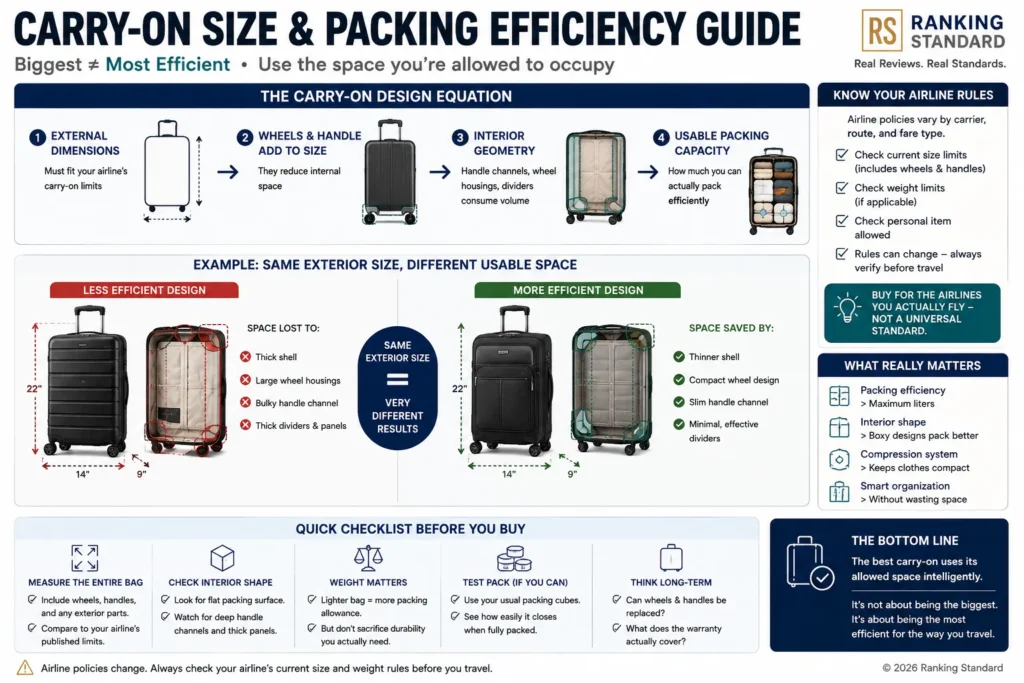
A carry-on exists inside a limited external footprint.
That makes efficient use of space unusually important.
Ranking Standard evaluates this through the concept of Packing Efficiency.
Conceptually:
Packing Efficiency = Useful Interior Space ÷ External Footprint
This isn’t intended as a universal laboratory formula.
It’s a decision tool.
Two suitcases can occupy almost the same external space while offering different usable interiors because of:
- Shell thickness
- Wheel architecture
- Handle channels
- Internal dividers
- Compression hardware
- Pocket construction
- Frame design
The best-designed carry-on uses its permitted exterior volume intelligently.
Step 4: Check the Handle Intrusion
Telescoping handles need rails.
Those rails often run down the back of the suitcase.
Inside, they can create raised channels that reduce the flatness of the packing surface.
That may not sound important until you’re trying to pack:
- Shoes
- Packing cubes
- Folded shirts
- Electronics
- Rectangular cases
Some manufacturers design the interior around these channels more effectively than others.
This is another reason quoted capacity alone doesn’t tell you how easily a suitcase packs.
Interior geometry matters.
Step 5: Hard Shell vs. Softside Is Really Structure vs. Flexibility
Instead of treating this as a fashion choice, think about what each architecture gives you.
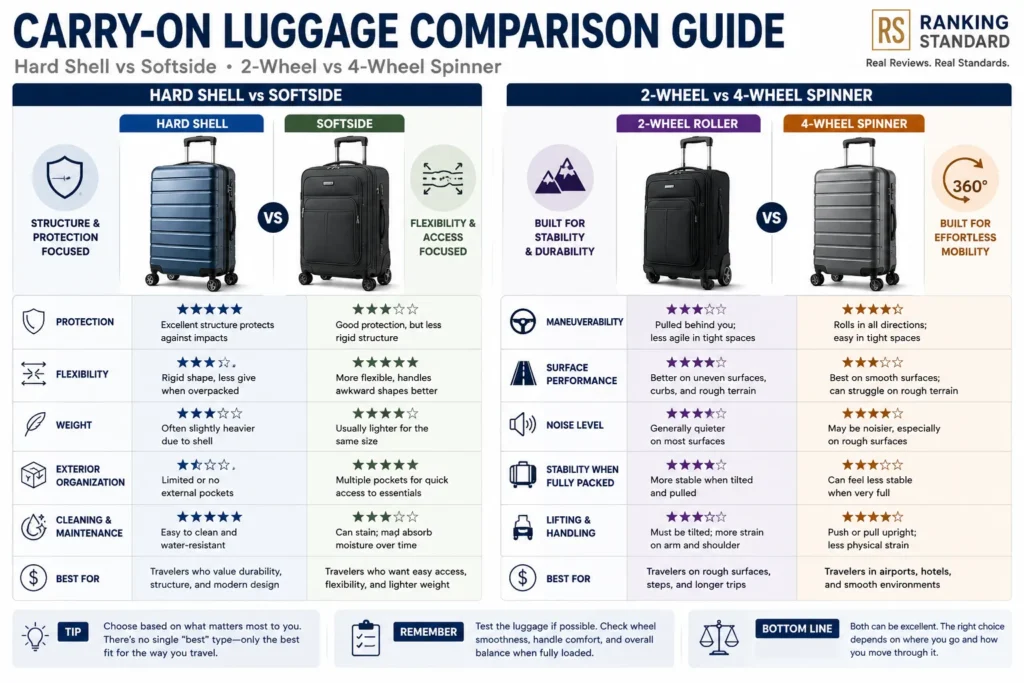
Choose Hard Shell When You Value:
- Structured protection
- A rigid packing shape
- Easy exterior cleaning
- A clean, modern design
- Less uncontrolled bulging
Choose Softside When You Value:
- Exterior pockets
- Flexible packing
- Quick access
- Some give in the exterior
- Traditional rollaboard designs
But there are exceptions within both categories.
A poorly constructed hard shell isn’t automatically more durable than a well-made softside bag.
A softside suitcase isn’t automatically lighter.
The category gives you tendencies.
The individual design determines the result.
Step 6: Understand Common Hard-Shell Materials
Hard luggage can be made from different materials and blends.
Instead of assuming one material name guarantees quality, consider what the material is trying to accomplish.
Polycarbonate
Commonly used because it can combine relatively low weight with impact resistance and some flexibility.
It’s widely found in quality consumer luggage.
Polypropylene
Can offer good impact resistance and relatively low weight depending on the design.
ABS
Frequently appears in lower-priced luggage.
It can provide a rigid shell at an accessible cost, although material quality and construction vary considerably.
Aluminum
Aluminum luggage occupies a specialized premium segment.
It can provide:
- Exceptional structural rigidity
- Distinctive appearance
- Strong frame construction
But it usually brings significant trade-offs:
- Higher weight
- Higher price
- Visible dents and marks
- Less forgiving structure
Aluminum isn’t simply “better hard-shell luggage.”
It’s a particular solution for buyers who value its construction and character enough to accept the compromises.
Step 7: Don’t Rank Materials Without Looking at Construction
A material label doesn’t tell you:
- How thick the shell is
- How the corners are reinforced
- How the wheels are attached
- How the handles are mounted
- How the case flexes under impact
- How well the zipper or frame is integrated
That’s why Ranking Standard avoids simplistic rules such as:
Polycarbonate = good. ABS = bad.
Material matters.
Engineering matters more.
Step 8: Zippered vs. Zipperless Luggage
Most carry-ons use zippers.
Some premium hard cases use rigid frames and latches instead.
Zippered Designs
Potential advantages include:
- Lower weight
- Flexible closure
- Expansion capability on some models
- Wide availability
Potential weaknesses depend heavily on zipper quality, stitching, and construction.
Latch / Frame Designs
Potential advantages may include:
- Structured closure
- No conventional zipper as a failure point
- Strong premium feel
Trade-offs can include:
- Additional weight
- Higher price
- Less packing flexibility
- No conventional expansion
A latch isn’t automatically more durable than every zipper.
Evaluate the complete construction.
Step 9: Four Wheels Doesn’t Mean Eight-Wheel Performance
Many spinner suitcases use double-wheel assemblies at each corner.
Marketing may describe these as eight-wheel systems.
The count isn’t particularly useful by itself.
What matters is:
- Bearing quality
- Wheel diameter
- Stability
- Alignment
- Mounting strength
- Rotation
- Noise
- Surface performance
A beautifully smooth suitcase on polished airport flooring may behave differently on:
- Sidewalk seams
- Cobblestones
- Train platforms
- Hotel carpeting
The more varied your travel environment, the more important real-world wheel behavior becomes.
Step 10: Wheel Replaceability Can Change Long-Term Value
Wheels experience enormous wear.
They’re also exposed components.
For frequent travelers, we give additional credit when manufacturers make wheel repair or replacement realistically possible.
Why?
Because throwing away an otherwise functional suitcase because of one damaged wheel is poor ownership economics.
When evaluating premium luggage, investigate whether:
- Replacement wheels exist
- Parts can be ordered
- Repair centers are available
- The warranty addresses wheel failures
Repairability is sustainability and value at the same time.
Step 11: Test the Telescoping Handle at Multiple Heights
Handle comfort isn’t only about wobble.
Travelers have different heights and walking styles.
A useful telescoping system should provide a comfortable pulling or pushing position without forcing awkward wrist or shoulder angles.
Look at:
- Extension height
- Intermediate locking positions
- Grip comfort
- Button placement
- Stability
- Smooth operation
Frequent travelers may extend and retract the handle dozens of times during a single trip.
A small ergonomic problem becomes much larger through repetition.
Step 12: Carry Handles Matter Too
At some point, even the best spinner has to be lifted.
Into an overhead bin.
Up stairs.
Onto a train.
Into a car.
That makes top and side grab handles important.
Evaluate:
- Grip comfort
- Handle placement
- Flex
- Attachment strength
- Clearance for your hand
A suitcase can roll beautifully and still be unpleasant to lift.
Step 13: Empty Weight Is Part of Your Packing Allowance
When an airline imposes a cabin-baggage weight limit, suitcase weight becomes part of the packing equation.
Conceptually:
Available Packing Weight = Airline Allowance − Empty Suitcase Weight
Again, the applicable allowance depends on the airline and fare.
But the principle is universal.
Every additional pound of suitcase structure is weight that cannot be used for clothing, electronics, or other belongings under a strict total limit.
That doesn’t mean you should always buy the lightest suitcase.
Extremely low weight may involve compromises in:
- Structure
- Wheels
- Handles
- Interior organization
- Materials
The goal is weight efficiency, not minimum weight at any cost.
Step 14: Capacity Claims Need Context
Manufacturers may advertise internal capacity in liters.
That’s useful when measured consistently.
Unfortunately, luggage capacity measurements aren’t always standardized in a way that makes cross-brand comparisons perfect.
So use liters as one input rather than an unquestionable ranking.
Also inspect:
- Interior shape
- Wheel intrusion
- Handle channels
- Divider thickness
- Compression hardware
- Pocket placement
A nominally smaller bag with efficient geometry can sometimes be easier to pack than a supposedly larger one.
Step 15: Compression Systems Should Create Space, Not Complexity
Internal compression can be genuinely valuable.
Good systems help:
- Stabilize clothing
- Reduce bulk
- Keep items organized
- Make closing easier
But elaborate compression panels can themselves occupy volume and add weight.
The ideal system is easy to use and produces a noticeable benefit.
If you need several minutes to engineer the compression mechanism every time you pack, the design may have crossed from useful into cumbersome.
Step 16: Interior Organization Depends on Your Packing Style
There are two broad approaches.
Built-In Organization
Multiple pockets, dividers, laundry compartments, shoe sections, and compression panels.
Best for travelers who like the suitcase to organize everything.
Open Interior
A relatively simple packing cavity.
Best for travelers who use:
- Packing cubes
- Separate toiletry bags
- Tech organizers
- Their own modular system
Neither is better.
If you already use packing cubes, paying for elaborate fixed organization may actually reduce flexibility.
Don’t pay twice for organization.
Step 17: Expansion Is a Backup Plan
Expansion can be extremely useful on the return journey.
But there are two questions.
Does Expansion Affect Airline Compatibility?
Often it increases external depth.
Check before assuming the expanded bag remains cabin-compatible.
Does Expansion Affect Stability?
Moving additional contents outward can change how the suitcase balances.
A heavily expanded spinner may become more prone to tipping.
Expansion should therefore be viewed as contingency capacity, not free permanent capacity.
Step 18: Laptop Compartments Change the Equation
Some carry-ons include dedicated laptop compartments.
For business travelers, this can eliminate the need to open the main suitcase at airport security or during a trip.
But laptop compartments require space.
On hard-shell luggage especially, an external laptop section can add:
- Thickness
- Structure
- Hinges or zippers
- Internal intrusion
If you already carry a separate personal-item backpack with your laptop, the feature may be redundant.
If the suitcase is your primary business bag, it may be extremely valuable.
Evaluate it as part of your total luggage system, not in isolation.
Step 19: Security Features Should Stay in Perspective
Integrated locks are common on modern luggage.
They can provide useful convenience and discourage casual access.
But luggage locks shouldn’t create a false sense of security.
A suitcase is not a safe.
Security decisions should also include:
- Keeping valuables in appropriate personal possession
- Following airline security requirements
- Protecting important documents
- Using tracking where appropriate
An integrated lock is a useful feature.
It isn’t a reason by itself to choose one suitcase over a substantially better design.
Step 20: Color Can Be a Practical Feature
Color sounds cosmetic.
Sometimes it is.
But distinctive luggage can be easier to identify:
- In crowded storage areas
- At hotels
- On trains
- If the bag unexpectedly has to be checked
Very light finishes may show dirt more readily.
Highly polished hard shells may show scratches differently from textured surfaces.
Appearance is subjective.
Ease of identification isn’t.
Step 21: What Should You Spend?
Carry-on prices vary enormously.
Instead of using rigid price boundaries that will age quickly, Ranking Standard focuses on what additional spending should deliver.
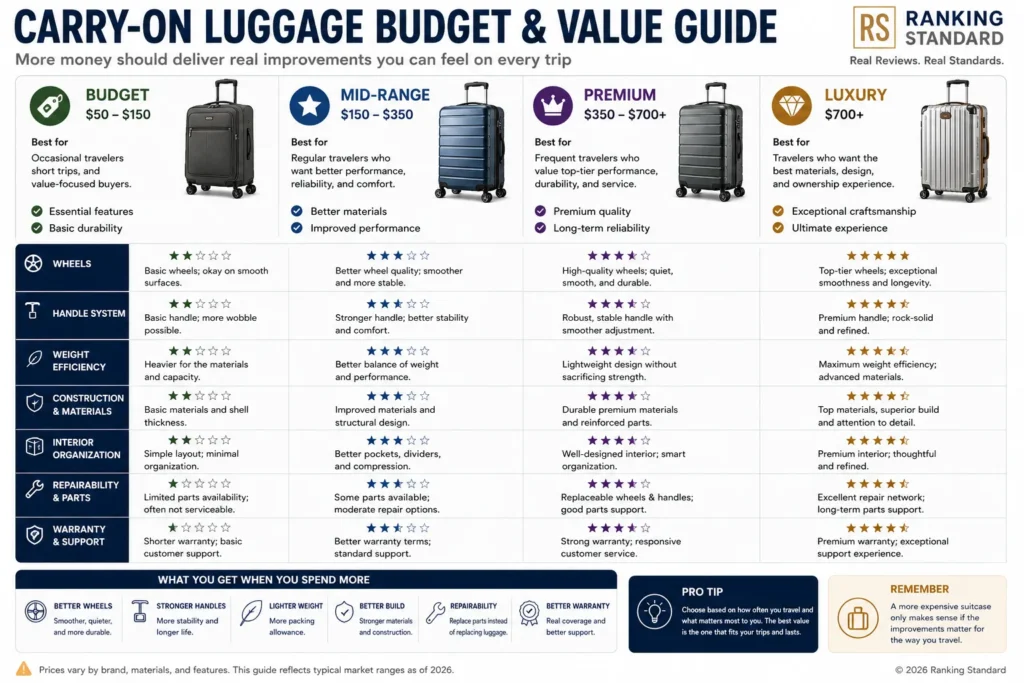
Budget Segment
A good budget carry-on should provide:
- Functional wheels
- A usable handle
- Reasonable construction
- Practical interior space
- Reliable closure
Common compromises may include:
- Simpler materials
- Less refined wheels
- More basic handles
- Limited parts support
- Shorter or more restrictive warranties
For occasional travelers, that may be perfectly acceptable.
Mid-Range Segment
This is where many travelers can find the best balance.
Additional spending should begin improving:
- Wheel quality
- Handle refinement
- Materials
- Weight
- Interior design
- Compression
- Warranty support
- Overall construction
For someone traveling several times each year, these improvements can be noticeable.
Premium Segment
Premium luggage should deliver more than branding.
We expect meaningful improvements in areas such as:
- Wheel smoothness and durability
- Handle engineering
- Weight efficiency
- Shell or fabric quality
- Interior construction
- Repairability
- Warranty execution
- Long-term parts availability
The product should feel better not only in the showroom but after dozens of trips.
Luxury Segment
Luxury luggage may add:
- Specialized materials
- Aluminum construction
- Distinctive design
- Exceptional finishing
- Brand heritage
- Prestige
Those qualities can have legitimate value to the buyer.
But Ranking Standard separates functional value from luxury value.
A suitcase can be more desirable without being more practical.
Buyers deserve to know the difference.
Step 22: Calculate Cost per Trip
Luggage is a category where purchase price can be misleading.
Consider:
Traveler A
Buys a $120 carry-on and uses it six times over five years.
Traveler B
Buys a $400 carry-on and uses it 150 times over five years.
Traveler B paid much more initially.
But the suitcase’s cost relative to usage may be far lower.
Conceptually:
Cost per Trip = Purchase Price ÷ Number of Trips
Repairs and replacement can be incorporated into the ownership calculation when relevant.
This doesn’t prove expensive luggage is always better.
It explains why travel frequency should influence how much durability is worth paying for.
Step 23: Warranty Quality Is More Important Than Warranty Length
“Lifetime warranty” sounds powerful.
It tells you very little without the terms.
Ask:
- What failures are covered?
- Is normal wear excluded?
- Is airline damage covered?
- Are wheels included?
- Are handles included?
- Who pays shipping?
- Is proof of purchase required?
- Is repair available locally?
- Will the manufacturer replace parts?
A shorter warranty with straightforward service can sometimes be more valuable than an impressive-sounding lifetime promise filled with exclusions.
Read the warranty as a service system, not a marketing number.
Step 24: Airline Damage Changes the Warranty Question
Even carry-on luggage isn’t guaranteed to remain in your hands.
Overhead bins can fill.
Flights can change.
Some bags may need to be gate-checked.
That exposes carry-ons to handling conditions more similar to checked luggage.
For frequent travelers, it’s therefore worth understanding how a manufacturer’s warranty treats carrier-related damage.
Airline responsibility and luggage warranty coverage are separate issues and can vary.
Don’t assume either automatically covers every type of damage.
Step 25: Repairability Should Influence Premium Purchases
If you’re spending substantially more on luggage, we expect a stronger ownership ecosystem.
Ideally, a premium suitcase shouldn’t become disposable because of:
- One wheel
- One handle
- One zipper pull
- One latch
We therefore look for:
- Replaceable components
- Parts availability
- Repair programs
- Clear warranty procedures
- Long-term manufacturer support
A durable product isn’t merely one that resists failure.
It’s one that can recover from failure.
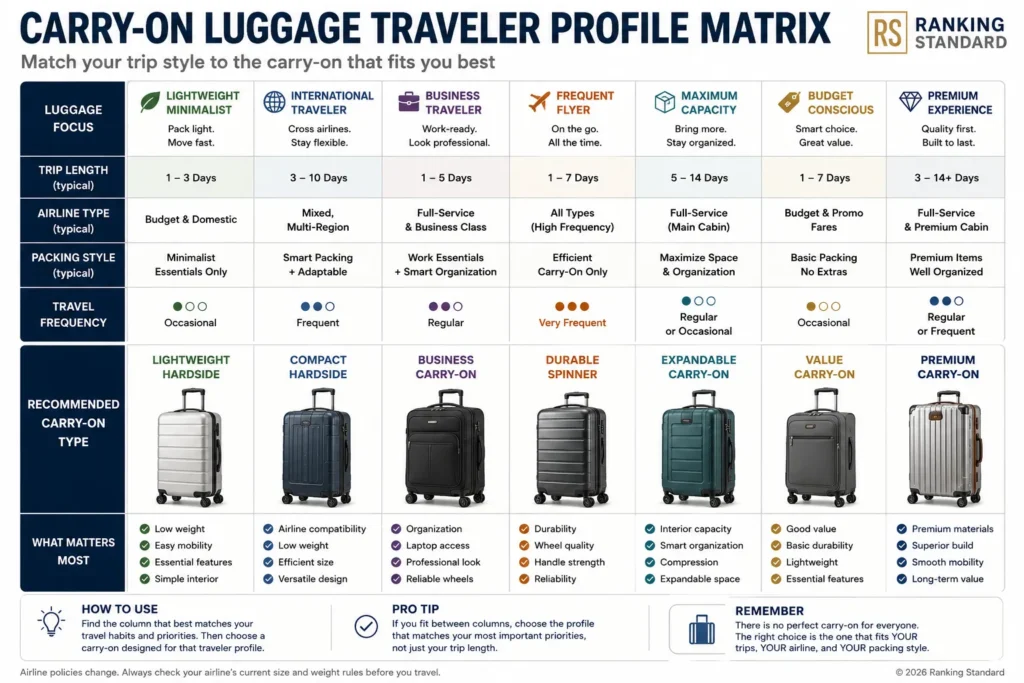
The Ranking Standard Traveler Profile Matrix
Before comparing brands, identify the traveler you most closely resemble.
| Traveler Profile | Prioritize | Usually Less Important |
|---|---|---|
| Occasional traveler | Value, simplicity, adequate durability | Premium repair ecosystem |
| Frequent flyer | Wheels, handle, durability, repairability | Decorative extras |
| International traveler | Conservative dimensions, low weight, efficiency | Maximum exterior size |
| Budget-airline traveler | Airline compatibility, weight, compact dimensions | Maximum packing capacity |
| Business traveler | Maneuverability, organization, reliability, professional design | Extreme expansion |
| Train-heavy traveler | Weight, lifting comfort, wheel durability, compact size | Oversized capacity |
| Packing-cube user | Open interior, compression, efficient geometry | Extensive fixed pockets |
| Heavy packer | Packing efficiency, compression, strong closure | Minimalist interior |
| Luxury buyer | Materials, construction, design, service | Lowest cost |
The purpose of this matrix isn’t to put travelers into permanent boxes.
It’s to identify which trade-offs should receive the most weight.
The Carry-On Compatibility Test
Before a suitcase becomes eligible for a strong Ranking Standard recommendation, we ask four questions.
1. Does It Fit the Intended Airline Environment?
Not every airline in the world.
The airlines relevant to the target traveler.
2. Is Its Empty Weight Appropriate?
Particularly where cabin weight limits matter.
3. Does It Use Its External Footprint Efficiently?
We’re looking for usable space, not merely external bulk.
4. Is It Still Practical When Fully Packed?
A suitcase can behave very differently when loaded.
Handles flex.
Wheels experience more stress.
Balance changes.
Expansion can affect stability.
A good carry-on has to work as luggage, not as an empty showroom object.
Ranking Standard’s Key Takeaway
Don’t compare carry-ons by asking:
Which suitcase is biggest?
Ask:
- Which airlines do I actually fly?
- What restrictions matter on those trips?
- How much do I realistically pack?
- Do I value structure or flexibility?
- Do I need two wheels or a spinner?
- How important is empty weight?
- How efficiently does the suitcase use its exterior dimensions?
- Do I need built-in organization or do I use packing cubes?
- How often will I travel with it?
- Can the wheels and handles be repaired or replaced?
- What does the warranty actually cover?
- Does the total ownership value justify the price?
Once those questions are answered, comparing brands such as Travelpro, Samsonite, Away, Briggs & Riley, Tumi, Rimowa, Monos, July, and others becomes far more useful.
Brand should be the last filter, not the first.
Part 3 – The Ranking Standard Carry-On Luggage Evaluation Framework
How Ranking Standard Evaluates Carry-On Luggage
Carry-on luggage is easy to rank badly.
A suitcase may feel premium in a store but prove frustrating once fully packed.
Another may be exceptionally light but sacrifice wheel strength or structure.
A third may offer enormous capacity but push so close to common airline limits that travelers constantly worry about whether it will fit.
That’s why Ranking Standard doesn’t ask only:
Which suitcase looks or feels best?
We ask:
Which carry-on delivers the best balance of compatibility, packing efficiency, mobility, durability, and ownership value for the traveler it’s designed to serve?
Our framework uses seven major evaluation categories.
1. Airline Compatibility & Size Efficiency – 20%
A carry-on cannot be evaluated without considering the environment in which it must operate.
We assess:
- Total exterior dimensions
- Whether wheels and handles are included in measurements
- Compatibility with the target travel profile
- Sensitivity to stricter airline policies
- Expansion impact
- Overall footprint efficiency
We do not assume one size standard works everywhere.
Instead, we evaluate whether a suitcase is appropriately designed for the routes and airlines its target buyer is likely to use.
This category also considers how much of the allowed exterior envelope is translated into useful interior volume.
A bag that occupies a large footprint but wastes space internally should not score as highly as one that uses its dimensions efficiently.
2. Packing Efficiency & Interior Design – 20%
Capacity isn’t just liters.
It’s how intelligently the suitcase uses its interior.
We evaluate:
- Usable packing space
- Handle-channel intrusion
- Wheel-housing intrusion
- Compression system effectiveness
- Divider thickness
- Pocket usefulness
- Packing-cube compatibility
- Interior geometry
- Expansion design
A carry-on with a smaller published capacity may still pack better than a larger competitor if the interior is flatter and more usable.
This is why Ranking Standard emphasizes packing efficiency, not merely volume claims.
3. Mobility & Handling – 15%
The suitcase spends a significant part of its life moving.
We evaluate:
- Wheel smoothness
- Wheel stability
- Wheel noise
- Maneuverability
- Performance on imperfect surfaces
- Telescoping-handle comfort
- Handle height
- Handle stability
- Grip ergonomics
- Ease of lifting
A suitcase that rolls perfectly on airport tile but becomes unstable on sidewalks or carpet may not deserve an exceptional mobility score.
For frequent travelers, this category becomes especially important.
4. Weight & Portability – 10%
Empty suitcase weight affects every trip.
It matters most where cabin-weight restrictions are meaningful, but it also affects:
- Lifting into overhead bins
- Stairs
- Train travel
- Public transportation
- General fatigue
We evaluate weight relative to what the suitcase provides.
A slightly heavier bag may still score well if the extra weight buys meaningful durability, structure, or repairability.
A very light bag does not automatically win.
The standard is weight efficiency.
5. Durability & Construction – 15%
Durability is a system-level property.
We evaluate:
- Shell or fabric construction
- Corner protection
- Zipper quality
- Latch quality
- Wheel mounts
- Grab-handle attachment
- Telescoping-handle structure
- Seams
- Interior hardware
- Frame integrity
- Resistance to repeated use
A strong shell with weak wheels is not a durable suitcase.
A good product must remain functional as a complete system.
6. Repairability, Warranty & Ownership – 10%
Luggage takes abuse.
Eventually, a wheel, handle, zipper, latch, or other component may need attention.
We evaluate:
- Warranty clarity
- Coverage scope
- Parts availability
- Wheel replaceability
- Handle replaceability
- Repair programs
- Service logistics
- Shipping burden
- Brand support
- Long-term parts availability
A premium suitcase should not become disposable because of one damaged component.
This category becomes more important as price rises.
7. Value for Money – 10%
Value is not determined by retail price alone.
We consider:
- Functional performance
- Construction quality
- Travel frequency
- Repairability
- Warranty
- Expected lifespan
- Feature usefulness
- Cost per trip
An inexpensive suitcase can offer excellent value for someone traveling twice a year.
A much more expensive suitcase can offer better value for someone flying weekly.
Context matters.
The Ranking Standard Carry-On Score
Our standard weighting is:
| Evaluation Category | Weight |
|---|---|
| Airline Compatibility & Size Efficiency | 20% |
| Packing Efficiency & Interior Design | 20% |
| Mobility & Handling | 15% |
| Weight & Portability | 10% |
| Durability & Construction | 15% |
| Repairability, Warranty & Ownership | 10% |
| Value for Money | 10% |
| Total | 100% |
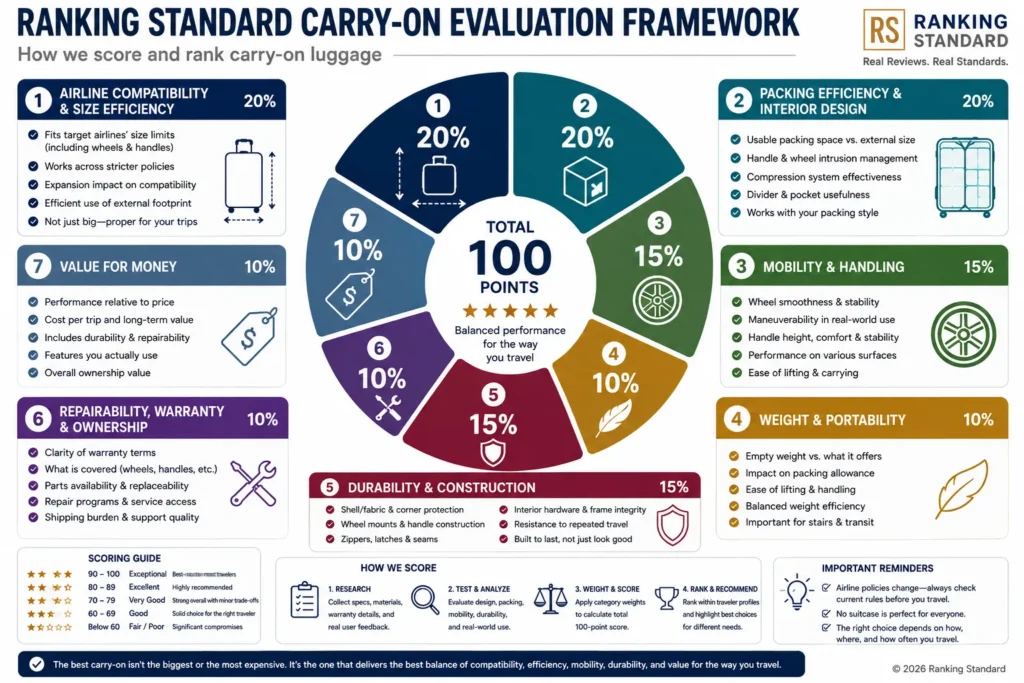
This is our general baseline.
But weighting changes depending on the traveler.
Why Traveler-Specific Weighting Matters
Frequent Flyers
We increase the importance of:
- Durability
- Wheels
- Handle quality
- Repairability
- Warranty execution
A traveler using a suitcase 80 times a year should not evaluate luggage the same way as someone flying twice.
International Travelers
We increase the importance of:
- Exterior dimensions
- Empty weight
- Conservative sizing
- Packing efficiency
- Ease of lifting
Maximum capacity matters less than cross-airline compatibility.
Business Travelers
We emphasize:
- Mobility
- Reliability
- Organization
- Professional design
- Fast access
- Laptop integration where relevant
Budget-Airline Travelers
We place greater emphasis on:
- Weight
- Size compatibility
- Compact dimensions
- Flexibility across fare structures
A suitcase that pushes every limit is less attractive here.
Train-Heavy Travelers
We emphasize:
- Liftability
- Wheel durability
- Compact dimensions
- Handle comfort
- Stability
Smooth airport-floor performance is not enough.
Specifications We Refuse to Rank in Isolation
Certain luggage specifications are useful.
None should determine the recommendation alone.
Liters
Capacity claims may not be perfectly standardized and don’t reveal geometry.
Weight
Lighter isn’t always better if durability suffers.
Number of Wheels
Wheel count doesn’t tell you wheel quality.
Shell Material
Material names don’t reveal overall construction.
Warranty Length
A lifetime warranty can be less useful than a shorter but more practical one.
Expansion
More volume is only useful if the expanded dimensions remain appropriate for your trip.
Price
Expensive doesn’t automatically mean durable, repairable, or efficient.
The Packing Efficiency Test
This is one of the most important Ranking Standard tests for carry-ons.
We compare:
External Footprint → Interior Geometry → Real Packing Result
We examine how much space is lost to:
- Wheel structures
- Handle channels
- Thick dividers
- Compression hardware
- Frame construction
The goal isn’t maximum theoretical capacity.
It’s maximum useful capacity within a practical external envelope.
The Full-Load Mobility Test
Empty luggage can be misleading.
A carry-on may roll beautifully when empty and feel completely different when loaded.
We therefore evaluate handling under realistic packed weight.
We consider:
- Wheel flex
- Tipping
- Handle strain
- Steering
- Balance
- Drag
- Lifting comfort
A suitcase must work as luggage, not as an empty display object.
The Overhead-Bin Test
Carry-on design ultimately has to interact with the aircraft cabin.
We consider:
- Ease of lifting
- Handle placement
- Overall shape
- Exterior protrusions
- Loaded balance
- Ease of maneuvering into storage
A suitcase can technically fit and still be unpleasant to handle overhead.
Good carry-on design considers both compatibility and human ergonomics.
The Expansion Reality Test
Expansion sounds like free capacity.
It isn’t.
We ask:
- How much does expansion change external depth?
- Does the bag become less stable?
- Does it remain easy to close?
- Is it still appropriate for cabin use on the target airline?
Expansion earns credit when it provides useful flexibility without creating disproportionate compromise.
The Wheel Failure Test
For frequent travelers, wheels are one of the most important potential failure points.
We therefore ask:
What happens if one wheel fails?
Can it be replaced?
Can the assembly be serviced?
Can parts be ordered?
Does the warranty help?
A suitcase with replaceable wheels may offer significantly stronger long-term value than one that requires total replacement.
The Handle Failure Test
The same principle applies to telescoping handles.
We evaluate:
- Stability
- Rail construction
- Locking mechanism
- Grip strength
- Replaceability
- Service options
A suitcase with a flawless shell and failed handle is still a failed suitcase.
The Cost-per-Trip Test
For luggage, usage frequency is critical.
Conceptually:
Ownership Cost per Trip = (Purchase Price + Repairs − Residual Value) ÷ Trips Used
This isn’t intended as a perfect accounting formula.
It’s a way to understand why a $500 suitcase may be irrational for one traveler and completely reasonable for another.
If a premium carry-on is used 200 times and remains repairable, the ownership economics can look very different from a cheap bag replaced every two years.
The Five-Year Question
Ranking Standard asks:
Would we still want to own this suitcase after five years of real travel?
That means considering:
- Wheel wear
- Handle wear
- Shell or fabric damage
- Zipper condition
- Repair options
- Parts availability
- Warranty support
- Interior durability
Luggage should improve with familiarity, not become a disposable accessory.
The Biggest Carry-On Buying Mistakes
Buying the Largest Allowed Bag
Airline rules vary.
Maxing out one airline’s allowance can reduce flexibility elsewhere.
Ignoring Empty Weight
Especially important for international or low-cost travel.
Buying by Material Name
Construction matters more than marketing shorthand.
Assuming Four Wheels Are Always Better
Travel surface and use case matter.
Ignoring Wheel Repairability
One damaged wheel shouldn’t necessarily end the suitcase’s life.
Overpaying for Organization You Don’t Use
Packing-cube users may prefer simpler interiors.
Treating Expansion as Permanent Capacity
Expanded dimensions can change compatibility.
Buying a Laptop Compartment You Don’t Need
If your personal item already carries electronics, the feature may waste space.
Believing Warranty Length Equals Warranty Quality
Coverage and execution matter more.
Buying Luxury Instead of Function
Luxury can be valuable.
But buyers should know whether they’re paying for performance or prestige.
Who Should Spend More?
Premium luggage makes the most sense if you:
- Travel frequently
- Fly internationally
- Depend heavily on carry-on-only travel
- Navigate trains and urban environments
- Value smooth mobility
- Want replaceable components
- Care about strong warranty support
- Expect to use the bag for many years
For these travelers, small improvements compound across hundreds of trips.
Who Probably Doesn’t Need Premium Luggage?
You may not need to spend heavily if you:
- Fly only a few times each year
- Mostly travel by car
- Rarely use cabin baggage
- Don’t care about premium materials
- Don’t need sophisticated organization
- Can easily replace the bag if it eventually fails
A well-designed budget or mid-range carry-on can be completely appropriate.
That’s not compromising.
It’s matching investment to usage.
Final Thoughts
Carry-on luggage is one of the clearest examples of why bigger specifications don’t automatically make a better product.
More capacity can hurt compatibility.
More structure can add weight.
More organization can consume interior space.
More wheels don’t guarantee better movement.
A longer warranty doesn’t guarantee better service.
And a higher price doesn’t guarantee a better trip.
The right carry-on balances the constraints that actually matter for you:
Airlines.
Packing.
Weight.
Mobility.
Durability.
Repairability.
Price.
Once those priorities are clear, choosing between brands becomes far simpler.
Editor Alter’s Note
A carry-on is unusual because every design decision competes for the same limited space.
Make the wheels bigger and smoother?
They take up room.
Strengthen the handle?
That structure has to go somewhere.
Add more dividers?
They consume interior volume.
Use heavier materials?
They reduce the weight you can pack where cabin limits apply.
That means the best carry-on can’t maximize everything.
It has to make the right compromises.
A good suitcase doesn’t simply hold your belongings.
It disappears into the trip.
You stop thinking about the wheels.
You stop fighting the handle.
You stop worrying about whether it fits.
You pack, move, lift, arrive, and continue.
That’s the standard.
The best carry-on is the one that creates the least friction between where you are and where you’re going.