
The Ranking Standard Evaluation Methodology
Every Ranking Starts with a Standard
Not every ranking you find online is created the same way.
Some rankings are based on popularity.
Others are influenced by advertising.
Some simply reflect one person’s opinion.
Without understanding how a ranking was created, it’s impossible to know whether you should trust it.
At Ranking Standard, we believe readers deserve more than just a list.
They deserve to understand the standard behind every ranking.
That’s why every article begins with the same principle:
Explain the evaluation standards before presenting the rankings.
Our Editorial Philosophy
Every product category is different.
A luxury watch shouldn’t be evaluated the same way as a smartphone.
A running shoe shouldn’t be judged like a kitchen appliance.
Instead of forcing every product into a single formula, we build category-specific evaluation standards while following one consistent editorial process.
This allows us to compare products fairly without ignoring what makes each category unique.
The Core Evaluation Factors
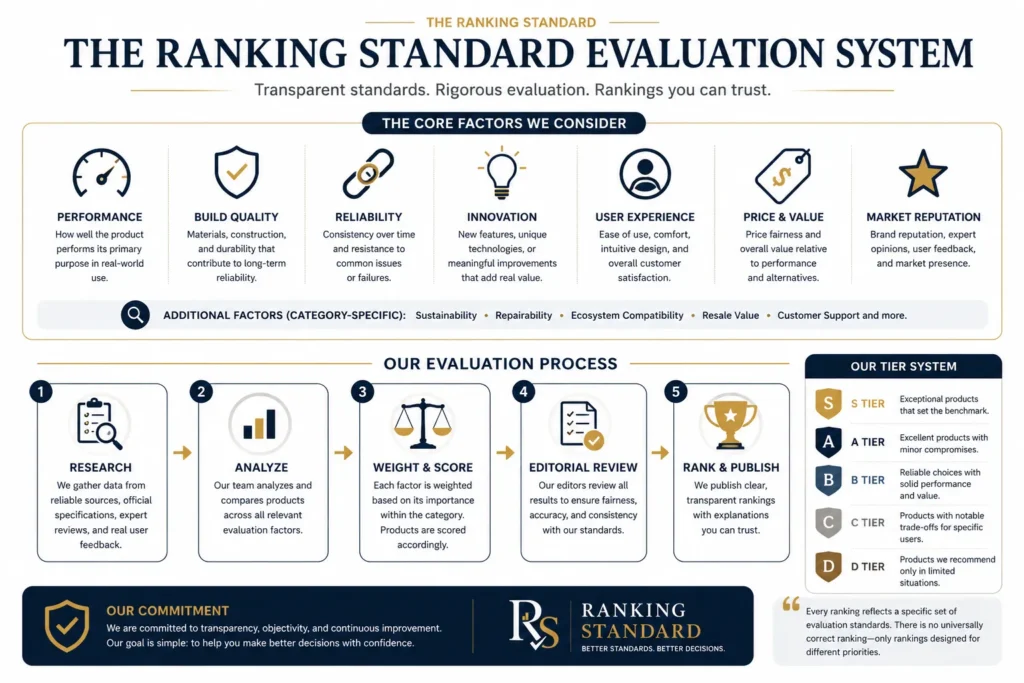
Although every category uses its own weighted criteria, most of our rankings consider the following factors:
- Performance
- Build Quality
- Reliability
- Innovation
- Design
- User Experience
- Price
- Overall Value
- Long-Term Ownership
- Market Reputation
- Expert Consensus
Some categories may also include sustainability, repairability, ecosystem compatibility, resale value, or customer support when those factors significantly influence long-term value.
Transparency Comes Before Rankings
Our rankings are never based on a single score.
Instead, we evaluate products across multiple criteria, weigh those criteria according to the product category, and explain the reasoning behind the final ranking.
Whenever possible, we also consider:
- Real-world usability
- Long-term ownership experience
- Independent expert opinions
- Market positioning
- Product maturity
We believe transparency is more valuable than pretending every ranking is perfectly objective.
Rankings Evolve as Markets Evolve
Technology changes.
Products improve.
Prices fluctuate.
New competitors emerge.
Because markets constantly evolve, rankings should evolve too.
When new information becomes available or a better product enters the market, we’ll review our rankings and update them when necessary.
A ranking that never changes eventually becomes outdated.
A trustworthy ranking grows alongside the market.
Understanding Our Tier System
Many of our articles organize products using a simple tier system.
S Tier
Exceptional products that set the benchmark for their category.
A Tier
Excellent products with only minor compromises.
B Tier
Reliable choices that offer solid performance and value.
C Tier
Products that suit specific users but involve noticeable trade-offs.
D Tier
Products that we recommend only in limited situations.
A lower tier doesn’t necessarily mean a product is bad.
It simply means that, under the evaluation standards for that category, other options performed better overall.
Our Commitment to Readers
Our mission isn’t to convince you that one product is objectively the best.
Our mission is to explain the evaluation standards clearly enough that you can decide which product is best for your own priorities.
That’s the difference between opinion and methodology.
And it’s the foundation of everything we publish.
Before You Explore Our Rankings
Every ranking tells a story.
But without understanding the standards behind that ranking, the story is incomplete.
That’s why Ranking Standard always explains the methodology first and the rankings second.
Because better decisions begin with better standards.
Editorial Note
Every ranking reflects a specific set of evaluation standards. There is no universally correct ranking—only rankings designed for different priorities. Our commitment is to explain those standards transparently, so every reader can make informed decisions with confidence.