

A sofa is one of the most important furniture purchases most households make.
This sofa buying guide explains how to compare construction, upholstery, seating comfort, dimensions, and long-term value before choosing the right sofa for your home.
It is where families gather, guests sit, children play, and people relax after a long day.
Unlike a decorative accessory, a sofa must perform several jobs at once. It needs to be comfortable, durable, appropriately sized, visually appealing, and practical to maintain.
Yet choosing the right sofa is surprisingly difficult.
Two sofas may look almost identical in a showroom while using very different frames, suspension systems, cushion materials, and upholstery.
One may remain supportive for years.
The other may develop sagging cushions, loose fabric, or an uncomfortable seating position much sooner than expected.
Price alone does not explain the difference.
A premium sofa can be poorly suited to a particular household, while a reasonably priced model with sensible construction may deliver better everyday value.
The best sofa is not necessarily the most expensive one. It is the sofa whose construction, comfort, materials, and dimensions match the way your household actually lives.
This guide explains how to evaluate those factors before making a purchase.
It also introduces Ranking Standard’s framework for comparing sofa brands, materials, and long-term ownership value.
What Makes a Good Sofa?
A good sofa must balance several characteristics.
| Buying Factor | Why It Matters | What to Check |
|---|---|---|
| Frame Construction | Supports the sofa’s structure | Materials, joints, warranty |
| Suspension | Supports the seating system | Spring or webbing design |
| Cushion Quality | Determines comfort and support | Foam specifications, filling |
| Upholstery | Affects durability and maintenance | Fabric type, leather quality |
| Seat Dimensions | Determines physical comfort | Depth, height, back support |
| Overall Size | Affects room usability | Width, depth, delivery access |
| Maintenance | Influences ownership costs | Cleaning, removable covers |
| Price & Warranty | Determines long-term value | Construction relative to price |
These factors interact.
A strong frame cannot compensate for cushions that feel uncomfortable.
Expensive upholstery cannot correct a sofa that is too deep for the intended user.
And a beautifully designed sectional becomes a poor purchase if it overwhelms the room.
The most effective buying process evaluates the sofa as a complete product.
Understanding the Different Types of Sofas
Before comparing brands, buyers should identify the sofa configuration that best suits their room and lifestyle.
Different sofa types serve different purposes.
Standard Sofa
A standard sofa typically provides seating for two or three people.
It is one of the most versatile configurations for apartments, living rooms, and family spaces.
<text preserveWhitespace={true}> </text>
Advantages
- Works in many room layouts
- Available across a wide price range
- Easier to reposition than large sectionals
- Often offers more design flexibility
Potential Drawbacks
- Limited seating for larger households
- May require additional chairs
- Less suitable for lounging with several people
Best for: Apartments, smaller living rooms, and buyers seeking flexible furniture arrangements.
Sectional Sofa
A sectional consists of multiple connected seating sections.
Configurations may include L-shaped, U-shaped, and modular arrangements.
Sectionals are popular in larger living rooms because they provide substantial seating and can define a conversation area.
However, their size creates practical challenges.
A sectional that looks balanced in a large showroom may feel overwhelming in a smaller home.
Buyers should carefully measure the available floor area and walking paths.
Advantages
- Generous seating capacity
- Useful for families and entertaining
- Comfortable lounging configurations
- Some models offer modular flexibility
Potential Drawbacks
- Requires substantial floor space
- More difficult to move
- Configuration may limit future room layouts
- Large modules can complicate delivery
Best for: Larger living rooms, families, and households that prioritize shared seating.
Loveseat
A loveseat is a compact sofa designed primarily for two people.
It can work well in smaller spaces or as additional seating alongside a larger sofa.
Advantages
- Space-efficient
- Suitable for compact rooms
- Easier to reposition
- Can complement existing furniture
Potential Drawbacks
- Limited seating capacity
- Less suitable for stretching out
- May not provide enough seating as the main living-room sofa
Best for: Small apartments, bedrooms, reading areas, and secondary seating.
Sleeper Sofa
A sleeper sofa combines conventional seating with a sleeping function.
Some models include a pull-out mattress.
Others convert the seat and backrest into a sleeping surface.
The main advantage is flexibility.
However, a sofa that performs two functions must be evaluated for both.
A comfortable seat does not automatically make a comfortable bed.
Similarly, a supportive mattress does not guarantee a pleasant everyday seating experience.
Best for: Guest rooms, studio apartments, and households that occasionally accommodate overnight visitors.
Reclining Sofa
Reclining sofas include adjustable seating positions.
Some use manual mechanisms, while others incorporate powered recliners.
These products can provide additional comfort for people who prefer elevated leg support.
However, reclining mechanisms introduce moving components that may eventually require maintenance.
Powered models also need access to electricity and sufficient clearance.
Best for: Media rooms, relaxation-focused living spaces, and buyers who prioritize adjustable seating positions.
Modular Sofa
Modular sofas use separate components that can be rearranged.
Some systems allow buyers to add, remove, or reposition sections over time.
This flexibility can be valuable for households that move frequently or expect their seating needs to change.
However, not every modular system offers the same level of flexibility.
Buyers should verify whether replacement modules remain available and how securely the components connect.
Best for: Flexible living spaces, growing households, and buyers who expect to change their room layout.
Sofa Types Comparison Matrix
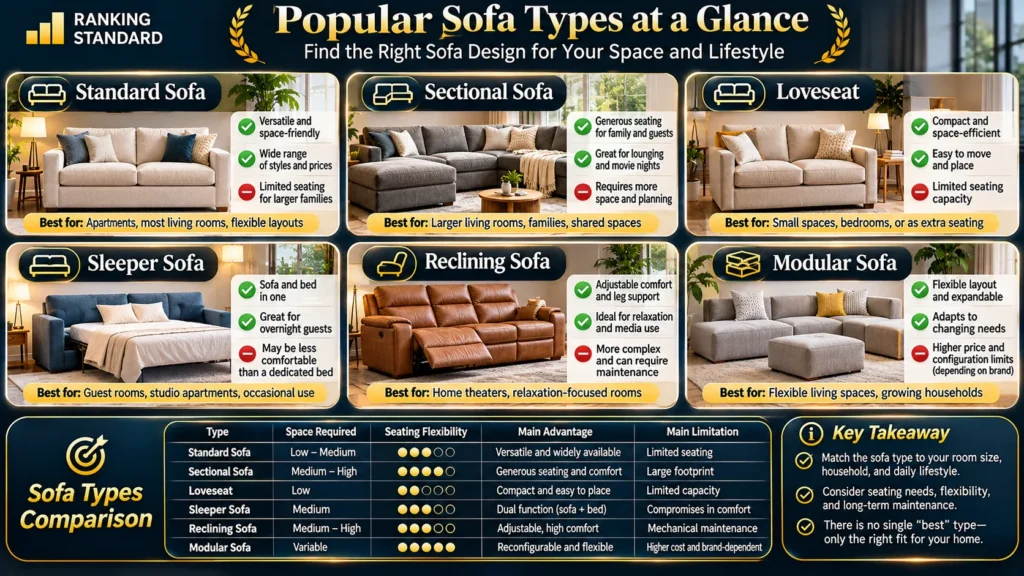
| Sofa Type | Space Required | Seating Flexibility | Main Advantage | Main Limitation |
|---|---|---|---|---|
| Standard Sofa | Low–Medium | Medium | Versatility | Limited seating |
| Sectional | Medium–High | Medium | Family seating | Large footprint |
| Loveseat | Low | Low | Compact size | Limited capacity |
| Sleeper Sofa | Medium | Medium | Dual functionality | Comfort compromises |
| Reclining Sofa | Medium–High | Medium | Adjustable comfort | Mechanical complexity |
| Modular Sofa | Variable | High | Reconfiguration | System-dependent costs |
The best configuration depends on the room and household rather than a universal ranking.
Sofa Frame Construction: What Determines Structural Quality?
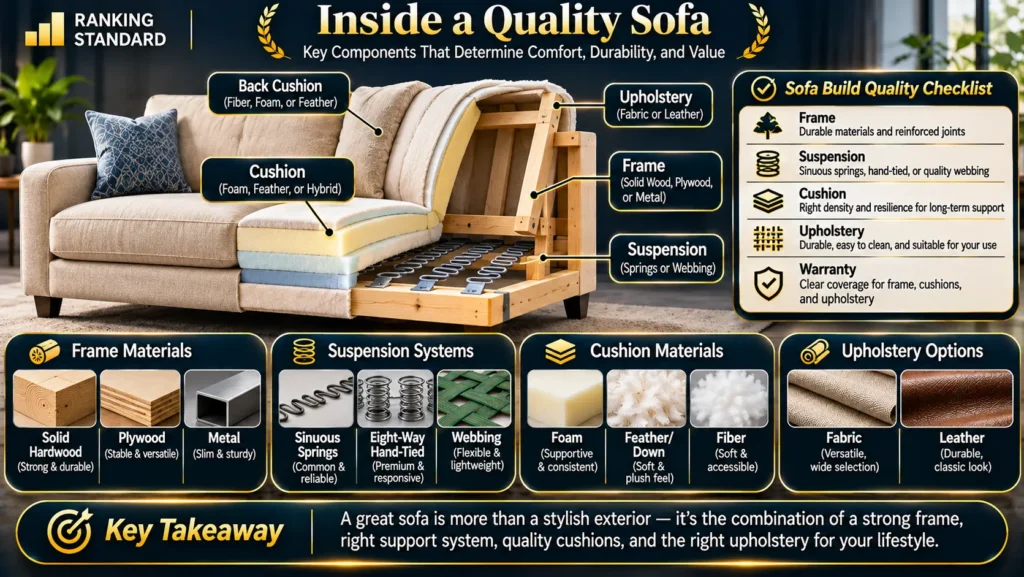
The frame forms the foundation of a sofa.
It supports the seating system, connects the structural components, and helps the furniture maintain its shape during regular use.
However, frame quality cannot be judged by material names alone.
Wood species, manufacturing methods, joint construction, and overall design all matter.
Solid Hardwood Frames
Solid hardwood is often associated with premium furniture construction.
Common hardwoods used in furniture include oak, maple, beech, and ash.
When appropriately selected, dried, and assembled, hardwood can provide a durable structural foundation.
However, the term hardwood is not a guarantee of quality.
Poorly constructed joints or unsuitable lumber can undermine the advantages of a strong material.
Buyers should ask about frame construction rather than relying only on a hardwood label.
Engineered Wood Frames
Engineered wood includes materials such as plywood and various wood-based panels.
High-quality furniture-grade plywood can provide strong, stable structural components.
In some applications, its layered construction can offer dimensional stability.
However, engineered wood products vary considerably.
A well-designed plywood frame should not automatically be considered inferior to a poorly constructed solid-wood frame.
The relevant questions concern material grade, thickness, structural design, and joint quality.
Metal Frames
Metal frames are used in selected contemporary, modular, and convertible sofas.
They can offer useful structural properties, particularly when the design requires relatively slim components or specialized mechanisms.
However, metal construction does not automatically guarantee comfort or longevity.
Weld quality, corrosion protection, joint design, and the interaction between metal and upholstered components remain important.
Frame Material Comparison
| Frame Material | Potential Strengths | Important Considerations |
|---|---|---|
| Solid Hardwood | Structural strength, traditional construction | Wood quality and joints |
| Furniture-Grade Plywood | Stability, design flexibility | Grade and construction |
| Metal | Strength in suitable designs | Welds, joints, corrosion |
| Lower-Grade Composite Panels | Lower production cost | Moisture sensitivity and structural suitability |
Ranking Standard Buying Principle: Evaluate the frame’s complete construction rather than treating one material name as proof of superior quality.
Why Sofa Joints Matter
A sofa frame is only as dependable as its structural connections.
Common construction methods include dowels, corner blocks, screws, and various forms of reinforced joinery.
The presence of one particular joint type does not guarantee durability.
Instead, buyers should look for evidence of thoughtful construction.
Useful questions include:
- Are major structural joints reinforced?
- Does the frame feel stable under normal use?
- Does the sofa creak or shift excessively?
- Does the manufacturer explain its construction?
- What does the structural warranty actually cover?
A sofa should not feel unstable when people sit down, stand up, or shift their weight.
However, showroom impressions alone cannot establish long-term durability.
Sofa Suspension Systems Explained
The suspension system sits beneath the cushions and supports the seating surface.
It plays a major role in how the sofa feels and how its support changes over time.
Several suspension approaches are common.
Sinuous Springs
Sinuous springs are curved metal springs arranged across the seating frame.
They are widely used in residential sofas.
A well-designed sinuous spring system can provide comfortable and durable support.
However, performance depends on spring quality, spacing, attachment methods, and the overall construction.
Eight-Way Hand-Tied Springs
Eight-way hand-tied suspension is often associated with traditional premium upholstery.
Individual springs are secured and tied in multiple directions.
This approach can provide carefully controlled support when properly executed.
However, it is labor-intensive and often expensive.
It should not automatically be assumed superior to every modern spring system.
The quality of execution matters more than the prestige of the terminology.
Webbing Suspension
Webbing systems use tensioned straps beneath the cushions.
Depending on the materials and construction, webbing can provide flexible support.
It is common in certain contemporary designs.
However, webbing quality, tension, and attachment methods vary.
Suspension Comparison
| Suspension Type | Typical Characteristics | What Buyers Should Check |
|---|---|---|
| Sinuous Springs | Widely used, supportive | Spring quality and attachment |
| Eight-Way Hand-Tied | Traditional premium construction | Execution and price premium |
| Webbing | Flexible, design-dependent | Strap quality and tension |
| Hybrid Systems | Combines multiple methods | Overall design and durability |
No suspension system should be judged in isolation.
The best seating experience depends on how the suspension works with the cushions and frame.
Sofa Cushions: The Most Important Comfort Decision
Cushions often have a greater immediate influence on comfort than frame materials.
Two sofas with similar dimensions can feel completely different because of their cushion construction.
The most common approaches include foam, fiber, feather or down blends, and layered combinations.
High-Density Foam
Foam cushions are popular because they can provide consistent support and a relatively structured appearance.
However, the term high-density foam is frequently used without meaningful specifications.
Density and firmness are different properties.
Foam density describes mass per unit volume.
Foam firmness describes resistance to compression under defined conditions.
A dense foam is not necessarily extremely firm.
Likewise, a firm-feeling cushion is not necessarily made from durable, high-density material.
Buyers should ask for actual specifications when available.
Feather and Down Cushions
Feather and down blends can create a soft, relaxed seating experience.
They are often associated with casual, lounge-oriented sofas.
However, they may require regular fluffing and reshaping.
Some buyers enjoy the softer appearance.
Others prefer cushions that maintain a more structured shape.
The correct choice depends on comfort preferences and willingness to perform maintenance.
Fiber-Filled Cushions
Polyester fiber and similar fillings are used in many sofa cushions and backrests.
They can provide softness at a relatively accessible price.
However, some fillings may compress or lose their original shape over time.
Construction quality and the amount of filling matter.
Layered Cushion Systems
Many sofas combine different materials.
A cushion may use a foam core for support with fiber or feather wrapping for softness.
This approach can provide a balance between structure and comfort.
However, the combination should be evaluated as a complete system.
Cushion Material Comparison
| Cushion Type | General Feel | Maintenance | Main Consideration |
|---|---|---|---|
| Foam | Structured, supportive | Usually moderate | Density and resilience |
| Feather/Down Blend | Soft, relaxed | Frequent reshaping | Ongoing fluffing |
| Fiber Fill | Soft, variable | Moderate–High | Compression over time |
| Layered Construction | Balanced, design-dependent | Variable | Core and wrapping quality |
The best cushion is not necessarily the softest one.
A very soft cushion may feel comfortable for a few minutes but provide insufficient support during extended sitting.
Conversely, an extremely firm cushion may not suit buyers who prefer relaxed lounging.
Sofa Upholstery: Fabric vs. Leather
Upholstery influences appearance, comfort, maintenance, and long-term ownership.
Fabric and leather are the two broad categories most buyers consider.
Neither is universally superior.
Fabric Sofas
Fabric sofas are available in a wide range of textures, colors, and price segments.
They can feel comfortable across different seasons and offer considerable design flexibility.
However, fabric performance varies substantially.
A tightly woven synthetic fabric may behave differently from a loosely woven natural-fiber blend.
Important considerations include abrasion resistance, pilling, stain behavior, cleaning instructions, and exposure to sunlight.
Leather Sofas
Leather sofas can offer distinctive appearance, texture, and aging characteristics.
However, the term leather covers multiple materials and finishing approaches.
Full-grain, top-grain, corrected-grain, and coated leathers can differ in appearance, surface characteristics, and maintenance requirements.
Leather should not automatically be assumed more durable than every fabric.
Its suitability depends on the specific leather, finishing process, household conditions, and maintenance.
Fabric vs. Leather Comparison
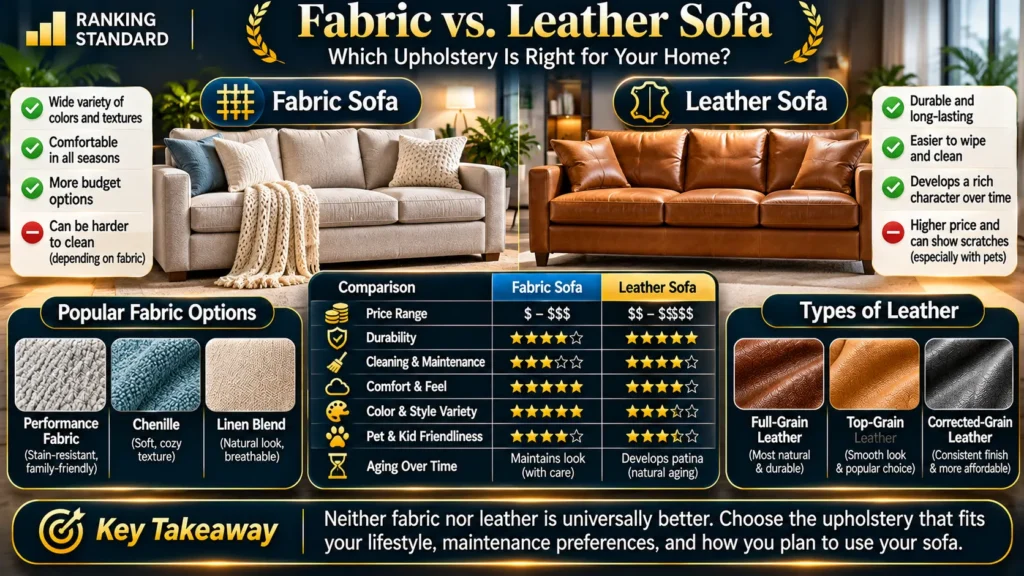
| Buying Factor | Fabric Sofa | Leather Sofa |
|---|---|---|
| Initial Price | Wide range | Often higher for premium leather |
| Color & Texture Variety | Extensive | More limited |
| Temperature Feel | Material-dependent | Can feel cool or warm initially |
| Stain Behavior | Fabric-dependent | Finish-dependent |
| Scratch Visibility | Material-dependent | Can be noticeable |
| Maintenance | Cleaning-code dependent | Leather-specific care |
| Aging Appearance | Varies | Some leathers develop patina |
| Best Choice | Depends on household | Depends on household |
The correct comparison is not simply fabric versus leather.
It is the exact fabric versus the exact leather being offered.
Performance Fabrics: Are They Worth Paying More For?
Performance fabrics are marketed for properties such as stain resistance, easier cleaning, and durability.
These characteristics can be useful in busy households.
However, performance fabric is a broad marketing category rather than a single universal quality standard.
Buyers should ask what specific performance claims have been tested.
Relevant questions include:
- Is the fabric designed to resist certain stains?
- Are cleaning instructions clearly provided?
- Does the manufacturer disclose abrasion testing?
- Is the fabric suitable for homes with pets?
- Are there restrictions on cleaning products?
- Does the warranty cover the upholstery?
A higher-priced performance fabric may offer meaningful benefits.
But buyers should avoid assuming that every product carrying the label will behave identically.
The Sofa Material Decision Matrix
| Household Priority | Recommended Starting Point | Important Trade-Off |
|---|---|---|
| Easy everyday maintenance | Suitable performance fabric | Verify cleaning claims |
| Traditional premium appearance | Quality leather | Cost and surface care |
| Soft, relaxed lounging | Feather/fiber blend cushions | Regular reshaping |
| Structured seating support | Appropriate foam-core cushions | Firmness preference |
| Long-term frame stability | Well-built hardwood or plywood | Construction matters |
| Flexible living-room layout | Modular sofa | Connection and replacement parts |
| Occasional overnight guests | Sleeper sofa | Sleeping comfort |
| Family seating capacity | Sectional sofa | Space requirements |
These recommendations identify useful starting points.
They do not replace model-specific evaluation.
A sofa with excellent materials can still be unsuitable if its dimensions, seating position, or maintenance requirements do not match the household.
The right sofa begins with how you live—not with the showroom appearance or brand name.
Sofa Dimensions: How to Choose the Right Size
One of the most common sofa-buying mistakes is choosing a model based on its appearance in a showroom rather than its dimensions at home.
Furniture stores often have spacious displays, high ceilings, and carefully arranged lighting.
A sofa that appears reasonably sized in that environment may dominate a smaller living room.
The opposite can also happen.
A compact sofa may look attractive online but feel undersized in a large family living space.
The correct starting point is not the sofa itself.
It is the room.
Measure the Available Floor Space
Before comparing models, measure the room’s usable seating area.
Consider the following dimensions:
- Overall room width and length
- Distance between walls and existing furniture
- Walking routes around the seating area
- Clearance for doors and drawers
- Space required for coffee tables
- Position of televisions, windows, and radiators
- Access to electrical outlets if purchasing a powered recliner
The goal is not simply to fit the sofa into the room.
It is to maintain a comfortable and functional living environment.
Typical Sofa Dimensions
The following ranges are approximate planning references rather than universal industry standards.
| Sofa Type | Typical Width | Typical Depth | Best Starting Point |
|---|---|---|---|
| Loveseat | 50–72 in | 30–40 in | Small rooms |
| Standard 3-Seat Sofa | 72–90 in | 32–42 in | Most living rooms |
| Large Sofa | 90–110 in | 35–45 in | Spacious living areas |
| Apartment Sofa | 60–80 in | 30–38 in | Compact apartments |
| Deep-Seated Sofa | Varies | 40–48+ in | Lounging |
| Sectional Sofa | Configuration-dependent | Configuration-dependent | Family seating |
Actual dimensions vary significantly by manufacturer and design.
Buyers should always consult the exact product specifications.
Leave Space for Movement
A sofa should not obstruct natural movement through the room.
As a practical starting point, approximately 30–36 inches of clearance can be useful for frequently used walking routes.
Smaller clearances may work in compact spaces, depending on the layout.
For a coffee table, approximately 14–18 inches between the table and the sofa is a common planning reference.
These are guidelines rather than mandatory dimensions.
The correct clearance depends on accessibility needs, furniture proportions, and how the room is used.
The Delivery Problem Most Buyers Forget
A sofa may fit perfectly in the living room but still be impossible to bring inside.
Before ordering, check:
- Entrance-door width
- Hallway width
- Staircase dimensions
- Elevator dimensions
- Tight corners
- Doorway height
- Whether the sofa arrives assembled
- Whether legs or modules can be removed
This is particularly important for large sectionals and sofas with rigid frames.
Ranking Standard Buying Principle: Measure the room, then measure the delivery route, and only then choose the sofa.
Sofa Seat Depth: Why Comfort Is Not Universal
Seat depth is one of the most important but frequently overlooked sofa specifications.
Two sofas can have similar overall dimensions yet feel completely different because of their seating geometry.
A shallow seat encourages a more upright position.
A deeper seat creates additional space for lounging.
Neither design is universally better.
Standard Seat Depth
Many conventional sofas have usable seat depths of approximately 20–24 inches, although designs vary.
This range can provide a relatively upright seating position for many adults.
However, comfort depends on the person’s height, leg length, back support, and cushion design.
Deep-Seated Sofas
Deep-seated sofas often provide more than 24 inches of usable seating depth.
They can be attractive for buyers who enjoy curling up, stretching out, or relaxing with their legs on the sofa.
However, a deep seat may be uncomfortable for someone who prefers sitting upright with their feet supported on the floor.
Additional back cushions can sometimes help, but they should not be treated as a guaranteed solution.
How to Test Seat Depth
When possible, sit on the sofa in the position you expect to use most often.
Ask yourself:
- Can my feet rest comfortably on the floor?
- Does my lower back receive adequate support?
- Do I need extra pillows to sit upright?
- Can I change position without difficulty?
- Is the seat comfortable after more than a few minutes?
The answers are more useful than a manufacturer’s description of the sofa as plush, deep, or ergonomic.
Seat Height, Back Height, and Armrest Design
Comfort is not determined by seat depth alone.
Seat Height
Many residential sofas have seat heights around 16–20 inches.
However, the appropriate height depends on the user.
A lower seat may feel relaxed but require more effort when standing up.
A higher seat may provide easier entry and exit for some people.
Back Height
Low-back sofas often emphasize modern styling.
Higher backs may provide more upper-body support.
However, cushion shape and seating angle can be as important as the overall back height.
Armrest Height
Armrests influence both appearance and practical comfort.
Wide, low arms can create a relaxed visual profile.
Higher, narrower arms may provide more conventional support.
Buyers who regularly lean against an armrest should test its comfort rather than choosing solely by appearance.
The Sofa Comfort Matrix
| Seating Preference | Useful Characteristics | What to Avoid |
|---|---|---|
| Upright Sitting | Moderate seat depth, supportive back | Excessively deep seating |
| Relaxed Lounging | Deep seat, softer cushions | Overly shallow designs |
| Frequent Standing Up | Appropriate seat height, stable support | Very low seating |
| Watching Television | Supportive back, comfortable depth | Poor neck support |
| Family Use | Balanced firmness, durable upholstery | Delicate materials |
| Occasional Sleeping | Adequate length and cushioning | Narrow, rigid seating |
| Formal Living Room | Structured cushions, controlled proportions | Excessively casual configurations |
A sofa should be evaluated according to its primary use.
A formal sitting-room sofa and a family television sofa may require very different designs.
Sofa Durability: What Actually Matters?
Durability is one of the most difficult furniture characteristics to evaluate before purchase.
A sofa can look excellent when new while hiding weaknesses in its internal construction.
Conversely, a relatively simple design may provide years of satisfactory service.
The most useful approach is to evaluate the factors that influence durability rather than relying on vague promises.
Frame Quality
The frame should be structurally appropriate for the sofa’s dimensions and intended use.
Buyers should look for clear information about materials, joints, and reinforcement.
However, frame material alone cannot establish long-term durability.
Cushion Resilience
Cushions experience repeated compression.
Over time, some materials may soften, lose height, or become uneven.
Foam density, resilience, construction, and the quality of surrounding materials can influence this process.
Buyers should distinguish between initial softness and long-term support.
Upholstery Wear
Fabric can experience abrasion, pilling, fading, and staining.
Leather may show scratches, stretching, finish wear, or changes in appearance.
The relevant risks depend on the specific material and household environment.
Suspension Quality
Springs and webbing should provide stable support under normal use.
However, the suspension system must be evaluated together with the frame and cushions.
Repairability
A sofa that allows replacement cushions, removable covers, or accessible components may be easier to maintain.
However, replacement parts are only useful if they remain available.
Buyers should verify the manufacturer’s actual support arrangements.
Understanding Fabric Durability Ratings
Upholstery manufacturers may publish abrasion-test results.
Two common testing approaches are Martindale and Wyzenbeek.
These tests use different methods and should not be treated as directly interchangeable.
Martindale
The Martindale test measures abrasion resistance through repeated rubbing cycles under specified conditions.
It is commonly referenced in European upholstery markets.
Wyzenbeek
The Wyzenbeek test measures abrasion resistance using repeated back-and-forth rubbing under specified conditions.
It is commonly encountered in North American upholstery specifications.
What These Ratings Do Not Tell You
A high abrasion-test result does not guarantee that a fabric will resist every form of damage.
It does not automatically establish resistance to:
- Staining
- Pilling
- Sunlight fading
- Pet claws
- Seam failure
- Cleaning chemicals
- Long-term cushion deformation
Buyers should evaluate upholstery using multiple relevant properties.
A high abrasion rating is useful evidence, not a complete durability guarantee.
How Much Should You Spend on a Sofa?
Sofa prices vary widely depending on materials, construction, size, manufacturing location, design, and retailer.
A higher price can reflect better components.
However, it can also reflect branding, customization, distribution costs, or premium styling.
For this reason, Ranking Standard recommends comparing construction and ownership value within a defined budget.
Illustrative Sofa Price Segments
The following ranges are broad U.S.-market planning categories, not verified November 2026 retail-price averages.
| Price Segment | Approximate Budget | Typical Buyer Priority |
|---|---|---|
| Entry-Level | Under $800 | Affordability |
| Affordable | $800–$1,500 | Everyday value |
| Mid-Range | $1,500–$3,000 | Comfort and construction |
| Premium | $3,000–$6,000 | Materials, customization, design |
| Luxury | $6,000+ | High-end design and specialized construction |
Large sectionals, sleeper sofas, and custom upholstery can cost substantially more than standard sofas within the same brand.
These ranges should therefore be treated as orientation rather than fixed market boundaries.
Under $800: Focus on Practicality
Buyers in this segment should prioritize:
- Appropriate dimensions
- Stable construction
- Comfortable seating
- Clear warranty terms
- Reasonable delivery costs
- Available replacement covers or components where relevant
Expecting premium upholstery and highly customized construction at the lowest prices may be unrealistic.
However, a basic sofa can still be a sensible purchase for a temporary home or limited budget.
$800–$1,500: Look for Balanced Value
This range may offer more upholstery choices and improved construction options.
However, buyers should not assume that every product is meaningfully better than a lower-priced alternative.
Compare frame information, cushion specifications, and warranty terms.
$1,500–$3,000: Examine Construction More Closely
At this level, buyers should expect clearer information about materials and product design.
It is reasonable to investigate:
- Frame construction
- Cushion materials
- Suspension system
- Upholstery specifications
- Warranty coverage
- Replacement-part availability
A sofa in this range should justify its price through meaningful product characteristics.
$3,000–$6,000: Evaluate the Premium
Premium sofas may offer more extensive customization, distinctive designs, and higher-cost materials.
However, buyers should ask whether those benefits improve their actual ownership experience.
A premium sofa that requires constant cushion reshaping may be less suitable for a busy household than a simpler design with structured cushions.
Above $6,000: Separate Luxury From Practical Value
Luxury sofas may justify their prices through design, craftsmanship, materials, or customization.
However, luxury positioning does not automatically establish superior comfort or durability.
Buyers should distinguish between paying for functional improvements and paying for aesthetic or brand-related value.
Both can be legitimate purchasing priorities.
They should simply be recognized as different priorities.
Best Sofa Brands: Ranking Standard’s Provisional S–D Tier List
Brand reputation can help buyers narrow the market.
However, a sofa brand’s name alone does not guarantee the quality of every product it sells.
Some manufacturers offer multiple product lines with different construction methods, upholstery materials, and price points.
Others specialize in particular categories such as reclining furniture, modular sofas, or premium customization.
For this reason, Ranking Standard evaluates sofa brands according to their general market positioning, product characteristics, ownership considerations, and available evidence.
The following tiers are provisional editorial assessments, not standardized laboratory scores or verified brand-wide reliability rankings.
Sofa Brand Tier List — 2026
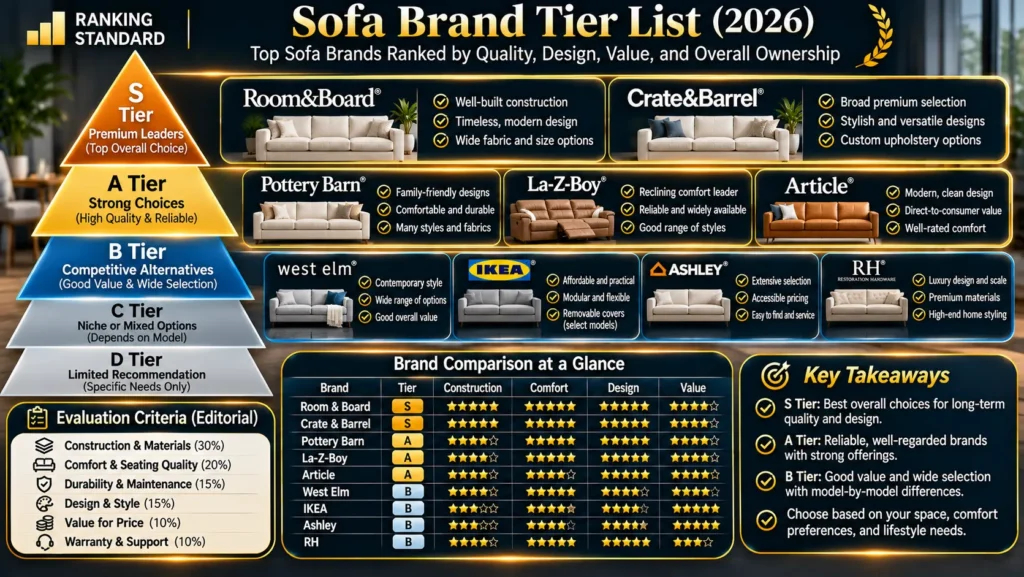
| Tier | Brand | General Positioning |
|---|---|---|
| S — Premium Leaders | Room & Board | Construction-focused premium furniture |
| S — Premium Leaders | Crate & Barrel | Broad premium sofa selection |
| A — Strong Choices | Pottery Barn | Traditional and family-oriented options |
| A — Strong Choices | La-Z-Boy | Reclining and comfort-focused seating |
| A — Strong Choices | Article | Modern design and direct-to-consumer positioning |
| B — Competitive Alternatives | West Elm | Contemporary styling and broad selection |
| B — Competitive Alternatives | IKEA | Affordable, functional, and modular options |
| B — Competitive Alternatives | Ashley | Accessible pricing and extensive retail distribution |
| B — Competitive Alternatives | RH | Luxury design and premium positioning |
| C — Mixed Performance | No brand assigned | Insufficient evidence for a broad negative classification |
| D — Significant Limitations | No brand assigned | Insufficient evidence for a broad negative classification |
These placements are intended to organize buying options rather than declare universal winners.
A lower-tier brand may offer a better sofa for a particular household.
Likewise, a premium brand may sell a model that is unsuitable for the buyer’s seating preferences or budget.
The distinction between S and A tiers is particularly subjective without consistent independent testing across comparable products.
Therefore, these placements should be treated as a working editorial framework that requires further product-level verification before being considered definitive.
Want a deeper comparison of manufacturers? Explore our Best Sofa Brands 2026: S–D Tier List to see how Room & Board, Crate & Barrel, Pottery Barn, La-Z-Boy, Article, West Elm, IKEA, Ashley, and RH compare across design, construction considerations, comfort, and purchasing value.
S Tier: Premium Sofa Brands
Room & Board — Construction-Focused Premium Furniture
Room & Board is a relevant starting point for buyers who prioritize relatively timeless designs and detailed furniture specifications.
Its sofa range includes products with different dimensions, upholstery options, and seating characteristics.
The brand’s appeal is particularly strong among consumers seeking premium furniture without highly ornate styling.
Potential strengths
- Broad upholstery choices
- Contemporary and timeless designs
- Product specification information
- Multiple seating configurations
- Premium-market positioning
What buyers should check
- Construction details for the specific model
- Cushion composition
- Upholstery performance
- Delivery and service arrangements
- Warranty limitations
Ranking Standard Assessment: S Tier — a strong premium starting point, subject to model-level verification.
Crate & Barrel — Broad Premium Sofa Selection
Crate & Barrel offers an extensive range of sofa designs, including contemporary, traditional, sectional, and modular configurations.
Its broad selection can be useful for buyers comparing different seating styles.
However, a large product range also means that construction and materials may vary considerably between models.
Potential strengths
- Extensive sofa selection
- Multiple design styles
- Custom upholstery options on selected products
- Sectional and modular configurations
- Established retail presence
What buyers should check
- Frame and suspension details
- Cushion construction
- Upholstery specifications
- Product-specific warranty
- Whether customization affects return eligibility
Ranking Standard Assessment: S Tier — a leading premium retailer with broad choice, but individual models require careful comparison.
A Tier: Strong Sofa Brand Choices
Pottery Barn — Traditional Comfort and Family-Oriented Design
Pottery Barn offers a wide range of residential furniture, including sofas designed around conventional comfort and familiar interior styles.
Its product selection may appeal to households seeking coordinated living-room furniture.
However, upholstery and construction can differ across product lines.
Best starting point for: Traditional interiors, family-oriented living spaces, and buyers seeking multiple upholstery choices.
Key consideration: Evaluate the exact sofa rather than assuming consistent construction across the entire catalog.
La-Z-Boy — Reclining and Comfort-Focused Seating
La-Z-Boy is particularly relevant for buyers seeking reclining sofas and adjustable seating.
Its specialization in motion furniture differentiates it from retailers primarily focused on fixed-frame sofas.
However, reclining mechanisms introduce additional components that may require service over time.
Best starting point for: Reclining sofas, media rooms, and buyers prioritizing adjustable seating positions.
Key consideration: Review mechanism warranties, motor coverage, and service availability.
Article — Modern Design and Direct-to-Consumer Positioning
Article is known for contemporary furniture and a direct-to-consumer business model.
Its sofas often emphasize streamlined styling and accessible modern design.
However, buyers should examine construction and upholstery details rather than assuming that a direct-to-consumer model guarantees superior value.
Best starting point for: Modern apartments, contemporary living rooms, and buyers seeking streamlined designs.
Key consideration: Review product-specific construction information, delivery arrangements, and return conditions.
B Tier: Competitive Sofa Alternatives
West Elm — Contemporary Design and Broad Styling Options
West Elm is particularly relevant for buyers seeking modern furniture with a strong design identity.
Its sofa range includes multiple silhouettes and upholstery options.
However, product construction and comfort can vary.
Best starting point for: Contemporary interiors and design-focused buyers.
Key consideration: Compare individual models rather than relying on brand reputation alone.
IKEA — Affordable and Functional Sofa Solutions
IKEA is an important manufacturer and retailer for buyers prioritizing affordability, modularity, and practical furniture design.
Selected sofa systems offer removable covers and replaceable components.
However, features and construction vary significantly across product families.
Best starting point for: Budget-conscious households, apartments, and buyers seeking modular options.
Key consideration: Verify the exact model’s construction, cover availability, and warranty terms.
Ashley — Accessible Pricing and Extensive Selection
Ashley offers a broad range of sofas across accessible price segments.
Its extensive distribution makes the brand relevant to many buyers.
However, product quality and construction can differ between collections.
Best starting point for: Budget-focused buyers and households comparing multiple conventional sofa styles.
Key consideration: Inspect construction specifications and compare the total delivered price.
RH — Luxury Design and Premium Positioning
RH occupies a luxury-oriented position in the furniture market.
Its sofas often emphasize substantial proportions, premium styling, and customization.
However, high prices and luxury branding do not automatically establish superior durability or value.
Best starting point for: Luxury interiors, buyers prioritizing design, and households with substantial furniture budgets.
Key consideration: Distinguish between design value and measurable construction advantages.
Sofa Brand Strengths Matrix
| Brand | Tier | Main Strength | Main Buying Consideration |
|---|---|---|---|
| Room & Board | S | Premium furniture positioning | Model-specific construction |
| Crate & Barrel | S | Broad premium selection | Variation across product lines |
| Pottery Barn | A | Traditional and family-oriented designs | Upholstery and customization |
| La-Z-Boy | A | Reclining comfort | Mechanism maintenance |
| Article | A | Modern direct-to-consumer designs | Delivery and product specifications |
| West Elm | B | Contemporary styling | Model-level quality variation |
| IKEA | B | Affordability and modular options | Construction and cover availability |
| Ashley | B | Accessible pricing and distribution | Collection-level differences |
| RH | B | Luxury design | Price relative to practical value |
The matrix is a starting point for identifying relevant brands.
It should not replace detailed product comparisons.
Why a Lower-Tier Sofa Brand Can Be the Better Choice
Imagine two hypothetical buyers.
The first is furnishing a temporary apartment and expects to move within two years.
The second is purchasing a sofa for a long-term family home.
The first buyer may prioritize affordability, manageable dimensions, and easy transport.
An IKEA sofa could be a sensible choice.
The second buyer may place greater emphasis on construction, upholstery options, and long-term maintenance.
A Room & Board sofa may deserve closer consideration.
Neither purchase is automatically better.
The value depends on the household’s circumstances.
A similar distinction applies to luxury furniture.
A buyer may appreciate RH’s aesthetic and customization options.
However, another household may find that a less expensive sofa provides equal or greater everyday satisfaction.
The purpose of a brand ranking is to narrow the search—not to replace the buyer’s judgment.
How to Compare Two Sofas From Different Brands
When comparing products, use the same evaluation categories for both.
| Comparison Factor | Sofa A | Sofa B |
|---|---|---|
| Overall Dimensions | Verify | Verify |
| Seat Depth | Verify | Verify |
| Seat Height | Verify | Verify |
| Frame Materials | Verify | Verify |
| Suspension System | Verify | Verify |
| Cushion Construction | Verify | Verify |
| Upholstery Specifications | Verify | Verify |
| Warranty | Verify | Verify |
| Delivery & Returns | Verify | Verify |
| Total Purchase Cost | Calculate | Calculate |
If important information is missing, contact the retailer before purchasing.
A sofa that offers transparent construction details may be easier to evaluate than one relying primarily on lifestyle photography and broad marketing claims.
However, missing information does not automatically establish poor quality.
It indicates that the buyer needs more evidence.
The Most Important Sofa Buying Rule
A sofa should be evaluated in the following order:
Room Size → Seating Comfort → Construction → Upholstery → Maintenance → Price → Brand
This sequence may appear different from the way furniture is advertised.
Marketing often begins with brand identity, design, and price.
But the buyer’s actual satisfaction depends heavily on whether the sofa fits the room, supports the body comfortably, and remains practical to own.
A famous brand cannot compensate for the wrong seat depth.
Premium upholstery cannot make an oversized sectional fit a compact apartment.
And a low purchase price may become less attractive if the sofa is difficult to maintain or unsuitable for everyday use.
Choose the sofa that fits your home and lifestyle before choosing the brand that fits your aspirations.
How to Choose the Best Sofa for Your Lifestyle
A sofa that works beautifully in one household may be a frustrating purchase in another.
The difference often has little to do with brand reputation.
A couple living in a compact apartment may prioritize dimensions, easy delivery, and flexible furniture arrangements.
A family with children may place greater importance on stain management, cushion support, and accessible cleaning.
A household with pets may need upholstery that tolerates frequent use and routine maintenance.
Meanwhile, someone furnishing a formal living room may care more about appearance, proportions, and occasional seating comfort.
These buyers should not automatically choose the same sofa.
The following recommendations are practical starting points rather than universal rules.
Best Sofas for Families With Children
Family sofas often experience more demanding everyday use than furniture in formal sitting rooms.
Children may sit, lie down, play, eat snacks, or gather with other family members on the same piece of furniture.
That makes practical maintenance particularly important.
What Families Should Prioritize
- A stable, appropriately constructed frame
- Cushions that provide consistent support
- Upholstery with clear cleaning instructions
- Comfortable seating for multiple people
- Appropriate seat height and depth
- Rounded or less exposed hard edges where practical
- Removable covers when available
- A configuration that allows easy movement around the room
A large sectional can be attractive for family use.
However, its dimensions should not obstruct walking routes or dominate the living space.
Fabric or Leather for Families?
Neither material is universally superior.
Certain performance fabrics may provide useful stain-management properties.
Some finished leathers can be wiped clean more easily after particular spills.
However, both categories vary considerably.
A fabric advertised as stain-resistant may still be vulnerable to certain substances.
Leather can show scratches, finish wear, or discoloration.
The correct choice depends on the specific upholstery and how the household intends to maintain it.
A Practical Family Buying Example
Imagine a family choosing between two similarly priced sofas.
The first has a fashionable low profile, delicate upholstery, and deep cushions that require frequent reshaping.
The second offers more structured cushions, a washable cover option, and comfortable seating for several family members.
If the sofa will be used intensively every day, the second product may offer better practical value.
That does not mean the first sofa is poorly made.
It simply serves a different set of priorities.
Ranking Standard Recommendation: Families should prioritize comfort, maintainability, and appropriate construction before decorative features.
Best Sofas for Homes With Pets
Pet owners face a different set of upholstery challenges.
Dogs and cats can introduce hair, dirt, moisture, and additional wear.
Some animals also scratch furniture or repeatedly occupy the same seating position.
No sofa material is completely pet-proof.
However, thoughtful material selection can make routine ownership easier.
Upholstery Considerations for Pet Owners
Tightly woven fabrics may be easier to manage than certain loose or highly textured weaves.
Some performance fabrics are designed to resist particular stains.
Leather may allow easier removal of loose pet hair, but scratches can remain visible.
The best choice depends on the animal’s behavior and the exact upholstery material.
What to Check Before Buying
| Factor | Why It Matters |
|---|---|
| Fabric Weave | Can affect snagging and hair removal |
| Cleaning Instructions | Determines acceptable maintenance methods |
| Removable Covers | May simplify cleaning |
| Cushion Construction | Influences support under repeated use |
| Upholstery Color | Affects visibility of hair and marks |
| Replacement Parts | May improve long-term maintainability |
Buyers should avoid assuming that a product marketed as pet-friendly has passed a universal durability standard.
Ask which specific properties have been tested.
A Practical Pet-Friendly Scenario
Consider a household with a dog that regularly sleeps on the sofa.
A very soft feather-filled design may require frequent reshaping.
A structured cushion system with accessible covers may be easier to maintain.
However, if the dog tends to scratch upholstery, the fabric’s snagging behavior becomes particularly important.
Ranking Standard Recommendation: Choose upholstery according to the pet’s actual behavior rather than relying on a generic pet-friendly label.
Best Sofas for Small Apartments
Small apartments require careful furniture planning.
A sofa may be the largest object in the living room.
Its dimensions influence walking routes, storage access, and the overall sense of space.
What Matters Most
A compact sofa should provide useful seating without consuming unnecessary floor area.
Buyers should consider:
- Overall width and depth
- Armrest thickness
- Seat depth
- Leg height and visual openness
- Delivery access
- Whether the sofa can be disassembled
- Potential future moves
A sofa with relatively slim arms may offer more usable seating width than a model with thick, oversized arms of the same overall width.
However, slimmer arms should still provide adequate structural support.
Apartment Sofa vs. Loveseat
An apartment sofa is generally intended to provide conventional sofa seating in a smaller footprint.
A loveseat usually offers seating for two people.
The distinction is not standardized across all manufacturers.
Buyers should compare actual dimensions rather than relying on product-category labels.
A Practical Small-Apartment Scenario
Imagine a buyer choosing between an 84-inch sofa and a 72-inch sofa.
Both fit along the intended wall.
However, the larger model restricts access to a nearby doorway and leaves little room for a coffee table.
The smaller model may create a more functional living space despite offering less seating width.
Ranking Standard Recommendation: In compact homes, prioritize room usability over maximum seating capacity.
Best Sofas for Large Living Rooms
Large living rooms create different challenges.
A sofa that is too small may look visually disconnected from the surrounding space.
A sectional or modular configuration can help define a seating area.
However, larger furniture is not automatically more comfortable.
Sectional or Multiple Sofas?
A sectional can provide generous shared seating.
Two separate sofas may create more flexible conversation arrangements.
A sofa combined with accent chairs may offer greater adaptability.
The correct arrangement depends on how the room is used.
For example, a household that regularly watches movies together may prefer a large sectional.
A household that frequently entertains guests may appreciate separate seating positions that encourage conversation.
Modular Sofas for Changing Needs
Modular designs can offer flexibility when layouts change.
However, buyers should verify how securely the sections connect and whether additional modules remain available.
A modular sofa is only meaningfully flexible when its components can be rearranged or expanded in practical ways.
Ranking Standard Recommendation: Choose the seating arrangement that supports the room’s primary activities rather than filling the largest possible area.
Best Sofas for Older Adults and Buyers Who Prefer Upright Seating
Some buyers prefer sofas that make sitting down and standing up relatively easy.
This can be influenced by seat height, cushion firmness, seat depth, and armrest design.
A very low, deep sofa may feel luxurious when reclining but less convenient for upright seating.
Useful Characteristics
- A seat height appropriate for the user
- Cushions that provide stable support
- Moderate usable seat depth
- Supportive armrests
- A backrest that allows comfortable upright sitting
- A stable frame
These features are not exclusive to any particular age group.
They can benefit anyone who prefers a conventional seated posture.
Why Showroom Testing Matters
The buyer should sit down, remain seated for several minutes, and stand up again.
A sofa that feels comfortable for a brief moment may not provide the preferred support during longer use.
Individual comfort needs vary, so no single seat height or firmness should be treated as universally ideal.
Ranking Standard Recommendation: Prioritize actual seating geometry and comfort rather than choosing based solely on a sofa’s appearance.
The Sofa Lifestyle Recommendation Matrix
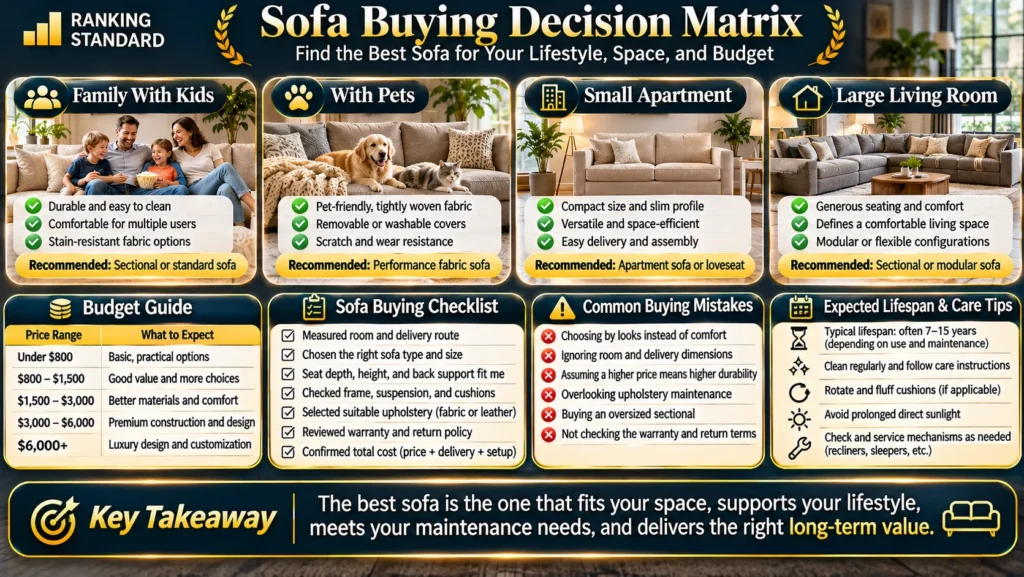
| Household | Recommended Starting Point | Main Priority | Key Trade-Off |
|---|---|---|---|
| Family With Children | Standard or sectional sofa | Maintenance and support | Larger footprint |
| Home With Pets | Suitable tightly woven upholstery | Cleaning and wear management | Material-specific limitations |
| Small Apartment | Compact or apartment sofa | Space efficiency | Seating capacity |
| Large Living Room | Sectional or modular sofa | Shared seating | Delivery and layout |
| Frequent Guests | Sleeper sofa | Dual functionality | Seating/sleeping compromises |
| Upright Seating Preference | Supportive standard sofa | Seat geometry | Less relaxed lounging |
| Design-Focused Home | Premium upholstered sofa | Appearance and customization | Higher price |
| Frequently Moving Household | Modular or compact sofa | Transport flexibility | Component availability |
The matrix should be used to identify suitable configurations.
It does not establish that one sofa type is universally better than another.
How Long Should a Sofa Last?
Sofa lifespan is frequently discussed in furniture marketing.
However, a precise lifespan cannot be guaranteed from a brand name, material description, or purchase price.
Actual longevity depends on construction, usage, maintenance, environmental conditions, and the owner’s expectations.
A sofa may remain structurally functional while its cushions become less comfortable.
Another may retain comfortable seating but develop upholstery wear.
These are different forms of aging.
The Main Factors Affecting Sofa Longevity
Frame construction: Structural materials, joints, and reinforcement influence how well the sofa tolerates repeated use.
Suspension: Springs or webbing must continue providing appropriate support.
Cushions: Foam and other fillings can change in firmness, height, or shape.
Upholstery: Fabric and leather may experience wear, fading, staining, or surface changes.
Usage intensity: A sofa used occasionally will experience different conditions from one used by several people every day.
Maintenance: Appropriate cleaning and care can help preserve the sofa’s condition.
Can a Sofa Last Ten Years?
Some sofas remain serviceable for a decade or longer.
Others require significant maintenance or replacement sooner.
However, a ten-year lifespan should not be promised without reliable evidence for the specific product and usage conditions.
A more useful approach is to evaluate whether the sofa offers repairable or replaceable components.
Repairability Can Matter More Than Initial Appearance
A sofa with replaceable cushions or removable upholstery may offer more maintenance options.
However, replacement parts must actually be available.
Before purchasing an expensive sofa, ask whether the manufacturer supplies replacement cushion inserts, covers, legs, or other relevant components.
Ranking Standard Buying Principle: Long-term value depends not only on how a sofa is built, but also on whether it can be maintained economically.
Sofa Maintenance: How to Protect Your Purchase
A sofa’s maintenance requirements depend on its upholstery and construction.
The manufacturer’s care instructions should take priority over generic cleaning advice.
Fabric Sofa Maintenance
Regular vacuuming can help remove loose debris.
Spills should be addressed according to the fabric’s approved cleaning method.
Some upholstery requires professional cleaning.
Others may permit carefully controlled water-based cleaning.
Buyers should not assume that every fabric cover is machine washable.
Leather Sofa Maintenance
Leather care depends on the leather type and surface finish.
Some finishes tolerate gentle cleaning more readily than others.
Harsh chemicals and unsuitable conditioners can damage certain surfaces.
Buyers should use products approved for the specific leather.
Cushion Maintenance
Some cushions benefit from periodic rotation or reshaping.
However, not every cushion is reversible.
Follow the manufacturer’s instructions rather than forcing a cushion into an unintended position.
Sunlight and Heat
Extended exposure to strong sunlight can contribute to fading or material changes.
Placing furniture too close to heat sources may also create problems for certain materials.
The appropriate precautions depend on the upholstery and surrounding environment.
Sofa Maintenance Checklist
| Maintenance Task | General Recommendation |
|---|---|
| Remove loose dust and debris | Regularly |
| Address spills | Promptly, using approved methods |
| Inspect cushions | Periodically |
| Rotate reversible cushions | If permitted |
| Check exposed hardware | According to manufacturer guidance |
| Protect from excessive sunlight | Where practical |
| Follow upholstery cleaning codes | Always |
| Review replacement-part availability | Before and during ownership |
These recommendations are general.
The correct maintenance schedule depends on the product and household conditions.
Buying a Sofa Online vs. In a Showroom
Online furniture shopping offers convenience and broad selection.
However, sofas are difficult to evaluate through photographs alone.
A product image cannot fully communicate seat firmness, cushion resilience, back support, or fabric texture.
This creates a different purchasing risk from many smaller household products.
Advantages of Buying Online
- Easy comparison of dimensions
- Access to multiple retailers
- Convenient specification research
- Potentially broader selection
- Ability to compare delivery terms
Advantages of Visiting a Showroom
- Direct assessment of seating comfort
- Better understanding of proportions
- Opportunity to inspect upholstery texture
- Ability to compare firmness
- More realistic assessment of seat depth and height
However, showroom testing also has limitations.
A brief seating trial cannot prove long-term durability.
Display models may have experienced substantial use.
The Best Approach
When possible, research specifications online and test shortlisted products in person.
If buying online without a showroom visit, prioritize retailers that provide detailed specifications, clear return policies, and reliable customer support.
Sofa Delivery: The Hidden Cost of Furniture Shopping
A sofa’s listed price may not represent the total purchase cost.
Delivery, assembly, room placement, and removal of old furniture can create additional expenses.
Questions to Ask Before Ordering
- Is delivery included?
- Is the sofa delivered to the entrance or inside the home?
- Is assembly included?
- Will the delivery team remove packaging?
- Are stairs or difficult access subject to additional charges?
- Can the sofa be returned after assembly?
- Who pays return shipping?
- Are custom upholstery orders returnable?
These questions can materially change the value comparison.
A sofa that costs less online may become more expensive after delivery and return-related charges.
Sofa Warranty: What Buyers Should Actually Read
Furniture warranties often distinguish between different components.
A manufacturer may offer one coverage period for the frame and another for cushions, upholstery, or reclining mechanisms.
Buyers should not interpret a long frame warranty as a guarantee that every component will remain in excellent condition for the same period.
Common Warranty Categories
| Component | What to Check |
|---|---|
| Frame | Structural defects and exclusions |
| Suspension | Spring or webbing coverage |
| Cushions | Compression and firmness exclusions |
| Upholstery | Fabric or leather limitations |
| Reclining Mechanism | Mechanical parts and labor |
| Electrical Components | Motors, controls, and power systems |
| Service | Shipping, inspection, and labor charges |
Warranty terms vary by manufacturer, retailer, product, and country.
Buyers should review the written policy applicable to the exact purchase.
The Custom Sofa Return Problem
Customized sofas may have different return conditions from standard-stock products.
A buyer who selects a special upholstery color or configuration may discover that the order cannot be returned for a simple change of preference.
This is particularly important for expensive sofas.
Before ordering a customized product, verify the return and cancellation terms in writing.
The True Cost of Sofa Ownership
A sofa’s long-term value depends on more than its purchase price.
Potential expenses include:
- Delivery and assembly
- Upholstery cleaning
- Replacement cushions
- Replacement covers
- Mechanism repairs
- Transportation during a move
- Disposal or replacement costs
Consider two hypothetical sofas.
| Cost Factor | Sofa A | Sofa B |
|---|---|---|
| Purchase Price | $900 | $1,600 |
| Delivery | $100 | $100 |
| Maintenance Over Five Years | $150 | $100 |
| Cushion Replacement | $300 | $0 |
| Illustrative Five-Year Total | $1,450 | $1,800 |
Sofa A remains less expensive in this example.
However, the comparison is incomplete without considering comfort, condition, resale value, and whether either sofa needs replacement after five years.
A higher purchase price does not automatically create lower ownership costs.
Likewise, a lower purchase price does not automatically represent poor value.
The right comparison considers the cost of obtaining and maintaining a sofa that continues to meet the household’s needs.
The Most Common Sofa Buying Mistakes
Choosing Appearance Before Comfort
A visually attractive sofa may have unsuitable seat depth, firmness, or back support.
Ignoring Delivery Dimensions
A sofa that fits the room may not fit through the entrance or staircase.
Assuming Expensive Means Durable
Price may reflect design, branding, or customization rather than measurable construction advantages.
Trusting Upholstery Marketing Without Specifications
Terms such as performance fabric and premium leather require product-specific verification.
Ignoring Cushion Construction
Cushions strongly influence comfort and how the sofa feels over time.
Buying an Oversized Sectional
Large seating capacity can become a disadvantage when the sofa obstructs movement.
Overlooking Cleaning Requirements
Delicate upholstery may be unsuitable for intensive family use.
Failing to Read Return Conditions
Customized furniture may have restrictive return policies.
Comparing Brands Instead of Models
A manufacturer may offer products with substantially different construction and comfort characteristics.
Forgetting Long-Term Maintenance
Replacement covers, cushions, and repair support can affect ownership value.
The Final Sofa Buying Checklist
Before purchasing, confirm the following:
- Have I measured the available room space?
- Have I checked doorways, hallways, stairs, and elevators?
- Is the sofa configuration suitable for the household?
- Is the seat depth comfortable?
- Is the seat height appropriate?
- Does the backrest provide the preferred support?
- What materials are used in the frame?
- What suspension system supports the cushions?
- What are the cushion materials and specifications?
- Is the upholstery suitable for everyday use?
- Are cleaning instructions clearly provided?
- Are replacement covers or cushions available?
- What does the warranty actually cover?
- What are the delivery and return conditions?
- Is the total purchase price reasonable for the construction and features?
A buyer who can answer these questions is better prepared to make a confident decision.
Frequently Asked Questions
What Is the Best Sofa Brand?
There is no universally best sofa brand.
Ranking Standard’s provisional brand framework identifies Room & Board and Crate & Barrel as premium starting points, while other manufacturers offer advantages in affordability, reclining comfort, design, or modularity.
The best purchase depends on the individual sofa.
Is an Expensive Sofa Worth It?
An expensive sofa may justify its price through construction, materials, customization, or design.
However, a higher price does not automatically guarantee better durability or comfort.
How Long Should a Sofa Last?
There is no universal lifespan.
Longevity depends on construction, usage, maintenance, and expectations.
Buyers should prioritize product specifications and repairability over unsupported lifespan promises.
Is Leather Better Than Fabric?
Neither material is universally superior.
The correct choice depends on the specific upholstery, maintenance requirements, household conditions, and personal preferences.
What Is the Most Durable Sofa Fabric?
No single fabric is best for every type of wear.
Buyers should consider abrasion resistance, pilling, stain behavior, cleaning instructions, and the needs of their household.
Are Sectional Sofas Better Than Regular Sofas?
Sectionals can provide more shared seating.
However, standard sofas may offer greater flexibility and easier placement.
The best configuration depends on room size and lifestyle.
Is a Firm Sofa Better Than a Soft Sofa?
Not necessarily.
Firmness is a comfort preference, while long-term support depends on cushion construction and materials.
A firm-feeling cushion is not automatically more durable.
Are IKEA Sofas Worth Buying?
Selected IKEA sofas may offer useful value, particularly for buyers prioritizing affordability, modularity, or removable covers.
However, construction and features vary by product family.
Is Room & Board Better Than West Elm?
The brands have different product ranges and market positions.
Ranking Standard provisionally places Room & Board higher in its general brand framework, but this does not establish that every Room & Board sofa is superior to every West Elm sofa.
Specific models should be compared.
Should I Buy a Sofa Online?
Online purchasing can be convenient when product specifications and return terms are clear.
However, showroom testing is valuable because seating comfort is difficult to evaluate through photographs.
What Sofa Is Best for a Family With Children?
A sofa with appropriate construction, comfortable seating, and manageable upholstery maintenance is a useful starting point.
The best configuration depends on the family’s space and habits.
What Sofa Is Best for Pets?
Pet-friendly buying should focus on the animal’s behavior, upholstery characteristics, cleaning requirements, and cushion maintenance.
No upholstery material is completely resistant to every form of pet-related wear.
How Deep Should a Sofa Seat Be?
Many conventional sofas offer usable seat depths of approximately 20–24 inches, while deep-seated designs may exceed that range.
The appropriate depth depends on the user’s body proportions and preferred seating position.
What Should I Check Before Buying a Sofa?
Measure the room and delivery route, test comfort where possible, review construction and upholstery specifications, and confirm warranty and return conditions.
Final Thoughts
Buying a sofa is not simply a choice between brands, colors, and prices.
It is a decision about how a household will use a major piece of furniture over time.
The most important factors include seating comfort, appropriate dimensions, frame construction, suspension, cushion quality, upholstery, maintenance, and total ownership cost.
A premium sofa may offer excellent design and construction.
A more affordable model may provide better practical value for a particular household.
Neither outcome can be determined by price alone.
For families, maintenance and seating capacity may be the main priorities.
For small apartments, dimensions and delivery access may matter most.
For pet owners, upholstery characteristics and cleaning requirements deserve particular attention.
And for buyers seeking long-term furniture, construction transparency and repairability can be especially valuable.
Ranking Standard’s provisional sofa brand tiers can help organize the market, but they should not replace individual product comparisons.
The best sofa is the one that fits the room, supports the household comfortably, and remains practical to own.
Choose the sofa that fits your life—not simply the one that looks best in the showroom.
Ready to compare individual products? Explore our Best Sofas 2026: Top 10 Models Ranked for practical recommendations based on comfort, construction, upholstery, room size, and long-term purchasing value.
Editor’s Note
At Ranking Standard, we believe that buying guides should help readers make better decisions rather than simply repeat marketing claims.
Sofas are an important example.
A beautiful product photograph can reveal the overall design, but it cannot establish frame quality, cushion resilience, seating comfort, or long-term durability.
Those characteristics require closer examination.
That is why this guide emphasizes construction, dimensions, materials, ownership costs, and practical household needs.
Our provisional S–D brand framework is intended to organize manufacturers according to their general market positioning and available product information.
It is not a standardized laboratory ranking, and it should not be interpreted as proof that every product from a higher-tier brand outperforms every product from a lower-tier manufacturer.
Ranking Standard has not independently tested the full sofa portfolios of the brands discussed in this guide.
Brand assessments should be reviewed as additional credible evidence becomes available.
Future sofa brand rankings and model-level comparisons will examine manufacturers and individual products in greater detail.
The objective is to create a connected furniture decision system:
Understand the construction. Compare the materials. Evaluate the brands. Choose the right sofa.
Because a ranking should do more than identify a popular name.
It should explain what makes a product worth buying.
Every Ranking Has a Standard.