
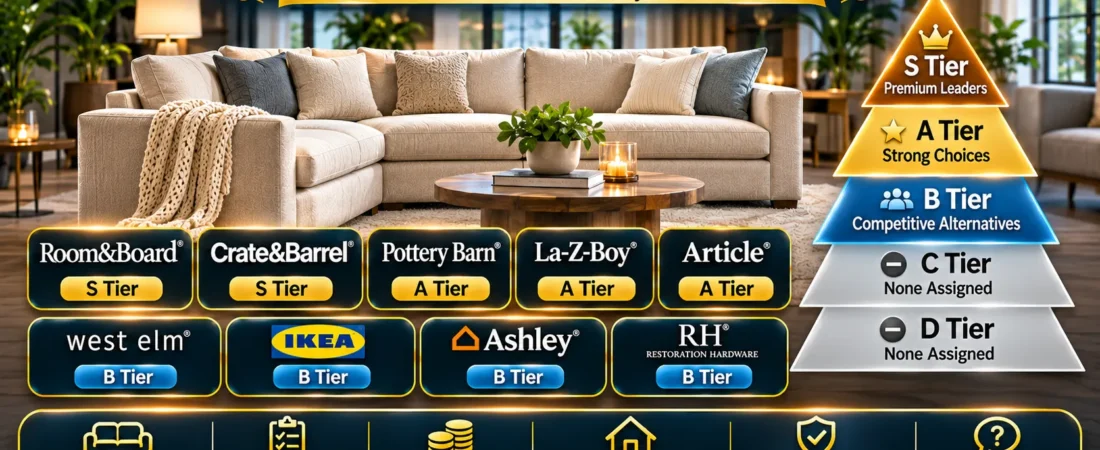
Updated November 2026 | Ranking Standard Furniture Brand Rankings
The best sofa brands 2026 offer more than attractive living room furniture. They give buyers meaningful choices in construction, seating comfort, upholstery, customization, and long-term ownership.
But finding the right brand is not straightforward.
A sofa from a luxury retailer can cost several times more than a comparable-looking model from a mainstream furniture company.
Does that higher price guarantee better construction?
Not necessarily.
Does an affordable sofa automatically have a shorter lifespan?
Not necessarily, either.
The furniture market is complicated because brands often sell products built with different materials, manufactured by different suppliers, and designed for different buyers.
Even within the same collection, upholstery choices and cushion configurations can change the ownership experience.
That makes broad statements such as “Brand A is always better than Brand B” unreliable.
At Ranking Standard, we believe sofa brands should be evaluated through a combination of construction transparency, seating options, materials, ownership considerations, and value.
This guide compares nine widely recognized furniture brands:
Room & Board, Crate & Barrel, Pottery Barn, La-Z-Boy, Article, West Elm, IKEA, Ashley, and RH.
Our goal is to help readers identify the brands worth investigating before comparing individual sofas.
New to sofa shopping? Start with our Ultimate Sofa Buying Guide to understand frame construction, cushion materials, upholstery, seating dimensions, and the factors that matter most before comparing furniture brands.
Best Sofa Brands 2026: The S–D Tier List
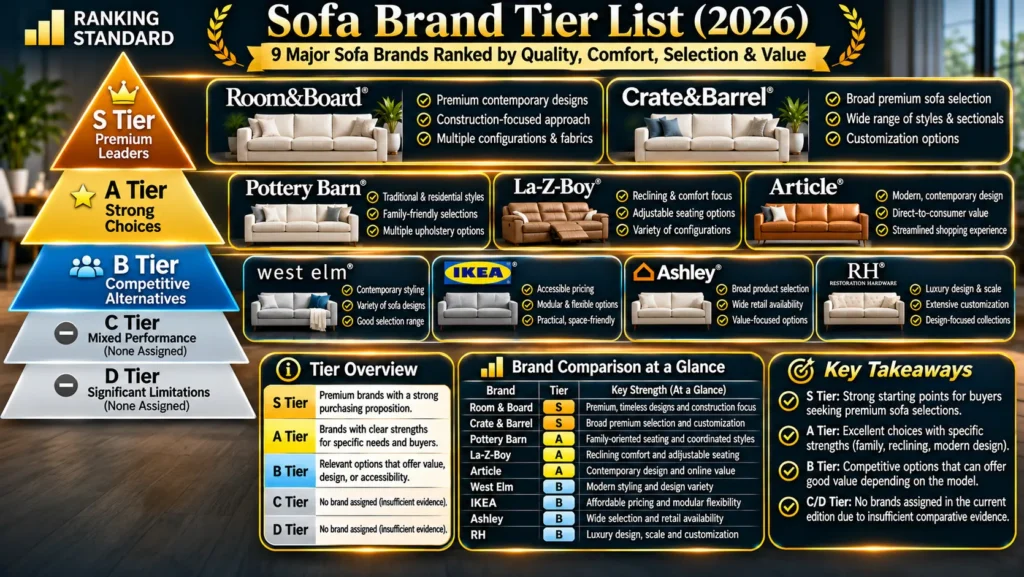
Ranking Standard organizes the selected brands into five potential tiers.
However, not every tier needs to contain a manufacturer.
A brand should not receive a negative classification simply because it is affordable, unfamiliar, or positioned differently from a luxury competitor.
The 2026 Sofa Brand Rankings
| Tier | Brand | Primary Strength | Best Starting Point For |
|---|---|---|---|
| S — Premium Leaders | Room & Board | Premium furniture selection and construction-focused positioning | Long-term furniture buyers |
| S — Premium Leaders | Crate & Barrel | Broad premium sofa portfolio | Buyers seeking style and customization |
| A — Strong Choices | Pottery Barn | Traditional and family-oriented collections | Family living rooms |
| A — Strong Choices | La-Z-Boy | Reclining and comfort-focused seating | Recliner buyers |
| A — Strong Choices | Article | Modern direct-to-consumer furniture | Contemporary homes |
| B — Competitive Alternatives | West Elm | Contemporary design variety | Design-focused buyers |
| B — Competitive Alternatives | IKEA | Accessible pricing and modular systems | Budget-conscious households |
| B — Competitive Alternatives | Ashley | Broad selection and retail availability | Value-focused shoppers |
| B — Competitive Alternatives | RH | Luxury design and customization | High-budget design buyers |
| C — Mixed Performance | None Assigned | Insufficient comparative evidence | — |
| D — Significant Limitations | None Assigned | Insufficient comparative evidence | — |
Important: These are provisional editorial classifications, not the results of identical laboratory testing or a statistically representative reliability survey.
Ranking Standard has not independently inspected every sofa sold by these manufacturers.
The tiers reflect general brand positioning, product-selection characteristics, and practical buying considerations. They should be treated as a framework for narrowing the search, not a verified hierarchy of product quality.
What the Tiers Actually Mean
S Tier — Premium Leaders
Brands that serve as strong starting points for buyers seeking premium furniture selections, multiple upholstery choices, and substantial product information.
S Tier does not mean that every sofa is exceptionally durable or that its price is always justified.
A Tier — Strong Choices
Brands with meaningful strengths in specific categories, such as reclining comfort, family-oriented furniture, or contemporary design.
An A-tier product may be the best purchase for a particular household.
B Tier — Competitive Alternatives
Brands that offer relevant products but require careful consideration of pricing, construction differences, or specialized market positioning.
B Tier should not be interpreted as poor quality.
C Tier — Mixed Performance
Reserved for manufacturers where sufficient comparable evidence supports meaningful concerns across a broader product range.
No manufacturer has been assigned this tier in the current edition.
D Tier — Significant Limitations
Reserved for manufacturers where credible evidence supports substantial concerns relevant to purchasing decisions.
No manufacturer has been assigned this tier in the current edition.
Not Yet Rated
Other sofa manufacturers are outside the scope of this comparison. Their absence should not be interpreted as a negative assessment.
How Ranking Standard Evaluates Sofa Brands
A useful sofa brand ranking should explain its evaluation criteria.
Otherwise, the result risks becoming little more than a list of famous furniture retailers.
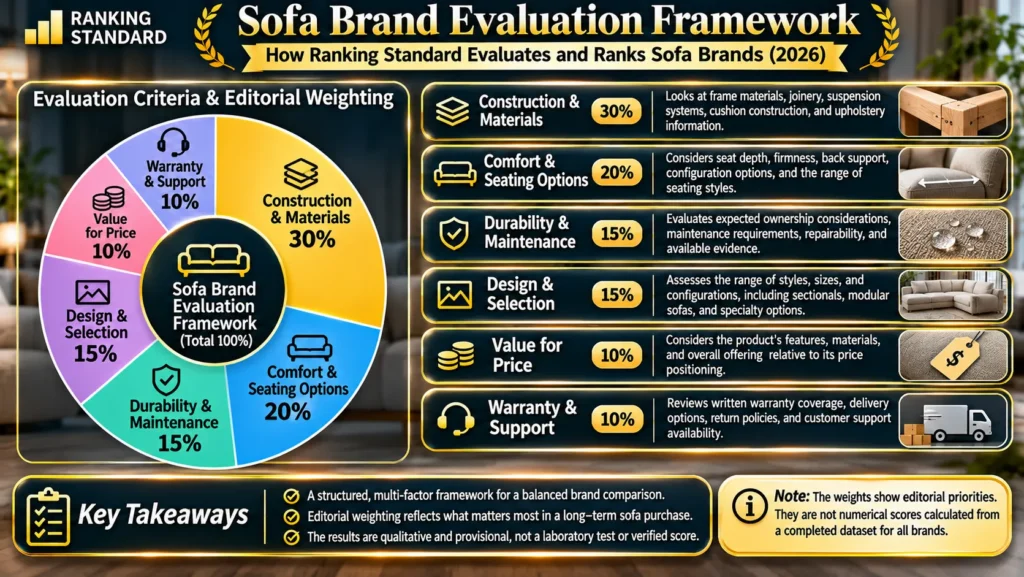
Our framework emphasizes six dimensions.
| Evaluation Category | Editorial Weight | What We Examine |
|---|---|---|
| Construction & Materials | 30% | Frame information, suspension, cushion materials, upholstery |
| Comfort & Seating Options | 20% | Seat configurations, depth options, customization |
| Durability & Maintenance | 15% | Maintenance requirements, repairability, available evidence |
| Design & Selection | 15% | Range of styles, dimensions, and configurations |
| Value for Price | 10% | Product characteristics relative to purchase cost |
| Warranty & Support | 10% | Written coverage, delivery, returns, service |
| Total | 100% |
These percentages express Ranking Standard’s editorial priorities.
They are not numerical scores calculated from a completed dataset for all nine brands.
The current rankings remain qualitative and provisional.
Construction and Materials — 30%
Construction receives the greatest emphasis because a sofa is a substantial furniture purchase.
We look for information about frame materials, structural joints, suspension systems, cushion construction, and upholstery.
However, a premium material name alone does not prove superior durability.
The quality of the complete design matters.
Comfort and Seating Options — 20%
Comfort is partly subjective.
Different households prefer different seat depths, firmness levels, back heights, and configurations.
We therefore consider the range of available seating options rather than declaring one universal comfort winner.
Durability and Maintenance — 15%
Long-term ownership matters.
But reliable durability comparisons require more than isolated customer reviews.
We consider available construction information, maintenance requirements, replacement components, and credible ownership evidence.
Where such evidence is incomplete, we avoid promising a particular lifespan.
Design and Selection — 15%
A broad product portfolio can help buyers find furniture that fits their space.
However, selection alone does not establish quality.
A specialized brand with fewer products may still offer an excellent choice for its intended audience.
Value for Price — 10%
Value depends on what the buyer receives for the money.
A premium sofa may justify its price through materials, customization, or design.
A budget sofa may offer better practical value for a temporary apartment.
Both outcomes can be reasonable.
Warranty and Support — 10%
Furniture ownership involves more than the initial purchase.
Delivery arrangements, return eligibility, warranty exclusions, and access to replacement components can influence the final decision.
Buyers should verify the written terms for the exact product and country.
S Tier: Premium Sofa Brands
Our provisional S Tier includes Room & Board and Crate & Barrel.
These brands are relevant starting points for buyers investigating premium sofas.
However, they should not be assumed to outperform every competing manufacturer.
Their placement reflects an editorial assessment of their overall purchasing proposition, not verified superiority across all construction or durability measures.
Room & Board — Premium Furniture With a Construction-Focused Approach
Ranking Standard Assessment: S Tier — Premium Leader
Room & Board is an important brand for buyers who want contemporary furniture with a relatively timeless appearance.
Its sofas tend to emphasize designs that can work across different interior styles rather than relying exclusively on short-lived decorative trends.
The brand offers various configurations, upholstery options, and seating dimensions.
This makes it a relevant starting point for consumers seeking a substantial furniture purchase.
Where Room & Board Stands Out
One of Room & Board’s main attractions is its combination of contemporary design and product customization.
Buyers can investigate different seating configurations and upholstery choices without necessarily moving toward highly decorative furniture.
Its portfolio is particularly relevant for people who prefer understated furniture that can remain visually appropriate as surrounding décor changes.
Potential strengths include:
- Contemporary and timeless designs
- Multiple sofa configurations
- Broad upholstery selections
- Product-specific construction information
- Premium furniture positioning
- Options for different room sizes
These characteristics make Room & Board worth investigating.
They do not establish that every model has the same internal construction or durability.
Construction: What Buyers Should Verify
A premium retailer should provide enough information for buyers to understand what they are purchasing.
For a Room & Board sofa, useful questions include:
- What materials are used in the frame?
- What suspension system supports the cushions?
- What is the cushion core made from?
- Are seat cushions reversible or replaceable?
- What cleaning instructions apply to the chosen upholstery?
- What does the warranty cover?
The answers may vary between models.
A buyer should therefore compare individual products rather than assuming uniform specifications across the entire brand.
Comfort and Seating Style
Room & Board offers sofas intended for different seating preferences.
Some buyers may prefer a structured, upright position.
Others may want a deeper seat suitable for relaxed lounging.
The most expensive configuration is not automatically the most comfortable.
A sofa that supports the buyer’s preferred posture is more valuable than one that simply appears luxurious.
Potential Limitations
Room & Board may be less attractive to buyers who prioritize the lowest possible purchase price.
Other considerations include:
- Premium pricing
- Upholstery-dependent maintenance
- Model-specific cushion construction
- Delivery arrangements
- Product-specific warranty terms
- Limited suitability for some international buyers
Consumers outside established service markets should verify delivery and support availability before purchasing.
A Practical Buying Scenario
Imagine a household furnishing a living room it expects to use for many years.
The buyers prefer a simple design and want to avoid replacing furniture merely because its appearance becomes unfashionable.
They are willing to pay more for a sofa if its dimensions, construction, upholstery, and maintenance requirements meet their expectations.
Room & Board would be a sensible brand to investigate.
However, the final choice should still depend on the specific model.
A less expensive sofa from another manufacturer may offer equally suitable comfort and construction.
Who Should Consider Room & Board?
Best starting point for:
- Buyers seeking premium contemporary furniture
- Households prioritizing understated design
- Consumers comparing upholstery and configuration options
- Long-term furniture shoppers
- Buyers willing to examine construction details
Less suitable for:
- Very limited budgets
- Buyers prioritizing the lowest upfront price
- Consumers without access to appropriate delivery or service support
Ranking Standard Verdict
Room & Board is a strong premium starting point for buyers who want contemporary designs and a broad selection of furniture configurations.
Its provisional S-tier placement reflects its positioning and purchasing proposition.
However, construction quality and long-term value must be verified at the model level.
S Tier — Premium Leader
Crate & Barrel — Broad Premium Selection and Design Flexibility
Ranking Standard Assessment: S Tier — Premium Leader
Crate & Barrel is one of the most recognizable premium home-furnishing retailers in the United States.
Its sofa portfolio includes a wide variety of styles, dimensions, configurations, and upholstery options.
This breadth is one of the brand’s most important advantages.
A buyer looking for a compact apartment sofa may find relevant options.
Another buyer seeking a large sectional for a family living room may also find suitable configurations.
However, a broad catalog introduces a challenge.
Different products may use different construction methods, cushion materials, and manufacturing arrangements.
The brand name alone cannot establish identical quality across every sofa.
Where Crate & Barrel Stands Out
Crate & Barrel is particularly relevant for buyers who want to compare multiple sofa styles within a premium retail environment.
Its product range may include:
- Standard sofas
- Apartment-sized sofas
- Large sectionals
- Modular configurations
- Deep-seated designs
- Multiple upholstery choices
- Different cushion and seating styles
This variety can make the brand useful during the early stages of furniture shopping.
A buyer can explore several design directions before narrowing the search to specific products.
The Advantage of Customization
Customization can help buyers select a sofa that fits their room and preferences.
However, additional choices create additional decisions.
A buyer may need to compare fabric durability, cushion firmness, seating depth, and delivery timelines.
Special-order upholstery may also affect cancellation and return eligibility.
Before placing a customized order, the buyer should confirm the applicable terms in writing.
Construction and Product-Line Variation
A major consideration with broad furniture retailers is variation between product lines.
One sofa may emphasize a structured seating position.
Another may prioritize deep, relaxed cushions.
A third may use a modular construction designed for flexible arrangements.
These products should not automatically receive the same construction assessment.
Buyers should examine:
- Frame specifications
- Suspension design
- Cushion materials
- Upholstery performance
- Warranty terms
- Replacement-part availability
When product information is incomplete, asking the retailer for clarification is preferable to assuming either high or low quality.
Potential Limitations
Crate & Barrel’s broad selection can make comparisons more complicated.
Potential trade-offs include:
- Premium pricing on selected collections
- Significant variation between sofa designs
- Upholstery-dependent maintenance
- Custom-order restrictions
- Delivery costs and lead times
- Differences in product-specific warranties
A large catalog is valuable only when buyers can identify the models that meet their actual needs.
A Practical Buying Scenario
Consider a family choosing furniture for a newly renovated living room.
The family wants a large sectional but has not decided between a structured design and a deep lounge-style sofa.
Crate & Barrel offers a useful starting point because the buyers can investigate different configurations and upholstery options.
However, the family should not select a product solely because it looks attractive in a staged interior photograph.
They should measure the room, verify delivery access, and compare seat depth and cushion construction.
Who Should Consider Crate & Barrel?
Best starting point for:
- Buyers seeking a broad premium sofa selection
- Households comparing sectionals and standard sofas
- Consumers interested in upholstery customization
- Design-conscious buyers
- Families furnishing larger living spaces
Less suitable for:
- Buyers seeking the lowest possible price
- Consumers unwilling to review product-specific details
- Households requiring highly flexible return conditions for custom orders
Ranking Standard Verdict
Crate & Barrel offers a substantial premium sofa portfolio with useful design and customization options.
Its provisional S-tier placement reflects its broad purchasing appeal.
However, the quality and value of individual products should be evaluated independently.
S Tier — Premium Leader
Room & Board vs. Crate & Barrel: Which S-Tier Brand Is Better?
Both brands offer relevant options for premium sofa buyers.
However, their appeal differs.
Room & Board is a useful starting point for buyers who favor relatively timeless contemporary designs.
Crate & Barrel may be particularly attractive to shoppers who want to compare a wide variety of styles and configurations.
Neither distinction establishes superior durability.
S-Tier Brand Comparison Matrix
| Buying Factor | Room & Board | Crate & Barrel |
|---|---|---|
| General Positioning | Premium contemporary furniture | Broad premium home furnishings |
| Design Appeal | Understated, timeless styling | Wide variety of styles |
| Sofa Selection | Multiple configurations | Extensive configurations |
| Upholstery Choices | Broad selection | Broad selection |
| Construction | Model-specific verification required | Model-specific verification required |
| Comfort | Depends on selected model | Depends on selected model |
| Long-Term Durability | Insufficient evidence for universal superiority | Insufficient evidence for universal superiority |
| Price | Premium | Premium |
| Best Starting Point | Timeless contemporary interiors | Broad design exploration |
The Decision That Matters More Than Brand Reputation
Imagine comparing two sofas at similar prices.
The Room & Board model has the dimensions and seating firmness the buyer prefers.
The Crate & Barrel model offers more upholstery choices but has a deeper seat that feels uncomfortable during upright sitting.
For that buyer, Room & Board may be the better purchase.
Now consider another household.
Its members prefer deep lounging, want a large sectional, and find a Crate & Barrel configuration that fits their room particularly well.
For them, Crate & Barrel may be the better choice.
Neither conclusion requires declaring one manufacturer universally superior.
The correct sofa is determined by the specific product and the household—not simply by which brand occupies the highest tier.
Why S Tier Does Not Mean Every Sofa Is Worth Buying
Premium positioning can help narrow the search.
It cannot replace product evaluation.
A high-priced sofa may offer exceptional styling but require more cushion maintenance than the buyer expects.
Another may use attractive upholstery that is poorly suited to a household with pets.
A third may have excellent construction but an uncomfortable seat depth for the intended user.
These are not necessarily manufacturing defects.
They are examples of a mismatch between the product and the buyer.
Before purchasing any premium sofa, confirm:
Room dimensions → Seat comfort → Frame and suspension → Cushion construction → Upholstery → Maintenance → Warranty → Total price
This sequence helps prevent brand reputation from overshadowing practical requirements.
A sofa should earn its place in the home through its suitability, not simply through its name.
A Tier: Strong Sofa Brands Worth Considering
An A-tier sofa brand should not be interpreted as a second-rate choice.
For many households, a well-selected sofa from an A-tier manufacturer may be more suitable than a premium model from an S-tier retailer.
The difference often comes down to seating preferences, product specialization, upholstery options, and the total cost of ownership.
Pottery Barn, La-Z-Boy, and Article illustrate three different approaches to the sofa market.
Pottery Barn emphasizes residential furniture and traditional design flexibility.
La-Z-Boy specializes in comfort-oriented seating, particularly reclining furniture.
Article focuses on contemporary designs and a direct-to-consumer shopping experience.
Each brand deserves consideration for different reasons.
Pottery Barn — Traditional Comfort and Family-Oriented Furniture
Ranking Standard Assessment: A Tier — Strong Choice
Pottery Barn is a recognizable home-furnishing retailer offering sofas, sectionals, chairs, and other living-room furniture.
Its collections often emphasize comfortable residential interiors, familiar silhouettes, and coordinated furniture designs.
For buyers furnishing a family living room, this can be attractive.
However, the brand’s broad catalog also means that construction, cushion materials, and upholstery options vary between products.
Where Pottery Barn Stands Out
Pottery Barn offers a wide selection of sofa configurations.
Depending on the collection, buyers may find:
- Standard sofas and loveseats
- Large family sectionals
- Deep-seated lounging designs
- Sleeper sofas
- Multiple upholstery choices
- Customization options
- Coordinating living-room furniture
This variety makes the brand useful for households seeking a cohesive interior.
Its strongest appeal is not necessarily a single construction technology.
It is the ability to compare different seating styles and upholstery options within a familiar furniture retailer.
The Importance of Cushion Selection
A sofa’s cushion construction strongly influences everyday comfort.
Some buyers prefer a structured seat that maintains a relatively tailored appearance.
Others prefer a softer, relaxed design.
Pottery Barn’s different collections may accommodate these preferences, but buyers should verify the actual cushion specifications.
A product described as plush may require more frequent reshaping.
A firmer-feeling sofa may provide a different seating experience.
Neither is automatically more durable.
What Buyers Should Check
Before purchasing, confirm:
- Frame materials and construction
- Suspension design
- Cushion core and filling
- Seat depth and height
- Upholstery cleaning requirements
- Custom-order return conditions
- Warranty coverage
A customized sofa may have different cancellation and return terms from a standard-stock product.
These details can materially affect the purchase.
A Practical Buying Scenario
Imagine a family furnishing a living room used for television, conversation, and occasional guests.
The buyers want a comfortable sectional with upholstery that can be maintained without excessive difficulty.
Pottery Barn is a reasonable brand to investigate because of its range of residential seating options.
However, the family should compare the exact upholstery specifications and cushion construction before choosing.
A product’s appearance in a catalog cannot establish its long-term suitability.
Potential Limitations
- Premium pricing on selected collections
- Product-line differences
- Upholstery-dependent maintenance
- Potential restrictions on customized orders
- Delivery and lead-time considerations
Who Should Consider Pottery Barn?
Best for: Family living rooms, traditional or transitional interiors, and buyers seeking upholstery and configuration choices.
Less suitable for: Buyers prioritizing the lowest purchase price or highly simplified product selection.
Ranking Standard Verdict
Pottery Barn is a strong A-tier starting point for households seeking comfortable residential furniture and a broad range of configurations.
Its value depends on the individual sofa’s construction, comfort, and maintenance requirements.
A Tier — Strong Choice
La-Z-Boy — Reclining Comfort and Specialized Seating
Ranking Standard Assessment: A Tier — Strong Choice
La-Z-Boy occupies a distinctive position in the sofa market.
While many furniture retailers emphasize fixed-frame sofas, La-Z-Boy is particularly associated with reclining chairs and motion furniture.
This specialization makes it relevant for buyers seeking adjustable seating positions.
A reclining sofa serves a different purpose from a conventional sofa.
It introduces additional comfort options, but also mechanical components that should be evaluated carefully.
Where La-Z-Boy Stands Out
La-Z-Boy offers seating designed around adjustable comfort.
Depending on the product, features may include:
- Manual reclining mechanisms
- Powered reclining options
- Adjustable leg support
- Different seat configurations
- Various upholstery selections
- Motion-focused furniture designs
These features can be useful for households that spend substantial time watching television or relaxing in a seated position.
However, a reclining mechanism should not automatically be interpreted as a comfort advantage for every buyer.
Some people prefer the simplicity and appearance of a fixed sofa.
Understanding Recliner Mechanisms
A reclining sofa contains components that a conventional sofa may not require.
These can include:
- Hinges and linkages
- Manual operating mechanisms
- Electric motors
- Power supplies
- Electronic controls
The presence of additional moving parts creates additional maintenance considerations.
That does not mean reclining sofas are inherently unreliable.
It means buyers should evaluate mechanism construction, service availability, and warranty coverage.
The Hidden Cost of Powered Furniture
A powered reclining sofa may offer convenient adjustment.
However, buyers should consider the possibility of future repairs.
Important questions include:
- What is the motor warranty?
- Are replacement parts available?
- Does the warranty cover labor?
- Is in-home service available?
- What happens if the electrical system stops working?
- Can the sofa still be used comfortably without power?
These questions matter more than the number of adjustment buttons.
A Practical Buying Scenario
Consider a household furnishing a media room.
The owners regularly watch films and prefer adjustable leg support.
A reclining sofa may offer meaningful benefits compared with a conventional fixed sofa.
In this situation, La-Z-Boy deserves consideration.
However, if the room is used primarily for conversation and entertaining, a standard sofa may provide better flexibility.
Potential Limitations
- Mechanical complexity
- Additional maintenance considerations
- Potentially bulky designs
- Space requirements for reclining
- Product-specific motor and mechanism warranties
Who Should Consider La-Z-Boy?
Best for: Reclining sofas, media rooms, and buyers prioritizing adjustable seating.
Less suitable for: Buyers seeking minimalist fixed-frame furniture or the simplest possible maintenance.
Ranking Standard Verdict
La-Z-Boy earns its provisional A-tier placement through its specialization in reclining and comfort-oriented seating.
For buyers who genuinely need those functions, it may be more relevant than a general premium furniture retailer.
A Tier — Strong Choice
Article — Contemporary Design and Direct-to-Consumer Value
Ranking Standard Assessment: A Tier — Strong Choice
Article is known for contemporary furniture sold through a direct-to-consumer business model.
Its product selection emphasizes modern designs, relatively streamlined shopping, and coordinated furniture collections.
This positioning can appeal to buyers who want a contemporary sofa without navigating a traditional showroom-heavy purchasing process.
However, a direct-to-consumer model does not automatically guarantee superior construction or lower ownership costs.
Where Article Stands Out
Article’s main strengths relate to design accessibility and a relatively focused furniture shopping experience.
Potential advantages include:
- Contemporary sofa designs
- Streamlined product presentation
- Multiple upholstery and configuration options
- Direct online purchasing
- Coordinated furniture collections
- Options for different room sizes
For buyers furnishing a modern apartment or contemporary living room, Article may offer attractive choices.
The Online Comfort Problem
One of the main challenges with purchasing furniture online is the inability to evaluate seating comfort directly.
A product photograph cannot fully communicate:
- Seat firmness
- Cushion resilience
- Back support
- Upholstery texture
- Seat depth
- How the sofa feels after extended sitting
Detailed specifications can reduce uncertainty.
However, they cannot completely replace a physical seating trial.
Buyers should therefore review return conditions carefully.
Construction Transparency
Article sofas should be evaluated individually.
Buyers should look for information about:
- Frame materials
- Cushion construction
- Suspension
- Upholstery
- Seat dimensions
- Warranty coverage
- Assembly requirements
If important information is missing, contacting the retailer is preferable to assuming that the product is either exceptionally durable or poorly constructed.
A Practical Buying Scenario
Imagine a buyer furnishing a modern apartment.
The buyer prefers clean lines and wants a sofa that complements a minimalist interior.
Article offers relevant options.
However, the buyer should compare the sofa’s dimensions with the available space and verify whether the seat depth suits their preferred posture.
If the product is purchased online without testing, the return policy becomes particularly important.
Potential Limitations
- Limited opportunity for in-person comfort testing in some markets
- Product-specific construction differences
- Delivery and return considerations
- Upholstery-dependent maintenance
- Regional availability limitations
Who Should Consider Article?
Best for: Contemporary interiors, apartment living, and buyers comfortable with online furniture shopping.
Less suitable for: Buyers who require extensive in-person testing before purchase.
Ranking Standard Verdict
Article is a relevant A-tier option for buyers seeking contemporary design and a streamlined purchasing experience.
Its value should be assessed through the specific product’s construction, comfort, and total delivered cost.
A Tier — Strong Choice
B Tier: Competitive Sofa Brands With Different Strengths
B-tier brands should not be interpreted as poor-quality manufacturers.
The classification reflects differences in market positioning, pricing strategies, product selection, and purchasing trade-offs.
In some cases, a B-tier brand may offer the most suitable sofa for a particular household.
This is especially important in furniture, where comfort and room suitability are highly individual.
The four brands in this tier serve different buyers.
West Elm emphasizes contemporary design.
IKEA focuses on accessibility and practical furniture systems.
Ashley offers broad retail availability across accessible price segments.
RH occupies a luxury design market with substantial emphasis on aesthetics and customization.
Their differences matter more than the tier label alone.
West Elm — Contemporary Styling and Design Flexibility
Ranking Standard Assessment: B Tier — Competitive Alternative
West Elm is a recognizable furniture retailer associated with contemporary interior design.
Its sofa collections often emphasize modern silhouettes, varied upholstery, and coordinated living-room furniture.
For design-conscious buyers, this can be attractive.
However, a broad selection does not establish consistent construction across every model.
Where West Elm Stands Out
- Contemporary design variety
- Multiple sofa configurations
- Upholstery options
- Apartment and living-room furniture
- Coordinating home accessories
- Customization on selected products
The brand’s main appeal is its design selection.
Buyers can compare sofas that suit different interior styles without moving exclusively into the luxury price segment.
What Buyers Should Check
Construction and comfort should be evaluated at the model level.
Important considerations include:
- Frame specifications
- Cushion materials
- Suspension design
- Seat dimensions
- Upholstery performance
- Custom-order return terms
A fashionable silhouette should not be treated as evidence of long-term durability.
A Practical Buying Scenario
Consider a buyer who wants a contemporary sofa for a newly furnished apartment.
The buyer prefers a specific silhouette and upholstery color.
West Elm may offer a suitable design.
However, if a competing sofa provides better seating comfort and clearer construction information at a similar price, that alternative may be the stronger purchase.
Ranking Standard Verdict
West Elm is a competitive option for buyers who prioritize contemporary styling.
Its B-tier placement reflects the need for careful model-level evaluation, not proof of inferior construction.
B Tier — Competitive Alternative
IKEA — Affordable Furniture and Modular Flexibility
Ranking Standard Assessment: B Tier — Competitive Alternative
IKEA occupies an important position in the global furniture market.
Its sofas are particularly relevant for buyers seeking accessible prices, compact dimensions, and practical furniture systems.
The company also offers selected modular sofas and products with removable covers.
However, construction and ownership characteristics vary considerably across its collections.
Where IKEA Stands Out
IKEA’s strongest advantages often include:
- Accessible price segments
- Compact furniture options
- Modular seating systems
- Removable covers on selected products
- Standardized product information
- Broad international presence
These characteristics make IKEA relevant for apartments, temporary homes, and households seeking flexible furniture.
Why Removable Covers Matter
A removable cover can provide practical benefits.
It may make cleaning or changing the appearance of a sofa easier.
However, removable does not necessarily mean machine washable.
Buyers must follow the care instructions for the exact fabric.
Replacement covers may also be available only for certain models or periods.
The Modular Advantage
Some IKEA sofa systems allow buyers to combine seating modules.
This can be useful for households that expect their room layout to change.
However, modular flexibility depends on the specific system.
Buyers should verify whether additional modules and replacement components remain available.
A Practical Buying Scenario
Imagine a household furnishing an apartment for a relatively short period.
The buyers expect to move again and do not want to invest heavily in furniture that may not fit their next home.
An affordable IKEA sofa may be a sensible choice.
A more expensive premium sofa could offer little additional practical value in this situation.
Potential Limitations
- Construction differences across product lines
- Variable cushion characteristics
- Model-specific cover availability
- Assembly requirements
- Limited customization on some products
Ranking Standard Verdict
IKEA offers meaningful value for buyers prioritizing affordability, modularity, and practical furniture design.
Its B-tier placement should not discourage buyers from considering suitable individual models.
B Tier — Competitive Alternative
Ashley — Broad Selection and Accessible Pricing
Ranking Standard Assessment: B Tier — Competitive Alternative
Ashley is a major furniture name with extensive retail distribution and a broad range of residential seating products.
Its market position makes it relevant to buyers seeking conventional sofa designs across accessible price segments.
However, the size of its catalog means that construction and materials can differ substantially between collections.
Where Ashley Stands Out
- Broad product selection
- Extensive retail availability
- Multiple seating configurations
- Accessible price options
- Traditional and contemporary designs
- Reclining furniture choices
For many buyers, Ashley’s main advantage is the ability to compare numerous furniture options within a familiar retail environment.
The Importance of Collection-Level Comparison
A large furniture catalog should not be evaluated as if every product were identical.
One collection may emphasize affordability.
Another may offer more elaborate upholstery or reclining functions.
Buyers should compare the exact sofa’s specifications.
Useful questions include:
- What materials are used in the frame?
- What is the cushion construction?
- Is the upholstery suitable for the household?
- What warranty applies?
- What is the final delivered price?
A Practical Buying Scenario
Consider a household with a fixed furniture budget.
The buyers need a conventional three-seat sofa and want to compare several styles before making a decision.
Ashley may offer relevant options.
However, a low advertised price should be compared with delivery, assembly, and potential maintenance costs.
Potential Limitations
- Wide product-line variation
- Model-specific construction information
- Different retail and service arrangements
- Upholstery-dependent maintenance
- Price differences between sellers
Ranking Standard Verdict
Ashley is a relevant B-tier alternative for buyers seeking accessible furniture and broad retail selection.
Its products should be evaluated individually rather than through assumptions about the entire brand.
B Tier — Competitive Alternative
RH — Luxury Design and Premium Customization
Ranking Standard Assessment: B Tier — Competitive Alternative
RH occupies a different market position from most other brands in this comparison.
Its furniture emphasizes luxury interiors, substantial proportions, premium styling, and design-focused collections.
Some buyers may reasonably wonder why a luxury-oriented brand appears in B Tier rather than S Tier.
The answer lies in Ranking Standard’s distinction between luxury positioning and practical purchasing value.
Why RH Is Different
RH’s appeal is strongly connected to aesthetics.
Its sofas may feature:
- Large-scale proportions
- Distinctive luxury styling
- Extensive upholstery options
- Deep-seated configurations
- Coordinated premium interiors
- Design-focused collections
These characteristics can be valuable to buyers who prioritize a particular interior style.
However, they do not automatically establish superior comfort or durability.
Luxury Price vs. Practical Value
A sofa can be expensive for several reasons.
These may include:
- Premium materials
- Design development
- Customization
- Manufacturing complexity
- Distribution costs
- Brand positioning
Some of these factors may improve the ownership experience.
Others may primarily influence aesthetics or exclusivity.
Neither is inherently illegitimate.
But buyers should understand what they are paying for.
Why RH Is Provisionally B Tier
RH’s placement does not mean that its sofas are poorly made.
Nor does it establish that its construction is inferior to that of Room & Board or Crate & Barrel.
Instead, the classification reflects a value-oriented editorial framework in which high purchase prices require clear justification through relevant product benefits.
The available evidence does not support a universal claim that RH provides superior durability across its portfolio.
At the same time, there is insufficient comparable evidence to prove that RH offers worse construction than the higher-tier brands.
Therefore, RH’s B-tier placement should be interpreted as a purchasing-value judgment, not an objective quality ranking.
A future evidence-based reassessment could change this classification.
A Practical Buying Scenario
Imagine a buyer furnishing a large luxury residence.
The buyer wants a particular sofa silhouette, generous proportions, and coordinated furniture.
RH may offer exactly the desired design.
In that situation, the aesthetic benefits may justify the purchase price.
Now consider a household primarily seeking comfortable, durable everyday seating.
If a substantially less expensive sofa provides comparable comfort and suitable construction, the premium may be difficult to justify.
The correct decision depends on the buyer’s priorities.
Potential Limitations
- High purchase prices
- Large furniture dimensions
- Upholstery-dependent maintenance
- Potentially restrictive custom-order conditions
- Value that depends heavily on design preferences
Ranking Standard Verdict
RH is a legitimate luxury furniture option for buyers who prioritize design, scale, and customization.
Its provisional B-tier placement reflects a value-oriented assessment rather than a negative judgment about its overall quality.
B Tier — Competitive Alternative
Sofa Brand Strengths Matrix: All Nine Brands Compared
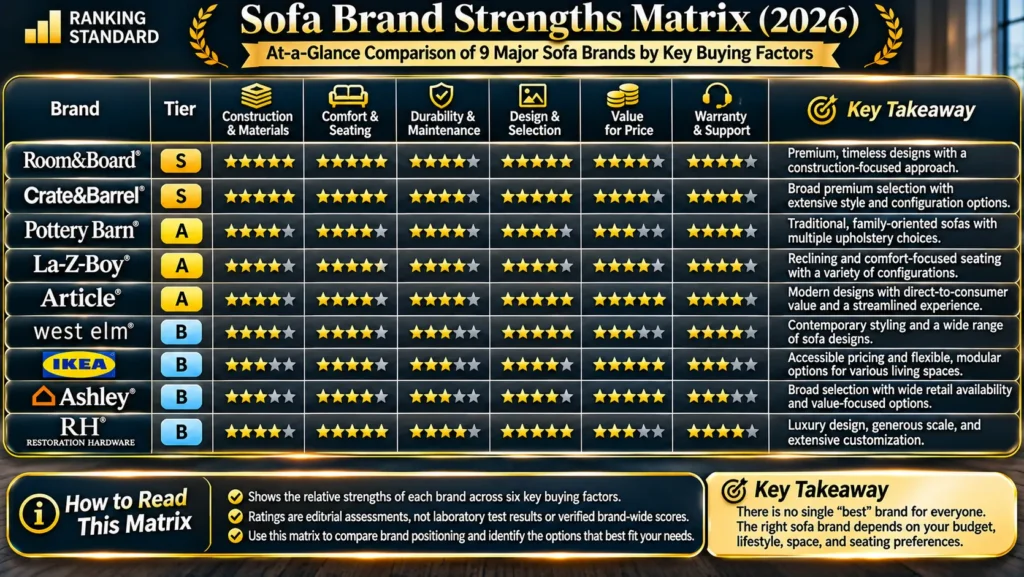
The following matrix summarizes the distinctive purchasing propositions of the nine brands.
These are qualitative editorial descriptions rather than standardized performance scores.
| Brand | Tier | Primary Strength | Main Trade-Off | Best Starting Point |
|---|---|---|---|---|
| Room & Board | S | Timeless premium design | Higher purchase cost | Long-term furniture shoppers |
| Crate & Barrel | S | Broad premium selection | Product-line variation | Customization and sectionals |
| Pottery Barn | A | Family-oriented collections | Upholstery and order complexity | Family living rooms |
| La-Z-Boy | A | Reclining specialization | Mechanical maintenance | Adjustable seating |
| Article | A | Contemporary online shopping | Limited physical testing | Modern apartments |
| West Elm | B | Contemporary styling | Model-specific construction | Design-focused buyers |
| IKEA | B | Affordability and modularity | Collection-level differences | Budget and flexible living |
| Ashley | B | Broad retail selection | Variation across collections | Value-focused shoppers |
| RH | B | Luxury design and scale | High price premium | Luxury interiors |
The matrix should help buyers identify brands worth investigating.
It should not be interpreted as proof that every S-tier sofa is superior to every A- or B-tier sofa.
Which Sofa Brand Is Best for Your Home?
Different households should begin their search with different manufacturers.
Best Starting Point for Premium Contemporary Furniture
Room & Board
Relevant for buyers seeking relatively timeless designs and premium furniture selections.
Best Starting Point for Broad Premium Sofa Selection
Crate & Barrel
Useful for buyers comparing different styles, upholstery options, and sectional configurations.
Best Starting Point for Traditional Family Living Rooms
Pottery Barn
Worth investigating for comfortable residential seating and coordinated interiors.
Best Starting Point for Reclining Comfort
La-Z-Boy
Particularly relevant when adjustable seating is a major purchasing priority.
Best Starting Point for Modern Online Furniture Shopping
Article
A useful option for buyers seeking contemporary design through a streamlined online shopping process.
Best Starting Point for Contemporary Styling
West Elm
Worth comparing when the sofa’s design and silhouette are important.
Best Starting Point for Budget-Conscious Buyers
IKEA
Relevant for accessible pricing, compact dimensions, and selected modular systems.
Best Starting Point for Broad Retail Availability
Ashley
Useful for buyers who want to compare conventional sofas across multiple accessible price segments.
Best Starting Point for Luxury Design
RH
Relevant for buyers who prioritize large-scale luxury furniture and a specific aesthetic.
The Most Important Lesson From the Brand Rankings
A sofa brand ranking can help buyers decide where to begin.
It cannot determine which sofa will be most comfortable, durable, or appropriate for every household.
A lower-priced sofa may offer excellent value for a temporary apartment.
A reclining sofa may be more useful than a premium fixed-frame design for someone who prioritizes adjustable comfort.
A luxury sofa may justify its price for a buyer who values its design.
The final purchasing decision should follow a practical sequence:
Room Size → Seat Comfort → Construction → Upholstery → Maintenance → Warranty → Total Price → Brand
This sequence puts the household’s needs ahead of brand reputation.
A sofa should be selected because it works for the buyer—not because its manufacturer occupies a particular tier.
How Much Should You Spend on a Sofa?
One of the most difficult questions in furniture shopping is deciding how much to spend.
A sofa may cost a few hundred dollars or well over $10,000.
The difference can reflect construction, materials, size, customization, design, manufacturing arrangements, and brand positioning.
However, price alone does not establish durability.
A more expensive sofa is not automatically more comfortable.
And an affordable sofa is not automatically a poor investment.
The most useful approach is to define a budget and identify which product characteristics matter within that range.
Sofa Price Segments: A Practical Buying Framework
The following ranges are broad U.S.-market planning categories, not verified retail-price averages for November 2026.
| Budget | Market Segment | Brands Worth Investigating | Main Buying Priority |
|---|---|---|---|
| Under $800 | Entry-Level | IKEA, Ashley | Practical affordability |
| $800–$1,500 | Affordable | IKEA, Ashley, selected Article models | Comfort and basic construction |
| $1,500–$3,000 | Mid-Range | Article, West Elm, Pottery Barn, selected La-Z-Boy models | Materials and seating comfort |
| $3,000–$6,000 | Premium | Room & Board, Crate & Barrel, Pottery Barn, La-Z-Boy | Construction, upholstery, customization |
| Above $6,000 | Luxury | RH, premium Room & Board and Crate & Barrel collections | Design, scale, specialized options |
These are shopping starting points rather than claims that every listed brand consistently offers sofas within each range.
Large sectionals, reclining configurations, and customized upholstery may cost substantially more than standard sofas.
Buyers should confirm current prices for the exact models they are considering.
Under $800: Prioritize Function Over Prestige
At the entry level, buyers should focus on practical requirements.
The sofa needs to fit the room, provide acceptable seating comfort, and offer appropriate construction for its intended use.
A relatively inexpensive sofa may be sensible for a first apartment, temporary residence, or secondary room.
What to Prioritize
- Appropriate dimensions
- Stable construction
- Comfortable seating
- Clear assembly instructions
- Manageable delivery costs
- Understandable warranty terms
At this price level, buyers should be particularly careful about judging quality from photographs alone.
A sofa can look substantial online while using lightweight construction or relatively simple cushion materials.
However, inexpensive materials do not automatically make a product unsuitable.
The correct question is whether the sofa meets the buyer’s expectations at a reasonable total cost.
Brands Worth Investigating
IKEA and Ashley are relevant starting points because they offer furniture across accessible price segments.
However, product availability and specifications vary.
A buyer should compare individual models rather than assuming that either brand is universally better.
$800–$1,500: Look for Meaningful Improvements
This budget may provide access to a broader selection of upholstery, seating configurations, and designs.
However, buyers should avoid assuming that a higher price automatically delivers better construction.
Instead, look for specific improvements.
These may include:
- Better-documented frame materials
- More suitable cushion construction
- Additional upholstery choices
- Improved seating comfort
- More practical dimensions
- Clearer warranty and service information
Brands Worth Investigating
IKEA, Ashley, and selected Article models may be relevant, depending on current pricing.
However, buyers should remain flexible.
A discounted product from another manufacturer may provide better value than a full-priced model within the expected budget category.
$1,500–$3,000: Evaluate the Construction Carefully
The mid-range segment is where buyers should begin expecting more detailed product information.
A sofa in this price range should justify its cost through meaningful characteristics.
These may include better materials, improved seating options, customization, or construction transparency.
However, not every model will provide all of these benefits.
Brands Worth Investigating
Article, West Elm, Pottery Barn, and selected La-Z-Boy models are useful starting points.
The correct choice depends on the buyer’s priorities.
For example, someone seeking a contemporary fixed-frame sofa may prefer Article or West Elm.
A buyer seeking reclining functionality may find La-Z-Boy more relevant.
A family looking for a traditional sectional may want to investigate Pottery Barn.
The Key Buying Question
What am I receiving for the additional money?
If the answer is primarily a preferred design, that may still be worthwhile.
But buyers should distinguish aesthetic value from measurable construction advantages.
$3,000–$6,000: Premium Sofas Require Closer Scrutiny
At premium prices, buyers should examine construction and ownership considerations more carefully.
A high price creates an expectation of meaningful benefits.
These may include extensive upholstery options, specialized dimensions, premium materials, or more elaborate construction.
However, the benefits should be verified rather than assumed.
Brands Worth Investigating
Room & Board, Crate & Barrel, Pottery Barn, and La-Z-Boy may offer relevant products in this segment.
Some configurations may fall outside the range.
Questions Worth Asking
- What materials are used in the frame?
- What suspension system is installed?
- What is the cushion construction?
- Are replacement cushions available?
- Can upholstery be repaired or replaced?
- What does the warranty cover?
- What happens if the sofa develops a problem?
- Are delivery and service charges included?
These questions help buyers distinguish a genuinely suitable premium product from one whose appeal depends mainly on styling.
Above $6,000: Understand What Luxury Adds
Luxury furniture can offer distinctive design, substantial proportions, specialized upholstery, and extensive customization.
For some buyers, these features justify the cost.
However, luxury positioning should not be confused with universal functional superiority.
Brands Worth Investigating
RH and selected premium collections from Room & Board and Crate & Barrel may be relevant.
The correct choice depends on the exact product and the buyer’s design priorities.
When Luxury Makes Sense
A luxury sofa may be a reasonable purchase when the buyer values a particular design, scale, material, or customization option that is difficult to obtain elsewhere.
When Luxury May Not Be Worth It
If the buyer primarily wants comfortable everyday seating, a substantially less expensive sofa may meet those needs equally well.
The key is to understand which benefits are functional and which are aesthetic.
Ranking Standard Buying Principle: Pay for the features and qualities you actually value, not simply for the prestige of the price tag.
Why Sofa Brand Rankings Are More Difficult Than They Appear
Sofa brands are challenging to compare because they often sell products with different construction methods and intended uses.
One manufacturer may offer compact apartment sofas, large sectionals, sleeper sofas, and reclining furniture.
These products cannot always be evaluated using identical criteria.
A reclining sofa introduces mechanical components.
A modular sofa depends on the quality of its connections.
A deep-seated lounge sofa may require different cushion construction from a structured upright design.
Therefore, a brand-level ranking must be interpreted carefully.
The Problem With Brand-Wide Durability Claims
A manufacturer may offer hundreds of different furniture products.
Even if one model performs well over time, that does not establish the durability of the entire catalog.
Likewise, one negative customer experience does not prove that a brand’s products are generally unreliable.
Reliable brand-wide durability conclusions would require substantial comparable evidence.
That evidence is not consistently available across the sofa market.
Why Customer Reviews Are Not Enough
Customer reviews can provide useful information about delivery, comfort, and ownership experiences.
However, they have limitations.
Different buyers may have different expectations.
A sofa that feels too firm to one person may feel appropriately supportive to another.
Delivery complaints may involve a retailer, logistics provider, or local service arrangement rather than the sofa’s construction.
Reviews may also overrepresent unusually positive or negative experiences.
For these reasons, Ranking Standard treats customer feedback as one source of information rather than definitive proof of product quality.
When Should a Sofa Brand Move Up or Down a Tier?
The S–D classification is intended to evolve as better information becomes available.
A brand should not move higher simply because it introduces an expensive collection.
Nor should it move lower because of one unfavorable review.
Meaningful changes require credible evidence.
Reasons a Brand Might Move Higher
A manufacturer may deserve reassessment when it demonstrates:
- More transparent construction specifications
- Consistently competitive product quality
- Better documented warranty and service support
- Improved repairability
- More attractive ownership value
- Credible independent performance evidence
Reasons a Brand Might Move Lower
A manufacturer may warrant reassessment if credible evidence reveals:
- Recurring structural problems across comparable products
- Meaningful deterioration in materials or construction
- Persistent warranty or service limitations
- Significant reductions in ownership value
- Repeated problems supported by reliable evidence
These considerations should be evaluated carefully.
A single product issue should not automatically determine the classification of an entire brand.
Why C and D Tiers Remain Unassigned
Ranking Standard does not believe every tier must contain a manufacturer.
A negative classification should require sufficient supporting evidence.
A brand should not receive C or D Tier merely because it is inexpensive, unfamiliar, or outside the premium market.
For the current edition, no manufacturer has been assigned either category.
Other brands remain Not Yet Rated until there is enough relevant information to support a useful comparison.
Sofa Warranty Comparison: What Matters More Than the Headline
Furniture warranties can be complicated.
A manufacturer may advertise a long structural warranty while providing shorter coverage for cushions, upholstery, mechanisms, or labor.
The headline warranty period therefore tells only part of the story.
The Components Buyers Should Check
| Component | Important Warranty Questions |
|---|---|
| Frame | What structural defects are covered? |
| Suspension | Are springs or webbing included? |
| Cushions | Is compression or loss of firmness excluded? |
| Upholstery | What wear, fading, or staining exclusions apply? |
| Reclining Mechanisms | Are moving components covered? |
| Motors & Electronics | What is the coverage period? |
| Labor | Are repair costs included? |
| Transportation | Who pays shipping or collection costs? |
These details can be more important than the length of the headline warranty.
Why a Lifetime Frame Warranty Is Not a Lifetime Sofa Warranty
A frame warranty may cover specified structural defects.
It does not necessarily cover normal cushion softening, upholstery wear, or accidental damage.
A sofa may remain structurally sound while becoming less comfortable.
Buyers should therefore read the complete written warranty rather than relying on marketing language.
International Buyers Should Be Especially Careful
Warranty and service arrangements may differ by country.
A sofa purchased from an overseas retailer may not receive the same support as a product sold through an authorized local distributor.
Buyers should verify regional warranty eligibility before purchasing.
Delivery and Returns: The Hidden Part of Sofa Value
A sofa is a large, expensive product.
Delivery and returns can therefore create substantial costs and inconvenience.
This is particularly important for customized furniture.
Standard Stock vs. Custom Orders
A standard-stock sofa may have different return conditions from a made-to-order product.
Customized upholstery, dimensions, or configurations may limit cancellation and return eligibility.
Buyers should verify these terms before placing an order.
Delivery Services Are Not Identical
Furniture retailers may offer different service levels.
These can include:
- Entrance delivery
- Room-of-choice delivery
- Assembly
- Packaging removal
- Old furniture removal
- Specialized delivery for difficult access
The lowest listed purchase price may not include the services the household needs.
A Practical Delivery Scenario
Imagine two hypothetical sofas.
Sofa A costs $1,800 and requires an additional $250 for the delivery service the buyer needs.
Sofa B costs $1,950 and includes that service.
| Cost Factor | Sofa A | Sofa B |
|---|---|---|
| Sofa Price | $1,800 | $1,950 |
| Required Delivery | $250 | Included |
| Total | $2,050 | $1,950 |
Sofa B becomes the less expensive purchase despite its higher advertised price.
This example is illustrative, not a comparison of actual retailers.
The total delivered cost matters more than the sticker price alone.
Five Realistic Sofa Buying Scenarios
The following situations are hypothetical examples designed to illustrate purchasing decisions.
They do not represent personal product testing or actual customer experiences.
Scenario 1: A Family Buying Its Main Living Room Sofa
A family needs a sofa that will be used every day.
The household values comfortable seating, manageable cleaning, and sufficient space for several people.
Pottery Barn and Crate & Barrel may be useful starting points because of their residential seating selections.
However, the family should prioritize the specific upholstery, cushion construction, and sectional dimensions.
A lower-priced model that meets these requirements may be preferable to a more expensive sofa with delicate materials.
Buying lesson: Daily practicality should outweigh brand prestige.
Scenario 2: A Couple Furnishing a Modern Apartment
A couple wants a contemporary sofa that fits a relatively compact living room.
Article and West Elm may offer relevant designs.
However, the buyers should compare usable seat depth, overall width, and delivery access.
A visually attractive sofa that obstructs the room may be a poor purchase.
Buying lesson: Design should work with the available space.
Scenario 3: A Household That Moves Frequently
A household expects to relocate within a few years.
The buyers want furniture that is manageable to transport and adaptable to different rooms.
IKEA’s modular or compact options may be relevant.
However, the buyers should verify assembly requirements and whether the product can be safely disassembled and reassembled.
Buying lesson: Flexibility can be more valuable than premium materials.
Scenario 4: A Buyer Who Wants Adjustable Seating
A buyer spends substantial time watching television and prefers elevated leg support.
La-Z-Boy may be a particularly relevant manufacturer.
However, the buyer should test the reclining mechanism, measure the required clearance, and review motor and service warranties.
Buying lesson: Specialized functions should justify their added complexity.
Scenario 5: A Luxury Interior Project
A buyer is furnishing a large home and wants a distinctive sofa design with generous proportions.
RH may offer relevant options.
However, the buyer should distinguish between aesthetic value and measurable construction benefits.
If the design is central to the project, the premium may be justified.
If the priority is everyday seating value, a less expensive alternative may be more appropriate.
Buying lesson: Luxury can be worthwhile, but its value depends on the buyer’s priorities.
The Final Sofa Brand Comparison Checklist
Before choosing a brand, confirm the following:
- Does the brand offer sofas that fit the intended room?
- Are the seating dimensions appropriate?
- Can the buyer evaluate comfort before purchasing?
- Are frame and suspension details available?
- Are cushion materials clearly described?
- Does the upholstery suit the household?
- Are cleaning instructions provided?
- Are replacement covers or cushions available?
- What does the warranty actually cover?
- Are delivery and assembly included?
- Are custom orders returnable?
- Is local customer support available?
- What is the total delivered price?
- Does the specific sofa offer good value relative to alternatives?
- Would the buyer still choose the product without knowing the brand name?
The final question is particularly useful.
A strong purchasing decision should be based on the sofa’s suitability, not merely its reputation.
Frequently Asked Questions
What Are the Best Sofa Brands in 2026?
Ranking Standard provisionally places Room & Board and Crate & Barrel in S Tier.
Pottery Barn, La-Z-Boy, and Article occupy A Tier, while West Elm, IKEA, Ashley, and RH are classified as B-tier alternatives.
These are qualitative editorial assessments, not standardized laboratory rankings.
Is Room & Board Better Than Crate & Barrel?
Neither brand is universally superior.
Room & Board may appeal to buyers seeking relatively timeless contemporary designs.
Crate & Barrel offers a broad selection of premium styles and configurations.
The better purchase depends on the individual sofa.
Is Pottery Barn a Good Sofa Brand?
Pottery Barn offers a wide range of residential sofas and sectionals.
It is worth considering for family living rooms and buyers seeking upholstery choices.
However, construction and comfort vary between models.
Is La-Z-Boy Worth Buying?
La-Z-Boy is particularly relevant for buyers seeking reclining furniture.
Its value depends on the specific seating design, mechanism, comfort, and service arrangements.
Is Article Better Than West Elm?
Neither brand is universally better.
Article may appeal to buyers seeking contemporary direct-to-consumer furniture.
West Elm offers a broad range of modern designs.
Specific product specifications and return terms should determine the choice.
Are IKEA Sofas Good Quality?
IKEA offers sofas across different price segments and construction approaches.
Some models may provide excellent practical value for their intended use.
However, quality should be evaluated at the product level rather than assumed across the brand.
Is Ashley Furniture Worth Buying?
Ashley offers a broad selection of accessible furniture.
It may be a sensible option for buyers comparing conventional sofas within a defined budget.
However, construction and materials differ between collections.
Why Is RH in B Tier if It Is a Luxury Brand?
Ranking Standard’s provisional classification considers practical purchasing value rather than luxury positioning alone.
RH may offer distinctive design and customization, but its high prices require buyers to assess whether those benefits justify the premium.
The classification is not a claim that RH has inferior construction.
What Sofa Brand Lasts the Longest?
There is insufficient comparable evidence to identify one manufacturer as universally offering the longest-lasting sofas.
Longevity depends on the individual product’s construction, materials, usage, and maintenance.
Which Sofa Brand Is Best for Families?
Pottery Barn and Crate & Barrel may be useful starting points for family-oriented seating.
However, the best choice depends on upholstery, cushion construction, room dimensions, and maintenance requirements.
Which Sofa Brand Is Best for Small Apartments?
IKEA, Article, and West Elm offer relevant options for buyers seeking compact or contemporary sofas.
The exact dimensions matter more than the brand name.
Which Sofa Brand Offers the Best Value?
There is no universal winner.
Value depends on purchase price, comfort, construction, maintenance, and intended ownership period.
An affordable sofa may be ideal for a temporary apartment, while a premium model may suit a long-term furniture purchase.
Should I Buy a Sofa Online?
Online shopping can be convenient when product specifications and return policies are clear.
However, in-person testing is valuable because seating comfort is difficult to judge through photographs.
Does a Higher Price Mean Better Sofa Quality?
Not necessarily.
Price can reflect design, customization, materials, distribution, and branding.
Buyers should look for meaningful product characteristics rather than assuming that price establishes durability.
Final Thoughts
The best sofa brands of 2026 serve different buyers, budgets, and lifestyles.
Some emphasize premium furniture selection.
Others specialize in reclining comfort, contemporary design, modularity, affordability, or luxury interiors.
For this edition, Ranking Standard provisionally places Room & Board and Crate & Barrel in S Tier.
Pottery Barn, La-Z-Boy, and Article occupy A Tier, reflecting their strengths in family-oriented furniture, specialized comfort, and contemporary design.
West Elm, IKEA, Ashley, and RH are classified as B-tier alternatives, recognizing their distinctive purchasing propositions and the importance of evaluating price relative to practical value.
No brand has been assigned C or D Tier without sufficient comparative evidence.
These classifications are not permanent.
They should evolve as credible information about construction, ownership, service, and product performance becomes available.
More importantly, a brand ranking should never replace individual product evaluation.
A lower-priced sofa may be the better choice for one household.
A premium sofa may be worthwhile for another.
The right purchase depends on dimensions, comfort, construction, upholstery, maintenance, warranty, and total cost.
Choose the sofa that fits your home and lifestyle—not simply the brand with the highest tier.
Want to move from brand comparisons to specific buying recommendations? See our Best Sofas 2026: Top 10 Models Ranked to compare individual sofas for different homes, seating preferences, and budgets.
Editor’s Note
Ranking Standard was created to make purchasing decisions clearer and more useful.
Sofas demonstrate why that mission matters.
Furniture marketing often emphasizes beautiful interiors, premium materials, and brand identity.
Yet the most important buying questions are frequently more practical.
Does the sofa fit the room?
Is the seating position comfortable?
What is inside the cushions?
How is the frame constructed?
Can the upholstery be maintained?
And what happens if the product needs service?
These questions deserve greater attention than brand prestige alone.
Our S–D tier system is designed to organize manufacturers according to an explicit editorial framework.
It is not intended to create an illusion of scientific precision where comparable evidence is incomplete.
Ranking Standard has not independently tested the full sofa portfolios of the brands discussed in this guide.
The classifications remain provisional and should be reviewed as stronger evidence becomes available.
For readers who want to understand sofa types, frame construction, suspension systems, cushion materials, and upholstery, our Ultimate Sofa Buying Guide provides the category foundation.
This brand ranking addresses a different question: which manufacturers deserve consideration, and why?
Future model-level comparisons will help readers evaluate specific sofas for different rooms, budgets, and seating preferences.
Together, these resources form Ranking Standard’s sofa decision system:
Understand the construction. Compare the brands. Evaluate the models. Choose with confidence.
Because a ranking should do more than declare a winner.
Every Ranking Has a Standard.