The World’s Most Prestigious Luxury Fashion Houses
Evaluated Using the Ranking Standard Luxury Framework
Introduction
Luxury fashion has never been more influential than it is today.
A single handbag can sell for more than a family vacation.
A limited-edition scarf can become a collector’s item.
Some brands maintain waiting lists that stretch for years, while others sell out new collections within minutes.
Yet one important question remains:
What truly makes a luxury fashion house great?
Is it price?
Popularity?
Celebrity endorsements?
Or is true luxury built on something much deeper?
At Ranking Standard, we believe luxury cannot be measured by hype alone.
A brand’s true value is built over decades—sometimes centuries—through exceptional craftsmanship, cultural influence, disciplined brand management, and an unwavering commitment to quality.
That’s why our rankings aren’t based on social media popularity or annual sales figures.
Instead, every fashion house is evaluated using the seven editorial standards introduced in our previous guide:
- Heritage
- Craftsmanship
- Exclusivity
- Innovation
- Value Retention
- Brand Influence
- Long-Term Reputation
If you haven’t read that guide yet, we recommend starting there, as it explains the methodology behind every luxury ranking we publish.
How We Evaluated These Fashion Houses
Luxury fashion isn’t simply about producing beautiful products.
The world’s leading maisons succeed because they consistently deliver excellence across multiple dimensions.
For this ranking, we considered factors including:
- Historical significance within the luxury industry
- Craftsmanship and manufacturing quality
- Exclusivity and brand desirability
- Innovation while preserving heritage
- Influence on global fashion culture
- Long-term customer trust
- Brand value retention
Rather than rewarding the most expensive products, we reward brands that have demonstrated consistent excellence over time.
Our Luxury Fashion Tier List
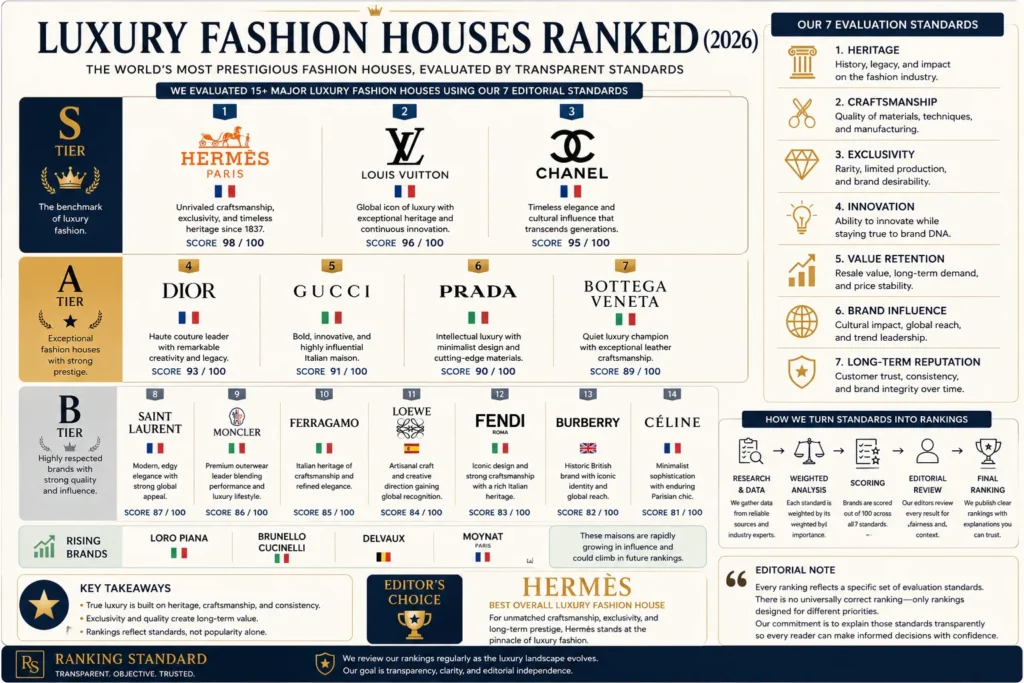
Before looking at the individual rankings, here’s how our tier system works.
S Tier
The absolute benchmark of luxury fashion.
These brands define industry standards rather than follow them.
A Tier
Exceptional fashion houses with remarkable craftsmanship, prestige, and global recognition.
B Tier
Highly respected luxury brands that continue to produce outstanding products but fall slightly behind the industry’s most influential maisons.
S Tier
🥇 1. Hermès
Country: France
When discussing luxury fashion, nearly every conversation eventually arrives at Hermès.
Founded in 1837, the Parisian maison has become the benchmark against which many luxury brands are measured.
Unlike many competitors, Hermès has never relied heavily on celebrity marketing or seasonal trends.
Instead, the company has focused on timeless craftsmanship, controlled production, and extraordinary attention to detail.
Its iconic Birkin and Kelly bags have become symbols of modern luxury—not because they’re expensive, but because demand consistently exceeds supply.
Waiting lists, meticulous handcrafting, and remarkable resale values have helped Hermès achieve a level of desirability few brands have ever matched.
Why It Ranked #1
✔ Exceptional craftsmanship
✔ Industry-leading exclusivity
✔ Outstanding resale value
✔ Timeless brand prestige
✔ Remarkable consistency over generations
Editor’s Score
98 / 100
Best For
Collectors, long-term luxury buyers, and those seeking the highest level of craftsmanship.
🥈 2. Louis Vuitton
Country: France
Few luxury brands have achieved the global recognition of Louis Vuitton.
Since 1854, the house has successfully balanced tradition with innovation, expanding from travel trunks into leather goods, ready-to-wear fashion, jewelry, fragrances, and fine watches.
Louis Vuitton’s greatest strength lies in its ability to remain culturally relevant without abandoning its heritage.
Collaborations with contemporary artists and designers have introduced the brand to new generations while preserving its reputation as one of the world’s leading luxury maisons.
Its international retail network and consistent product quality continue to reinforce its position at the top of the industry.
Why It Ranked #2
✔ Global influence
✔ Exceptional craftsmanship
✔ Continuous innovation
✔ Strong luxury identity
✔ Outstanding heritage
Editor’s Score
96 / 100
Best For
Buyers seeking iconic luxury pieces with enduring worldwide recognition.
🥉 3. Chanel
Country: France
Few names have influenced fashion more profoundly than Chanel.
Founded by Gabrielle “Coco” Chanel in 1910, the house transformed women’s fashion through simplicity, elegance, and timeless design.
The Chanel jacket, quilted handbags, and the legendary Chanel No. 5 fragrance remain among the most recognizable luxury products ever created.
Rather than chasing fast-changing trends, Chanel has consistently reinforced its identity through refined craftsmanship and disciplined brand management.
Its ability to remain desirable across generations continues to make it one of the strongest names in luxury fashion.
Why It Ranked #3
✔ Timeless design language
✔ Extraordinary cultural influence
✔ Exceptional heritage
✔ Strong brand prestige
✔ Consistent global demand
Editor’s Score
95 / 100
Best For
Luxury buyers who value timeless elegance and iconic fashion history.
Why These Three Brands Lead the Industry
Although many luxury fashion houses produce exceptional products, Hermès, Louis Vuitton, and Chanel consistently outperform competitors because they excel across nearly every evaluation standard.
They possess:
- Centuries of heritage
- Exceptional craftsmanship
- Worldwide cultural influence
- Strong long-term desirability
- Remarkable brand discipline
Most importantly, they continue to create products that remain desirable long after seasonal trends have disappeared.
That is one of the defining characteristics of true luxury.
A Tier
Luxury fashion isn’t defined only by history.
The brands in A Tier represent the very best of modern luxury, combining remarkable craftsmanship, global recognition, and enduring prestige.
However, when evaluated against our seven editorial standards, they fall just short of the extraordinary consistency demonstrated by the S Tier maisons.
4. Dior
Country: France
Founded in 1946, Dior rapidly transformed post-war fashion with the introduction of the iconic “New Look.”
Today, Dior remains one of the world’s most influential luxury houses, successfully balancing haute couture with ready-to-wear collections, leather goods, jewelry, and fragrances.
Its creative direction continues to evolve while preserving the elegance that has defined the brand for decades.
Why It Ranked #4
✔ Exceptional craftsmanship
✔ Strong couture heritage
✔ High cultural influence
✔ Consistent innovation
Why It Didn’t Reach S Tier
Although Dior enjoys enormous prestige, it does not consistently achieve the same level of exclusivity or long-term resale value as Hermès or Chanel.
Editor’s Score
93 / 100
5. Gucci
Country: Italy
Few brands have experienced as many reinventions as Gucci.
Founded in Florence in 1921, Gucci has successfully navigated changing trends while maintaining worldwide recognition.
Its bold designs have attracted younger luxury consumers and expanded the brand’s influence far beyond traditional fashion circles.
Why It Ranked #5
✔ Global recognition
✔ Strong creative direction
✔ Exceptional leather craftsmanship
✔ Wide product portfolio
Why It Didn’t Reach S Tier
Greater production volume and broader accessibility reduce the sense of exclusivity compared with higher-ranked maisons.
Editor’s Score
91 / 100
6. Prada
Country: Italy
Prada has long represented intellectual luxury.
Known for minimalist aesthetics, premium materials, and forward-thinking design, the brand appeals to consumers seeking understated sophistication.
Why It Ranked #6
✔ Timeless design
✔ Innovative materials
✔ Strong heritage
✔ Consistent quality
Editor’s Score
90 / 100
7. Bottega Veneta
Country: Italy
Bottega Veneta has built its reputation on quiet luxury.
Rather than relying on large logos, the brand lets craftsmanship speak for itself.
Its signature Intrecciato leather weaving has become one of the most recognizable symbols of understated luxury.
Why It Ranked #7
✔ Outstanding leather craftsmanship
✔ High exclusivity
✔ Elegant brand identity
Editor’s Score
89 / 100
B Tier
These brands remain outstanding luxury houses.
Their placement in B Tier does not suggest poor quality.
Instead, it reflects stronger competition in heritage, exclusivity, or long-term market influence.
Balenciaga
Known for pushing creative boundaries and redefining modern fashion.
However, its contemporary identity remains more polarizing than timeless.
Burberry
A historic British luxury house celebrated for its trench coats and iconic check pattern.
Strong heritage but slightly less influential in today’s global luxury landscape.
Fendi
An exceptional Roman fashion house renowned for leather craftsmanship and fur innovation.
Continues to produce outstanding products but faces intense competition from larger global maisons.
Loewe
One of Spain’s most respected luxury brands.
Increasingly recognized for artisanal craftsmanship and creative direction.
A rapidly rising maison with significant long-term potential.
Celine
Minimalist elegance and refined tailoring define Celine.
The brand enjoys strong prestige but currently lacks the broader cultural influence of higher-ranked competitors.
Why Famous Brands Sometimes Rank Lower
One of the most common misconceptions about luxury is that popularity equals prestige.
It doesn’t.
Some brands sell millions of products every year.
Others intentionally limit production.
Some focus on trend-driven collections.
Others prioritize timeless craftsmanship.
Popularity can increase visibility.
But true luxury is measured by consistency, exclusivity, craftsmanship, and long-term desirability.
That is why a globally famous brand may still rank below a smaller maison with stronger fundamentals.
Editor’s Choice
🏆 Best Overall Luxury Fashion House
Hermès
Hermès remains the benchmark for modern luxury.
Its remarkable craftsmanship, disciplined production, exceptional resale performance, and enduring prestige place it at the top of our rankings.
Rather than chasing trends, Hermès creates timeless products that continue to gain value and desirability over generations.
For those seeking the highest expression of luxury fashion, no other maison currently offers a more complete balance of heritage, craftsmanship, exclusivity, and long-term reputation.
Brands to Watch
The luxury industry continues to evolve.
Several fashion houses are strengthening their global position and could climb in future editions of our rankings.
Notable names include:
- Loewe
- Brunello Cucinelli
- Loro Piana
- The Row
These brands continue to invest heavily in craftsmanship and quiet luxury, reflecting changing consumer preferences.
Final Verdict
Luxury fashion is not a competition based on price.
Nor is it simply a contest of popularity.
The world’s greatest fashion houses have earned their reputations through generations of exceptional craftsmanship, disciplined brand management, innovation, and cultural influence.
While rankings may change as markets evolve, our evaluation standards remain consistent.
That consistency is what allows us to compare brands fairly and transparently.
Our goal isn’t to tell you what to buy.
Our goal is to explain why one brand ranks above another—so you can make your own informed decision.
Frequently Asked Questions
Why isn’t Gucci ranked higher?
Gucci remains one of the world’s strongest luxury brands, but its broader accessibility and higher production volumes reduce its overall exclusivity compared with Hermès or Chanel.
Why isn’t price the most important factor?
A higher price doesn’t automatically represent higher quality or stronger long-term prestige.
Our rankings prioritize craftsmanship, heritage, exclusivity, and reputation over retail pricing.
Will these rankings change?
Yes.
Luxury brands continue to evolve, and our rankings will be reviewed periodically as markets, craftsmanship, and consumer expectations change.
Editorial Note
Every ranking reflects a specific set of evaluation standards. There is no universally correct ranking—only rankings designed for different priorities. Our commitment is to explain those standards transparently so every reader can make informed decisions with confidence.