Find the Right Running Shoe for Your Goals — Not Just the Highest-Ranked Brand
Introduction
Walk into any running store or search online for the best running shoes, and you’ll quickly find hundreds of recommendations.
Nike.
ASICS.
HOKA.
Brooks.
New Balance.
Saucony.
On.
Mizuno.
Adidas.
Every brand claims to build the perfect running shoe.
Every review seems to recommend something different.
The problem isn’t that these recommendations are wrong.
The problem is that they’re answering different questions.
A marathon runner looking for maximum race-day speed doesn’t need the same shoe as someone walking 5 kilometers every evening.
A beginner training for a first 10K shouldn’t buy the same model used by elite athletes chasing Olympic qualification times.
Yet many rankings still compare entire brands without explaining which shoes are actually designed for which type of runner.
At Ranking Standard, we believe that’s the wrong approach.
Running shoes should first be organized by purpose, then by model, and only then by brand.
Because people don’t simply buy Nike.
They buy Pegasus.
They don’t buy ASICS.
They buy Nimbus or Superblast.
The model—not the logo—is what determines your running experience.
This guide is designed to help you choose the right shoe for the way you run.
Why Brand Rankings Alone Don’t Work
Imagine saying:
“Nike is the best running brand.”
What does that actually mean?
Nike produces:
- Pegasus
- Vomero
- Invincible
- Structure
- Vaporfly
- Alphafly
- Zegama
Each serves a completely different purpose.
The same applies to every major manufacturer.
ASICS offers Nimbus, Kayano, Novablast, Superblast, Metaspeed Sky, and Trabuco.
HOKA produces Clifton, Bondi, Mach, Skyward X, Speedgoat, and Rocket X.
These shoes are not competitors simply because they share the same logo.
They solve different problems.
That is why Ranking Standard evaluates running shoes differently from luxury brands.
Our Running Shoe Framework
Instead of asking:
“Which brand is best?”
We ask:
“What kind of runner are you?”
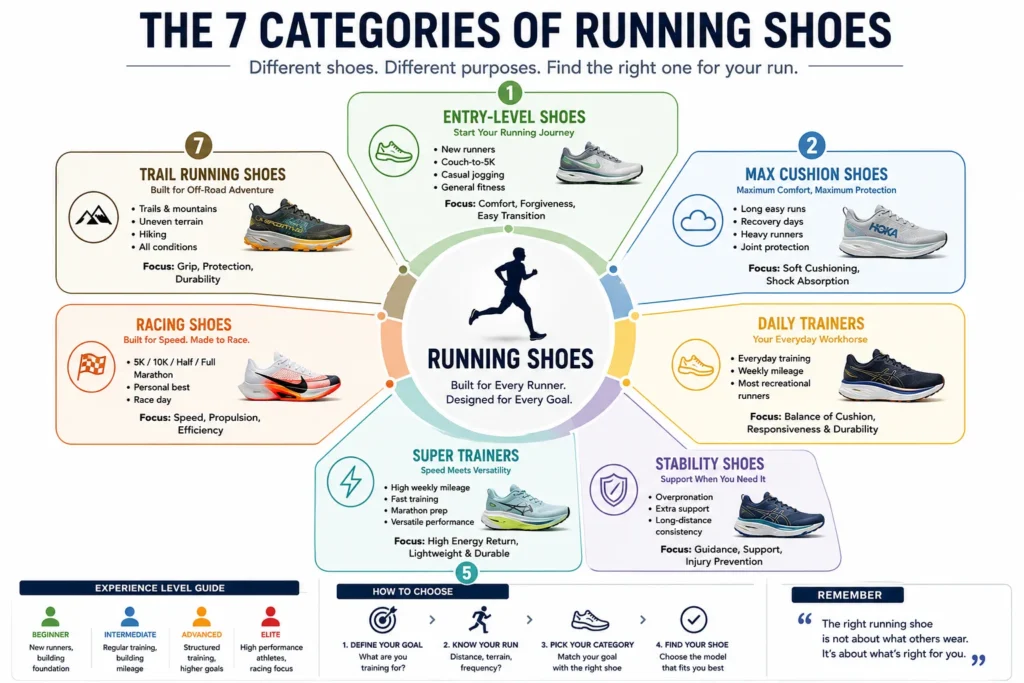
Every shoe in this guide belongs to one of the following categories.
Entry-Level Running Shoes
Designed for:
- New runners
- Couch-to-5K programs
- Casual fitness
- Occasional running
Primary focus:
- Comfort
- Stability
- Easy transition
Max Cushion Shoes
Designed for:
- Long easy runs
- Recovery days
- Heavy runners
- Joint protection
Primary focus:
- Soft cushioning
- Shock absorption
- Comfort over speed
Daily Trainers
The most versatile category.
These are shoes capable of handling the majority of weekly training.
For many runners, this will be the only shoe they need.
Stability Shoes
Created for runners who require additional guidance and support.
These models prioritize consistency and injury prevention rather than outright speed.
Super Trainers
One of the fastest-growing categories in modern running.
They combine lightweight foams with advanced geometries to deliver exceptional energy return while remaining durable enough for daily mileage.
Racing Shoes
Built for speed.
Carbon-plated midsoles, aggressive rocker geometry, and ultra-lightweight construction define this category.
These shoes are designed to help runners perform at their highest level on race day.
Trail Running Shoes
When the pavement ends, different priorities emerge.
Grip.
Protection.
Stability.
Durability.
Trail shoes are designed specifically for uneven terrain rather than road running.
Beginner • Intermediate • Advanced • Elite
One of the biggest problems with most running shoe guides is that they assume every runner has the same experience.
We disagree.
Throughout this guide, every recommended model will also receive an experience level.
🟢 Beginner
Ideal for new runners and recreational training.
🔵 Intermediate
Suitable for runners building weekly mileage.
🟠 Advanced
Designed for experienced athletes with structured training plans.
🔴 Elite
Purpose-built racing shoes requiring efficient running mechanics and strong conditioning.
This approach helps runners choose shoes that match their ability—not simply the most expensive option.
Finding the Right Shoe Starts with the Right Category
One of the biggest mistakes runners make is comparing shoes that were never designed to compete with one another.
For example:
Should you compare the Nike Pegasus with the Nike Alphafly?
Not really.
One is built as a versatile daily trainer.
The other is designed almost exclusively for racing.
Likewise, comparing the ASICS Gel-Nimbus with the Metaspeed Sky rarely makes sense.
Each serves a completely different purpose.
That’s why, before comparing brands or individual models, every runner should first understand the seven major categories of modern running shoes.
1. Entry-Level Running Shoes
Best for
- New runners
- Couch-to-5K programs
- Casual jogging
- General fitness
Entry-level shoes prioritize comfort, forgiveness, and ease of use.
They aren’t the fastest.
They aren’t the lightest.
But they’re often the smartest place to begin.
Typical examples include:
- Nike Pegasus
- Brooks Ghost
- ASICS Gel-Cumulus
- Saucony Ride
- New Balance 880
Experience Level
🟢 Beginner
2. Max Cushion Shoes
Best for
- Recovery runs
- Long easy mileage
- Heavy runners
- Joint protection
These shoes maximize comfort rather than speed.
Their thick midsoles reduce impact and help runners stay comfortable over long distances.
Popular examples include:
- ASICS Gel-Nimbus
- HOKA Bondi
- Brooks Glycerin Max
- New Balance 1080
- Nike Vomero
Experience Level
🟢 Beginner
🔵 Intermediate
3. Daily Trainers
Best for
- Everyday training
- Weekly mileage
- Most recreational runners
If you only own one pair of running shoes, this is usually the category you should choose.
Daily trainers offer the best balance between cushioning, durability, stability, and responsiveness.
Representative models include:
- Nike Pegasus
- HOKA Clifton
- ASICS Novablast
- Brooks Ghost
- Saucony Ride
Experience Level
🟢 Beginner
🔵 Intermediate
🟠 Advanced
4. Stability Shoes
Best for
- Runners requiring additional support
- Overpronation
- Long-distance consistency
Modern stability shoes have become far more comfortable than previous generations.
Today’s designs provide guidance without feeling overly rigid.
Examples include:
- ASICS Gel-Kayano
- Brooks Adrenaline GTS
- HOKA Arahi
- Saucony Guide
- New Balance 860
Experience Level
🟢 Beginner
🔵 Intermediate
5. Super Trainers
Best for
- High weekly mileage
- Marathon preparation
- Fast training sessions
One of the newest categories in running.
Super trainers combine highly responsive foams with advanced rocker geometry, offering race-like performance while remaining durable enough for everyday training.
Examples include:
- ASICS Superblast
- HOKA Mach X
- New Balance SC Trainer
- Saucony Endorphin Trainer
- Adidas Boston
Experience Level
🔵 Intermediate
🟠 Advanced
6. Racing Shoes
Best for
- Half Marathon
- Marathon
- Personal Best attempts
These shoes are built for speed.
Most feature carbon-fiber plates, ultra-lightweight foams, and aggressive geometry designed to maximize running efficiency.
Representative models include:
- Nike Alphafly
- Nike Vaporfly
- ASICS Metaspeed Sky
- Adidas Adizero Adios Pro
- HOKA Rocket X
- Saucony Endorphin Elite
Experience Level
🟠 Advanced
🔴 Elite
7. Trail Running Shoes
Best for
- Mountain trails
- Technical terrain
- Hiking
- Off-road adventures
Trail shoes emphasize grip, durability, and protection rather than lightweight speed.
Popular choices include:
- HOKA Speedgoat
- Nike Zegama
- ASICS Trabuco
- Salomon Speedcross
- Brooks Cascadia
Experience Level
🟢 Beginner
🔵 Intermediate
🟠 Advanced
Which Category Should You Choose?
Choosing the right category is often more important than choosing the right brand.
Ask yourself:
- Are you training for a marathon?
- Running three times a week?
- Looking for maximum comfort?
- Recovering from injury?
- Running mostly on trails?
Once you identify your goal, the number of suitable options becomes much smaller—and your decision becomes much easier.
Choosing the Right Running Shoe
By now, you’ve probably realized something important.
There is no single “best” running shoe.
Only the best running shoe for your goals.
A carbon-plated racing shoe may help an elite marathon runner achieve a personal best.
The same shoe could make a beginner’s running experience uncomfortable—or even increase the risk of injury.
Likewise, the softest max-cushion shoe may feel incredible during recovery runs but sluggish during speed workouts.
The key is matching the shoe to your training, experience, and objectives.
Quick Recommendations
If you’re not sure where to begin, start here.
Your Goal → Our Recommendation
🟢 First Running Shoe
If you’ve never owned a proper running shoe before:
- Nike Pegasus
- Brooks Ghost
- ASICS Gel-Cumulus
- Saucony Ride
- New Balance 880
These models offer an excellent balance of comfort, durability, and versatility.
☁ Maximum Comfort
If cushioning is your highest priority:
- ASICS Gel-Nimbus
- HOKA Bondi
- Brooks Glycerin Max
- New Balance Fresh Foam 1080
- Nike Vomero
Ideal for recovery days, easy mileage, and runners seeking maximum comfort.
🏃 Best Daily Trainer
For runners who want one shoe capable of doing almost everything:
- HOKA Clifton
- Nike Pegasus
- ASICS Novablast
- Saucony Ride
- Brooks Ghost
These shoes provide the best balance between cushioning, responsiveness, and durability.
⚡ Marathon & Racing
If your goal is speed:
- Nike Alphafly
- Nike Vaporfly
- ASICS Metaspeed Sky
- Adidas Adizero Adios Pro
- Saucony Endorphin Elite
- HOKA Rocket X
These shoes are designed for race day—not everyday training.
🛡 Stability
For runners who need additional support:
- ASICS Gel-Kayano
- Brooks Adrenaline GTS
- HOKA Arahi
- Saucony Guide
- New Balance 860
Supportive shoes have evolved dramatically and now provide guidance without sacrificing comfort.
🌲 Trail Running
For off-road adventures:
- HOKA Speedgoat
- Salomon Speedcross
- Nike Zegama
- ASICS Trabuco
- Brooks Cascadia
Designed for grip, protection, and confidence on uneven terrain.
Our Favorite Brands
Although we don’t believe one brand is perfect for every runner, each manufacturer has developed a clear identity.
| Brand | Best Known For |
|---|---|
| Nike | Racing innovation and versatile daily trainers |
| ASICS | Cushioning, stability, marathon training |
| HOKA | Maximum cushioning and trail performance |
| Brooks | Comfort, consistency, beginner-friendly models |
| New Balance | Everyday versatility and fit options |
| Saucony | Balanced performance across all categories |
| Adidas | Race-day speed and responsive foams |
| Mizuno | Traditional ride and long-term durability |
| On | Lightweight feel and modern design |
| Altra | Zero-drop philosophy and natural foot shape |
Rather than choosing the highest-ranked brand, choose the brand whose strengths align with your own running goals.
Frequently Asked Questions
Do I need more than one pair of running shoes?
Not necessarily.
Most runners can comfortably complete the majority of their training with a single quality daily trainer.
As weekly mileage increases, many runners eventually build a rotation consisting of:
- Daily Trainer
- Recovery Shoe
- Racing Shoe
Are expensive shoes always better?
No.
The best shoe is the one that matches your purpose.
Buying a $300 racing shoe for occasional jogging rarely makes sense.
Likewise, using a beginner shoe for elite marathon racing may limit performance.
Purpose matters more than price.
How often should running shoes be replaced?
Most road running shoes perform best for approximately 500–800 kilometers (300–500 miles).
The exact lifespan depends on:
- Runner weight
- Running surface
- Training intensity
- Midsole material
When cushioning, stability, or responsiveness noticeably decline, it’s usually time to replace them.
Editor’s Choice
Rather than selecting one overall winner, we’ve chosen the strongest model in each category.
| Category | Editor’s Choice |
|---|---|
| Beginner | Nike Pegasus |
| Max Cushion | ASICS Gel-Nimbus |
| Daily Trainer | HOKA Clifton |
| Stability | ASICS Gel-Kayano |
| Super Trainer | ASICS Superblast |
| Racing | Nike Alphafly |
| Trail | HOKA Speedgoat |
Because different runners have different goals, we believe this approach is more useful than naming a single “best running shoe.”
Final Verdict
Running shoes are among the most personal purchases an athlete can make.
The right shoe can make training more enjoyable, improve consistency, and reduce fatigue.
The wrong shoe may lead to frustration—or even injury.
That’s why Ranking Standard approaches running shoes differently.
Instead of asking,
“Which brand is best?”
we ask,
“Which shoe is best for your goals?”
Because choosing the right category comes before choosing the right brand.
And choosing the right model comes before following the crowd.
Every runner is different.
Your shoes should reflect that.
Editorial Note
Every recommendation reflects a specific set of evaluation standards. There is no universally correct running shoe—only models designed for different runners, goals, and training styles. Our mission is to make those differences transparent so every runner can choose with confidence.