

Why Buying a Carry-on Is Harder Than It Looks
Buying a carry-on suitcase sounds simple—until you actually try to choose one.
A quick search brings up hundreds of options. Some brands promise aircraft-grade aluminum. Others advertise lightweight polycarbonate shells, lifetime warranties, silent spinner wheels, compression systems, or “premium travel” experiences. Prices range from under $100 to well over $1,500.
At first glance, it feels like buying a better suitcase simply means spending more money.
After comparing dozens of models and reading countless traveler discussions, one thing becomes clear: that assumption is usually wrong.
The best carry-on isn’t the most expensive one.
It’s the one that matches the way you travel.
Someone who flies twice a month for business values very different things than a family taking one international vacation a year. A photographer carries fragile equipment. A digital nomad lives out of a suitcase for months. A weekend traveler might care more about airline flexibility than luxury finishes.
The mistake many buyers make is choosing a suitcase because of the logo instead of the trip.
That’s exactly why we created this guide.
Rather than ranking brands from best to worst, we’ll help you understand which features actually matter, what compromises are worth making, and how to identify the suitcase that fits your own travel style.
Because every ranking should start with a standard.
Why Most “Best Carry-on” Lists Miss the Point
Search online for the best carry-on luggage, and you’ll notice a familiar pattern.
One article crowns Rimowa.
Another says Away is unbeatable.
A third insists Samsonite offers the best value.
A fourth recommends Travelpro because airline crews use it.
None of these recommendations are necessarily wrong.
But they often answer the wrong question.
The real question isn’t:
“Which suitcase is the best?”
It’s:
“Which suitcase is best for me?”
Those are completely different questions.
A frequent business traveler may happily invest in an aluminum case that survives hundreds of flights.
A student studying abroad might prioritize capacity and affordability.
Parents traveling with young children often value smooth wheels and easy organization over premium materials.
Budget airline passengers may care more about external dimensions than brand prestige.
The context changes everything.
That’s why Ranking Standard evaluates products differently.
Instead of searching for a universal winner, we look at how different travelers make different decisions.
Our Philosophy: Every Ranking Has a Standard
One of the biggest problems with buying guides is that they often hide their criteria.
Readers see a list of products but never learn why one ranks above another.
At Ranking Standard, we believe every recommendation should be built on transparent standards.
For carry-on luggage, we evaluate products using factors that have a measurable impact on real-world travel.
These include:
- Cabin compatibility across major airlines
- Weight and packing efficiency
- Durability after repeated travel
- Wheel performance on different surfaces
- Handle stability and comfort
- Interior organization
- Warranty and long-term support
- Overall value relative to price
Notice what’s missing.
Brand reputation alone is never enough.
A luxury logo may improve craftsmanship or resale value, but it doesn’t automatically make a suitcase the best choice for every traveler.
Good decisions come from matching the product to the purpose—not from chasing the highest price tag.
The First Decision Isn’t the Brand
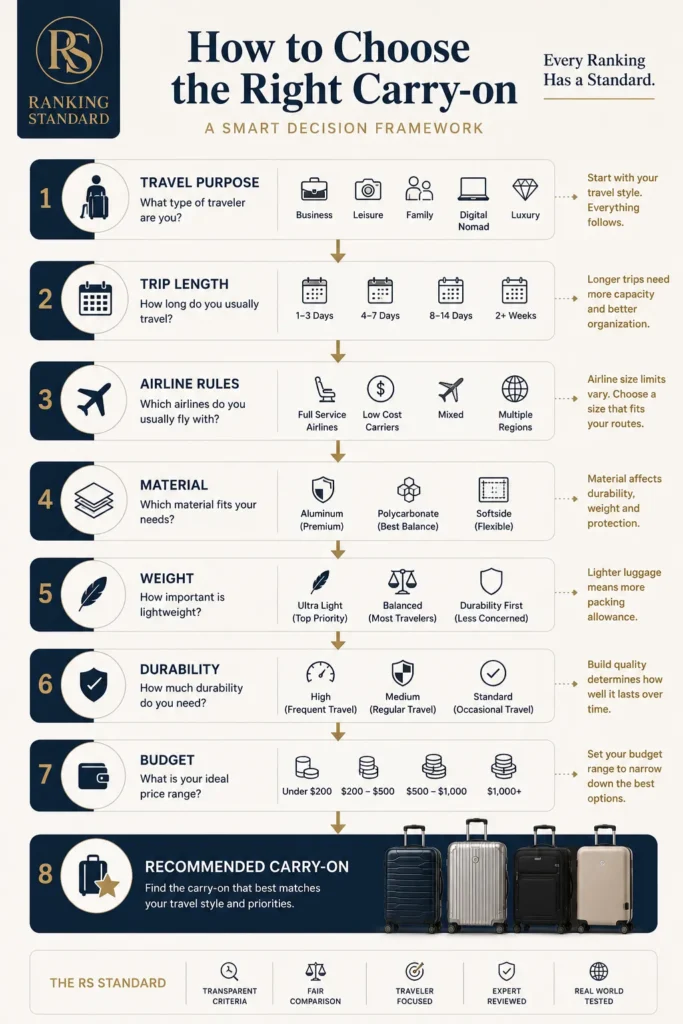
Most people start shopping by asking:
“What brand should I buy?”
Ironically, that’s usually the wrong place to begin.
The better first question is:
“What kind of traveler am I?”
Once you answer that honestly, many options disappear naturally.
For example:
- If you mainly fly low-cost airlines, strict cabin dimensions become a top priority.
- If you’re traveling internationally every month, durability matters far more than appearance.
- If you’re carrying a laptop, camera, and work equipment, interior organization becomes essential.
- If you often walk through old city streets or train stations, wheel quality is much more important than glossy marketing photos.
This small shift in thinking changes the entire buying process.
Instead of comparing logos, you begin comparing solutions.
And that’s exactly how experienced travelers tend to shop.
The Four Questions You Should Answer Before Buying
Before looking at brands, answer these four questions.
1. How often do you travel?
A suitcase used twice a year doesn’t need to survive the same abuse as one used every week.
Frequency changes the value equation dramatically.
2. Which airlines do you usually fly?
Not every airline accepts the same cabin dimensions.
Choosing the wrong size can lead to unexpected gate-check fees, especially on budget carriers.
3. What do you usually pack?
Business clothing.
Photography equipment.
Family essentials.
Minimalist travel.
Each requires a different type of interior layout.
4. Which matters more to you?
- Lowest weight
- Maximum durability
- Better organization
- Luxury appearance
- Best long-term value
There’s no universally correct answer.
There is only the answer that matches your travel habits.
Once you’ve answered these questions, choosing the right carry-on becomes much easier.
In the next part, we’ll break down the different suitcase materials, wheel systems, sizes, and construction methods that separate an average carry-on from one you’ll still enjoy using years from now.
Hard Shell or Soft Shell? The Answer Depends on Your Travel Style
One of the first decisions you’ll encounter is whether to buy a hard-shell or soft-shell suitcase.
This debate has been going on for years, but the truth is that neither option is universally better.
Each solves a different problem.
Hard-shell luggage has become increasingly popular over the past decade, largely because modern materials such as polycarbonate are lighter and more durable than older plastics. These cases also provide better protection against impacts, making them ideal for electronics, cameras, and fragile items.
Soft-shell luggage, on the other hand, offers flexibility.
If you’ve ever struggled to fit a slightly overpacked suitcase into an overhead bin, you’ll understand why some travelers still prefer fabric luggage. External pockets are another advantage, especially for documents, chargers, or a light jacket that you want to access quickly.
If your trips are mostly business travel or international flights where your suitcase may occasionally be gate-checked, a hard shell is usually the safer investment.
If you frequently travel by train, car, or need quick access to your belongings, a well-designed soft-shell model may actually make your journey easier.
Neither is objectively better.
The better choice is the one that matches how you travel.
Understanding Suitcase Materials
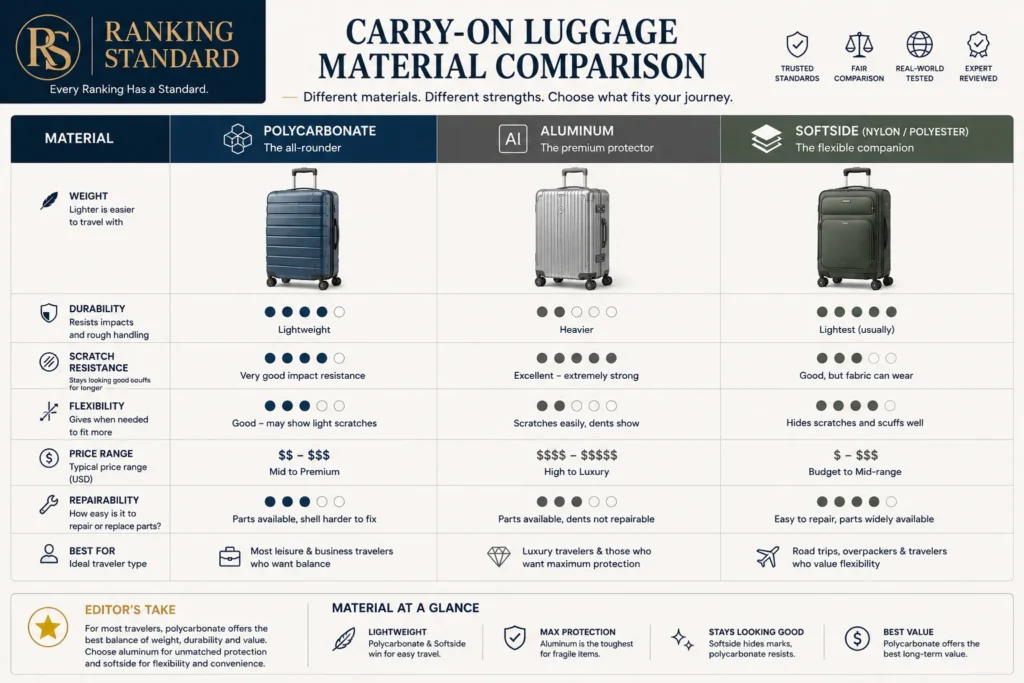
Many buyers focus on the brand name, but experienced travelers often pay more attention to the material.
The shell determines how the suitcase ages, how well it protects your belongings, and even how enjoyable it is to use after years of travel.
Polycarbonate
Polycarbonate has become the benchmark for premium hard-shell luggage.
It’s lightweight, slightly flexible, and excellent at absorbing impacts without cracking. Small scratches are inevitable, but the material generally survives frequent travel remarkably well.
For most travelers, this is the sweet spot between durability and weight.
Aluminum
Aluminum luggage has an unmistakable premium appearance.
It’s exceptionally rigid and offers excellent protection for delicate contents.
However, there’s a trade-off.
Aluminum dents much more easily than many first-time buyers expect. Those dents rarely affect functionality, but they quickly become part of the suitcase’s character.
Some owners love this “well-traveled” look.
Others find the cosmetic damage frustrating.
It’s also significantly heavier and usually much more expensive.
Unless durability and aesthetics are equally important to you, aluminum isn’t automatically the best choice.
ABS Plastic
ABS luggage is often found in lower-priced models.
It’s inexpensive and lightweight, making it attractive for occasional travelers.
The downside is longevity.
After repeated impacts, ABS shells are more likely to crack compared with polycarbonate.
For someone who flies once or twice a year, this may not be a major concern.
For frequent travelers, it usually isn’t the best long-term investment.
Do Four Wheels Really Make a Difference?
If you’ve only owned older two-wheel suitcases, upgrading to four spinner wheels can completely change your travel experience.
Modern spinner wheels allow the suitcase to move beside you rather than behind you.
That may sound like a small improvement, but after walking through a large airport, you’ll immediately notice the difference.
Less strain on your wrist.
Better maneuverability.
Easier movement in crowded terminals.
That said, wheel quality matters far more than wheel quantity.
Cheap spinner wheels may wobble, become noisy, or wear unevenly after extended use.
High-quality wheels continue rolling smoothly years later.
This is one of those features that’s difficult to judge in online photos but obvious in real-world use.
Weight Matters More Than Most People Realize
Many travelers focus on packing capacity.
Experienced travelers often focus on empty weight.
Imagine two carry-ons with exactly the same external dimensions.
One weighs 2.4 kg.
The other weighs 4.3 kg.
You’ve already “used up” nearly 2 kilograms of your airline allowance before packing anything.
For airlines with strict cabin weight limits, that difference can determine whether your bag stays in the cabin or gets checked.
Lighter isn’t always better—ultralight luggage sometimes sacrifices durability—but unnecessary weight is rarely an advantage.
Finding the right balance is what matters.
Don’t Ignore the Handle
Ask frequent travelers what fails first on a suitcase, and many won’t mention the shell.
They’ll mention the telescoping handle.
A loose handle can make even an expensive suitcase feel unstable.
When evaluating luggage, pay attention to:
- Minimal side-to-side movement
- Comfortable grip
- Multiple height positions
- Smooth extension and retraction
These details rarely appear in advertisements, yet they affect every single trip.
Cabin Size Isn’t Universal
One of the biggest misconceptions about carry-on luggage is that there’s a single global standard.
There isn’t.
Different airlines have different cabin size limits, and low-cost carriers are often much stricter than full-service airlines.
A suitcase that’s accepted on one airline may require gate-checking on another.
This becomes especially important if you frequently fly within Europe, where budget airlines often enforce cabin dimensions more aggressively.
Instead of buying the largest suitcase you can find, it’s usually smarter to choose one that comfortably fits the most restrictive airlines you use regularly.
You’ll sacrifice a little packing space, but you’ll gain peace of mind every time you board.
A Better Way to Think About Value
Many buyers compare suitcases by asking:
“Which one is cheaper?”
Experienced travelers often ask a different question:
“Which one will still be working five years from now?”
A $400 suitcase that lasts ten years may actually cost less per trip than a $120 suitcase that needs replacing every few seasons.
Price matters.
But value is about cost over time—not just cost today.
That’s one of the most important mindset shifts you can make before buying luggage.
Our Recommendation Matrix
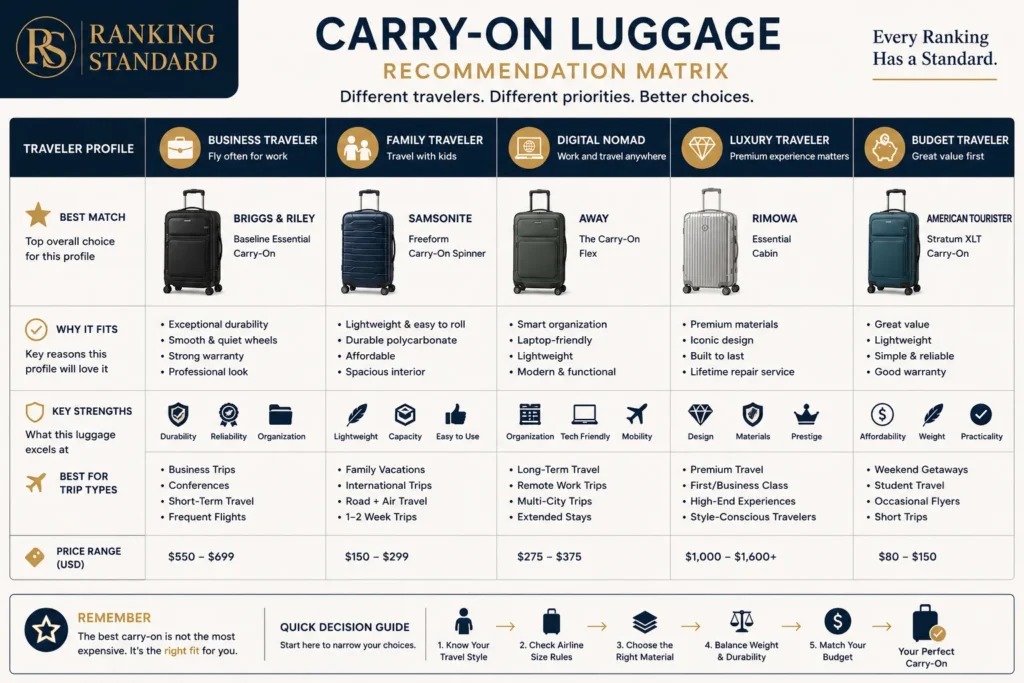
By now, you’ve probably realized something important.
Choosing the right carry-on isn’t really about finding the “best” suitcase.
It’s about finding the suitcase that’s best for the way you travel.
That’s why we don’t believe in a single winner.
Instead, we recommend thinking in traveler profiles.
Traveler Profile 1: The Frequent Business Traveler
Priorities
- Reliability
- Smooth wheels
- Strong warranty
- Professional appearance
- Excellent organization
If you’re flying every week, small inconveniences quickly become major frustrations.
A handle that rattles.
Wheels that become noisy.
A zipper that sticks.
These issues don’t show up on day one—but they matter after dozens of flights.
For business travelers, investing in premium durability usually makes sense.
Best fit:
- Briggs & Riley
- Travelpro Platinum Elite
- Rimowa Essential (for those willing to pay more)
Traveler Profile 2: The Leisure Traveler
You travel once or twice a year.
Maybe a summer vacation.
Maybe Christmas.
Maybe a long weekend abroad.
You probably don’t need airline-crew-level durability.
Instead, look for:
- Good value
- Lightweight construction
- Easy packing
- Reliable wheels
A mid-range polycarbonate suitcase often delivers the best overall experience.
Spending twice as much rarely means you’ll enjoy your holiday twice as much.
Traveler Profile 3: The Family Traveler
Traveling with children changes everything.
Parents rarely have one free hand.
One hand holds a child’s backpack.
The other may be pulling another suitcase.
Sometimes you’re pushing a stroller at the same time.
In these situations, maneuverability becomes more important than luxury materials.
Look for:
- Excellent spinner wheels
- Lightweight body
- Large opening
- Easy organization
Families also benefit from suitcases that are simple to repair if something breaks during a trip.
Traveler Profile 4: The Digital Nomad
Living from a suitcase is completely different from traveling with one.
Your carry-on becomes your mobile office.
Laptop.
Camera.
Chargers.
Documents.
Portable monitor.
Organization matters almost as much as storage space.
A poorly designed interior means unpacking everything just to reach a cable.
Good organization saves time every single day.
Traveler Profile 5: The Luxury Buyer
Some buyers simply appreciate exceptional craftsmanship.
That’s perfectly reasonable.
Luxury luggage isn’t only about function.
It’s also about design, materials, engineering, and ownership experience.
Just remember one thing.
Luxury does not automatically mean better value.
A premium suitcase often offers incremental improvements—not revolutionary ones.
Understanding that difference helps set realistic expectations before spending over $1,000.
Brand Personalities at a Glance
One mistake buyers make is assuming every premium luggage brand serves the same customer.
They don’t.
Think of them like this.
Rimowa
Luxury engineering.
Beautiful design.
Excellent build quality.
Premium price.
Best suited to travelers who appreciate craftsmanship as much as functionality.
Samsonite
Perhaps the most balanced choice in the industry.
Wide product range.
Reliable quality.
Available almost everywhere.
Strong value for most travelers.
Travelpro
Built with frequent flyers in mind.
There’s a reason airline crews have trusted this brand for years.
Practicality comes before fashion.
Briggs & Riley
Known for one of the strongest warranties in the luggage industry.
Expensive.
But designed to last.
Ideal for travelers who see luggage as a long-term investment.
Away
Modern.
Minimalist.
Popular among younger travelers.
Strong focus on design and user experience.
Monos
Clean aesthetics.
Premium feel.
Competitive pricing.
A good example of a modern direct-to-consumer travel brand.
Mistakes Buyers Regret Later
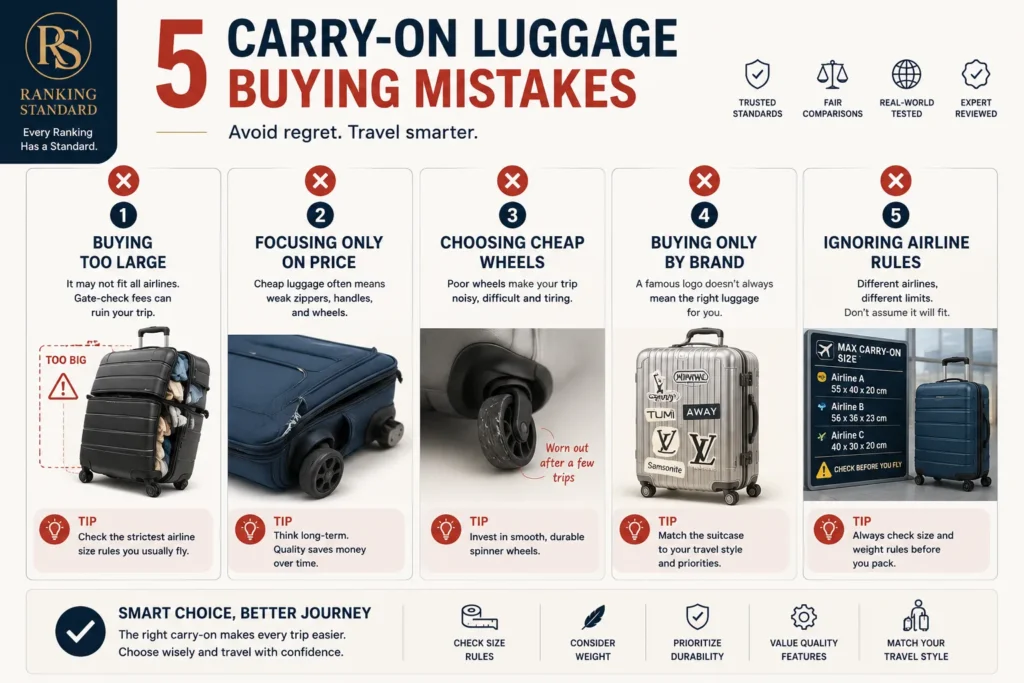
After reading hundreds of traveler reviews, the same regrets appear repeatedly.
Buying the largest cabin suitcase available
It may fit one airline.
It may fail on another.
A few extra liters rarely justify the stress of unexpected gate-check fees.
Paying for luxury without understanding why
Buying expensive luggage simply because it’s expensive often leads to disappointment.
Luxury should be an informed decision—not an emotional one.
Ignoring warranty support
Even the best luggage eventually needs maintenance.
Replacement wheels.
Handle repairs.
Broken zippers.
Good customer support often matters more than one extra design feature.
Focusing only on online photos
Marketing images rarely tell you how stable the handle feels.
How quietly the wheels roll.
Or how comfortable it is to lift into an overhead bin.
Those details are what you’ll remember after your tenth trip—not the promotional photos.
So… Which Carry-on Should You Buy?
If you’ve read this guide hoping we’d name one perfect suitcase, you might be disappointed.
But we believe that’s actually good news.
Because there isn’t one perfect suitcase.
There are different excellent choices for different travelers.
That’s exactly how buying decisions should work.
Instead of asking,
“What is the best carry-on?”
Ask,
“What kind of traveler am I becoming?”
Once you answer that question honestly, your options become much clearer.
And that’s the goal of this guide.
Not to tell you what to buy.
But to help you understand why one choice fits you better than another.
Final Thoughts
At Ranking Standard, we don’t build rankings simply to place products in order.
We build frameworks that help people make better decisions.
Every recommendation starts with a clear evaluation standard.
Every comparison has context.
Every buying guide is designed to reduce uncertainty—not create more of it.
Because every traveler is different.
Every journey is different.
And every ranking should have a standard.
What’s Next?
If this guide helped you understand how to choose a carry-on, you may also enjoy our upcoming articles:
- Best Carry-on Luggage Brands Ranked
- Aluminum vs Polycarbonate Carry-ons
- Best Carry-on Luggage for International Travel
- Best Carry-on for Business Travelers
- Best Carry-on Under $200
- Carry-on Size Guide by Airline
- Away vs Rimowa: Which Is Right for You?
- Samsonite vs Travelpro: Value or Performance?