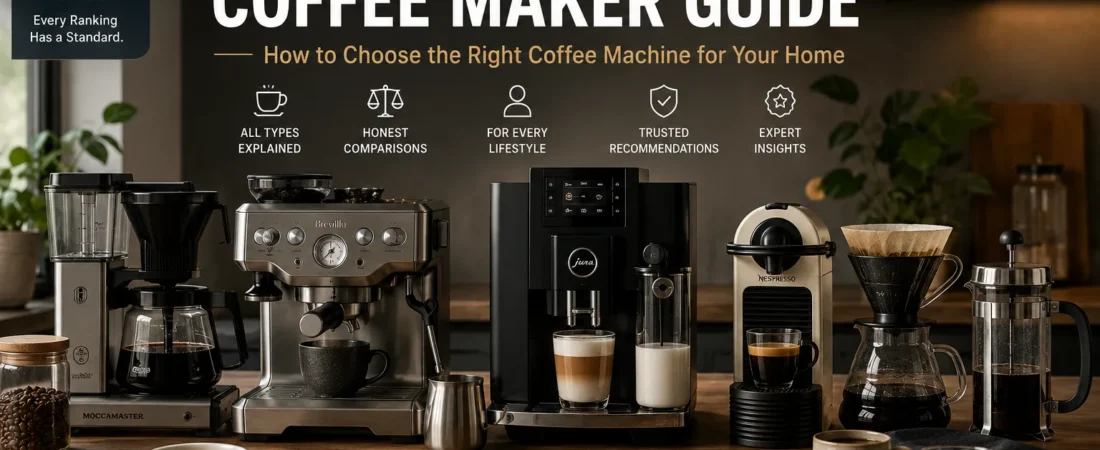
Why Buying a Coffee Maker Is More Complicated Than Ever
Buying a coffee maker used to be simple.
You chose a basic drip machine, bought a bag of ground coffee, and that was the end of the decision.
Today, it’s a completely different story.
Walk into any appliance store—or spend just ten minutes browsing online—and you’ll find espresso machines, capsule systems, bean-to-cup machines, pour-over brewers, French presses, AeroPress, cold brew makers, and countless hybrid options.
Some promise café-quality espresso.
Others focus on convenience.
Some can prepare ten different drinks with a single touch, while others require you to grind, tamp, brew, and steam milk manually.
Prices range from less than $50 to several thousand dollars.
With so many choices, it’s easy to assume that buying the most expensive machine will automatically give you the best coffee.
In reality, that’s rarely true.
The best coffee maker isn’t the one with the longest feature list.
It’s the one that fits your lifestyle.
That’s the philosophy behind this guide.
Rather than telling you which machine is “the best,” we’ll help you understand which type of coffee maker makes the most sense for the way you drink coffee every day.
Because every ranking should begin with a clear standard.
Why Most Coffee Machine Reviews Leave Buyers Confused
Search for “best coffee maker” online, and you’ll quickly notice a pattern.
One reviewer praises premium espresso machines.
Another insists capsule systems are unbeatable.
Someone else argues that manual brewing produces the richest flavor.
They’re all describing different experiences.
The problem isn’t that they’re wrong.
The problem is that they’re answering different questions.
Someone who drinks a quick cup before work has completely different priorities from someone who enjoys making coffee as a weekend hobby.
A family that brews an entire pot each morning doesn’t have the same needs as someone who drinks a single espresso after dinner.
Yet many buying guides compare every coffee maker as though they were designed for the same customer.
That’s where confusion begins.
At Ranking Standard, we believe every recommendation should start with one simple question:
How do you actually drink coffee?
Once you answer that honestly, the list of suitable machines becomes much shorter.
Our Philosophy: There Is No Perfect Coffee Machine
Many people ask,
“What is the best coffee machine?”
We think there’s a better question.
“What is the best coffee machine for me?”
Those two questions produce very different answers.
Imagine these three people.
The first drinks one black coffee every morning before leaving for work.
The second enjoys experimenting with different beans, adjusting grind size, and practicing latte art.
The third simply wants excellent coffee without learning barista skills.
Would you recommend the same machine to all three?
Of course not.
Each person values something different.
One wants speed.
Another wants control.
Another wants convenience.
None of those priorities are wrong.
They’re simply different.
That’s why we don’t believe in universal winners.
We believe in matching the right product to the right person.
The First Decision Isn’t the Brand
One of the biggest mistakes buyers make is beginning with a brand.
They ask,
“Should I buy Breville?”
“Is De’Longhi better than Philips?”
“Is Nespresso worth it?”
Those are reasonable questions—but they come too early.
Before comparing brands, you need to understand what kind of machine you’re actually looking for.
A capsule machine isn’t competing directly with a manual espresso machine.
A drip coffee maker serves a completely different purpose from a bean-to-cup system.
Comparing them without context is like comparing a family SUV with a sports car.
Both are excellent.
They simply solve different problems.
Understanding the category first makes every later decision much easier.
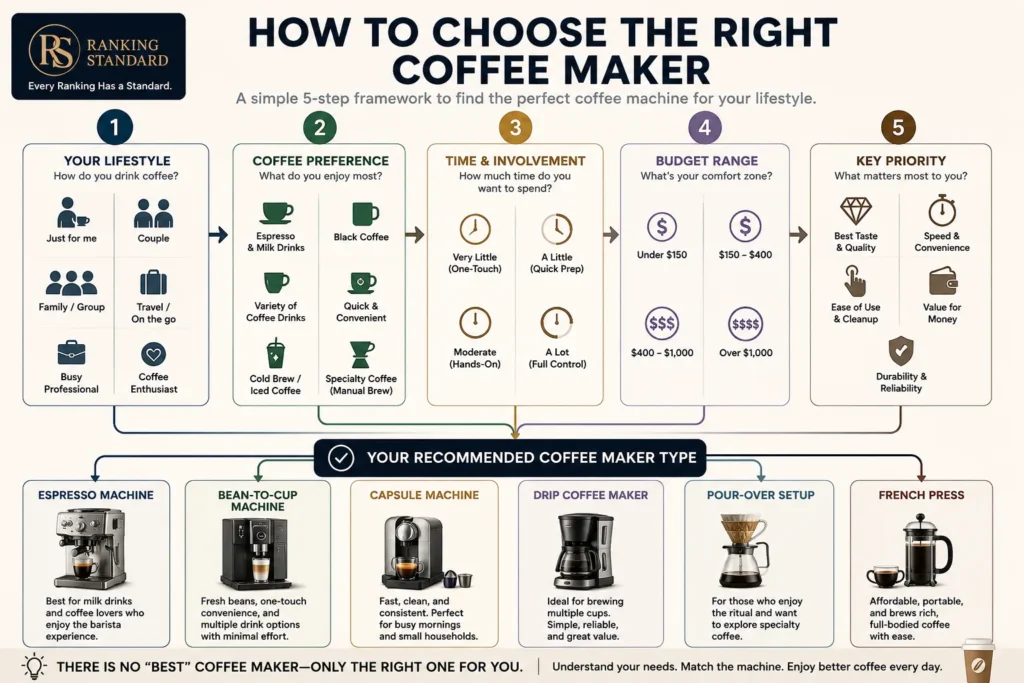
Five Questions to Ask Before Buying
Before looking at prices or brands, answer these questions.
1. How often do you drink coffee?
One cup each morning?
Several cups throughout the day?
Only on weekends?
Your daily routine influences the type of machine that’s worth investing in.
2. What kind of coffee do you actually enjoy?
Espresso.
Americano.
Latte.
Cappuccino.
Flat White.
Pour-over.
Cold Brew.
Different drinks require different brewing methods.
The machine should match your taste—not the other way around.
3. How much time do you want to spend making coffee?
Some people enjoy weighing beans, adjusting grind settings, and carefully extracting espresso.
Others simply want to press one button.
Neither approach is better.
The important thing is choosing a machine that fits your routine.
4. How involved do you want to be?
Do you enjoy learning new skills?
Or would you rather let the machine do the work?
Coffee can be a hobby.
It can also be a daily convenience.
Understanding which experience you want will eliminate many unsuitable options immediately.
5. What’s your realistic budget?
It’s tempting to buy a premium machine because reviewers say it’s the best.
But paying for features you’ll never use rarely improves your coffee experience.
A well-chosen $300 machine often provides more satisfaction than a poorly matched $1,500 machine.
Value comes from fit—not from price.
Understanding the Different Types of Coffee Makers
One of the biggest reasons people regret buying a coffee machine is surprisingly simple.
They bought the wrong category.
Not the wrong brand.
Not the wrong model.
The wrong type of machine.
That’s an important distinction.
Imagine buying a professional DSLR camera when all you wanted was something easy to take on vacation.
Or purchasing a heavy-duty pickup truck when you mostly drive through city streets.
The products themselves aren’t bad.
They’re simply designed for a different person.
Coffee makers work exactly the same way.
Before comparing brands, you need to understand which brewing system fits your lifestyle.
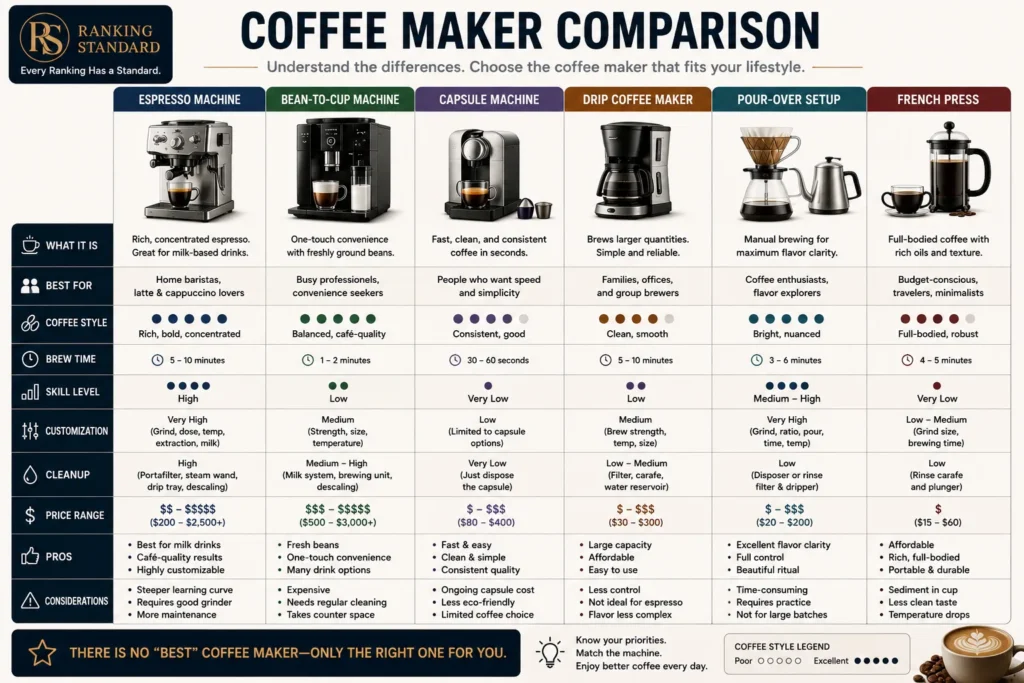
Espresso Machines
If you’ve ever ordered a cappuccino, latte, flat white, or macchiato, you’ve already experienced espresso.
Espresso is the foundation of many popular coffee drinks.
Unlike drip coffee, it uses high pressure to force hot water through finely ground coffee, producing a concentrated shot with a rich body and a layer of crema on top.
For coffee enthusiasts, this brewing method offers the highest level of control.
You can adjust the grind size, dose, extraction time, and milk texture to create drinks that rival many cafés.
But that control comes with responsibility.
Manual espresso machines require practice.
Grinding beans consistently.
Learning how firmly to tamp.
Understanding extraction time.
Steaming milk correctly.
It’s a rewarding hobby, but it’s also one of the most demanding ways to make coffee at home.
If making coffee feels like part of the experience rather than a chore, an espresso machine can be incredibly satisfying.
If you simply want caffeine before work, it may be more machine than you actually need.
Bean-to-Cup Machines
Bean-to-cup machines aim to solve a simple problem.
How do you get café-style coffee without learning barista skills?
These machines grind fresh beans, brew espresso, and often froth milk automatically.
Many can prepare espresso, cappuccino, latte, and Americano with the press of a single button.
For busy households, this combination of convenience and quality is difficult to beat.
The trade-off is cost.
Bean-to-cup machines are usually more expensive than basic coffee makers and require regular cleaning to keep the grinder and milk system working properly.
If you’re willing to spend a few minutes on maintenance each week, they provide one of the best balances between convenience and coffee quality.
Capsule Coffee Machines
Few coffee products have divided opinions as much as capsule machines.
Some coffee lovers dismiss them because they don’t offer the same level of freshness or customization as freshly ground beans.
Others wouldn’t trade them for anything.
Both perspectives make sense.
Capsule systems are designed around consistency and convenience.
There’s no grinder to adjust.
No coffee grounds to measure.
No complicated setup.
Insert a capsule.
Press a button.
Your coffee is ready in less than a minute.
For many people, that’s exactly what they need.
The downside is flexibility.
You’re tied to compatible capsules, ongoing capsule costs can add up over time, and your ability to experiment with different beans is limited.
If convenience is your highest priority, however, few systems are easier to live with.
Drip Coffee Makers
Despite the rise of espresso and capsule machines, drip coffee makers remain one of the most practical choices for many homes.
Why?
Because they do one thing exceptionally well.
They brew larger quantities of coffee efficiently.
If your household drinks several cups each morning—or if you often entertain guests—a drip coffee maker is hard to beat.
Modern premium models have also improved dramatically.
Many now include programmable timers, precise temperature control, bloom functions, and thermal carafes that keep coffee hot without burning it.
For black coffee drinkers, a high-quality drip machine often provides outstanding value.
Pour-Over Brewing
Pour-over brewing has become increasingly popular among specialty coffee enthusiasts.
At first glance, it looks simple.
Just pour hot water over coffee grounds.
In reality, it’s surprisingly technical.
Water temperature.
Pouring speed.
Grinding consistency.
Bloom time.
Even the shape of the dripper influences extraction.
For those who enjoy experimenting with beans from different regions, pour-over offers remarkable clarity of flavor.
Every cup feels intentional.
But if you’re rushing out the door on a Monday morning, it may not fit your routine.
French Press
The French Press has remained popular for decades for one reason.
Simplicity.
No electricity.
No expensive filters.
No complicated technology.
Coffee grounds are immersed directly in hot water before being separated by a metal mesh filter.
The result is a full-bodied cup with rich texture and natural oils that paper filters normally remove.
Some people love this heavier mouthfeel.
Others prefer the cleaner profile produced by drip or pour-over brewing.
Neither is objectively better.
They’re simply different experiences.
Which Coffee Maker Fits Your Lifestyle?
Instead of asking which machine is “best,” consider which description sounds most like you.
Choose an espresso machine if you:
- Enjoy learning new skills
- Love milk-based drinks
- Want maximum control
- View coffee as a hobby
Choose a bean-to-cup machine if you:
- Want fresh coffee every day
- Prefer convenience
- Drink several types of coffee
- Are comfortable with regular maintenance
Choose a capsule machine if you:
- Value speed above all else
- Drink one or two cups a day
- Want consistent results
- Prefer minimal cleanup
Choose a drip coffee maker if you:
- Mostly drink black coffee
- Brew multiple cups at once
- Want reliable daily performance
- Prefer simplicity
Choose pour-over if you:
- Love specialty coffee
- Enjoy experimenting
- Appreciate subtle flavor differences
- Don’t mind taking your time
Choose a French Press if you:
- Want affordable equipment
- Like rich-bodied coffee
- Prefer manual brewing
- Travel frequently or need a portable solution
The Best Coffee Machine Is the One You’ll Actually Enjoy Using
It’s easy to get distracted by specifications.
Pressure ratings.
Built-in grinders.
Touchscreens.
Automatic milk systems.
But after the excitement of buying a new machine fades, one question matters more than all the others.
Will you still enjoy using it six months from now?
The answer depends less on technology than on compatibility with your daily routine.
A simple machine that fits your lifestyle will almost always provide more satisfaction than a complicated one that doesn’t.
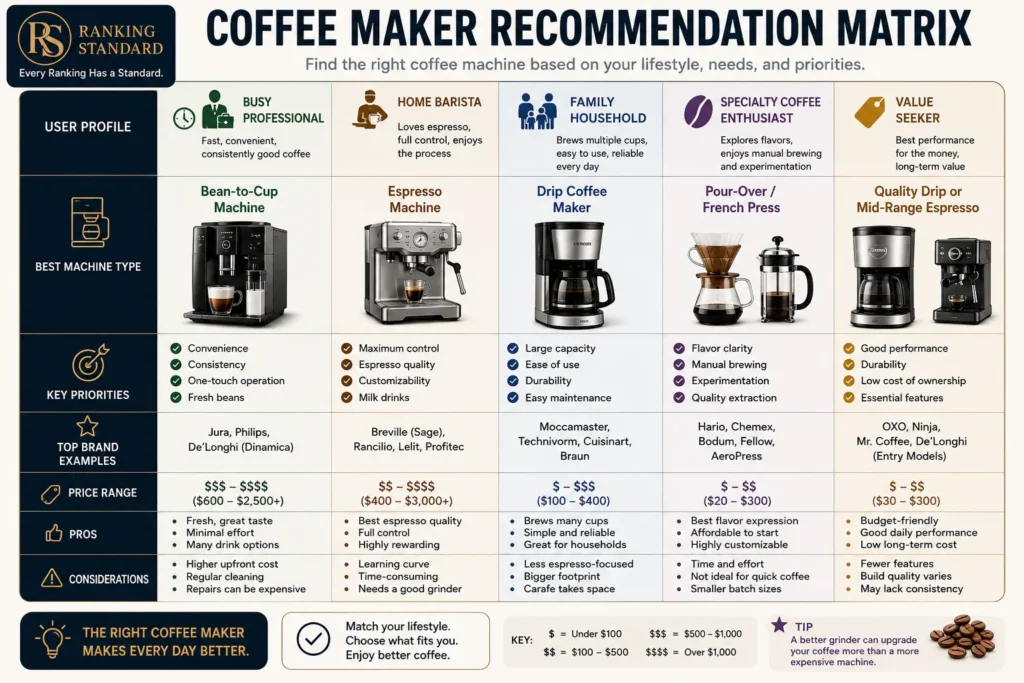
Our Recommendation Matrix
By now, one thing should be clear.
There isn’t a single coffee maker that’s perfect for everyone.
The right machine depends on how you drink coffee, how much time you want to spend making it, and what kind of experience you’re looking for.
That’s why Ranking Standard doesn’t choose one overall winner.
Instead, we recommend machines based on different types of coffee drinkers.
Profile 1: The Busy Professional
Your mornings are busy.
You don’t want to weigh coffee beans or adjust extraction times.
You simply want consistently good coffee before heading out the door.
For this type of user, convenience is more valuable than customization.
Best Choice
- Bean-to-Cup Machine
- Premium Capsule Machine
Why?
Fresh coffee.
Minimal effort.
Fast preparation.
Excellent consistency.
For many professionals, these machines become part of a daily routine rather than a weekend hobby.
Profile 2: The Home Barista
Coffee isn’t just a drink.
It’s a hobby.
You enjoy experimenting with different beans, dialing in the grind, practicing latte art, and improving each cup.
For you, the process is part of the reward.
Best Choice
- Manual Espresso Machine
- High-quality Burr Grinder
Why?
Maximum control.
Maximum learning.
Maximum flavor potential.
These machines require patience, but they also offer the greatest opportunity to improve your brewing skills over time.
Profile 3: The Family Household
Several people drink coffee every morning.
Brewing one cup at a time quickly becomes inconvenient.
Consistency and capacity matter more than café-style espresso.
Best Choice
- Premium Drip Coffee Maker
- Large Bean-to-Cup Machine
Why?
Easy to prepare multiple cups.
Simple operation.
Reliable daily performance.
Families often appreciate machines that require very little thought before the first cup of the day.
Profile 4: The Specialty Coffee Enthusiast
You’re curious.
You enjoy tasting different origins.
You notice flavor notes like chocolate, citrus, berries, or caramel.
Coffee is something to explore rather than simply consume.
Best Choice
- Pour-over Equipment
- French Press
- Manual Brewing Tools
Why?
These methods reveal subtle flavor differences that highly automated machines sometimes mask.
For many coffee lovers, brewing becomes part of the enjoyment.
Profile 5: The Value Seeker
You don’t need luxury.
You simply want excellent coffee for a reasonable price.
This doesn’t mean buying the cheapest machine.
It means finding the best balance between performance, durability, and long-term ownership costs.
Often, mid-range machines deliver the highest overall value.
Spending twice as much rarely produces coffee that’s twice as enjoyable.
Understanding Coffee Machine Brands
Many people start by asking,
“Which brand should I buy?”
But brands have personalities just like cars or cameras.
Knowing what each company specializes in makes shopping much easier.
Breville (Sage)
Known for bringing professional espresso features into home kitchens.
Excellent for aspiring home baristas.
Strong build quality.
Outstanding temperature control.
Ideal if espresso is your primary focus.
De’Longhi
One of the most versatile brands on the market.
Offers everything from affordable espresso machines to premium automatic systems.
Excellent choice for buyers who want flexibility across different budgets.
Philips
Especially well known for reliable bean-to-cup machines.
Simple interfaces.
Easy maintenance.
Designed for everyday convenience rather than advanced customization.
Jura
Premium automatic coffee machines.
Exceptional build quality.
Excellent milk systems.
Outstanding coffee with minimal effort.
The downside is price.
Jura machines represent a significant investment, but many owners keep them for years.
Nespresso
Perhaps the easiest way to enjoy espresso-style coffee at home.
Fast.
Consistent.
Minimal cleanup.
Perfect for users who prioritize convenience.
Keep in mind that capsule costs become part of the long-term ownership experience.
Moccamaster
A favorite among coffee enthusiasts who primarily drink filter coffee.
Its reputation comes from brewing at ideal temperatures with exceptional consistency.
Simple by design.
Outstanding in execution.
Common Buying Mistakes
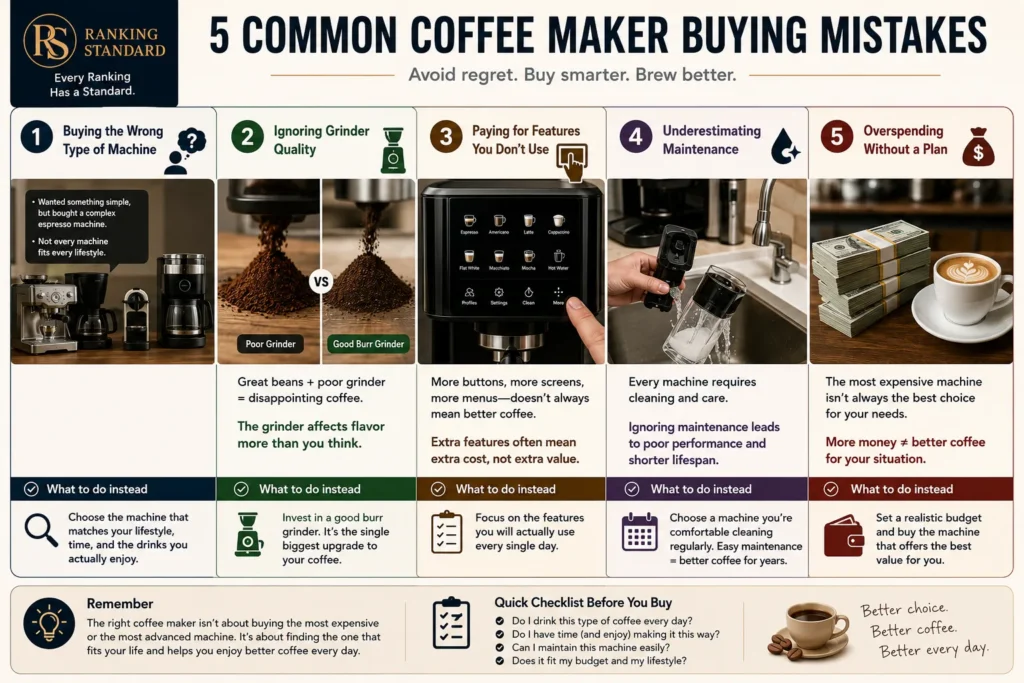
After reading thousands of customer reviews, the same regrets appear again and again.
Buying an espresso machine without wanting the espresso workflow
Many buyers love the idea of making café-quality coffee.
Far fewer enjoy cleaning, adjusting, grinding, and maintaining the equipment every day.
There’s nothing wrong with preferring convenience.
Be honest about your habits.
Ignoring grinder quality
A premium espresso machine paired with a poor grinder often produces disappointing coffee.
Experienced baristas frequently say the grinder influences coffee quality more than the machine itself.
If your budget is limited, investing in a better grinder may improve your coffee more than upgrading the machine.
Buying features you’ll never use
Touchscreens.
Twenty drink options.
App connectivity.
Personalized user profiles.
These features sound impressive, but many owners end up using only two or three functions every day.
Don’t pay for complexity if simplicity suits your lifestyle.
Underestimating maintenance
Every coffee machine requires cleaning.
Some require very little.
Others demand regular descaling, milk system cleaning, filter replacement, and grinder maintenance.
Ignoring maintenance almost always shortens the machine’s lifespan and reduces coffee quality.
So… Which Coffee Maker Should You Buy?
If you’re looking for one universal answer, this guide probably hasn’t given you one.
And that’s intentional.
Because there isn’t a universally perfect coffee maker.
There is only the right coffee maker for your habits.
If you love experimenting, buy a machine that rewards curiosity.
If convenience matters most, don’t feel guilty about choosing automation.
If your family drinks multiple cups every morning, choose capacity over complexity.
Buying the right machine isn’t about impressing other coffee enthusiasts.
It’s about making your own mornings better.
Final Thoughts
Coffee is deeply personal.
Some people see it as fuel.
Others see it as a ritual.
Some enjoy mastering every variable.
Others simply want a reliable cup before work.
None of these approaches is better than the others.
They’re simply different.
That’s why we believe buying guides should focus less on declaring winners and more on helping people understand themselves.
At Ranking Standard, we don’t rank products simply to create lists.
We build decision frameworks that reduce uncertainty and make choosing easier.
Because every purchase tells a story.
Every coffee routine is unique.
And every ranking should have a standard.
Continue Exploring
If this guide helped you understand coffee makers, you may also enjoy these upcoming guides:
- Best Coffee Makers for Beginners
- Best Espresso Machines for Home
- Bean-to-Cup vs Espresso Machine
- Nespresso vs Bean-to-Cup Machines
- Best Drip Coffee Makers
- Best Coffee Grinders
- Burr Grinder vs Blade Grinder
- Best Coffee Makers Under $500
- Best Coffee Beans for Espresso
- Coffee Brewing Methods Explained