

The best dishwashers aren’t necessarily the ones with the most cycles, the smartest apps, or the highest price.
A great dishwasher solves a much more ordinary problem:
It gets your dishes clean, gets them reliably dry, fits the way your household loads dishes, and does all of that without becoming an appliance you constantly think about.
That sounds simple.
Shopping for one isn’t.
Two dishwashers can look almost identical from the outside while behaving very differently once they’re installed.
One may clean baked-on food exceptionally well but struggle to dry plastic containers.
Another may run so quietly that you barely know it’s operating, yet have a rack layout that makes your everyday dishes frustrating to load.
A third may advertise dozens of cycles and Wi-Fi connectivity while getting the fundamentals no more right than a less expensive machine.
Then there are specifications buyers have to decode:
Decibels. Third racks. Stainless-steel tubs. Soil sensors. Heated drying. Condensation drying. Auto-opening doors. Filtration systems. Hard-food disposers. Adjustable tines.
The challenge isn’t finding a dishwasher with impressive features.
It’s figuring out which differences will matter in your kitchen for the next several years.
A Dishwasher Is Really a Workflow Appliance
Dishwashers are usually marketed around cleaning performance.
Cleaning obviously matters.
But that’s only part of the ownership experience.
Think about what happens during a normal day.
Dirty dishes accumulate.
Someone loads them.
Someone rearranges them because the bowls don’t fit.
Someone discovers there’s nowhere sensible for a large spatula.
The machine runs.
Then someone unloads it.
Perhaps the ceramic dishes are dry.
The plastic containers aren’t.
Maybe water has collected on the bottoms of mugs.
Perhaps the filter needs cleaning.
Then the process starts again tomorrow.
This is why Ranking Standard treats a dishwasher as a kitchen workflow appliance, not simply a cleaning machine.
Its job is to reduce the amount of work surrounding dishes.
That includes:
- Loading
- Cleaning
- Drying
- Unloading
- Maintenance
- Noise
- Reliability
A dishwasher that cleans brilliantly but creates friction everywhere else isn’t automatically the best dishwasher.
Start With Your Dishes, Not the Brand
It’s tempting to begin shopping with:
Bosch or KitchenAid?
LG or Samsung?
GE or Whirlpool?
But brand should come later.
Consider three households.
One is a couple who cooks at home occasionally and mostly loads plates, glasses, mugs, and silverware.
Another is a family of five generating breakfast dishes, lunch containers, pots, bowls, water bottles, and dinnerware every day.
The third is a serious home cook who regularly needs to accommodate mixing bowls, cookware, utensils, cutting boards, and awkwardly shaped kitchen tools.
All three households might have exactly the same dishwasher opening.
They don’t necessarily need the same dishwasher.
The couple may prioritize quiet operation and straightforward loading.
The family may care about capacity, flexible racks, drying performance, and fast turnaround.
The home cook may value adjustable tines, powerful cleaning zones, rack flexibility, and space for unusually shaped items.
Before comparing manufacturers, ask:
What actually goes into our dishwasher?
That question eliminates a surprising amount of confusion.
The Major Dishwasher Types
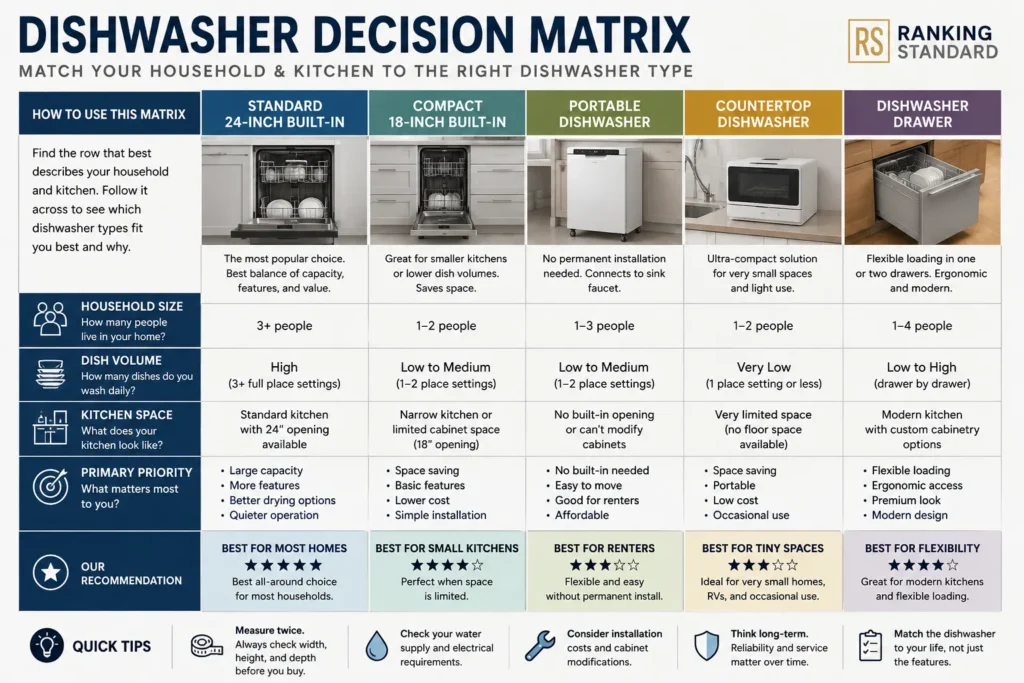
The market becomes easier to understand once dishwashers are separated by installation and use case.
Standard Built-In Dishwashers
The familiar built-in dishwasher is the default choice for many U.S. kitchens.
Most full-size models are designed for a roughly 24-inch-wide installation space, although buyers should always verify actual product and cabinet dimensions before purchasing.
This category offers the widest range of:
- Prices
- Rack configurations
- Cleaning systems
- Drying technologies
- Noise levels
- Finishes
- Smart features
For most households with a conventional dishwasher opening, this is where the buying decision begins.
But even within this category, two machines can provide radically different ownership experiences.
Compact 18-Inch Dishwashers
An 18-inch built-in dishwasher solves a space problem.
It can make sense for:
- Smaller kitchens
- Apartments
- Condominiums
- One- or two-person households
- Secondary kitchens
The obvious compromise is capacity.
For a small household, that may not matter.
For a family producing several meals’ worth of dishes each day, reduced capacity can mean running the machine more frequently.
As with washing machines, the correct question isn’t whether bigger is better.
It’s whether the capacity matches the workload.
Portable Dishwashers
Portable dishwashers are useful when permanent built-in installation isn’t practical.
They can be attractive for renters or kitchens that weren’t designed with a dishwasher opening.
The trade-off is convenience.
A portable unit may need to be moved and connected for use, then stored afterward.
For someone who can’t install a conventional machine, that’s a reasonable compromise.
For someone with an available built-in opening, it may create unnecessary friction.
Countertop Dishwashers
Countertop models serve an even more specific use case.
They’re compact and can work well for:
- Very small households
- Tiny apartments
- RVs
- Limited kitchens
- Situations where floor space is unavailable
But capacity is inherently limited.
A countertop dishwasher isn’t a miniature replacement for every full-size dishwasher.
It’s a different solution for a different space constraint.
Dishwasher Drawers
Drawer-style dishwashers approach the problem differently.
Instead of one large drop-down door, they use one or more pull-out drawers.
Depending on the configuration, this can allow users to run smaller loads independently or create easier access in certain kitchen layouts.
Potential advantages include:
- Flexible load sizes
- Ergonomic access
- Independent washing zones on some designs
- Distinctive installation options
But they also represent a more specialized segment and may involve different capacity, price, and service considerations.
They make sense when their architecture solves a specific household problem—not simply because they’re unusual.
Capacity Is More Than a Place-Setting Number
Dishwasher capacity is often described using place settings.
That’s useful for standardized comparisons.
Real kitchens aren’t standardized.
A household doesn’t load identical dinner plates, cups, saucers, and utensils every night.
It loads:
- Large bowls
- Tall glasses
- Food containers
- Children’s dishes
- Water bottles
- Frying pans
- Serving utensils
- Pots
- Cutting boards
- Oddly shaped kitchen tools
That’s why usable capacity matters more than the headline capacity figure alone.
Rack geometry can determine whether a dishwasher that looks large on paper actually accommodates your dishes efficiently.
Rack Design May Matter More Than You Expect
This is one of the most underestimated parts of dishwasher shopping.
A rack isn’t just a basket.
It’s the interface between your dishes and the machine.
Consider:
- Adjustable upper racks
- Folding tines
- Stemware holders
- Bottle supports
- Silverware baskets
- Third racks
- Deep vs. shallow rack layouts
A dishwasher with flexible racks may accommodate more of your real dishes than another machine with a similar advertised capacity.
This is particularly important if your household frequently washes:
- Large bowls
- Tall glasses
- Water bottles
- Pots
- Oversized plates
If you’re shopping in person, don’t simply look inside.
Imagine loading your actual dishes.
Even better, measure the items that routinely cause problems in your current machine.
The Third Rack: Useful Upgrade or Lost Space?
Third racks have become increasingly common.
They’re positioned above the traditional upper rack and can provide space for items such as:
- Flatware
- Cooking utensils
- Small bowls
- Lids
- Measuring tools
A well-designed third rack can free space elsewhere and improve organization.
But not all third racks are equally useful.
A shallow rack may accommodate only flat utensils.
A deeper, more flexible design may handle substantially more.
There can also be a trade-off involving vertical clearance below.
So the useful question isn’t:
Does it have a third rack?
It’s:
Does the third rack increase usable capacity for the dishes I actually own?
Cleaning Performance Is a System
Dishwasher marketing often highlights individual spray technologies.
Extra jets.
Bottle jets.
Special wash zones.
Multiple spray arms.
These can be useful.
But cleaning performance comes from the interaction of several factors:
- Water distribution
- Spray coverage
- Water pressure
- Temperature
- Detergent
- Filtration
- Soil sensing
- Cycle programming
- Loading
- Cycle duration
No single jet guarantees clean dishes.
And a powerful cleaning system can’t compensate for dishes loaded in a way that blocks water from reaching them.
Ranking Standard therefore evaluates cleaning consistency across realistic loads, not the number of cleaning features printed on the box.
You Probably Don’t Need to Pre-Wash Everything
A dishwasher should remove ordinary food soil.
If you’re completely washing dishes by hand before putting them into the machine, much of the appliance’s purpose has disappeared.
That doesn’t mean loading plates covered in large pieces of food.
Scraping significant food debris into the trash or disposal is sensible.
But modern dishwasher detergents and cycles are designed to perform the actual washing.
Exact recommendations can vary by dishwasher, detergent, water conditions, and load, so owners should follow the manufacturer’s guidance.
From a purchasing perspective, though, one standard is clear:
A dishwasher shouldn’t require you to do most of its job before closing the door.
Drying Performance Deserves Its Own Evaluation
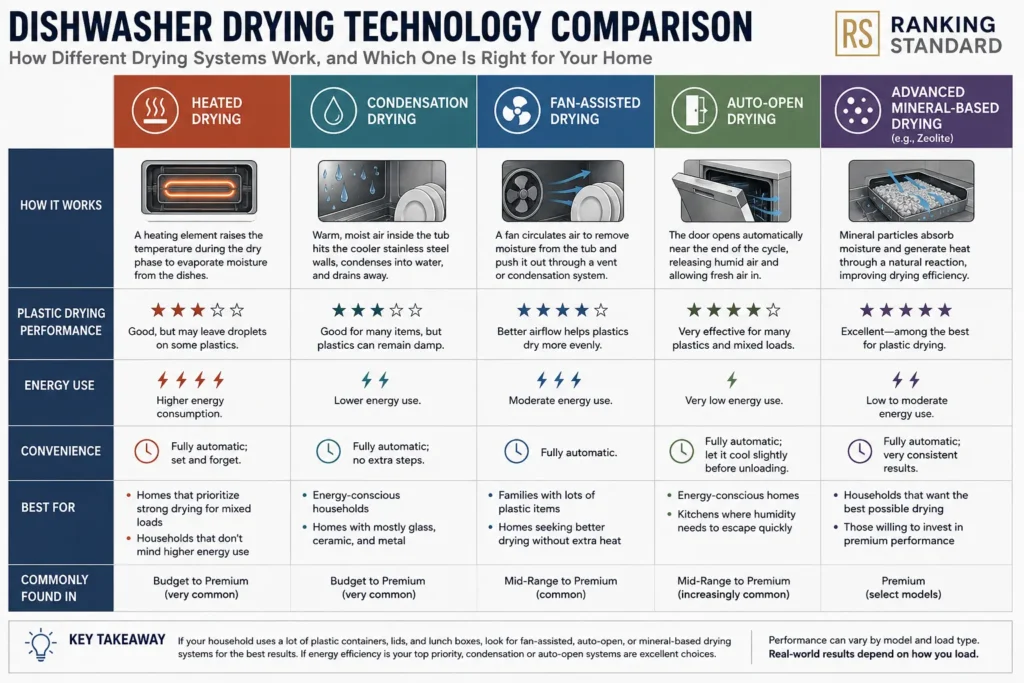
A dishwasher can clean perfectly and still disappoint when you open the door.
Why?
Wet dishes.
And especially:
wet plastic.
Ceramic, glass, and metal retain heat relatively well.
Many plastics don’t.
That difference can make plastic containers harder to dry using certain systems.
Manufacturers address drying in different ways.
Depending on the machine, you may encounter:
- Exposed heating elements
- Condensation drying
- Fan-assisted drying
- Automatic door opening
- Mineral-based drying systems
- Combinations of multiple methods
These approaches have different strengths and trade-offs.
The important point is that cleaning and drying are separate performance categories.
A machine shouldn’t receive an exceptional overall score simply because it cleans well if the target household constantly unloads wet dishes.
Heated Drying vs. Condensation Drying
Traditional heated-dry systems use additional heat to assist the drying process.
They can be effective, but they may use additional energy and require care with heat-sensitive items.
Condensation-based systems approach drying differently, using the thermal characteristics of the tub and dishes to encourage moisture to condense away from the load.
These systems can be efficient and effective for many materials.
Plastics may remain more challenging.
Neither method should automatically be declared superior.
The right choice depends partly on what you wash.
A household filled with reusable plastic containers may prioritize drying differently from one washing mostly ceramic plates and glassware.
Auto-Open Drying Is More Than a Gimmick
Some dishwashers automatically open the door slightly near the end of the cycle.
The idea is straightforward:
Allow moist air to escape and encourage additional drying.
This is a good example of a feature Ranking Standard evaluates by real-world effect rather than technological complexity.
If a relatively simple mechanism meaningfully improves drying and reduces the need to hand-dry dishes, it can be more valuable than a sophisticated app feature.
The best technology isn’t necessarily the most complicated.
It’s the technology that removes friction.
Stainless-Steel Tub vs. Plastic Tub
Tub material is another common comparison.
Stainless-Steel Tubs
Potential advantages may include:
- Premium construction
- Good durability
- Noise-management benefits as part of the overall design
- Compatibility with certain condensation-drying approaches
- Resistance to staining and odor absorption
They’re common in mid-range and premium machines.
Plastic Tubs
Plastic tubs can help manufacturers keep prices lower.
They don’t automatically mean poor cleaning performance or poor reliability.
A well-designed dishwasher with a plastic tub may represent excellent value for a household that doesn’t need premium construction.
Once again:
One material doesn’t determine the quality of the entire machine.
Noise: What Dishwasher Decibels Actually Mean
Dishwasher noise is usually expressed in decibels, or dB.
The lower the rating, generally, the quieter the machine is expected to be under the manufacturer’s test conditions.
But buyers shouldn’t turn one decibel into a competition.
The practical question is whether the dishwasher is quiet enough for where it will be installed.
Noise matters much more in:
- Open-plan kitchens
- Small apartments
- Kitchen/living-room combinations
- Homes where cycles run at night
- Work-from-home environments
A household with a closed kitchen may have little reason to pay a large premium for the quietest machine available.
A family watching television ten feet from the dishwasher may feel very differently.
Quietness has value when your floor plan gives it value.
How Quiet Is Quiet Enough?
Instead of chasing the lowest possible number, think in practical tiers.
A machine in the low-40-dB range is generally marketed as very quiet.
Models around the mid-to-upper 40s can still be comfortably quiet for many households.
Once noise climbs further, operation may become more noticeable, especially in open spaces.
But exact perception depends on:
- Room acoustics
- Installation
- Cabinetry
- Floor plan
- Type of sound
- Distance from the machine
The lesson isn’t to memorize a magic decibel number.
It’s to avoid paying for silence you don’t need—or discovering after installation that noise matters more than you expected.
Filters vs. Hard-Food Disposers
Dishwashers need a way to manage food particles removed during washing.
Different designs may use filtration systems, grinders or hard-food disposers, or combinations of approaches.
Filter-Based Systems
Filters capture food particles and may require periodic cleaning.
Potential advantages include:
- Simple operation
- Quiet performance
- Straightforward maintenance on accessible designs
The trade-off is obvious:
Someone has to clean the filter.
Hard-Food Disposal Systems
Some machines mechanically process food particles.
This can reduce certain manual filter-cleaning requirements, depending on the design.
But additional mechanical components may influence noise, complexity, and maintenance.
Neither approach eliminates the need to understand the machine’s care instructions.
The better system is the one whose maintenance requirements fit the owner.
Maintenance Should Be Part of the Purchase
Dishwashers aren’t maintenance-free.
Depending on the model and water conditions, ownership may involve:
- Filter cleaning
- Spray-arm inspection
- Gasket cleaning
- Interior cleaning
- Detergent-dispenser care
- Rinse-aid refilling
- Hard-water management
None of this is particularly alarming.
But accessibility matters.
If a filter requires routine cleaning, it should be easy to remove and reinstall.
If spray arms can become obstructed, inspection shouldn’t require unnecessary disassembly.
Good appliance design includes the tasks owners perform after purchase.
Hard Water Can Change the Ownership Experience
Water chemistry doesn’t receive enough attention in dishwasher buying guides.
Mineral-heavy water can contribute to:
- Spots
- Film
- Scale buildup
- Reduced appearance of glassware
- Maintenance requirements
Detergent choice, rinse aid, machine settings, and—in some circumstances—water-softening solutions can influence results.
Some dishwashers also include built-in water-softening capabilities.
That feature may be largely unnecessary for one household and extremely useful for another.
This is another reason product recommendations should account for where and how the machine will be used.
Efficiency Isn’t Just About Water
Modern dishwashers can be highly efficient compared with washing the same amount of tableware manually under running water, but actual use varies.
When comparing machines, standardized U.S. information such as the EnergyGuide label and ENERGY STAR qualification can help buyers evaluate energy and water efficiency.
But Ranking Standard again looks at the complete workflow.
Efficiency can also mean:
- Fitting more into each useful load
- Avoiding unnecessary rewashing
- Effective soil sensing
- Choosing appropriate cycles
- Reliable drying
- Running full, well-loaded cycles
An efficient dishwasher that forces frequent rewashing isn’t an efficient household system.
Reliability and Repairability Matter More Than Feature Count
Dishwashers combine water, heat, pumps, electronics, valves, sensors, racks, seals, and moving components.
Eventually, something can require service.
That makes long-term support important.
Before buying, consider:
- Warranty coverage
- Local service availability
- Replacement parts
- Rack replacement cost
- Pump and control-board availability
- Manufacturer support
- Model complexity
A premium dishwasher should provide more than an attractive interior and additional buttons.
Its long-term ownership proposition should make sense too.
The Ranking Standard Philosophy
Dishwasher shopping usually begins too late in the decision process.
People start with:
Which brand is best?
Ranking Standard starts earlier.
First:
What dishes do you wash?
Then:
How much capacity do you actually need?
Then:
How flexible must the racks be?
Then:
How important are drying, noise, and maintenance in your household?
Then:
What level of reliability, service, and convenience are you willing to pay for?
Only after those questions should individual models and brands enter the comparison.
That changes the question from:
Which dishwasher wins?
to:
Which dishwasher solves my kitchen’s problems with the least friction?
That’s a much more useful standard.
What You’ll Learn
In the rest of this guide, we’ll examine:
- How much dishwasher capacity you actually need
- When a third rack is worth paying for
- Which rack features genuinely improve loading
- The major drying technologies and their trade-offs
- How to think about dishwasher noise
- Filters vs. hard-food disposers
- When stainless-steel tubs matter
- Which cycles and smart features are genuinely useful
- How water hardness can influence your choice
- What premium dishwashers should deliver for the extra money
- Reliability, repairability, and long-term ownership
- How Ranking Standard evaluates dishwashers
By the end, you shouldn’t simply know which dishwasher brands are popular.
You should understand what kind of dishwasher belongs in your kitchen and why.
That’s where the right purchase begins.
Understanding Dishwasher Technology Before Choosing a Brand
Once you’ve identified your kitchen size, household workload, and the kinds of dishes you regularly wash, the next step is understanding what you’re actually paying for.
Dishwasher specification sheets can make expensive models appear dramatically more sophisticated than basic ones.
More spray zones.
More cycles.
More racks.
More sensors.
More connectivity.
But the feature count doesn’t tell you whether those additions will improve your daily routine.
Some dishwasher upgrades genuinely change the ownership experience.
Others mostly make the brochure longer.
The goal is to separate the two.
Step 1: Think About Usable Capacity, Not Maximum Capacity
Dishwasher capacity isn’t simply about how many dishes technically fit inside.
It’s about how efficiently your dishes fit.
Imagine two dishwashers with similar advertised capacity.
Dishwasher A has fixed tines and a shallow third rack.
Dishwasher B has adjustable racks, folding tines, and a deeper third rack.
A standardized capacity figure may make them appear similar.
Your kitchen may tell a completely different story.
Large cereal bowls might fit awkwardly in one.
Tall glasses may collide with the upper rack.
A frying pan might occupy half the bottom basket.
That’s why Ranking Standard evaluates:
Usable Capacity = Interior Space × Rack Flexibility × Your Dish Mix
The largest interior doesn’t automatically provide the greatest practical capacity.
Step 2: Adjustable Upper Racks Can Be More Valuable Than Extra Cycles
One of the most useful dishwasher features is also one of the least glamorous.
An adjustable upper rack allows you to change vertical clearance.
Raise it and you may create additional room below for:
- Large dinner plates
- Pots
- Cutting boards
- Serving dishes
Lower it and you may create space above for:
- Tall glasses
- Mugs
- Bottles
- Bowls
Some designs even allow adjustment while the rack is loaded.
That’s the kind of feature Ranking Standard likes.
It solves a recurring problem without requiring the user to think about it very much.
If your dishes vary substantially in size, rack flexibility may improve everyday ownership more than several specialized wash cycles combined.
Step 3: Folding Tines Are About Geometry
Fixed tines work well when your dishes resemble the manufacturer’s expected load.
Real kitchens aren’t always that cooperative.
Folding or adjustable tines can create room for:
- Pots
- Deep bowls
- Odd-shaped serving pieces
- Food-storage containers
- Larger cookware
But more adjustability isn’t automatically better.
A complicated rack filled with moving parts can become irritating if the mechanisms are awkward or fragile.
The best rack system isn’t the one with the most adjustments.
It’s the one that adapts quickly to the loads you actually wash.
Step 4: Evaluate the Third Rack by What It Can Hold
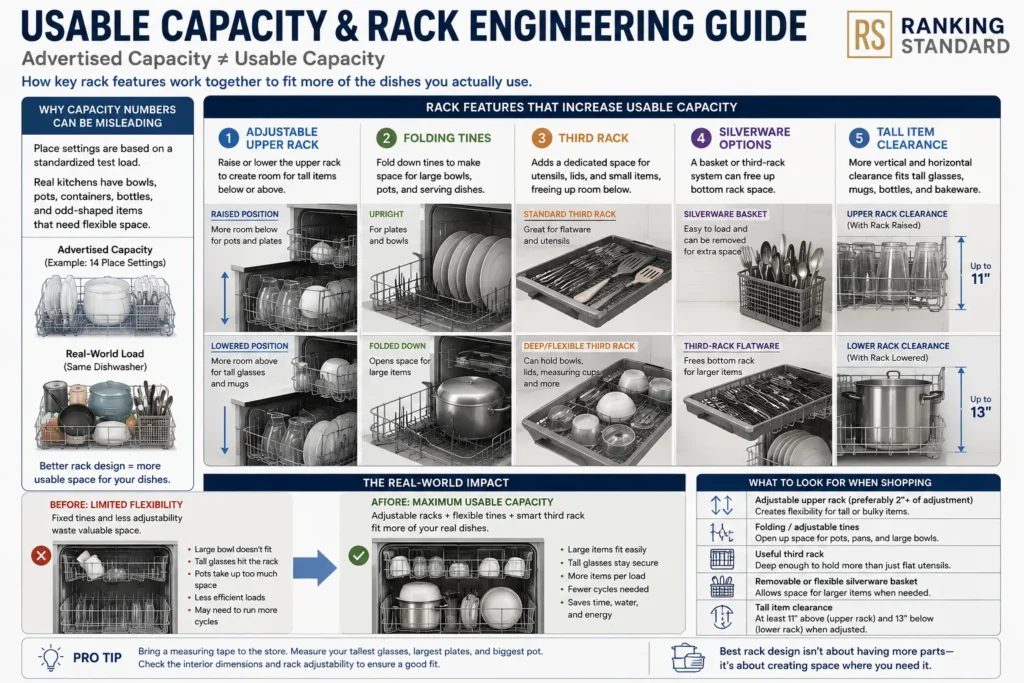
Third racks deserve more scrutiny than a simple yes-or-no checkbox.
There are roughly two approaches.
Shallow Third Racks
Primarily designed for:
- Flatware
- Knives
- Small utensils
- Cooking tools
They can free space in the lower silverware basket.
Deeper Third Racks
Depending on the design, they may accommodate:
- Small bowls
- Cups
- Lids
- Larger utensils
- Additional flatware
This can meaningfully increase usable capacity.
But geometry matters.
A deep third rack may reduce clearance in the rack below unless the overall interior has been designed around it.
So don’t ask:
Does this dishwasher have three racks?
Ask:
What can I put on the third rack without making the other two worse?
Step 5: The Silverware Basket Still Matters
Third racks haven’t made traditional silverware baskets irrelevant.
Some households prefer dropping forks and spoons into a basket rather than arranging them individually above.
Others appreciate the organization of a dedicated third rack.
A removable or repositionable silverware basket can also free bottom-rack space when needed.
This is a perfect example of why specifications don’t determine usability.
Two buyers can legitimately prefer opposite solutions.
Step 6: Spray Systems Should Improve Coverage, Not Marketing
Manufacturers use different approaches to distribute water throughout the tub.
You may encounter:
- Multiple spray arms
- Dedicated bottle jets
- Targeted wash zones
- Additional upper-level sprayers
- Moving spray mechanisms
- Specialized high-pressure zones
These features can improve cleaning in particular situations.
But more jets don’t automatically equal cleaner dishes.
Water still has to reach dirty surfaces effectively.
A sophisticated spray system combined with poor rack geometry may perform worse with your load than a simpler system that provides consistent coverage.
Ranking Standard therefore asks:
Does the wash system produce reliable cleaning across realistic loads?
Not:
How complicated does the spray arm look?
Step 7: Soil Sensors Can Be Genuinely Useful
Many modern dishwashers use sensors to estimate how dirty the wash water or load is and adjust the cycle accordingly.
Depending on the machine, this may influence:
- Cycle duration
- Water use
- Temperature
- Number of rinses
This makes automatic or sensor-based cycles particularly useful for households whose loads vary significantly.
One evening may contain lightly used breakfast dishes.
Another may include cookware after a large family dinner.
A good automatic cycle can reduce the need to manually decide how aggressively each load should be washed.
This is technology doing something useful:
removing a decision from the owner.
Step 8: Normal, Auto, Heavy and Quick May Be All You Need
Dishwashers sometimes advertise an enormous number of cycles.
Most households repeatedly use only a few.
Normal
Designed for ordinary everyday loads and often important for standardized efficiency operation.
Auto / Sensor
Adjusts operation according to the machine’s sensing system.
Heavy / Pots & Pans
Useful for heavily soiled cookware and difficult loads.
Quick / Express
Useful when turnaround time matters and the load is appropriate for the program.
Other specialized programs can certainly be useful.
But don’t pay a premium because a dishwasher has 15 cycles if you’ll use four of them for almost everything.
Cycle quality matters more than cycle quantity.
Step 9: Drying Technology Can Justify Paying More
Cleaning differences between competent modern dishwashers may sometimes be smaller than buyers expect.
Drying differences can be much easier to notice.
This is especially true if your household uses a lot of plastic.
When evaluating drying, look at the complete system.
Heated Drying
Additional heat can improve drying but may increase energy use and isn’t ideal for every heat-sensitive item.
Condensation Drying
Uses retained heat and cooler tub surfaces to encourage moisture movement away from dishes.
It can work particularly well with glass, ceramic, and metal.
Plastic remains more difficult.
Fan-Assisted Systems
Air movement can help remove moisture from the tub.
Automatic Door Opening
Allows humid air to escape near the end of the cycle.
Advanced Mineral-Based Systems
Some premium designs use moisture-absorbing materials as part of the drying process.
These can provide strong drying performance but typically appear at higher price points.
There isn’t one universally superior technology.
The important question is:
How dry are the materials your household actually washes?
Step 10: Plastic Is the Drying Test That Matters
If your household frequently uses:
- Food-storage containers
- Children’s dishes
- Reusable lunch containers
- Plastic cups
- Lightweight lids
pay particular attention to drying performance.
Why?
Plastic doesn’t retain heat like ceramic, glass, or metal.
That makes evaporation more difficult.
A dishwasher that leaves a few drops on a ceramic plate may leave significantly more moisture on plastic.
For a household with very little plastic, this may barely matter.
For a family packing several lunch boxes every morning, it may become one of the most important differences between models.
This is exactly why Ranking Standard evaluates products by use case rather than specification prestige.
Step 11: Noise Has Diminishing Returns
Quiet dishwashers are valuable.
But the value doesn’t increase forever.
Moving from a noticeably loud machine to a quiet one can transform an open-plan kitchen.
Moving from an already very quiet machine to one that’s marginally quieter may be difficult to notice in everyday life.
This is a classic diminishing-return curve.
Once a dishwasher becomes sufficiently quiet for your home, additional spending may produce greater value elsewhere.
For example:
- Better racks
- Better drying
- Improved service support
- More useful capacity
Don’t pay for a specification victory you can’t meaningfully experience.
Step 12: Your Kitchen Determines How Much Quietness Is Worth
Consider where the dishwasher sits.
Open-Plan Kitchen
Noise deserves substantial weight.
Small Apartment
The dishwasher may be close to the living and sleeping areas.
Again, noise matters.
Closed Kitchen
A moderate noise difference may matter much less.
Mostly Overnight Operation
Quietness may become more important depending on proximity to bedrooms.
There is no universal “best dishwasher decibel rating.”
There is an appropriate noise level for your floor plan.
Step 13: Stainless Steel Should Be Evaluated as Part of the System
Stainless-steel tubs are frequently treated as a shorthand for quality.
They can offer meaningful advantages.
But don’t turn tub material into a ranking by itself.
A stainless interior doesn’t guarantee:
- Better cleaning
- Better rack design
- Better reliability
- Better controls
- Better serviceability
Likewise, a plastic tub doesn’t automatically make a dishwasher bad.
At lower price points, spending money on strong fundamental cleaning and usable racks may matter more than obtaining stainless steel purely for prestige.
The question is always:
What does the feature improve?
Step 14: Filter Maintenance Is a Real Ownership Cost
Filter-based dishwashers can operate quietly and effectively.
But filters don’t clean themselves indefinitely.
Food particles and debris can accumulate.
Depending on the dishwasher and usage, periodic inspection and cleaning may be required according to the manufacturer’s instructions.
This isn’t necessarily difficult.
The important issue is maintenance friction.
Ask:
- Is the filter easy to access?
- Can it be removed without tools?
- Is it easy to rinse?
- Is reinstalling it obvious?
- Does the manual clearly explain maintenance?
A dishwasher that needs five minutes of simple maintenance occasionally is very different from one that makes basic cleaning unnecessarily awkward.
Step 15: Hard Water Can Make an Expensive Dishwasher Look Bad
Suppose a premium dishwasher finishes a cycle and your glasses still show mineral spots.
The dishwasher may not be the main problem.
Water hardness can significantly influence dishwashing results.
Depending on local conditions, households may need to consider:
- Rinse aid
- Detergent formulation
- Detergent quantity
- Dishwasher settings
- Periodic descaling
- Water treatment
Some machines include integrated water-softening systems.
In areas with significant hard-water problems, that may be a meaningful premium feature.
In areas with naturally softer water, it may provide little additional value.
Local conditions can change product value.
Step 16: Smart Features Should Remove Friction
Dishwasher connectivity may provide:
- Cycle notifications
- Remote status monitoring
- Maintenance alerts
- Diagnostic information
- Downloadable programs
- Usage information
- Smart-home integration
Some are useful.
Others are easy to ignore after the first week.
Cycle-completion notifications can be genuinely convenient.
Maintenance alerts may help owners remember routine care.
Remote start is less transformative when someone still needs to physically load the dishes and add detergent.
Ranking Standard’s rule is straightforward:
Smart features earn value when they save time, prevent problems, or simplify ownership.
Connectivity itself earns nothing.
Step 17: Automatic Detergent Dosing Is Interesting—but Not Essential
Some higher-end dishwashers offer systems designed to automate detergent dosing.
The concept is attractive:
Store detergent in the machine and let the dishwasher dispense the appropriate amount.
Potential advantages include:
- Less manual dosing
- More consistent detergent use
- Reduced preparation
- Convenience for frequent users
But this isn’t an essential dishwasher feature.
A household running the dishwasher twice every day may value automation much more than someone running it three times a week.
Again:
Frequency of use determines feature value.
Step 18: Don’t Ignore Cycle Time
Energy- and water-efficient dishwasher cycles can be surprisingly long.
That isn’t necessarily a defect.
Longer operation can be part of how a machine achieves cleaning while managing resource consumption.
But cycle duration becomes important when household demand is high.
Imagine a family that fills the dishwasher after breakfast and again after dinner.
A long cycle may be perfectly manageable.
Now imagine a large gathering where three consecutive loads need to be processed.
Turnaround suddenly matters.
Quick cycles can help, but they may involve trade-offs in load size, soil level, drying, or efficiency depending on the machine.
Consider daily throughput, not just cleaning performance.
Step 19: Look at the Entire Door-Open-to-Door-Open Experience
A dishwasher cycle isn’t finished simply because the wash motor stops.
The complete workflow is:
Load → Start → Wash → Dry → Unload → Ready for Next Load
Every stage matters.
A dishwasher with excellent cleaning but poor drying extends the process because someone must hand-dry items.
A dishwasher with awkward racks increases loading time.
A dishwasher with poor unloading geometry creates another inconvenience.
Ranking Standard calls this Dishwashing Throughput.
It’s the amount of clean, dry, ready-to-use tableware the machine can return to the household with minimal intervention.
That’s a more useful measure than cycle time alone.
Step 20: What Should You Spend?
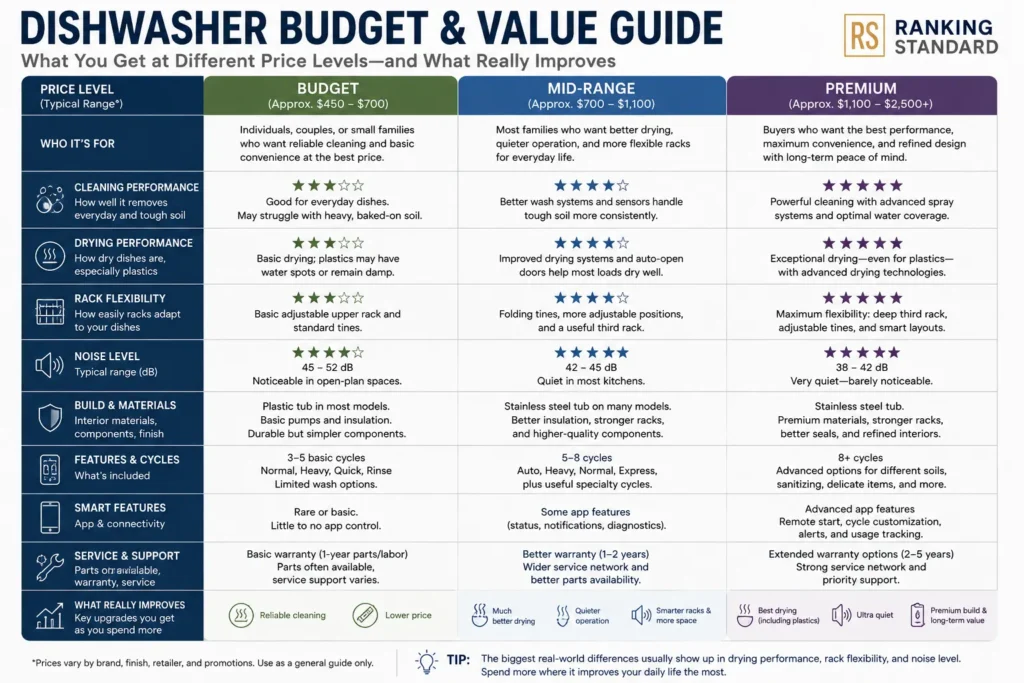
Exact dishwasher prices change with retailers, promotions, finishes, installation packages, and model updates.
So rather than defining quality by rigid dollar thresholds, it’s more useful to understand what moving upmarket should buy.
Budget Segment
A good budget dishwasher should deliver:
- Dependable basic cleaning
- Practical racks
- Essential cycles
- Straightforward controls
Common compromises may include:
- More noticeable noise
- Simpler drying
- Less rack flexibility
- More basic materials
- Fewer convenience features
That’s acceptable.
A budget dishwasher shouldn’t be punished for lacking luxury features.
It should be judged on whether it performs the fundamentals well.
Mid-Range Segment
This is likely to be the value sweet spot for many households.
Additional spending should begin producing noticeable improvements such as:
- Quieter operation
- Stainless-steel construction on many models
- Better rack adjustment
- Useful third racks
- Improved drying
- More refined automatic cycles
- Better user interfaces
This is where dishwasher ownership can become noticeably more convenient.
Premium Segment
Premium machines should offer more than expensive finishes.
Look for meaningful improvements in:
- Cleaning consistency
- Drying performance
- Very quiet operation
- Rack engineering
- Materials
- Specialized loading flexibility
- Automation
- Water management
- Build quality
- Ownership support
The important phrase is meaningful improvements.
A premium badge doesn’t automatically justify a premium price.
Step 21: Luxury Has Diminishing Returns Too
At the top of the market, dishwashers can become exceptionally refined.
But once a machine:
- Cleans extremely well
- Dries well
- Runs quietly
- Offers excellent racks
- Fits your dishes
- Provides appropriate support
additional spending may produce smaller practical gains.
Perhaps the interior lighting is nicer.
Perhaps the controls feel more sophisticated.
Perhaps the machine is marginally quieter.
Those things can be enjoyable.
But they’re not equally valuable to every buyer.
Ranking Standard separates:
Performance Premium
from
Luxury Premium.
The first improves what the machine does.
The second improves how exclusive or refined it feels.
Buyers should know which one they’re paying for.
Step 22: Reliability Should Be Model-Aware
“Which dishwasher brand is most reliable?”
It’s one of the first questions buyers ask.
It’s also easy to oversimplify.
Reliability can vary by:
- Model
- Product generation
- Component design
- Usage
- Installation
- Water conditions
- Maintenance
Brand-level reputation can provide context.
It shouldn’t replace model-level evaluation.
When Ranking Standard evaluates specific dishwashers, we’ll look for evidence around:
- Reliability history where available
- Warranty
- Parts availability
- Service network
- Repair complexity
- Manufacturer support
The logo on the door is only one part of that analysis.
Step 23: Local Service Can Change Which Brand Is Best for You
This point is particularly important with major appliances.
Imagine Dishwasher A slightly outperforms Dishwasher B.
But authorized service for Dishwasher A is difficult to obtain where you live.
Dishwasher B has multiple local technicians and readily available parts.
Which is the better long-term purchase?
The answer may be Dishwasher B.
Serviceability is geographically dependent.
That’s why a national “best dishwasher” ranking should never pretend that ownership conditions are identical everywhere.
Before buying an expensive appliance, checking local service availability is worth the effort.
Step 24: Installation Costs Belong in the Budget
The sticker price isn’t necessarily the installed price.
Depending on your situation, additional costs can include:
- Delivery
- Removal of the old dishwasher
- Installation
- Plumbing adjustments
- Electrical work
- New hoses or installation components
- Cabinet modifications
Requirements vary by home and retailer.
That means two machines separated by a modest retail-price difference may end up costing substantially different amounts once installed.
Compare total acquisition cost, not simply shelf price.
Step 25: Measure Before You Buy
Dishwashers appear standardized.
Kitchens aren’t always.
Before purchasing, verify:
- Opening width
- Opening height
- Opening depth
- Flooring height
- Countertop clearance
- Door-opening clearance
- Plumbing location
- Electrical requirements
This becomes especially important in older kitchens or spaces that have been remodeled.
A premium dishwasher that doesn’t fit is not a premium buying decision.
The Ranking Standard Dishwasher Decision Matrix
Before comparing brands, identify your household profile.
| Household Situation | Prioritize | Usually Less Important |
|---|---|---|
| Single / couple | Appropriate capacity, quietness, efficiency | Maximum rack capacity |
| Large family | Usable capacity, rack flexibility, drying, throughput | Luxury finishes |
| Heavy home cooking | Cleaning power, flexible racks, cookware space | Large number of specialty cycles |
| Open-plan home | Quiet operation, drying, usability | Extreme quick-cycle performance |
| Lots of plastic containers | Drying performance, flexible racks | Marginally lower noise once already quiet |
| Hard-water area | Water management, rinse performance, maintenance | Decorative smart features |
| Small kitchen | Dimensions, usable capacity, installation fit | Oversized interior |
| Premium buyer | Rack engineering, drying, quietness, build, support | Feature count for its own sake |
Notice again:
The matrix starts with the household—not the manufacturer.
That’s deliberate.
Ranking Standard’s Key Takeaway
Don’t choose a dishwasher by asking:
Which one has the most features?
Ask:
- What kinds of dishes do we actually wash?
- How much usable capacity do we need?
- How important is rack flexibility?
- Do we regularly wash plastic containers?
- How much does drying performance matter?
- How quiet does the dishwasher need to be in our floor plan?
- Do we have hard water?
- Which convenience features would we actually use?
- How much routine maintenance are we willing to perform?
- Is reliable service available where we live?
- What will the dishwasher cost after delivery and installation?
Once those questions are answered, comparing Bosch, KitchenAid, GE Appliances, LG, Samsung, Whirlpool, Miele, Frigidaire, and other manufacturers becomes far more meaningful.
A brand comparison should be the last stage of the decision—not the first.
In Part 3, we’ll turn everything we’ve learned into the Ranking Standard Dishwasher Evaluation Framework, establishing exactly how we evaluate cleaning, drying, loading flexibility, noise, efficiency, reliability, serviceability, and long-term value.
Part 3 – The Ranking Standard Dishwasher Evaluation Framework
How Ranking Standard Evaluates Dishwashers
Dishwashers are deceptively difficult products to rank.
A machine can clean extremely well but leave plastic containers wet.
Another can be exceptionally quiet but have frustrating racks.
A third may offer excellent performance but become difficult or expensive to service several years later.
Simply declaring one of them “the best dishwasher” ignores the compromises involved.
Ranking Standard therefore evaluates the complete ownership experience.
We ask:
How effectively does this dishwasher remove work from the household?
That includes what happens before, during, and after the wash cycle.
Our standard uses seven major evaluation categories.
1. Cleaning Performance – 25%
Cleaning remains the dishwasher’s primary job, so it receives the largest individual weighting.
We evaluate performance across realistic loads rather than relying on one ideal cycle.
Important factors include:
- Everyday food removal
- Difficult and dried-on soil
- Cookware cleaning
- Spray coverage
- Rinse effectiveness
- Detergent distribution
- Sensor-cycle performance
- Consistency across different rack positions
- Performance with mixed loads
A dishwasher shouldn’t require perfectly arranged laboratory-style loads to clean well.
Real households load bowls at awkward angles.
They add a pan at the last minute.
Someone places a large cutting board near a spray path.
A strong dishwasher should remain reasonably effective under realistic conditions.
2. Drying Performance – 15%
Drying deserves a separate score.
We evaluate:
- Ceramic drying
- Glassware drying
- Metal drying
- Plastic drying
- Water pooling
- Interior moisture
- Effectiveness of automatic door opening where applicable
- Performance of heated, condensation, fan-assisted, or other drying systems
Plastic receives particular attention because it exposes differences between drying systems more clearly than many other materials.
A dishwasher isn’t truly finished if the owner regularly needs a towel before putting dishes away.
Clean and dry is the complete job.
3. Loading Flexibility & Usable Capacity – 15%
Published capacity doesn’t tell us enough.
We examine how effectively the interior accommodates real kitchenware.
That includes:
- Lower-rack geometry
- Upper-rack adjustability
- Third-rack usefulness
- Folding tines
- Silverware organization
- Tall-item clearance
- Bowl placement
- Cookware accommodation
- Bottle and glass support
- Ease of unloading
A well-engineered interior can outperform a theoretically larger dishwasher because less space is wasted.
Ranking Standard therefore scores usable capacity, not merely advertised capacity.
4. Noise & Everyday Usability – 10%
A dishwasher is part of the living environment.
We consider:
- Operating noise
- Sound character
- Control layout
- Display visibility
- Cycle selection
- Remaining-time information
- Door operation
- Rack movement
- Handle design
- Status indicators
- Cycle-completion feedback
- App usefulness where applicable
Noise receives context-sensitive weighting.
In an open-plan apartment, it may be extremely important.
In a closed utility-style kitchen, the same sound level may matter much less.
Usability isn’t about technological sophistication.
It’s about how little effort the appliance demands.
5. Efficiency & Water Management – 10%
We evaluate efficiency as part of the complete dishwashing system.
Important considerations include:
- Water consumption
- Energy consumption
- Sensor-cycle behavior
- Drying energy
- Load utilization
- Rinse performance
- Hard-water management where applicable
- Rewashing risk
Standardized information such as EnergyGuide data and ENERGY STAR qualification can provide useful comparison evidence in the United States.
But efficiency isn’t simply about achieving the lowest possible consumption figure.
A cycle that fails to clean properly and has to be repeated hasn’t produced an efficient outcome.
6. Reliability, Maintenance & Serviceability – 15%
Dishwashers operate in a difficult environment involving water, heat, detergent, food debris, electronics, seals, pumps, and moving components.
Long-term ownership therefore deserves substantial weight.
We consider:
- Warranty
- Parts availability
- Local service availability
- Filter accessibility
- Spray-arm maintenance
- Rack durability
- Pump and motor considerations
- Electronic complexity
- Manufacturer support
- Model-specific reliability evidence where available
- Repair accessibility
No dishwasher can be guaranteed never to fail.
The better question is:
How manageable is ownership when maintenance or repair eventually becomes necessary?
7. Value for Money – 10%
Value isn’t determined by price alone.
A relatively inexpensive dishwasher can represent outstanding value if it cleans consistently, fits the household well, and avoids unnecessary complexity.
A premium machine can also represent excellent value when additional spending delivers improvements the owner experiences every day.
We look for meaningful gains in:
- Cleaning
- Drying
- Rack engineering
- Noise
- Build quality
- Efficiency
- Automation
- Maintenance
- Service support
We don’t award additional value simply because a machine contains more features.
Price should buy better outcomes, not a longer specification sheet.
The Ranking Standard Dishwasher Score
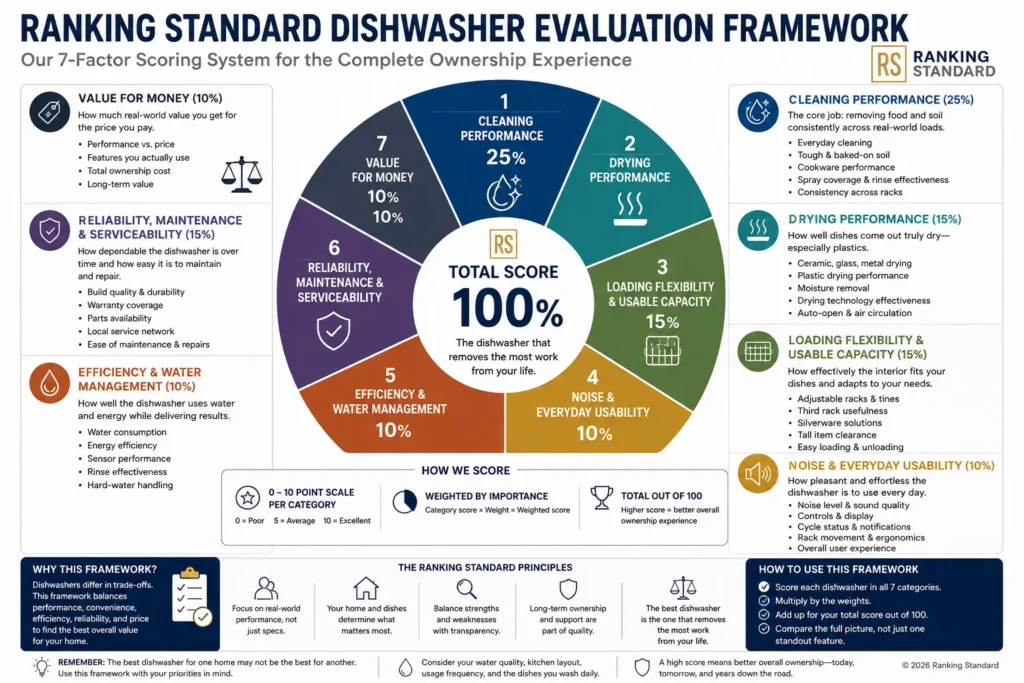
Our standard general-purpose weighting is:
| Evaluation Category | Weight |
|---|---|
| Cleaning Performance | 25% |
| Drying Performance | 15% |
| Loading Flexibility & Usable Capacity | 15% |
| Noise & Everyday Usability | 10% |
| Efficiency & Water Management | 10% |
| Reliability, Maintenance & Serviceability | 15% |
| Value for Money | 10% |
| Total | 100% |
This gives us a consistent baseline for future dishwasher comparisons.
But we don’t apply the weighting blindly.
Why the Score Changes With the Buyer
The same dishwasher can be an excellent recommendation for one household and an average recommendation for another.
That’s not inconsistency.
It’s the point of a decision platform.
Large Families
We place greater emphasis on:
- Usable capacity
- Rack flexibility
- Drying
- Cycle throughput
- Reliability
A family filling the dishwasher multiple times a day has different priorities from a couple running it every other evening.
Open-Plan Homes
We increase the importance of:
- Noise
- Sound character
- Cycle status visibility
- Drying
- Everyday usability
Here, quietness can genuinely improve daily life.
Serious Home Cooks
We emphasize:
- Difficult-soil cleaning
- Cookware accommodation
- Adjustable racks
- Folding tines
- Heavy-cycle performance
- Filter and maintenance design
A beautifully organized flatware rack matters less if there’s nowhere sensible to put the stockpot.
Families Using Lots of Plastic
Drying receives additional weight.
Food-storage containers, children’s dishes, lids, and lunch boxes can expose weaknesses that aren’t obvious when testing only ceramic plates and glasses.
Hard-Water Households
We pay greater attention to:
- Water management
- Rinse results
- Maintenance
- Softening capability where offered
- Glassware results
The environment in which an appliance operates can change which features are worth paying for.
Specifications We Refuse to Rank in Isolation
Dishwasher marketing contains plenty of numbers.
Some are useful.
None should determine the winner by itself.
Decibel Rating
Lower can be better.
But once a dishwasher is sufficiently quiet for your home, additional reductions have diminishing practical value.
Number of Place Settings
Standardized capacity is useful for comparison.
Your bowls and pans don’t care about the standardized test load.
Number of Cycles
More isn’t automatically better.
Useful cycles are better.
Number of Spray Jets
Cleaning results matter more than jet count.
Third Rack
A poorly designed third rack isn’t automatically an advantage.
Stainless-Steel Tub
It can provide meaningful benefits but doesn’t guarantee an excellent dishwasher.
Wi-Fi
Connectivity receives no automatic credit.
Useful functionality does.
The Ranking Standard Dishwasher Throughput Test
Cycle time alone can be misleading.
We therefore consider the complete process:
Load → Wash → Dry → Unload → Ready for Next Load
Imagine two dishwashers.
Dishwasher A finishes washing faster but leaves many items wet.
Dishwasher B takes slightly longer but returns dishes ready for the cabinet.
Which machine actually completes the household task faster?
Potentially Dishwasher B.
That’s why our definition of throughput isn’t simply:
Minutes per cycle.
It’s:
How efficiently does the dishwasher return clean, dry, usable dishes to the household?
The Rack Reality Test
Before recommending a dishwasher strongly, we ask whether its interior works with real kitchenware.
Not just plates.
Real kitchens contain:
- Deep bowls
- Oversized mugs
- Water bottles
- Storage containers
- Lids
- Wine glasses
- Frying pans
- Serving spoons
- Cutting boards
- Odd-shaped utensils
A dishwasher shouldn’t require a geometry lesson every night.
Good rack engineering makes loading intuitive.
Great rack engineering creates useful space where another machine wastes it.
This is why interior design can justify paying more even though it has nothing to do with motor power or Wi-Fi.
The Plastic Test
Plastic drying gets its own informal stress test within our framework.
Why?
Because it’s difficult.
A machine that dries glass and ceramic beautifully may still leave water across plastic lids and containers.
For households using very little plastic, this weakness may have minimal importance.
For families preparing lunches every day, it can fundamentally change the recommendation.
Again:
The weakness matters in proportion to the buyer’s exposure to it.
The Feature Frequency Test
We apply the same principle used across Ranking Standard categories:
Value of Feature = Benefit × Frequency of Use
Consider:
A beautifully designed adjustable rack gets used during almost every load.
A remote-start function may be used a few times.
Which deserves more weight?
Usually the rack.
Likewise, a useful third rack, automatic door opening, or excellent filter design may influence ownership far more often than an impressive specialty program.
The features used repeatedly deserve the greatest attention.
The Maintenance Friction Test
Every dishwasher requires some care.
What matters is how much friction the manufacturer creates around that care.
We consider:
- Filter accessibility
- Ease of filter cleaning
- Spray-arm inspection
- Interior access
- Gasket care
- Hard-water maintenance
- Clarity of maintenance instructions
A dishwasher that takes a few minutes to maintain occasionally is reasonable.
A machine that turns routine maintenance into an unnecessarily complicated task deserves criticism.
Maintenance is part of product design.
The Five-Year Repair Scenario
A dishwasher can look exceptional during its first month.
Ranking Standard also imagines another moment:
It’s five years old and something stops working.
Then we ask:
- Is service available?
- Are replacement parts obtainable?
- Is the likely repair economically sensible?
- Can common components be accessed?
- Does the manufacturer still support the machine?
- Would repairing it make more sense than replacing it?
We can’t predict every future failure.
But considering the repair ecosystem helps prevent short-term performance from dominating the entire recommendation.
The Total Cost Test
The dishwasher’s price tag isn’t necessarily what you’ll spend to own it.
Depending on the home and retailer, acquisition costs may include:
- Delivery
- Installation
- Old-appliance removal
- Plumbing modifications
- Electrical work
- Required installation hardware
Ownership can later include:
- Detergent
- Rinse aid
- Cleaning products
- Maintenance
- Parts
- Repairs
This doesn’t mean buyers should calculate every future dollar before purchasing.
It means a $799 dishwasher isn’t automatically cheaper than an $899 alternative if the ownership proposition is substantially worse.
Purchase price is one number. Value is a much larger equation.
The Biggest Dishwasher Buying Mistakes
Buying by Brand Alone
Brand reputation can provide context.
Specific model design and local service matter more.
Buying the Lowest Decibel Number
Quietness has diminishing returns.
Spend where you’ll notice the improvement.
Treating Third Rack as a Checkbox
Evaluate what it actually holds.
Ignoring Plastic Drying
Especially if your household uses plastic containers every day.
Choosing Capacity Without Examining Rack Geometry
Usable capacity matters more.
Paying for Cycles You’ll Never Use
A great Auto cycle may be worth more than ten specialty programs.
Ignoring Hard Water
Water chemistry can affect both results and maintenance.
Forgetting Installation Cost
Compare the installed price, not just the advertised price.
Ignoring Local Service
An appliance isn’t truly premium if getting it repaired becomes a major problem.
Paying for Technology Instead of Convenience
A simple feature that removes daily friction can be worth more than sophisticated technology you rarely use.
Who Should Spend More?
Moving into a higher dishwasher tier can make sense if you:
- Run the dishwasher every day
- Have a large family
- Live in an open-plan home
- Need exceptionally flexible racks
- Use large quantities of plastic containers
- Care strongly about drying
- Regularly wash cookware
- Value very quiet operation
- Expect refined controls and materials
- Place a premium on long-term ownership support
A feature that improves every daily load can provide meaningful value over years.
Who Probably Doesn’t Need a Premium Dishwasher?
You may not need to spend heavily if you:
- Run relatively few loads
- Wash mostly conventional plates and glasses
- Have a closed kitchen
- Don’t care about advanced rack systems
- Rarely wash plastic
- Use primarily Normal and Heavy cycles
- Don’t need smart-home integration
A straightforward dishwasher with strong fundamentals may provide everything you need.
That’s not compromising.
That’s refusing to pay for benefits you won’t use.
Final Thoughts
The dishwasher market makes it easy to compare the wrong things.
Decibels.
Cycle counts.
Place settings.
Spray jets.
Smart features.
Rack numbers.
Those specifications can provide useful clues.
But none answers the most important question:
What will make doing dishes easier in this particular home?
For one household, the answer may be exceptional drying.
For another, it’s a third rack that finally makes enough room for bowls.
For an open-plan apartment, quietness may dominate the decision.
For a serious home cook, flexible racks and cookware cleaning may matter far more.
And for someone living far from authorized service, repairability can outweigh a small performance advantage.
That’s why Ranking Standard doesn’t begin with a winner.
We begin with the household.
Understand the workload.
Understand the dishes.
Understand the kitchen.
Understand the trade-offs.
Then compare the machines.
That’s how a product ranking becomes a buying decision.
Editor Alter’s Note
A dishwasher is supposed to make something disappear.
Not dishes.
Work.
That’s the part of this category that specification sheets often fail to capture.
If you have to carefully reorganize every load, pre-wash everything, hand-dry plastic containers, clean an awkward filter, and spend weeks finding someone to repair the machine, the dishwasher may technically perform its wash cycle well.
But it hasn’t removed much friction from your life.
The best dishwasher isn’t necessarily the one that does the most.
It’s the one that asks the least from you while consistently returning clean, dry dishes.
That is the standard worth ranking.