
Electric bikes look simple from a distance.
Take a bicycle, add a motor and battery, and you have an e-bike.
But once you actually start shopping, the category becomes surprisingly complicated.
A $1,000 commuter e-bike and a $5,000 premium model may look similar in photographs, yet they can differ dramatically in how naturally they deliver power, how confidently they climb hills, how far they can realistically travel, how much they weigh, and how easy they are to maintain several years later.
Then there are the terms buyers have to decipher:
Class 1. Class 2. Class 3. Hub drive. Mid-drive. Torque sensor. Cadence sensor. Watt-hours. Hydraulic brakes. Integrated batteries.
None of these specifications tells you, by itself, whether an e-bike is right for you.
That’s where the buying decision should begin.
Why an E-Bike Can Be a Very Different Purchase From a Regular Bicycle
A conventional bicycle is primarily a mechanical product.
An electric bike is both a bicycle and an electrical system.
That changes the ownership equation.
You’re not only choosing a frame, wheels, brakes, drivetrain, and riding position. You’re also choosing a motor, battery, controller, sensors, software, charger, and an ecosystem of replacement components.
This creates trade-offs that don’t exist to the same degree with conventional bikes.
A larger battery can increase potential range, but it also adds weight and cost.
A more powerful motor may make hills easier, but maximum power isn’t necessarily what produces the most natural riding experience.
A cheaper direct-to-consumer e-bike may offer impressive specifications for the money, while a more expensive model supported by a strong dealer network may be easier to service years later.
Even convenience features create compromises.
Folding e-bikes are easier to store, but many are heavier than buyers expect.
Cargo e-bikes can replace some car trips, but their size changes storage and handling requirements.
Mountain e-bikes provide substantial assistance on steep terrain, but their intended use is very different from riding five miles to work.
The important question therefore isn’t:
What’s the best electric bike?
It’s:
What type of electric bike solves the transportation or riding problem you actually have?
Start With the Ride, Not the Motor
Motor specifications receive enormous attention in e-bike marketing.
They shouldn’t be your starting point.
Imagine three buyers.
One rides four relatively flat miles to an office and can charge the bike at work.
Another wants to carry two children and groceries through a hilly neighborhood.
A third lives in an apartment, takes a train every morning, and needs to carry the bike up a flight of stairs.
Giving all three buyers the same “best e-bike” recommendation would make little sense.
Their priorities are completely different.
The commuter may value reliability, fenders, lights, and a comfortable riding position.
The parent may need cargo capacity, strong braking, stability, and confident hill climbing.
The train commuter may care more about folded dimensions and total weight than maximum range.
Your use case should determine the technology you buy—not the other way around.
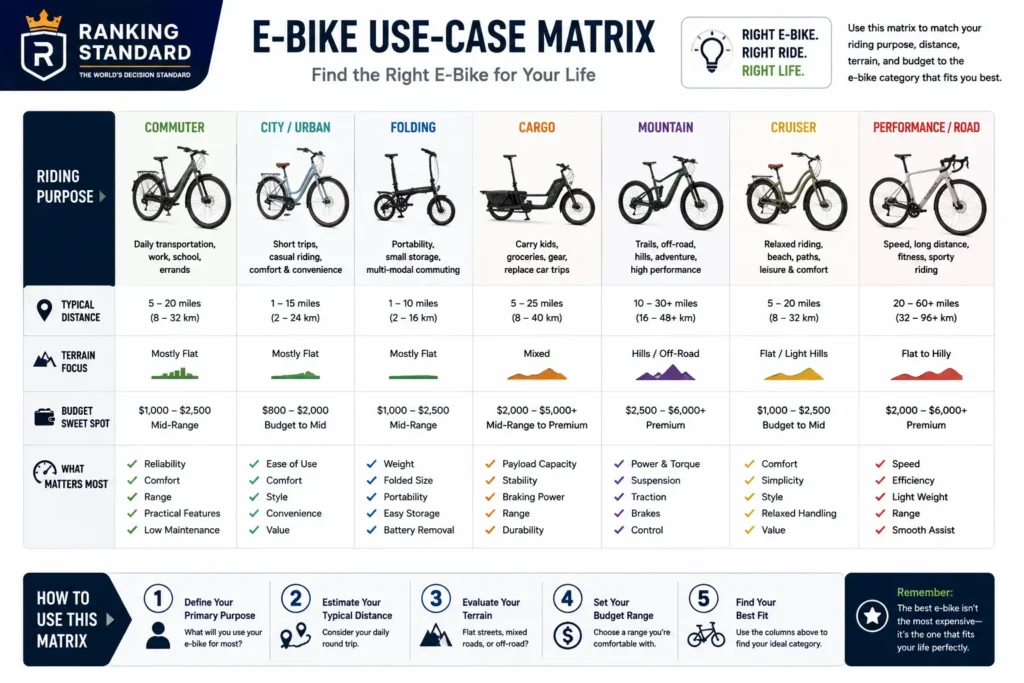
The Seven Major E-Bike Categories
Understanding the market becomes much easier once electric bikes are divided by purpose.
Commuter E-Bikes
Built primarily for transportation, commuter models typically emphasize efficiency, comfort, reliability, and everyday practicality.
Useful equipment may include:
- Integrated lights
- Fenders
- Rear racks
- Kickstands
- Comfortable tires
- Practical riding positions
For someone replacing regular car or public-transit trips, these features can matter more than headline motor output.
City and Urban E-Bikes
City e-bikes overlap with commuter models but often prioritize comfort and easy handling.
They may feature more upright riding positions and simpler controls, making them particularly approachable for casual riders.
They’re well suited to errands, short trips, and recreational urban riding.
Folding E-Bikes
Folding bikes solve a specific problem: space.
They’re attractive to apartment residents, RV owners, commuters combining cycling with public transportation, and anyone with limited storage.
But “folding” doesn’t automatically mean “light.”
The motor, battery, reinforced frame, and folding mechanism can make some electric folding bikes surprisingly heavy.
Always check actual weight and folded dimensions before buying one for portability.
Cargo E-Bikes
Cargo e-bikes are designed to carry much more than the rider.
Depending on the configuration, that may include:
- Children
- Groceries
- Work equipment
- Large bags
- Commercial deliveries
These bikes can potentially replace some short car trips, but stability, braking performance, payload capacity, accessories, and motor behavior become especially important.
A cargo e-bike should be evaluated as a transportation system, not simply as a bicycle with a large rack.
Electric Mountain Bikes
Electric mountain bikes—or e-MTBs—are designed for off-road riding.
Their priorities typically include:
- Strong climbing assistance
- Sophisticated suspension
- Trail-oriented geometry
- Powerful brakes
- Durable drivetrains
- Controlled motor delivery
For this category, motor refinement and handling often matter much more than achieving the lowest possible price.
Cruiser E-Bikes
Cruisers emphasize comfort and relaxed riding.
Expect wider tires, upright seating positions, comfortable saddles, and accessible controls.
They’re best suited to riders who prioritize recreational riding and comfort over speed or maximum efficiency.
Performance and Road E-Bikes
Performance-oriented e-bikes attempt to preserve much of the feel of a traditional road or fitness bicycle while adding discreet electric assistance.
Weight, motor integration, handling, and natural power delivery become especially important here.
These bikes demonstrate an important point:
More motor isn’t always better.
Sometimes the goal of electric assistance is not to dominate the riding experience, but to make a good bicycle easier to ride.
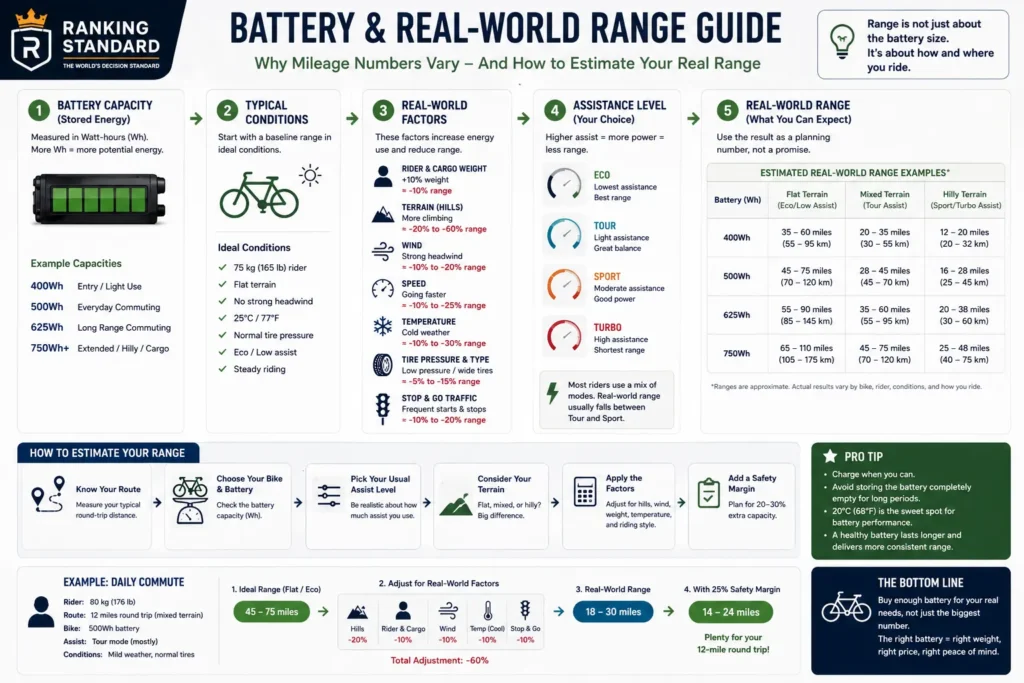
Why Range Numbers Can Be Misleading
Range is one of the most heavily advertised e-bike specifications—and one of the easiest to misunderstand.
A manufacturer might advertise a long maximum range, but actual riding distance depends on numerous variables:
- Rider weight
- Cargo
- Terrain
- Wind
- Temperature
- Tire pressure
- Assistance level
- Riding speed
- Stop-and-go traffic
- Battery condition
Two riders using the same bicycle can therefore experience very different ranges.
This is why Ranking Standard does not treat an advertised maximum-range figure as a guaranteed result.
Instead, range should be evaluated in relation to your actual daily distance plus a reasonable safety margin.
If your normal round trip is 12 miles, you don’t necessarily need the largest battery available.
If you regularly ride 40 miles through hilly terrain, battery capacity becomes a much more important part of the decision.
Battery Capacity: Understand Watt-Hours
One of the more useful battery specifications is watt-hours, commonly written as Wh.
It provides a standardized way to compare the approximate amount of energy different batteries can store.
For example, two batteries with different voltage and amp-hour ratings can still be compared using watt-hours.
But even Wh doesn’t tell the entire story.
A larger battery generally offers greater range potential, but the actual result still depends on motor efficiency, terrain, rider behavior, and assistance level.
More capacity also tends to mean more weight and expense.
The goal isn’t to buy the largest battery.
It’s to buy enough battery for the way you ride.
Motor Power Is Only Part of the Story
Motor wattage is another specification buyers frequently use as a shortcut.
It’s understandable.
A larger number looks like more performance.
But motors with similar advertised wattage can feel very different in practice.
Motor location, torque delivery, controller programming, sensors, gearing, bike weight, and rider input all influence the experience.
This is particularly important when comparing hub-drive and mid-drive systems, which we’ll examine in Part 2.
The same principle applies throughout this category:
Specifications provide clues. They don’t make the buying decision for you.
Safety and Serviceability Belong in the Buying Decision
E-bikes introduce another consideration that shouldn’t be buried near the bottom of a buying guide: the electrical system.
Battery quality, charging equipment, and system design deserve serious attention.
Buyers should look beyond maximum range and consider whether the electrical system comes from a reputable manufacturer, whether relevant safety certification is provided where applicable, and whether replacement batteries and chargers are realistically obtainable.
Serviceability matters too.
Ask what happens three or five years after purchase.
Can you buy another battery?
Can a local shop service the bicycle?
Are brake pads, tires, drivetrain components, displays, sensors, and other parts replaceable?
What happens if the manufacturer disappears?
A low purchase price can become much less attractive if a proprietary component makes the entire bike difficult to repair.
The true price of an e-bike is not just what you pay on the day you buy it.
E-Bike Laws Are Part of the Product Decision
Electric bicycle regulations can vary by jurisdiction.
Speed limits, motor operation, throttle rules, rider-age requirements, helmet requirements, and where different types of e-bikes may be ridden are not necessarily identical everywhere.
That means a model that makes sense for one buyer may not be appropriate—or permitted for the same use—in another location.
Before purchasing, buyers should verify current local rules with the relevant transportation or government authority.
This is particularly important when choosing among different e-bike classes or buying a high-powered model online.
Ranking Standard treats legal compatibility as part of product suitability, not as an afterthought.
The Ranking Standard Philosophy
The electric-bike market encourages shoppers to compare numbers.
More watts.
More range.
More speed.
More battery.
More features.
But buying more doesn’t necessarily produce a better ride.
At Ranking Standard, we evaluate the decision in the opposite direction.
First:
What do you need the bike to do?
Then:
Which category can do it?
Then:
Which technologies and specifications matter for that category?
Only after answering those questions should you start comparing brands and individual models.
This prevents one of the most common purchasing mistakes in the e-bike market: paying for impressive technology that doesn’t solve the buyer’s actual problem.
What You’ll Learn
In the rest of this guide, we’ll explain:
- How Class 1, Class 2, and Class 3 e-bikes differ
- Hub-drive vs. mid-drive motors
- Torque sensors vs. cadence sensors
- How much battery capacity you actually need
- How terrain changes the buying decision
- Which features matter for commuters, families, and recreational riders
- Why weight deserves more attention
- How to think about brakes, tires, components, and maintenance
- What premium e-bikes should deliver for the extra money
- How Ranking Standard evaluates an electric bike
By the end, you shouldn’t simply know which e-bikes receive good reviews.
You should understand what kind of e-bike you should be looking for in the first place.
That’s the standard that matters.
Understanding E-Bike Technology Before Choosing a Brand
Knowing that you want a commuter, cargo, folding, mountain, or recreational e-bike is only the first step.
Now you have to understand the technology underneath it.
This is where e-bike shopping becomes difficult because specifications that look similar on a product page can produce very different riding experiences.
The goal isn’t to memorize every technical term.
It’s to understand which ones should change your buying decision.
Step 1: Understand E-Bike Classes
In the United States, many states use a three-class framework to categorize electric bicycles, although specific rules and access restrictions can vary by state and locality.
The general framework is:
Class 1
A Class 1 e-bike provides motor assistance while you’re pedaling, with assistance generally ending at 20 mph.
There’s no throttle providing propulsion without pedaling under the standard Class 1 definition.
Often suited for:
- Everyday commuting
- Recreational riding
- Riders who want a traditional cycling feel
- Multi-use riding where local rules permit
Class 2
Class 2 e-bikes can generally use a throttle to propel the bicycle without requiring the rider to pedal, with motor-powered operation typically limited to 20 mph under the class framework.
That throttle can be genuinely useful.
For example, it may help when:
- Starting from a stop
- Carrying cargo
- Navigating stop-and-go traffic
- Getting moving on an incline
But throttle rules and permitted riding locations can differ, so buyers should verify local regulations.
Class 3
Class 3 e-bikes generally provide pedal assistance up to 28 mph.
They’re particularly attractive to riders covering longer commuting distances where higher assisted speeds can meaningfully reduce travel time.
However, Class 3 access can be more restricted on certain paths and trails.
Best suited for:
- Longer commutes
- Experienced urban riders
- Riders prioritizing transportation speed
The takeaway is simple:
Don’t automatically buy the fastest class available.
Buy the class that matches where and how you’re legally able to ride.
Step 2: Hub Motor vs. Mid-Drive
Motor placement dramatically affects how an e-bike feels.
The two major architectures are hub-drive and mid-drive.
Hub-Drive Motors
A hub motor sits inside either the front or rear wheel hub, although rear-hub designs are particularly common.
Hub-drive systems are widely used because they can be relatively simple and cost-effective.
Advantages
- Generally lower purchase price
- Mechanically straightforward
- Common on commuter and recreational models
- Motor operation is less dependent on the bicycle’s drivetrain
Trade-Offs
- Weight concentrated in a wheel
- Handling can feel less balanced
- Wheel removal may be more complicated
- Some systems feel less natural than refined mid-drive designs
For relatively flat commuting and everyday riding, a good hub-drive system can provide excellent value.
Mid-Drive Motors
A mid-drive motor is positioned around the crank area near the center of the bicycle.
Instead of driving the wheel directly, it delivers power through the bicycle’s drivetrain.
This allows the motor to benefit from the bike’s gears.
Advantages
- More centralized weight distribution
- Strong climbing ability
- Natural riding characteristics
- Efficient use of gearing
- Well suited to demanding terrain
Trade-Offs
- Usually more expensive
- Greater load on drivetrain components
- Drivetrain maintenance becomes more important
Mid-drive systems are particularly attractive for:
- Hilly terrain
- Cargo bikes
- Mountain biking
- Performance-oriented riding
But that doesn’t mean everyone needs one.
For a flat five-mile commute, paying substantially more for a sophisticated mid-drive system may deliver limited practical benefit.
Step 3: Torque Sensor vs. Cadence Sensor
This is one of the most important specifications that inexperienced buyers often overlook.
Both systems detect rider input.
They do it differently.
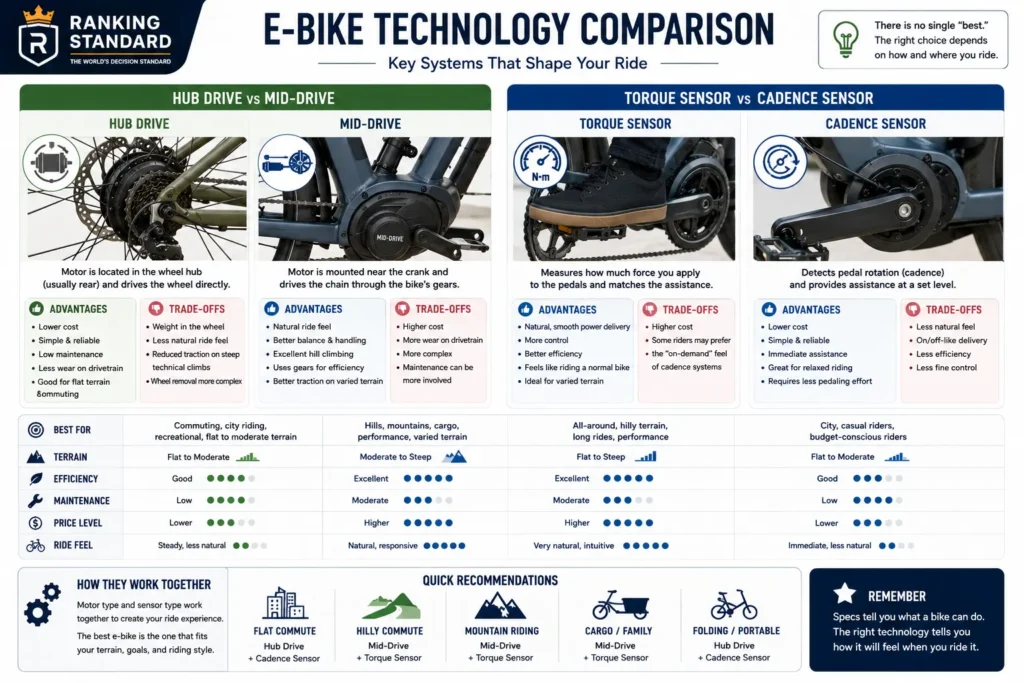
Cadence Sensors
A cadence sensor primarily detects whether the pedals are rotating.
Once pedaling is detected, the motor provides a predetermined level of assistance.
This can make assistance feel more like an on/off response.
Advantages
- Lower cost
- Simple operation
- Requires relatively little rider effort
- Common on affordable e-bikes
Trade-Offs
- Power delivery may feel less natural
- Fine control can be more difficult
- Assistance may arrive less progressively
Cadence-based systems can still work very well for casual transportation.
Torque Sensors
A torque sensor measures how much force the rider applies to the pedals.
Pedal gently and the motor assists gently.
Push harder and the motor increases its contribution.
The result can feel much more like riding a conventional bicycle with stronger legs.
Advantages
- Natural power delivery
- Better rider control
- Responsive assistance
- Particularly useful on changing terrain
Trade-Offs
- Usually increases cost
- Riders seeking effortless throttle-like assistance may not value the difference as much
For riders who care about ride quality, a well-tuned torque sensor can be more meaningful than a larger headline motor number.
Step 4: How Much Battery Do You Actually Need?
Battery capacity is typically expressed in watt-hours.
In general, a larger Wh figure means more stored energy.
But buying the largest battery available isn’t automatically the smartest strategy.
Consider three questions.
How far do you normally ride?
Think about your typical journey, not an imaginary once-a-year maximum ride.
Can you charge at your destination?
A commuter who can charge at work may need substantially less battery capacity than someone who cannot.
What terrain do you ride?
Hills, heavier loads, higher speeds, and stronger assistance levels can all increase energy consumption.
A practical approach is to estimate your normal daily requirement and leave comfortable reserve capacity rather than designing the entire purchase around an advertised maximum-range claim.
Step 5: Don’t Ignore Battery Replacement
Most buyers think about battery capacity.
Far fewer think about what happens when the battery eventually needs replacement.
That’s a mistake.
Before buying, investigate:
- Whether replacement batteries are available
- How much they cost
- Whether the battery uses a proprietary design
- Whether the manufacturer is likely to support the system long-term
- What warranty applies to the battery
- Whether an authorized service network exists
An inexpensive e-bike with a difficult-to-replace battery can become expensive electronic waste.
A more expensive bike with long-term component support may ultimately represent better value.
Step 6: Weight Matters More Than You Think
Electric bikes are often significantly heavier than conventional bicycles.
The motor and battery alone add weight, while cargo racks, suspension, wide tires, reinforced frames, and integrated accessories can add even more.
This matters if you need to:
- Carry the bike upstairs
- Load it into a vehicle
- Lift it onto a rack
- Take it on public transportation
- Maneuver it through an apartment
- Pedal it when assistance isn’t available
A difference of 10 or 15 pounds can feel minor on a specification sheet.
It may feel enormous when you’re carrying the bike up three flights of stairs.
For apartment dwellers and multimodal commuters, weight can be a more important specification than motor power.
Step 7: Brakes Should Match Speed and Weight
Electric bikes can be heavier and faster than conventional bicycles.
That makes braking performance particularly important.
Mechanical disc brakes can work adequately on many lighter and more affordable bikes.
Hydraulic disc brakes generally provide stronger, more consistent braking with less hand effort and are common on higher-performance models.
The importance of braking increases with:
- Higher speeds
- Steeper terrain
- Heavier riders
- Cargo
- Child passengers
- Heavier bicycle weight
A cargo e-bike carrying children should not be evaluated using the same braking expectations as a lightweight recreational commuter.
Step 8: Tire Size Changes the Ride
Tires influence comfort, efficiency, handling, puncture resistance, and overall character.
Narrower Tires
Generally favor:
- Efficiency
- Lower rolling resistance
- Lower weight
Often appropriate for paved commuting.
Wider Tires
Can provide:
- More cushioning
- Additional stability
- Better performance on rough surfaces
But they can also increase rolling resistance and weight.
Fat Tires
Fat-tire e-bikes have become extremely popular because of their distinctive appearance and comfortable ride.
They’re useful on certain loose or rough surfaces, but many buyers don’t actually need them.
For normal paved commuting, the extra size and weight may provide little benefit.
Again, the correct question isn’t:
Which tire looks most capable?
It’s:
Which tire fits where I actually ride?
Step 9: Suspension Isn’t Automatically Better
Suspension is another feature that can look impressive on a product page.
But every additional component adds cost, complexity, and often weight.
For smooth urban roads, good tires and a well-designed rigid frame may provide enough comfort.
Front suspension becomes more useful when riding:
- Rough roads
- Gravel
- Broken pavement
- Trails
Full suspension is primarily relevant to demanding off-road riding and specialized applications.
Don’t pay for mountain-bike technology if your e-bike spends its life on city streets.
Step 10: Practical Equipment Can Matter More Than Performance
For an everyday commuter, the most valuable features may be the least exciting ones.
Consider:
Integrated Lights
Particularly useful for commuting and evening transportation.
Fenders
Important when riding in wet conditions.
Rear Rack
Useful for panniers, groceries, work bags, or cargo.
Kickstand
Simple, but extremely practical for transportation-focused bikes.
Display
Should provide useful information without becoming unnecessarily complicated.
Security Features
Some modern systems include GPS connectivity, alarms, electronic locking, or app-based functions.
These can be valuable, but they shouldn’t compensate for poor fundamental bicycle design.
Step 11: Serviceability Is a Feature
A specification sheet rarely lists “easy to repair.”
Ranking Standard considers it one of the most important long-term characteristics.
An e-bike combines ordinary bicycle components with proprietary electronics.
The bicycle components may be easy to replace.
The electronics may not be.
Before purchasing, consider:
- Local dealer support
- Replacement battery availability
- Replacement display availability
- Motor service options
- Brake and drivetrain compatibility
- Firmware and app support
- Warranty procedures
This becomes particularly important when comparing established bicycle manufacturers with newer direct-to-consumer brands.
A direct-to-consumer bike may offer substantially more hardware for the price.
A dealer-supported bike may offer something harder to express in a specification table:
someone who can fix it.
Neither model is automatically better.
The right choice depends partly on your willingness and ability to perform maintenance yourself.
Step 12: Understand the Real Cost of Ownership
The purchase price isn’t the entire cost of an e-bike.
Depending on how much you ride, ownership may eventually involve:
- Tires
- Brake pads
- Chains
- Cassettes
- Tubes or sealant
- Professional servicing
- Battery replacement
- Electronic components
High-powered mid-drive systems and heavy cargo use can also place additional stress on drivetrain components.
This doesn’t make e-bikes poor value.
For some commuters, replacing even a portion of regular car trips can make an e-bike economically compelling.
But the correct comparison is total ownership cost, not sticker price alone.
The Ranking Standard E-Bike Use-Case Matrix
Before comparing brands, place yourself into a practical use case.
| Your Situation | Prioritize | Usually Less Important |
|---|---|---|
| Short urban commute | Reliability, lights, fenders, comfort | Maximum battery capacity |
| Long commute | Range, efficiency, comfort, reliability | Extreme off-road capability |
| Hilly commute | Torque delivery, gearing, brakes | Highest advertised range |
| Apartment living | Weight, size, removable battery | Large accessories |
| Family transportation | Stability, cargo capacity, brakes, serviceability | Lowest possible weight |
| Trail riding | Mid-drive performance, suspension, handling | Commuter accessories |
| Casual recreation | Comfort, simplicity, value | Maximum motor performance |
| Multimodal commuting | Folding size, weight, portability | Huge battery capacity |
This matrix is intentionally based on people rather than brands.
That’s the point.
What Should You Spend?
E-bike pricing covers an enormous range.
Rather than treating price as a measure of quality, it’s more useful to understand what additional spending should provide.
Budget: Under $1,500
Expect the strongest emphasis on value.
Common compromises may include:
- Simpler sensors
- Basic components
- Heavier construction
- Less sophisticated motor control
- More limited dealer support
There can still be excellent choices in this range, particularly for straightforward commuting and recreational use.
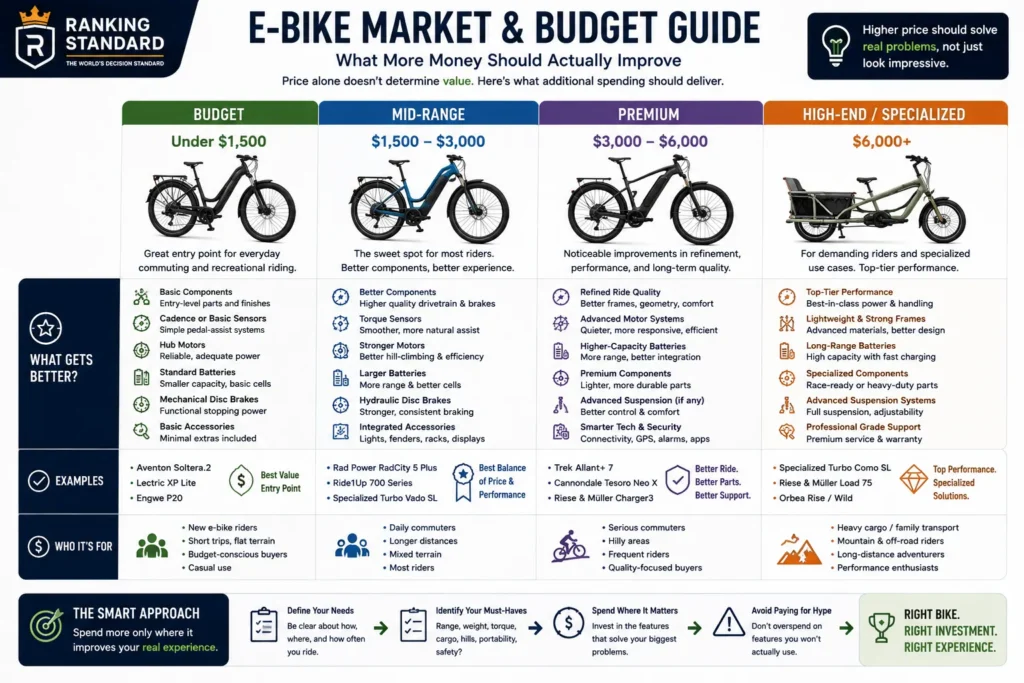
Mid-Range: $1,500–$3,000
This is an important sweet spot for many buyers.
Additional spending may bring:
- Better brakes
- Torque sensing
- Improved components
- Better integration
- Reduced weight
- Stronger warranties
- Better dealer or manufacturer support
For many everyday riders, this range can provide the best balance between performance and ownership cost.
Premium: $3,000–$6,000
Premium e-bikes should deliver more than larger specifications.
Look for meaningful improvements in:
- Motor refinement
- Frame quality
- Weight distribution
- Battery integration
- Components
- Braking
- Ride quality
- Service support
At this level, the complete bicycle should feel more cohesive.
High-End and Specialized: $6,000+
This segment includes premium mountain bikes, lightweight performance e-bikes, sophisticated cargo systems, and other specialized designs.
These products can make sense for serious riders with specific requirements.
For an ordinary five-mile commute?
Probably not.
A higher price should solve a problem—not create bragging rights.
Ranking Standard’s Key Takeaway
When two electric bikes appear similar, don’t simply compare:
Motor watts + Battery range + Price.
Compare the complete system.
Ask:
- What type of riding am I doing?
- Which e-bike class fits that use and my local rules?
- Do I need hub drive or mid-drive?
- How important is natural pedal assistance?
- How much real-world range do I need?
- Can I physically handle the bike’s weight?
- Are the brakes appropriate for the bike and load?
- Can I get replacement components?
- Who will service the bike?
- What will ownership cost over several years?
Those questions reveal far more about an e-bike than the biggest number on its product page.
In Part 3, we’ll turn those principles into the Ranking Standard E-Bike Evaluation Framework—the scoring system we’ll use when comparing individual electric bikes and determining which type of rider each one actually deserves to be recommended to.
The Ranking Standard E-Bike Evaluation Framework
How Ranking Standard Evaluates Electric Bikes
Electric bikes are unusually difficult products to rank.
A laptop can be compared through performance, battery life, display quality, and usability.
A conventional bicycle can be judged largely by its frame, components, geometry, handling, and ride quality.
An e-bike combines both kinds of complexity.
It has mechanical components.
It has an electrical system.
And most importantly, it has to work as a complete transportation or recreational system.
That’s why Ranking Standard doesn’t rank electric bikes primarily by motor power, claimed range, or the number of features included.
We evaluate whether the entire bike makes sense for the rider it’s designed to serve.
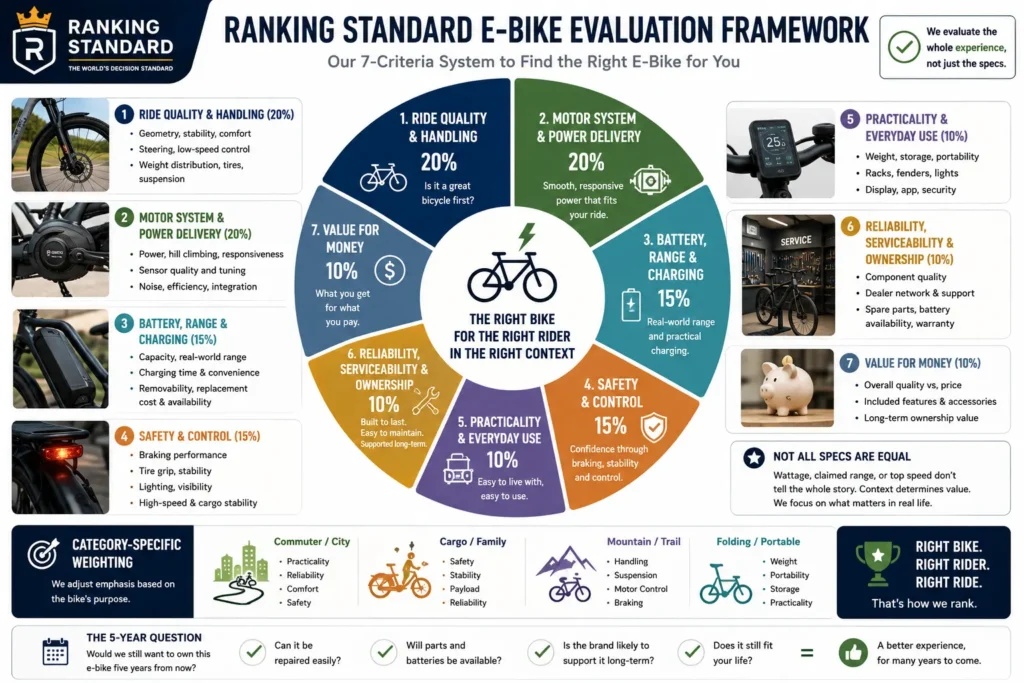
Our standard is built around seven major criteria.
1. Ride Quality & Handling – 20%
Before evaluating the electric components, we ask a basic question:
Is this actually a good bicycle?
Electric assistance cannot compensate for poor geometry, uncomfortable ergonomics, unstable handling, or badly distributed weight.
We evaluate:
- Riding position
- Steering behavior
- Stability
- Low-speed handling
- Weight distribution
- Comfort
- Frame geometry
- Tire behavior
- Suspension performance where applicable
The weighting changes depending on the category.
A commuter should feel predictable in traffic.
A cargo bike should remain stable when carrying a load.
A mountain e-bike should inspire confidence on technical terrain.
A folding bike should remain manageable despite its compact dimensions.
There is no single definition of ideal handling.
There is only appropriate handling for the intended use.
2. Motor System & Power Delivery – 20%
We don’t reward a motor simply because it advertises a large wattage figure.
Instead, we evaluate how effectively the system delivers assistance.
That includes:
- Power delivery
- Hill-climbing performance
- Responsiveness
- Motor noise
- Assistance transitions
- Controller tuning
- Sensor quality
- Low-speed behavior
- Efficiency
- Integration with gearing
A well-tuned lower-powered system can provide a better riding experience than a more powerful but poorly controlled motor.
Torque-sensing systems may score particularly well when natural riding feel matters, while strong hub-drive systems may provide better value for straightforward transportation.
Context always matters.
3. Battery, Range & Charging – 15%
Battery evaluation begins with capacity—but it doesn’t end there.
We consider:
- Battery capacity
- Real-world range potential
- Efficiency
- Charging time
- Charger practicality
- Battery placement
- Removability
- Replacement availability
- Replacement cost
- Battery warranty
- Electrical-system safety considerations
We deliberately distinguish between advertised maximum range and realistic usable range.
Maximum-range claims often depend on favorable conditions that don’t reflect everyday riding.
Our recommendations focus instead on whether the battery provides sufficient practical range for the intended user.
A commuter doesn’t need 100 miles of theoretical range if the daily round trip is 10 miles.
4. Safety & Control – 15%
Electric bikes can travel faster and carry more weight than many conventional bicycles.
Safety therefore deserves its own scoring category.
We assess:
- Braking performance
- Brake modulation
- Tire grip
- Frame stability
- Lighting
- Visibility
- Motor predictability
- Control layout
- High-speed stability
- Cargo stability where applicable
Electrical-system design and applicable safety certifications are also important considerations.
For cargo bikes designed to transport children or heavy loads, this category becomes even more significant.
More performance should always be accompanied by appropriate control.
5. Practicality & Everyday Use – 10%
Specifications don’t tell you whether an e-bike is pleasant to live with.
We evaluate practical details such as:
- Total weight
- Battery removal
- Storage requirements
- Rack compatibility
- Fender coverage
- Integrated lighting
- Kickstand design
- Display usability
- Charging convenience
- App functionality
- Security features
The weighting again depends on the category.
Weight may be relatively unimportant for a garage-stored cargo bike.
For someone carrying a folding bike onto a train every morning, it can determine whether the product is useful at all.
6. Reliability, Serviceability & Ownership – 10%
This is where many inexpensive products can become less attractive over time.
We evaluate not only whether the bike works when it’s new, but how realistically it can be kept working.
Important considerations include:
- Component quality
- Dealer network
- Warranty
- Replacement battery availability
- Replacement electronic components
- Standard vs. proprietary parts
- Manufacturer support
- Repair options
- Firmware and app support where relevant
- Long-term brand stability
An e-bike that becomes difficult to repair after three years is not automatically a good value because it was inexpensive on day one.
Serviceability is part of product quality.
7. Value for Money – 10%
Price matters.
But value isn’t the same thing as cheap.
We compare what the buyer receives relative to the cost.
That includes:
- Overall component quality
- Motor system
- Battery system
- Ride quality
- Safety equipment
- Included accessories
- Warranty
- Service network
- Expected ownership experience
A $4,000 e-bike can represent excellent value if it delivers meaningful advantages for the intended rider.
A $1,000 e-bike can represent poor value if compromises prevent it from performing its primary job reliably.
The question isn’t:
How cheap is it?
It’s:
What does each additional dollar actually buy?
The Ranking Standard E-Bike Score
Our standard weighting for general-purpose electric bikes is:
| Evaluation Category | Weight |
|---|---|
| Ride Quality & Handling | 20% |
| Motor System & Power Delivery | 20% |
| Battery, Range & Charging | 15% |
| Safety & Control | 15% |
| Practicality & Everyday Use | 10% |
| Reliability, Serviceability & Ownership | 10% |
| Value for Money | 10% |
| Total | 100% |
But this isn’t a rigid formula applied blindly to every bicycle.
Ranking Standard adjusts emphasis according to the intended category.
Why Category-Specific Weighting Matters
Consider three different electric bikes.
A Folding Commuter
Weight and portability deserve greater emphasis.
A technically excellent folding bike that weighs so much you can’t comfortably carry it onto a train has failed its primary purpose.
A Cargo E-Bike
Stability, braking, payload capability, reliability, and serviceability become more important.
Saving a few pounds matters much less.
An Electric Mountain Bike
Handling, suspension, motor control, climbing performance, braking, and drivetrain quality dominate the decision.
A rear rack or integrated commuter light becomes relatively insignificant.
This prevents a major problem with conventional rankings:
scoring fundamentally different products as if they were designed for the same person.
Specifications We Refuse to Judge in Isolation
Some numbers are useful.
None should decide a ranking alone.
Motor Wattage
More watts don’t automatically mean better performance.
Motor design, gearing, torque, controller tuning, bike weight, and local regulatory considerations all matter.
Claimed Range
Range without testing conditions provides limited information.
Battery Size
More Wh means more stored energy, but also potentially more weight and cost.
Number of Gears
More gears don’t automatically produce a better drivetrain.
Tire Width
Wider isn’t automatically better.
Top Speed
Faster isn’t automatically more useful—and may affect where or how the bicycle can legally be ridden.
The Ranking Standard approach is to ask what a specification changes in the real world.
If it doesn’t meaningfully improve the intended use, it receives little additional credit.
The Hidden Cost Test
Every e-bike we evaluate should also pass what we call the Hidden Cost Test.
Before recommending a product, we want buyers to consider what happens after the initial purchase.
Ask:
- What does a replacement battery cost?
- Are proprietary components required?
- Can local bicycle shops work on it?
- How expensive are replacement tires?
- How quickly might brake pads wear?
- Does the drivetrain use readily available parts?
- Who handles warranty repairs?
- What happens if the display or controller fails?
This is especially important when an unusually inexpensive e-bike appears to offer specifications comparable to models costing substantially more.
Sometimes it genuinely represents excellent value.
Sometimes the savings have simply been moved from the purchase price into future inconvenience.
The Five-Year Question
Ranking Standard also asks a simple question that rarely appears in specification comparisons:
Would we still want to own this product five years from now?
No one can guarantee exactly how long an individual e-bike will last.
But the question forces us to evaluate factors that short-term reviews often overlook.
Parts availability.
Battery replacement.
Manufacturer support.
Repairability.
Component standards.
Build quality.
Long-term usability.
An electric bike shouldn’t be treated like a disposable electronic gadget.
For many buyers, it’s transportation.
The Biggest E-Bike Buying Mistakes
After understanding the market, several mistakes become easy to recognize.
Buying the Biggest Motor
Power is useful only when it improves your actual ride.
Buying Maximum Range
Paying for battery capacity you rarely use means carrying extra cost and often extra weight on every trip.
Ignoring Weight
This is especially dangerous for apartment residents and multimodal commuters.
Choosing Fat Tires Because They Look Capable
Your pavement commute may not require them.
Ignoring Brakes
Motor performance and braking capability should make sense together.
Buying a Folding Bike Without Checking Folded Size
A folding mechanism doesn’t guarantee practical portability.
Ignoring Replacement Batteries
The battery is one of the most important long-term components of the bicycle.
Choosing Specifications Over Support
A spectacular feature list isn’t much comfort when nobody can repair the product.
Forgetting Local Rules
An e-bike only works as intended if you can legally use its capabilities where you ride.
Who Should Spend More?
Premium e-bikes aren’t automatically better purchases.
But spending more can make sense when the additional money buys something you genuinely need.
Consider moving upmarket if you:
- Ride almost every day
- Depend on the bike for transportation
- Regularly climb steep hills
- Carry children or heavy cargo
- Ride demanding trails
- Need lower weight
- Want sophisticated torque-sensing assistance
- Value a strong dealer network
- Expect to keep the bike for many years
For these buyers, better components, service support, refined motor systems, and stronger integration can provide meaningful value.
Who Probably Doesn’t Need a Premium E-Bike?
You may not need to spend thousands if you:
- Ride occasionally
- Travel relatively short distances
- Ride mostly flat terrain
- Carry little cargo
- Have straightforward transportation needs
- Don’t need advanced suspension
- Don’t care about maximum weight reduction
A reliable, well-designed entry-level or mid-range bike may serve you perfectly well.
That’s not settling for less.
That’s buying appropriately.
Final Thoughts
Electric bikes are changing what a bicycle can do.
For some riders, they make longer commutes practical.
For others, they make hills manageable.
Cargo models can help families carry children and groceries.
Folding models can connect cycling with trains, apartments, RVs, and small living spaces.
Electric mountain bikes can make difficult terrain more accessible.
But these benefits don’t come from simply adding the largest possible motor and battery to a bicycle.
The best e-bikes succeed because the motor, battery, frame, brakes, components, geometry, software, and accessories work together for a clearly defined purpose.
That’s why the most important decision isn’t choosing between brands.
It’s understanding what you need the bicycle to do.
Once you know that, the market becomes much easier to navigate.
Editor Alter’s Note
Electric bikes are exactly the kind of category Ranking Standard was created to explain.
They’re filled with numbers that appear objective:
500W.
750W.
28 mph.
60 miles.
720Wh.
Those numbers are useful.
But none of them tells you whether you’ll enjoy owning the bicycle.
A commuter carrying a 70-pound e-bike up an apartment staircase will learn very quickly that weight matters.
A parent carrying children downhill will understand why braking and stability matter.
A long-distance rider will discover why battery efficiency and replacement support matter.
And someone whose proprietary electrical component fails several years after purchase will understand why serviceability mattered from the beginning.
The specification sheet describes the machine.
The buying standard has to describe whether that machine fits your life.
That’s the difference Ranking Standard is built around.