
Understanding the Robot Vacuum Market
Robot Vacuums Are No Longer a Luxury
A decade ago, robot vacuums were considered expensive gadgets for tech enthusiasts. Today, they have become one of the fastest-growing categories in home cleaning. Improvements in navigation, obstacle detection, battery life, and self-emptying technology have transformed them from novelty products into practical household appliances.
For many homeowners, a robot vacuum isn’t about replacing a traditional vacuum. It’s about reducing the amount of time spent on routine floor cleaning. Running automatically every day helps maintain cleaner floors with less effort, especially in busy households with children, pets, or large living spaces.
As prices have become more competitive, buyers now face a different challenge: choosing the right model among hundreds of options that often advertise similar features.
Why Buying a Robot Vacuum Is So Confusing
Unlike many household appliances, robot vacuums are difficult to compare because manufacturers emphasize different specifications.
Some advertise suction power.
Others focus on AI obstacle avoidance.
Some highlight advanced mapping.
Others promote self-emptying docks or mopping performance.
The result is a market where shoppers frequently compare numbers without understanding which features actually improve everyday cleaning.
Questions such as these are common:
- Does higher suction always clean better?
- Is LiDAR better than camera navigation?
- Do you really need a self-emptying dock?
- Are combo vacuum-and-mop robots worth the extra money?
- Which robot works best for pet hair?
- Can budget models clean as well as premium models?
These aren’t simple brand comparisons. They’re buying decisions that depend on your home, flooring, lifestyle, and expectations.
The Ranking Standard Philosophy
Most buying guides begin by listing “the best robot vacuums.”
We don’t.
At Ranking Standard, we believe that no robot vacuum is universally the best.
A model that performs brilliantly in a large home with hardwood floors may struggle in a smaller apartment filled with rugs and furniture. Likewise, a premium flagship packed with AI features may offer little additional value for someone who simply wants automatic daily cleaning.
Instead of asking,
“Which robot vacuum is the best?”
we ask,
“Which robot vacuum is the best for your situation?”
That distinction changes everything.
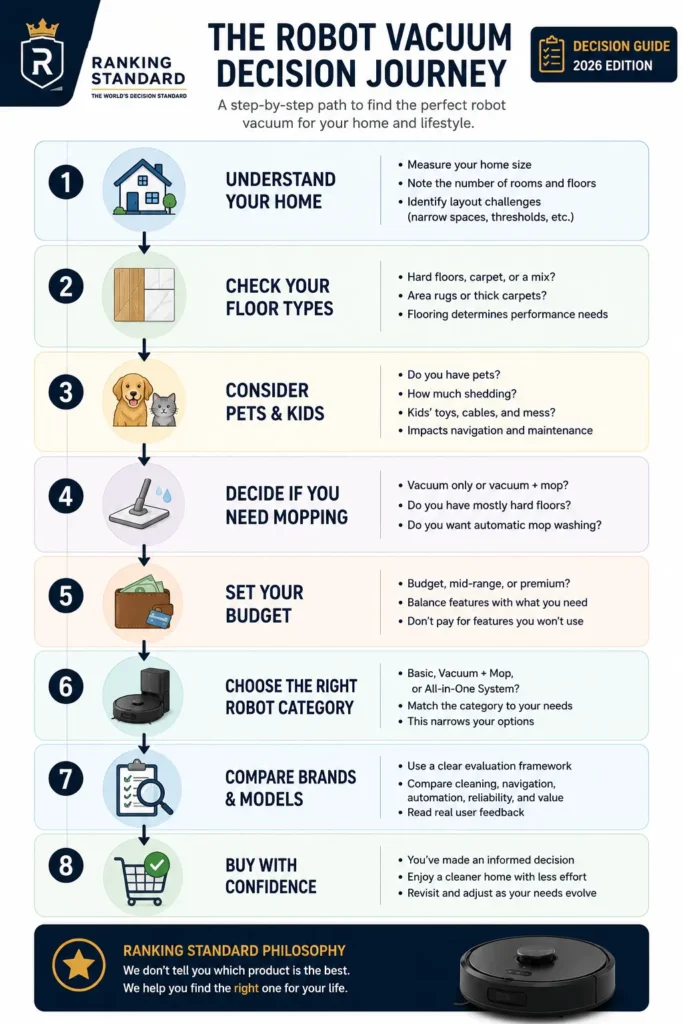
Our goal is to help you understand the market first, identify the features that genuinely matter, and then match those features to your needs before comparing specific brands or models.
Understanding Robot Vacuum Categories Before Choosing a Brand
Step 1: Choose the Right Type of Robot Vacuum
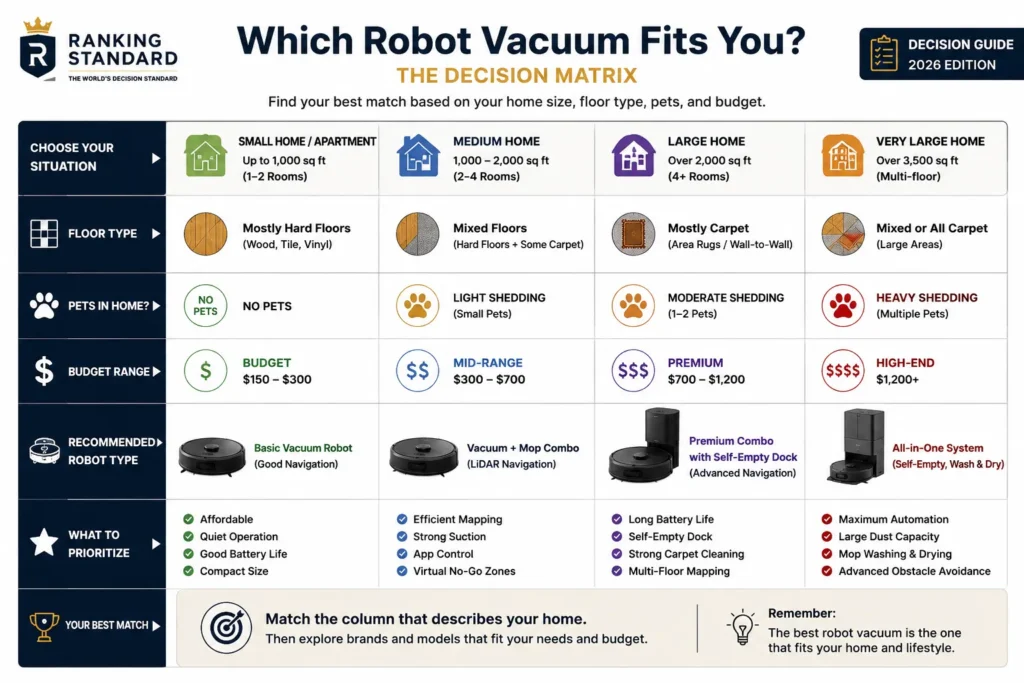
Not every robot vacuum is designed for the same type of home. Before comparing brands, decide which category best fits your needs.
Basic Vacuum Robots
These models focus on vacuuming only. They are generally more affordable, easier to maintain, and ideal for homes with mostly hard floors or light daily cleaning needs.
Best for:
- Apartments
- Small homes
- First-time buyers
- Budget-conscious shoppers
Vacuum + Mop Combo Robots
Today’s most popular category combines vacuuming and mopping in one machine. Premium models can automatically lift their mop pads when they detect carpets, allowing them to clean multiple floor types without manual intervention.
Best for:
- Hardwood floors
- Tile flooring
- Mixed-floor homes
- Busy families
Premium All-in-One Systems
These robots include advanced docking stations that can automatically:
- Empty the dustbin
- Wash mop pads
- Dry mop pads
- Refill clean water
- Collect dirty water
They require much less day-to-day maintenance and are designed for users who want a highly automated cleaning routine.
Best for:
- Large homes
- Daily scheduled cleaning
- Owners who value convenience
Step 2: Navigation Matters More Than Raw Suction
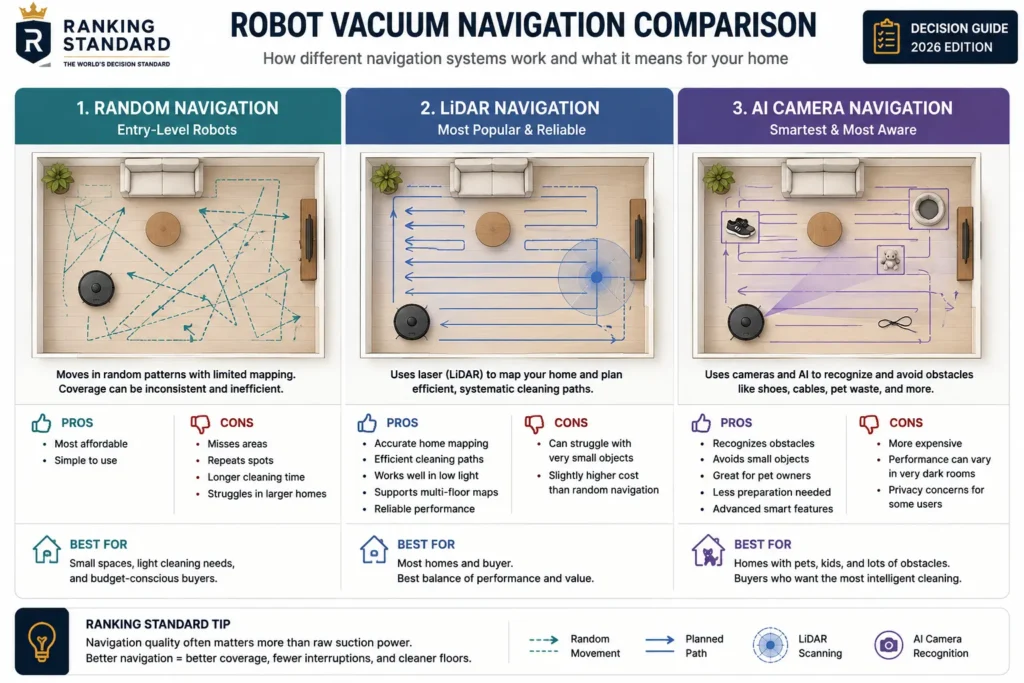
Many advertisements emphasize suction power, but navigation quality often has a greater impact on real-world cleaning performance.
Random Navigation
Entry-level robots move in seemingly random patterns. While inexpensive, they may miss areas or clean the same spot repeatedly.
Suitable only for very small spaces.
LiDAR Navigation
Laser-based LiDAR systems create detailed maps of your home and plan efficient cleaning paths.
Advantages include:
- Faster cleaning
- Better room recognition
- Reliable operation in low-light conditions
- Accurate multi-room mapping
For most buyers, LiDAR offers the best balance of performance and reliability.
Camera-Based AI Navigation
Premium robots use cameras and artificial intelligence to recognize obstacles such as shoes, cables, pet bowls, toys, and even pet waste.
These systems reduce interruptions and require less preparation before each cleaning cycle.
Ideal for homes with children or pets.
Step 3: Match the Robot to Your Home
Your home layout often determines which robot vacuum is the better choice.
Small Apartments
You usually don’t need the most expensive model.
Prioritize:
- Compact size
- Good navigation
- Reliable battery
- Quiet operation
Medium-Sized Homes
A mid-range robot with LiDAR navigation and room mapping typically provides the best value.
Features worth considering include:
- Virtual no-go zones
- Multi-floor maps
- Automatic room recognition
Large Homes
Battery capacity, efficient navigation, and advanced docking stations become increasingly important.
Look for:
- Long runtime
- Automatic recharge and resume
- Large dust capacity
- Self-emptying dock
Step 4: Consider Your Lifestyle
The “best” robot vacuum depends as much on your lifestyle as on your home.
Pet Owners
Prioritize:
- Strong carpet performance
- Effective hair pickup
- Large dustbin
- Self-emptying dock
- Tangle-resistant brush design
Families with Children
Look for:
- Excellent obstacle avoidance
- Quiet operation
- Reliable scheduling
- Easy app controls
Allergy Sufferers
Consider models with:
- Sealed filtration systems
- High-quality filters
- Self-emptying stations that minimize dust exposure
Step 5: Budget Segments
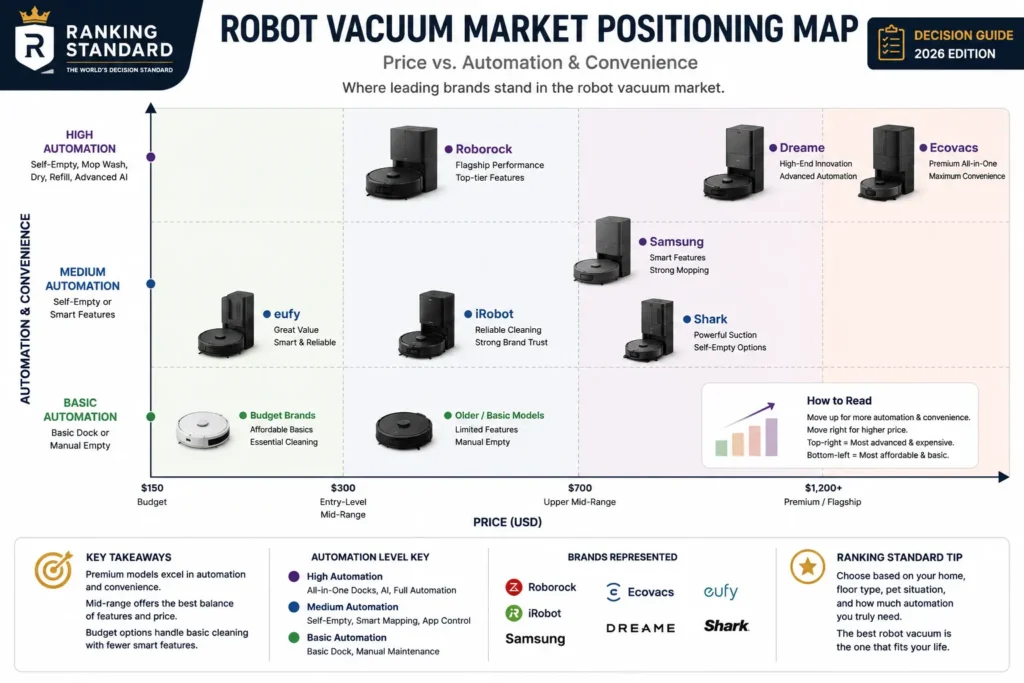
Rather than chasing the most expensive model, choose the price range that matches your expectations.
Budget ($150–300)
Good for:
- Smaller homes
- Basic daily maintenance
Expect fewer smart features and simpler navigation.
Mid-Range ($300–700)
This is where most buyers find the best balance of price and performance.
Common features include:
- LiDAR navigation
- Smart mapping
- Strong suction
- App control
- Virtual boundaries
Premium ($700+)
Premium models focus less on stronger suction and more on automation, convenience, and advanced intelligence.
Typical features include:
- AI obstacle avoidance
- Self-emptying docks
- Automatic mop washing and drying
- Voice assistant integration
- Advanced home mapping
Ranking Standard’s Key Takeaway
Many buyers compare brands first.
We recommend doing the opposite.
First, identify:
- Your home size
- Your floor types
- Whether you have pets
- Whether you need mopping
- How much maintenance you’re willing to do
- Your budget
Once those decisions are made, the list of suitable robot vacuums becomes much smaller—and choosing between brands such as Roborock, Samsung, iRobot, Ecovacs, Dreame, Eufy, Shark, and Dyson becomes far easier.
The Ranking Standard Evaluation Framework
How Ranking Standard Evaluates Robot Vacuums
Many review websites simply compare specifications or rank products from “best” to “worst.”
At Ranking Standard, we believe that approach often creates more confusion than clarity.
A robot vacuum with the highest suction power isn’t automatically the best choice. Likewise, the most expensive model isn’t always the smartest purchase.
Instead, we evaluate every robot vacuum using the same framework and adjust recommendations based on the type of buyer and the intended use.
Our Evaluation Criteria
Cleaning Performance (30%)
The primary purpose of any robot vacuum is simple: clean the floor effectively.
We evaluate:
- Hard floor performance
- Carpet performance
- Edge cleaning
- Corner cleaning
- Pet hair pickup
- Consistency across multiple cleaning cycles
Raw suction numbers alone are never enough. Brush design, airflow efficiency, and software optimization often have a greater impact on real-world results.
Navigation & Obstacle Avoidance (25%)
A powerful robot that constantly gets stuck quickly becomes frustrating.
We assess:
- Mapping accuracy
- Route efficiency
- Multi-floor support
- Cable avoidance
- Furniture navigation
- Recognition of common household obstacles
Reliable navigation saves time, reduces interruptions, and improves overall cleaning coverage.
Automation & Smart Features (15%)
Convenience is one of the biggest reasons people buy a robot vacuum.
We consider:
- Self-emptying docks
- Automatic mop washing
- Mop drying
- Water refilling
- Smart scheduling
- Voice assistant compatibility
- Mobile app usability
These features don’t necessarily improve cleaning quality, but they can dramatically improve the ownership experience.
Reliability & Maintenance (15%)
The best robot vacuum is one you’ll still enjoy using years from now.
We look at:
- Build quality
- Software stability
- Battery longevity
- Replacement parts availability
- Ease of maintenance
- Long-term reliability
Value for Money (10%)
Higher prices should deliver meaningful improvements—not just additional features.
Our value assessment considers:
- Performance relative to price
- Included accessories
- Dock capabilities
- Maintenance costs
- Expected lifespan
Ownership Experience (5%)
Small details often make a surprisingly big difference.
We evaluate:
- Noise levels
- Ease of setup
- Customer support
- Firmware updates
- Overall day-to-day usability
The Biggest Mistakes Buyers Make
Through years of observing the market, we’ve noticed several common buying mistakes.
Many shoppers:
- Focus only on suction power.
- Ignore navigation quality.
- Buy features they’ll never use.
- Purchase premium models for very small apartments.
- Underestimate long-term maintenance costs.
- Choose based solely on brand reputation.
Understanding your own needs is usually more important than buying the most expensive model.
Final Thoughts
Robot vacuums have evolved from niche gadgets into practical household appliances that can save hours of repetitive work every month.
However, there is no single robot vacuum that’s perfect for every home.
The right choice depends on your living space, flooring, household size, pets, cleaning expectations, and budget.
That’s why Ranking Standard begins with understanding your needs—not with a list of brands.
Once you know what type of robot vacuum fits your home, comparing products becomes much simpler, and you’ll be far more likely to buy a machine you’ll actually enjoy using for years.