
A luxury handbag can be one of the most expensive fashion purchases a person makes.
Some buyers are attracted to exceptional craftsmanship. Others appreciate iconic designs, premium leather, distinctive hardware, or the history associated with a particular fashion house.
For many people, a designer handbag is also a personal milestone.
But an expensive handbag is not automatically a good purchase.
A beautifully structured bag may be too heavy for everyday use. A soft leather tote may look elegant but show scratches more easily than expected. A miniature designer bag may be fashionable while offering surprisingly little practical storage.
And a handbag with a prestigious logo may command a high price without providing the best combination of materials, construction, and usability.
The best luxury handbag is not necessarily the most expensive or most recognizable. It is the bag whose design, materials, functionality, and long-term ownership value match the buyer’s priorities.
This luxury handbag buying guide explains how to compare designer bags through practical criteria rather than brand prestige alone.
We examine handbag types, leather quality, construction, hardware, functionality, and the trade-offs between different luxury brands.
We also distinguish between purchasing a handbag for personal enjoyment and treating it as a financial asset.
Ranking Standard has not independently tested every product discussed in this guide. Brand and product assessments should be understood as editorial comparisons informed by available product information, not standardized laboratory rankings.
What Makes a Luxury Handbag Worth Buying?
Luxury handbags can justify their prices in different ways.
Some emphasize distinctive design and brand heritage.
Others offer carefully executed leatherwork, specialized construction, or materials that are difficult to reproduce consistently.
However, these characteristics do not always appear together.
A highly recognizable handbag may be relatively delicate.
A less famous design may provide better everyday functionality.
A durable bag may have limited resale demand.
The key is understanding what the buyer actually values.
The Six Factors That Matter Most
| Buying Factor | Why It Matters | What to Examine |
|---|---|---|
| Materials | Influences appearance and wear | Leather type, coating, lining |
| Construction | Affects structural integrity | Stitching, edges, reinforcement |
| Functionality | Determines everyday usefulness | Size, weight, compartments |
| Design | Influences personal satisfaction | Shape, proportions, versatility |
| Ownership Cost | Affects long-term value | Maintenance, repairs, insurance |
| Brand & Market Position | Influences desirability | Heritage, availability, resale demand |
These factors should be considered together.
A bag made from expensive leather may still be inconvenient to carry.
A bag with excellent functionality may not appeal to someone seeking a distinctive statement piece.
And a handbag with strong historical resale demand may still be a poor purchase if the buyer does not enjoy using it.
Understanding the Different Types of Luxury Handbags
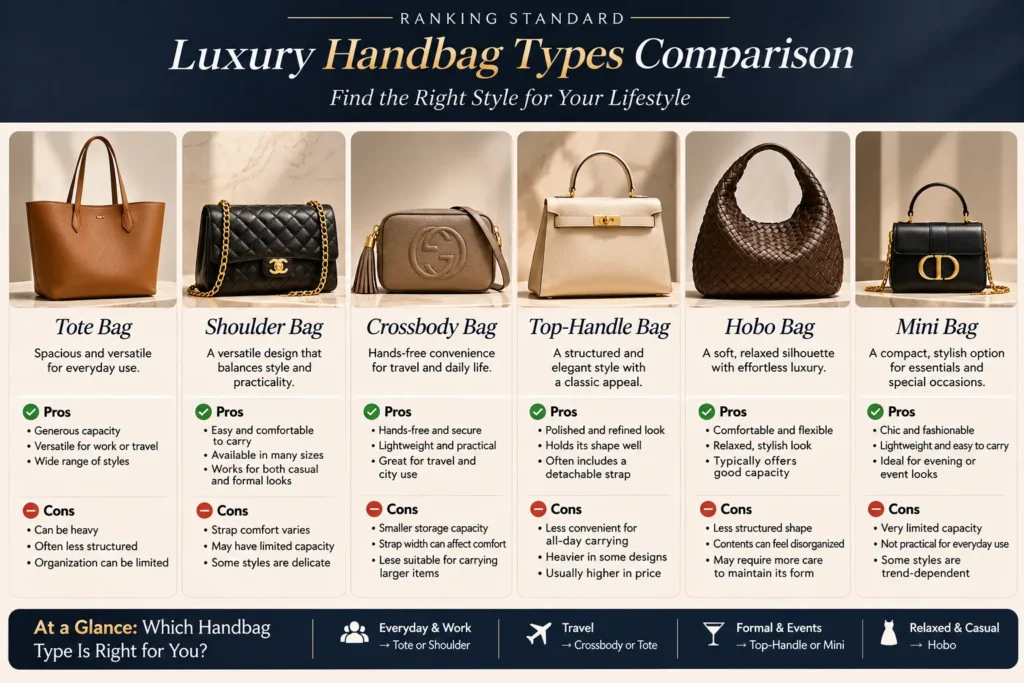
Before comparing brands, buyers should identify the type of handbag they actually need.
Different silhouettes serve different purposes.
Tote Bags — Best for Everyday Capacity
Tote bags typically offer a relatively large opening and generous storage space.
They can be useful for work, shopping, travel, and everyday activities.
However, not every luxury tote is designed to carry heavy items.
A large leather bag may become uncomfortable when filled.
Some totes also provide limited internal organization.
Advantages
- Generous storage capacity
- Versatile everyday use
- Often suitable for work essentials
- Available in structured and relaxed designs
Potential drawbacks
- Can become heavy
- Some designs lack secure closures
- Large interiors may be difficult to organize
- Soft leather may lose its original shape
Best for: Buyers who prioritize everyday functionality and carrying capacity.
Shoulder Bags — Best for Versatile Daily Style
Shoulder bags are designed to rest on one shoulder.
They are available in compact, medium, and relatively large formats.
Some emphasize elegant proportions.
Others offer more practical storage.
The most important consideration is how the strap length and bag shape interact with the buyer’s body.
A bag may look attractive in photographs but feel uncomfortable when carried for extended periods.
Best for: Everyday use, social occasions, and buyers seeking a balance between appearance and functionality.
Crossbody Bags — Best for Hands-Free Convenience
Crossbody bags are carried using a longer strap positioned across the body.
They can be practical for travel, shopping, and busy urban environments.
However, strap design matters.
A narrow strap may become uncomfortable when the bag is heavy.
A compact crossbody may also provide limited storage.
Best for: Travel, city use, and buyers who prefer hands-free carrying.
Top-Handle Bags — Best for Structured Elegance
Top-handle handbags often emphasize a more formal or structured appearance.
They can be associated with classic luxury designs.
Some include detachable shoulder straps, increasing versatility.
However, a bag designed primarily for hand carrying may be less practical for long days outside the home.
Best for: Formal occasions, classic styling, and buyers who value structured design.
Hobo Bags — Best for Relaxed Luxury
Hobo bags typically have a softer silhouette and a more relaxed shape.
They may use supple leather that drapes naturally.
This can create an elegant casual appearance.
However, soft construction may provide less protection for delicate contents.
Some designs also require more care to maintain their intended shape.
Best for: Casual luxury styling and buyers who prefer soft, relaxed silhouettes.
Mini Bags — Best for Fashion and Occasional Use
Mini bags emphasize compact proportions.
They can be visually distinctive and suitable for evening events.
However, some are too small for a modern smartphone or other daily essentials.
Buyers should check the actual interior dimensions rather than relying on product photographs.
Best for: Occasional use, evening styling, and buyers prioritizing design over storage.
Luxury Handbag Types Comparison Matrix
| Bag Type | Everyday Capacity | Carrying Convenience | Main Strength | Main Limitation |
|---|---|---|---|---|
| Tote | High | Medium | Storage | Weight and organization |
| Shoulder Bag | Medium | High | Versatility | Strap comfort |
| Crossbody | Low–Medium | High | Hands-free use | Limited capacity |
| Top-Handle | Variable | Medium | Structured appearance | Carrying flexibility |
| Hobo | Medium–High | Medium | Relaxed styling | Shape retention |
| Mini Bag | Very Low | Variable | Fashion appeal | Practical storage |
These descriptions are general.
Actual functionality depends on the individual model.
A small tote may carry less than a large shoulder bag.
Similarly, a structured top-handle bag with a detachable strap may be more versatile than its category suggests.
Luxury Handbag Materials: What Are You Actually Paying For?
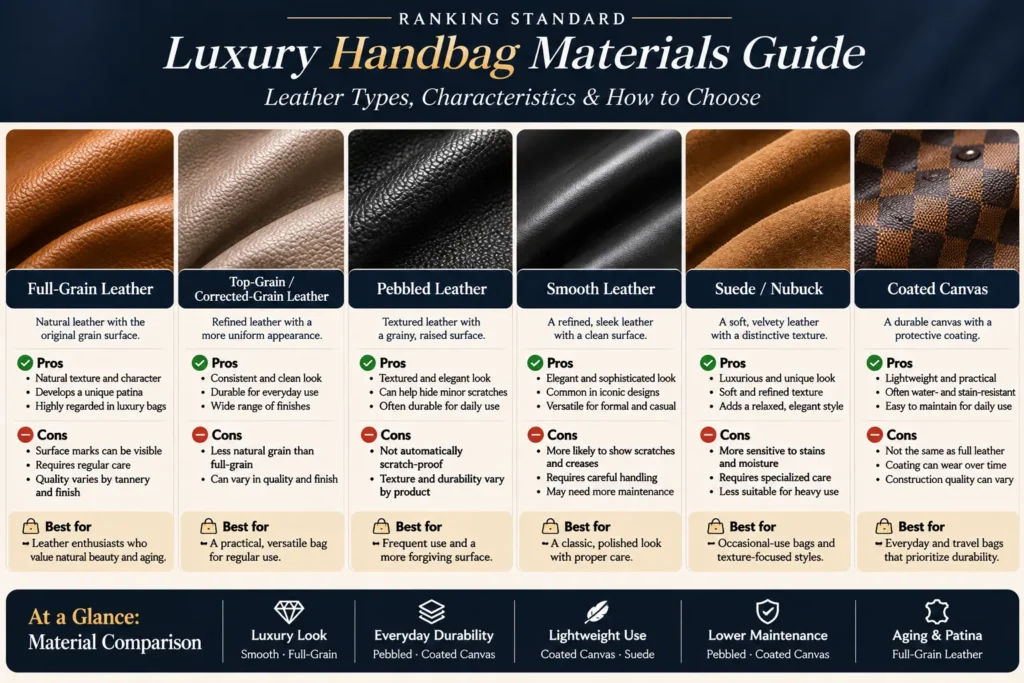
Material selection is one of the most important aspects of luxury handbag shopping.
However, the term premium leather does not provide enough information to establish quality.
Different leathers offer different appearances, textures, and maintenance requirements.
A material that is ideal for one handbag may be unsuitable for another.
Full-Grain Leather
Full-grain leather retains the natural grain surface.
It is often valued for its texture and potential to develop character over time.
However, its performance depends on the hide, tanning, finishing, and product construction.
Full-grain leather is not automatically the best choice for every handbag.
Some buyers prefer a more uniform appearance or a protective surface finish.
Potential Advantages
- Natural surface characteristics
- Distinctive texture
- Potential to develop patina
- Suitable for certain premium constructions
Potential Limitations
- Surface marks may be visible
- Appearance can change over time
- Maintenance requirements vary
- Quality differs between suppliers and finishes
Top-Grain and Corrected-Grain Leather
Top-grain leather generally refers to leather using the grain layer, which may be processed or finished in different ways.
Corrected-grain leather has undergone surface treatment to create a more uniform appearance.
These materials should not automatically be considered inferior.
A carefully finished leather may be more practical for a handbag exposed to regular handling.
The important question is whether the material’s properties suit the intended use.
Pebbled Leather
Pebbled leather describes a textured surface rather than a single universal leather grade.
The texture may be natural or created through processing.
It is popular in luxury handbags because it can provide visual interest and may make certain minor marks less noticeable.
However, resistance to scratches and wear depends on the underlying leather and finish.
A pebbled surface should not be treated as a guarantee of durability.
Best starting point for: Buyers seeking a textured appearance and potentially more forgiving everyday surface characteristics.
Smooth Leather
Smooth leather is associated with many iconic luxury handbag designs.
Its relatively uniform surface can create an elegant, refined appearance.
However, certain smooth leathers may show scratches, creases, and pressure marks more readily.
The degree of vulnerability depends on the specific material and finish.
Best starting point for: Buyers who prioritize a refined appearance and are comfortable with appropriate care.
Suede and Nubuck
Suede and nubuck offer distinctive soft textures.
They can create a luxurious visual and tactile experience.
However, they often require more careful maintenance than some finished leathers.
Water, oils, and staining can be particular concerns.
Buyers should review the manufacturer’s cleaning instructions before purchasing.
Best starting point for: Occasional-use bags and buyers willing to follow material-specific care requirements.
Coated Canvas
Coated canvas is used by several luxury fashion houses.
It typically combines a textile substrate with a protective coating.
This construction can offer useful practical characteristics, depending on the product.
However, coated canvas should not be confused with solid leather.
Its long-term performance depends on coating quality, edge construction, reinforcement, and how the bag is used.
A coated-canvas bag can still be a legitimate luxury purchase.
But buyers should understand which parts are canvas, leather, textile, or synthetic material.
Luxury Handbag Material Comparison
| Material | General Appeal | Main Consideration | Best Starting Point |
|---|---|---|---|
| Full-Grain Leather | Natural texture and character | Surface changes | Leather enthusiasts |
| Finished Top-Grain Leather | Consistent appearance | Finish quality | Everyday luxury |
| Pebbled Leather | Textured appearance | Material-specific wear | Frequent use |
| Smooth Leather | Refined styling | Visible scratches | Classic designs |
| Suede/Nubuck | Soft luxury texture | Staining and moisture | Occasional use |
| Coated Canvas | Practical lightweight options | Coating and trim condition | Everyday and travel bags |
No material is universally superior.
The best choice depends on the bag’s construction and the buyer’s lifestyle.
Handbag Construction: How to Recognize Quality
Luxury handbags often emphasize craftsmanship.
However, buyers should look beyond broad marketing language.
A useful construction assessment examines several specific elements.
Stitching
Stitching should be appropriate for the material and design.
Buyers can inspect whether seams appear consistent and whether areas exposed to repeated stress are appropriately reinforced.
However, decorative stitching and structural stitching serve different purposes.
Perfectly uniform visible stitches do not independently prove overall durability.
Edge Finishing
Leather edges may be folded, stitched, painted, or finished using other methods.
Each approach has different advantages and maintenance considerations.
Edge paint can create a clean appearance, but it may eventually show wear in frequently handled areas.
Buyers should examine edge finishing around handles, straps, and openings.
Handles and Straps
Handles and straps experience repeated loading.
Their construction is especially important for larger handbags.
Buyers should inspect:
- Attachment points
- Stitching and reinforcement
- Strap width
- Adjustable hardware
- Comfort when carrying the loaded bag
- Availability of replacement straps
A beautiful handbag becomes inconvenient if its handles are uncomfortable or poorly suited to the intended contents.
Hardware
Luxury handbags may use metal hardware for closures, buckles, rings, and decorative elements.
Hardware quality should be evaluated through function and finish.
A clasp should operate securely.
A zipper should move smoothly.
However, the weight or color of metal hardware does not automatically establish its quality.
Lining
The lining influences the interior appearance and usability of a handbag.
Materials may include leather, suede-like textiles, cotton, synthetic fabrics, or other constructions.
A premium lining can enhance the ownership experience.
However, it may also require additional care.
Buyers should consider how easily the interior can be cleaned.
Luxury Handbag Construction Checklist
| Component | What to Examine |
|---|---|
| Leather or Canvas | Material disclosure and finish |
| Stitching | Consistency and reinforcement |
| Handles | Comfort and attachment |
| Strap | Length, adjustability, load suitability |
| Hardware | Function, finish, security |
| Zipper | Smooth operation |
| Edge Finishing | Quality and maintenance |
| Lining | Durability and cleaning |
| Structure | Shape retention |
| Interior | Practical organization |
A luxury handbag should be evaluated as a complete product.
Exceptional leather cannot compensate for an impractical design.
Similarly, attractive hardware cannot justify a bag that is uncomfortable to carry.
Structured vs. Soft Luxury Handbags
One of the most important decisions is whether to choose a structured or soft handbag.
Structured Handbags
Structured bags maintain a relatively defined shape.
They often use reinforcement, carefully designed panels, or more rigid materials.
Advantages
- Consistent silhouette
- Formal appearance
- Potentially easier organization
- Often suitable for classic styling
Potential limitations
- Less flexibility
- May feel heavier or more rigid
- Corners and edges can experience concentrated wear
- Storage requires appropriate care
Soft Handbags
Soft handbags use more flexible construction.
They may conform more naturally to the body and contents.
Advantages
- Relaxed appearance
- Flexible storage
- Comfortable carrying in some designs
- Suitable for casual styling
Potential limitations
- Less shape retention
- Contents may be less organized
- Some materials crease or stretch
- Appearance may change with use
Which Is Better?
Neither is universally better.
A structured handbag may be ideal for someone who wants a polished appearance and organized contents.
A soft tote may be more practical for someone carrying varied everyday items.
Ranking Standard Buying Principle: Choose the handbag’s structure according to how you will use it—not simply how it looks in a product photograph.
The First Luxury Handbag Buying Decision
Before comparing brands, answer five questions.
1. What will I carry?
List the actual items the bag needs to hold.
2. How often will I use it?
Daily use creates different maintenance requirements from occasional use.
3. How will I carry it?
Consider shoulder comfort, strap length, and weight.
4. How much maintenance am I willing to perform?
Some materials require more care than others.
5. Am I buying it for personal use or expecting resale value?
These are different purchasing objectives.
A handbag purchased primarily for enjoyment should be evaluated differently from one purchased with financial expectations.
Even highly desirable luxury bags do not offer guaranteed resale profits.
The right luxury handbag begins with function, materials, and personal priorities. Brand prestige comes later.
The Best Luxury Handbag Brands: Understanding the Differences
Luxury fashion houses compete on more than logos.
Some are known for structured leather goods and traditional craftsmanship. Others emphasize distinctive design, fashion relevance, or recognizable silhouettes.
For buyers, the challenge is separating brand reputation from the characteristics of an individual handbag.
A fashion house may produce an exceptional classic bag alongside seasonal designs that offer very different ownership experiences.
That is why Ranking Standard evaluates luxury handbags through their materials, construction, usability, design, maintenance requirements, and purchasing value.
A brand’s prestige should help identify products worth considering—not replace the evaluation of those products.
For a broader perspective on the fashion industry, explore our Luxury Fashion Houses Ranked (2026) guide, which examines the positioning and influence of major luxury brands beyond handbags.
Luxury Handbag Brand Comparison Matrix
The following table summarizes the general market positioning of ten major luxury handbag houses.
It is a qualitative comparison, not a laboratory-tested quality ranking.
| Brand | Recognizable Handbag Lines | Primary Appeal | Main Buying Consideration |
|---|---|---|---|
| Hermès | Birkin, Kelly, Evelyne | Heritage and leather craftsmanship | Access, price, practicality |
| Chanel | Classic Flap, 2.55, Boy | Iconic design and brand identity | Price, weight, delicate finishes |
| Louis Vuitton | Speedy, Neverfull, Alma | Recognizable design and broad selection | Material and model differences |
| Dior | Lady Dior, Saddle, Book Tote | Distinctive fashion design | Shape, usability, material care |
| Gucci | Jackie 1961, Horsebit 1955 | Heritage details and versatile styling | Trend exposure and construction |
| Prada | Galleria, Re-Edition | Structured design and technical materials | Material-specific value |
| Saint Laurent | Le 5 à 7, Loulou | Minimalist contemporary luxury | Leather finish and daily wear |
| Bottega Veneta | Andiamo, Jodie | Woven-leather design identity | Maintenance and construction |
| Celine | Triomphe, 16 | Refined structured styling | Capacity and surface wear |
| Loewe | Puzzle, Flamenco | Creative leather construction | Shape, functionality, care |
The listed collections are reference points for comparing each brand’s design approach. Specific versions, availability, and specifications should be checked with the manufacturer.
Hermès — Heritage Craftsmanship and Exclusive Leather Goods
Hermès occupies a distinctive position in the luxury handbag market.
The house is closely associated with leather craftsmanship, traditional design, and highly recognizable products.
The Birkin and Kelly are among its best-known handbag families.
However, these designs serve different practical purposes.
Birkin vs. Kelly
The Birkin is generally associated with a relatively open, top-handle design.
The Kelly emphasizes a more structured silhouette and a distinctive closure system.
Both are available in different sizes and materials.
Neither should be considered universally superior.
A buyer who frequently needs quick access to personal belongings may have different preferences from someone prioritizing a formal, structured appearance.
What Buyers Should Consider
- Weight and size
- Leather type
- Closure convenience
- Handle and strap configuration
- Availability and purchase conditions
- Maintenance and repair arrangements
Hermès may be attractive to collectors and buyers who value its design heritage.
However, exclusivity should not be confused with guaranteed investment performance.
Ranking Standard Perspective: Hermès is a significant reference point for luxury leather goods, but the right purchase depends on the specific bag and its intended use.
Chanel — Iconic Quilted Handbags and Timeless Styling
Chanel is strongly associated with quilted handbags, chain straps, and recognizable hardware.
The Classic Flap and 2.55 are central to its handbag identity.
These bags are often purchased for their design history and distinctive appearance.
However, buyers should consider practical ownership factors.
Lambskin vs. Grained Leather
Chanel handbags are available in different materials and finishes.
Lambskin is often appreciated for its smooth, soft appearance.
However, certain lambskin finishes may show scratches or pressure marks more readily.
Grained leather may offer a more textured appearance.
The degree of wear resistance depends on the exact leather and finish.
Practical Considerations
Chain straps, flap closures, and structured interiors can influence usability.
A compact Chanel bag may be attractive for social occasions but less suitable for carrying larger everyday items.
Buyers should examine the actual interior dimensions.
Ranking Standard Perspective: Chanel is particularly relevant for buyers who prioritize iconic design, but material choice and carrying comfort deserve close attention.
Louis Vuitton — Broad Selection and Recognizable Design
Louis Vuitton offers a wide range of handbags, from compact crossbody designs to large everyday totes.
Its recognizable product families include the Speedy, Neverfull, and Alma.
One important distinction is that Louis Vuitton handbags are made from different materials.
Not every Louis Vuitton bag is made primarily from leather.
Coated Canvas vs. Leather
Selected Louis Vuitton designs use coated canvas with leather trim.
Others use various leather constructions.
These materials have different characteristics.
Coated canvas can be relatively practical for everyday use, depending on its finish and construction.
Leather may offer a different texture and aging experience.
Buyers should examine the material composition rather than assuming that a higher price necessarily indicates more leather.
Choosing Between Popular Designs
Speedy: A recognizable rounded silhouette suitable for buyers seeking a classic handbag design.
Neverfull: A tote-oriented option for buyers who value carrying capacity.
Alma: A structured handbag with a more defined silhouette.
Each offers a different balance of storage, carrying convenience, and appearance.
Ranking Standard Perspective: Louis Vuitton is particularly useful for comparing different handbag formats within one luxury house.
Dior — Distinctive Design and Fashion Identity
Dior’s handbag collections are strongly associated with recognizable silhouettes and design details.
The Lady Dior, Saddle, and Book Tote illustrate different approaches.
Lady Dior
The Lady Dior emphasizes a structured silhouette and distinctive decorative hardware.
Its design may appeal to buyers seeking a formal or refined handbag.
However, buyers should consider opening convenience, weight, and capacity.
Saddle
The Saddle is known for its distinctive curved silhouette.
Its visual identity is a major part of its appeal.
However, the shape may affect how efficiently the interior space can be used.
Book Tote
The Book Tote emphasizes a larger carrying format and recognizable textile designs.
It may be relevant for buyers who want a statement tote.
However, textile care and weight should be considered.
Ranking Standard Perspective: Dior offers strong design identities, but functionality varies considerably between its major handbag lines.
Gucci — Heritage Details and Everyday Versatility
Gucci combines recognizable heritage elements with contemporary fashion design.
The Jackie 1961 and Horsebit 1955 are useful reference points.
Both incorporate distinctive visual details associated with the house.
What Makes Gucci Different?
Gucci offers multiple approaches to handbag styling.
Some designs emphasize relatively classic silhouettes.
Others are more closely associated with seasonal fashion.
Buyers should consider whether the design will remain appealing to them beyond the current season.
Practical Considerations
- Strap configuration
- Closure convenience
- Leather or canvas composition
- Hardware maintenance
- Interior capacity
- Weight
Ranking Standard Perspective: Gucci deserves consideration for buyers who appreciate recognizable design details, but product-level evaluation remains essential.
Prada — Structured Leather Goods and Modern Materials
Prada is associated with structured leather handbags and technical textile designs.
Its Galleria and Re-Edition collections demonstrate these different approaches.
Prada Galleria
The Galleria is a structured handbag family associated with Prada’s Saffiano leather designs.
Saffiano refers to a textured leather finish, not a universal guarantee of quality.
Buyers should examine the exact product’s material and construction.
Prada Re-Edition
Re-Edition handbags often emphasize compact proportions and designs associated with earlier Prada styles.
Some versions use technical textiles or other materials.
They may appeal to buyers seeking a lightweight, casual luxury bag.
However, buyers should compare material composition and price carefully.
Ranking Standard Perspective: Prada offers useful alternatives for buyers who value structured styling or modern material choices.
Saint Laurent — Minimalist Luxury and Contemporary Styling
Saint Laurent handbags often emphasize clean lines, distinctive hardware, and contemporary silhouettes.
The Le 5 à 7 and Loulou collections illustrate different design directions.
Le 5 à 7
The Le 5 à 7 is associated with a streamlined shoulder-bag silhouette.
Its appeal lies partly in its relatively simple visual presentation.
However, buyers should examine capacity and closure security.
Loulou
The Loulou family emphasizes quilted styling and a softer visual character.
Different sizes and materials can affect weight, maintenance, and practicality.
What Buyers Should Consider
Saint Laurent may appeal to buyers seeking recognizable luxury styling without highly elaborate silhouettes.
However, leather finish and construction should still be evaluated.
Ranking Standard Perspective: Saint Laurent is a relevant option for contemporary everyday styling, subject to the specific model’s functionality.
Bottega Veneta — Woven Leather and Distinctive Craftsmanship
Bottega Veneta is particularly associated with woven-leather design.
Its intrecciato technique is a defining element of the house’s visual identity.
The Andiamo and Jodie collections are recognizable examples.
Why Woven Leather Matters
Woven leather can create a distinctive texture and appearance.
However, the presence of weaving does not automatically establish superior durability.
Buyers should consider how the construction is supported, how edges are finished, and how the bag should be maintained.
Andiamo vs. Jodie
The Andiamo emphasizes a more structured approach to the brand’s woven-leather design.
The Jodie is associated with a softer, rounded silhouette.
Different versions may vary in size and materials.
Ranking Standard Perspective: Bottega Veneta is especially relevant for buyers who value distinctive leather design and are comfortable with material-specific maintenance.
Celine — Refined Structured Design
Celine is associated with relatively restrained luxury styling and structured leather goods.
The Triomphe and 16 handbag families illustrate this approach.
Triomphe
The Triomphe emphasizes recognizable closure hardware and a structured appearance.
Buyers should consider the opening mechanism and available interior space.
16
The 16 collection is associated with a more classic structured handbag silhouette.
It may appeal to buyers who prefer formal styling and defined proportions.
Practical Considerations
Structured bags may retain their intended silhouette well, but they can also be less flexible when carrying irregularly shaped objects.
Smooth leather finishes may require careful handling.
Ranking Standard Perspective: Celine is worth considering for buyers who prioritize refined styling and structured handbag design.
Loewe — Creative Leather Construction and Distinctive Shapes
Loewe is associated with leather goods and distinctive handbag construction.
The Puzzle and Flamenco collections demonstrate different approaches to shape and structure.
Puzzle
The Puzzle is recognized for its geometric panel construction.
Its design creates a distinctive silhouette.
However, buyers should evaluate opening access, interior organization, and carrying comfort.
Flamenco
The Flamenco emphasizes a softer silhouette and drawstring-inspired closure details.
It may appeal to buyers who prefer relaxed luxury.
However, its structure and closure system may not suit every use.
Ranking Standard Perspective: Loewe offers distinctive alternatives for buyers who value creative leather design, but practicality should be assessed at the model level.
Luxury Handbag Brand Strengths Matrix
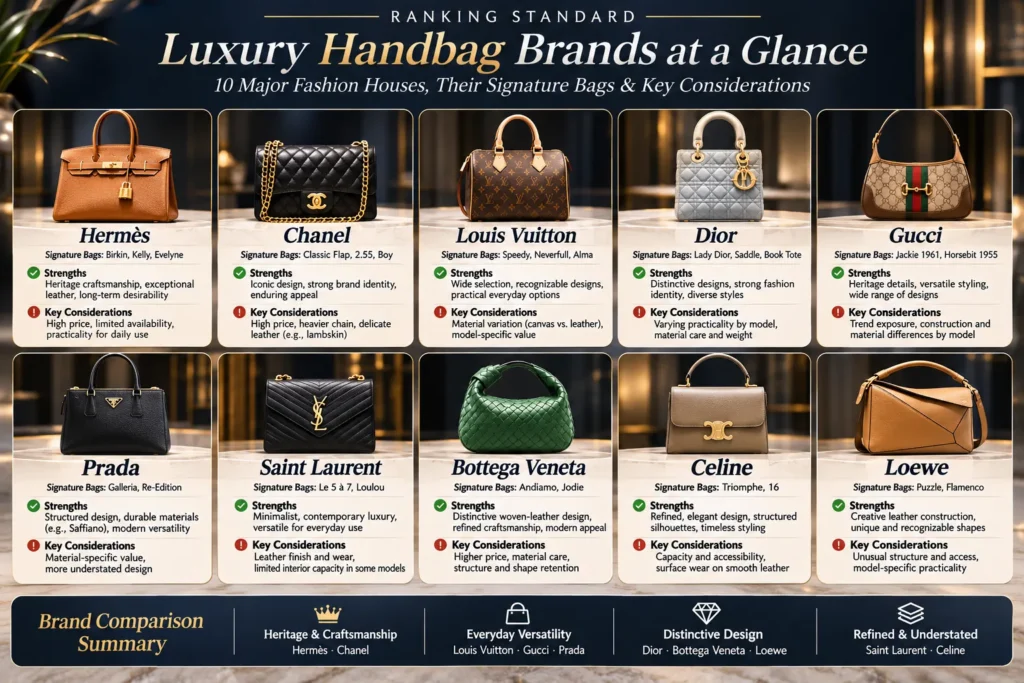
The following matrix summarizes the ten brands by their general design strengths.
| Brand | Primary Strength | Main Trade-Off | Best Starting Point |
|---|---|---|---|
| Hermès | Heritage leather goods | Access and cost | Collectors and classic luxury |
| Chanel | Iconic quilted designs | Price and material care | Classic statement bags |
| Louis Vuitton | Broad product selection | Material variation | Everyday luxury |
| Dior | Distinctive silhouettes | Model-specific practicality | Fashion-focused buyers |
| Gucci | Heritage styling | Seasonal design variation | Versatile designer bags |
| Prada | Structured and technical designs | Material-specific value | Modern everyday bags |
| Saint Laurent | Minimalist contemporary styling | Finish and capacity | Refined daily use |
| Bottega Veneta | Woven-leather identity | Maintenance considerations | Leather design enthusiasts |
| Celine | Structured elegance | Capacity and surface care | Classic understated styling |
| Loewe | Creative leather construction | Unusual shape and access | Design-focused buyers |
These comparisons are qualitative.
They do not establish a universal quality hierarchy.
A brand may offer different levels of construction and practicality across its collections.
Should Luxury Handbags Have an S–D Tier Ranking?
Ranking Standard uses S–D tiers to organize brands and products according to explicit editorial criteria.
However, a luxury handbag tier system should not simply reproduce a general luxury fashion-house ranking.
Handbag-specific evaluation should consider:
- Leather and material quality
- Construction and finishing
- Functional design
- Product range
- Maintenance and repair options
- Purchasing value
- Evidence supporting the assessment
Brand heritage and prestige may influence consumer interest, but they should not automatically determine the highest tier.
For that reason, this guide does not assign a new definitive S–D hierarchy to the ten brands.
A separate handbag brand ranking should establish its own methodology and explain the evidence supporting each classification.
How to Compare Two Luxury Handbags Fairly
Imagine a buyer comparing a structured leather top-handle bag with a lightweight coated-canvas tote.
The leather bag may offer the preferred appearance and a more formal design.
The coated-canvas tote may provide greater carrying capacity and easier everyday use.
Neither is automatically the better purchase.
The decision should consider:
- Intended use
- Carrying comfort
- Material characteristics
- Construction
- Maintenance
- Total cost
- Personal design preferences
A handbag’s value is ultimately determined by how well it serves the buyer.
Luxury should enhance the ownership experience—not make practical considerations irrelevant.
How Much Should You Spend on a Luxury Handbag?
One of the most difficult decisions in luxury handbag shopping is determining a reasonable budget.
Designer handbags can range from relatively accessible luxury products to extremely expensive collector-oriented pieces.
However, a higher price does not automatically indicate better construction, greater practicality, or stronger resale performance.
The most useful approach is to establish a budget before choosing a brand.
Buyers should then compare what different products offer in terms of materials, craftsmanship, functionality, design, and ownership costs.
Luxury Handbag Price Categories
The following are broad U.S.-dollar budgeting categories, not verified November 2026 retail-price averages or guarantees that particular models are available within each range.
| Budget | Shopping Segment | Brands Worth Exploring | Main Priority |
|---|---|---|---|
| Under $1,000 | Accessible Designer Options | Selected entry-level products and pre-owned bags | Practicality and condition |
| $1,000–$2,500 | Entry Luxury | Selected Gucci, Prada, Saint Laurent, and Louis Vuitton products | Material and everyday usability |
| $2,500–$5,000 | Established Luxury | Selected Louis Vuitton, Dior, Celine, Loewe, and Bottega Veneta products | Design, construction, versatility |
| $5,000–$10,000 | Premium Luxury | Selected Chanel, Dior, Hermès, and other premium collections | Craftsmanship, design, ownership costs |
| Above $10,000 | High Luxury & Collectibles | Selected Hermès, Chanel, and exceptional designer pieces | Specific model, provenance, condition |
Actual prices vary considerably by country, size, material, configuration, and availability.
Many iconic handbags fall outside these illustrative categories.
Buyers should check current official prices before making a purchasing decision.
Under $1,000: Focus on Value Rather Than Recognition
At this budget, buyers may find selected designer accessories, smaller handbags, discounted products, or pre-owned luxury bags.
However, a recognizable logo should not be the primary reason to purchase.
The most important questions are practical.
Is the bag large enough?
Is the material appropriate for frequent use?
Are the handles and closures in good condition?
Can the bag be maintained without excessive cost?
For pre-owned purchases, authenticity and condition become especially important.
A lower-priced luxury handbag can be a sensible purchase when it offers the functionality and appearance the buyer wants.
However, buying a damaged bag solely because it carries a famous logo may lead to expensive repairs and disappointing ownership.
$1,000–$2,500: Compare Everyday Functionality
This budget may provide access to selected entry-level luxury handbags and smaller designs.
Buyers should pay attention to the difference between material value and brand positioning.
A coated-canvas handbag may offer practical advantages for frequent use.
A smooth leather handbag may provide a more refined appearance but require greater care.
Neither is automatically the better choice.
What Matters Most
- Appropriate capacity
- Comfortable carrying options
- Secure closures
- Material suitability
- Construction details
- Maintenance requirements
- Total purchase price
A handbag should earn its place in the wardrobe through regular usefulness or genuine personal enjoyment.
$2,500–$5,000: Evaluate the Details
At this level, buyers should expect a convincing combination of design, construction, and material quality.
However, the price itself does not establish those characteristics.
Examine the actual handbag carefully.
Pay attention to stitching, edge finishing, handle attachments, hardware, lining, and structural reinforcement.
A bag that looks beautiful in photographs may still have practical limitations.
Important Questions
Does the handbag remain comfortable when loaded?
Can the interior accommodate everyday essentials?
Is the leather appropriate for frequent handling?
Does the closure work conveniently?
Are repair and after-sales services available?
These questions are more useful than simply comparing brand prestige.
$5,000–$10,000: Understand the Luxury Premium
At higher prices, buyers may be paying for a combination of craftsmanship, design heritage, brand positioning, limited availability, and specialized materials.
Some of these characteristics may improve the ownership experience.
Others may primarily contribute to exclusivity or aesthetic appeal.
Both can have legitimate value.
However, buyers should understand the difference.
A highly recognizable handbag may provide strong personal satisfaction without being the most practical everyday option.
That is not necessarily a poor purchase.
It becomes a problem only when expectations are unclear.
Above $10,000: Separate Collecting From Everyday Shopping
At the highest price levels, handbag purchases may involve rare materials, limited availability, distinctive designs, or significant collector demand.
Buyers should exercise additional caution.
Important considerations include:
- Authenticity and provenance
- Product condition
- Purchase documentation
- Insurance
- Storage
- Maintenance
- Resale fees
- Market liquidity
- Legal restrictions on certain materials
A high purchase price does not guarantee that the bag will retain its value.
Collectors should distinguish personal enjoyment from financial expectations.
Iconic Luxury Handbags: Which Designs Are Worth Considering?
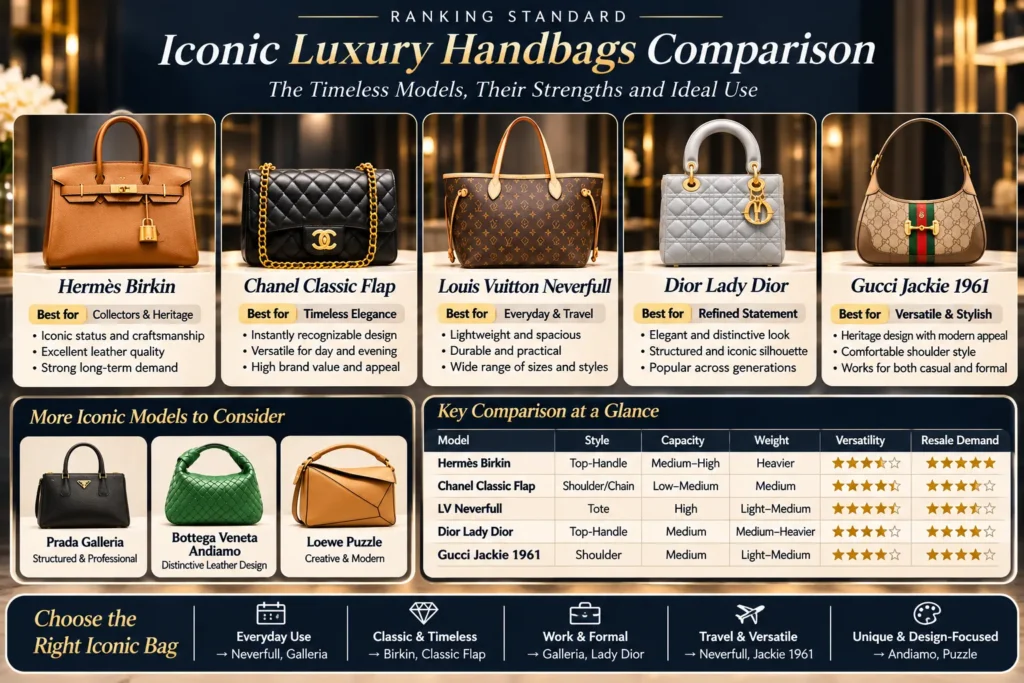
Some handbag designs remain recognizable over long periods.
However, an iconic reputation does not automatically make a product suitable for every buyer.
The following models illustrate different purchasing priorities.
| Handbag | Main Appeal | Main Buying Consideration |
|---|---|---|
| Hermès Birkin | Heritage and collector interest | Access, price, carrying practicality |
| Hermès Kelly | Structured elegance | Closure convenience and size |
| Chanel Classic Flap | Recognizable quilted design | Price, weight, leather care |
| Louis Vuitton Speedy | Classic rounded silhouette | Opening, strap options, capacity |
| Louis Vuitton Neverfull | Everyday tote functionality | Organization and closure |
| Dior Lady Dior | Structured luxury styling | Weight and carrying convenience |
| Gucci Jackie 1961 | Heritage shoulder-bag design | Strap fit and closure |
| Prada Galleria | Structured everyday elegance | Weight and dimensions |
| Bottega Veneta Andiamo | Woven-leather identity | Material care and price |
| Loewe Puzzle | Geometric construction | Access and interior usability |
These are representative handbag families, not a ranked list of objectively superior products.
Individual sizes, materials, and editions may offer substantially different ownership experiences.
Best Starting Point for Classic Luxury
Hermès Kelly or Chanel Classic Flap
These designs may appeal to buyers seeking recognizable, established luxury styling.
However, they involve different closure systems, materials, and carrying experiences.
Best Starting Point for Everyday Capacity
Louis Vuitton Neverfull
A relevant option for buyers who prioritize tote-style storage.
However, buyers should examine the closure, organization, and comfort when carrying heavier items.
Best Starting Point for Structured Professional Styling
Prada Galleria or Celine 16
These handbag families may appeal to buyers seeking relatively formal, structured designs.
The appropriate size and weight should be evaluated carefully.
Best Starting Point for Distinctive Leather Design
Bottega Veneta Andiamo or Loewe Puzzle
These designs may appeal to buyers who appreciate unusual construction and recognizable silhouettes.
However, buyers should evaluate functionality and material-specific maintenance.
Best Starting Point for Fashion-Focused Styling
Dior Saddle or Gucci Jackie 1961
These designs offer distinctive visual identities.
Their practicality depends on size, strap configuration, and intended use.
Are Luxury Handbags Good Investments?
Luxury handbags are sometimes described as investment assets.
However, that description can be misleading.
A handbag is primarily a consumer product.
Its resale value depends on market demand, condition, authenticity, availability, and selling costs.
Some highly desirable models may appreciate in certain markets or periods.
Others may lose substantial value after purchase.
There is no guarantee of profit.
Why Some Handbags Retain Value Better Than Others
Resale performance can be influenced by:
- Brand recognition
- Model popularity
- Supply and availability
- Condition
- Color and material
- Size
- Original accessories
- Documentation
- Market trends
- Selling platform fees
These factors can change.
A model that is highly desirable today may become less popular in the future.
Retail Price vs. Resale Price
Buyers should distinguish between three different figures.
Retail Price: The amount paid to purchase the handbag.
Advertised Resale Price: The price at which a seller lists the handbag.
Realized Resale Proceeds: The amount actually received after a completed sale and associated costs.
These figures are not interchangeable.
A handbag advertised for $8,000 has not necessarily sold for that amount.
An Illustrative Resale Calculation
Consider a hypothetical handbag purchased for $5,000.
Several years later, it sells for $5,500.
At first glance, the buyer appears to have made a $500 profit.
However, the actual calculation may be different.
| Transaction | Amount |
|---|---|
| Original Purchase | $5,000 |
| Resale Price | $5,500 |
| Selling Fees (10%) | -$550 |
| Shipping & Insurance | -$100 |
| Authentication & Preparation | -$100 |
| Net Resale Proceeds | $4,750 |
| Net Gain / Loss | -$250 |
This example is hypothetical and excludes taxes, inflation, currency changes, and other potential expenses.
It demonstrates why a higher resale price does not necessarily mean a profitable investment.
Ranking Standard Principle: Buy a luxury handbag primarily because you want to own and use it—not because future appreciation is guaranteed.
Buying New vs. Pre-Owned Luxury Handbags
The pre-owned luxury handbag market can provide access to discontinued designs, older collections, and products at different price points.
However, it also introduces additional risks.
Advantages of Buying New
- Purchase directly from an authorized source
- Clearer product provenance
- Current product documentation
- Applicable retailer and manufacturer support
- Opportunity to inspect available models
Potential Limitations of Buying New
- Higher purchase prices
- Limited availability of certain designs
- Waiting periods or purchase restrictions
- Immediate depreciation for some products
Advantages of Buying Pre-Owned
- Access to discontinued models
- Potentially lower prices
- Broader selection of older designs
- Opportunity to compare historical materials and construction
Potential Limitations of Buying Pre-Owned
- Counterfeit risk
- Undisclosed repairs
- Hidden damage
- Limited warranty support
- Condition-related uncertainty
- Authentication costs
- Return restrictions
Neither approach is universally superior.
The correct choice depends on budget, desired model, risk tolerance, and the reliability of the seller.
How to Authenticate a Luxury Handbag
Counterfeit luxury handbags can be difficult to identify.
Some counterfeits imitate stitching, packaging, hardware, labels, and serial-number formats.
Therefore, buyers should avoid relying on a single visual detail.
Check the Seller First
A reliable purchasing process begins with the seller.
Consider:
- Seller history
- Return policy
- Authentication procedures
- Payment protection
- Product documentation
- Dispute resolution
- Physical inspection opportunities
An established marketplace may offer useful protections, but no platform should automatically be assumed error-free.
Examine the Entire Handbag
Authenticity assessment may involve:
- Construction
- Material characteristics
- Hardware
- Stitching
- Interior details
- Model-specific markings
- Product dimensions
- Manufacturing characteristics
However, individual details can vary by year, model, and production period.
A particular marking should not be treated as universal proof of authenticity.
Do Serial Numbers Prove Authenticity?
No.
Serial numbers, date codes, and other identifiers may be copied or misrepresented.
Some brands have also changed their identification systems over time.
A serial number alone cannot establish authenticity.
Are Authentication Certificates Always Reliable?
Not necessarily.
The reliability of a certificate depends on the provider, methodology, and scope of the service.
Buyers should verify who performed the authentication and whether any guarantee or dispute process applies.
When to Use Professional Authentication
Independent authentication may be particularly valuable for expensive pre-owned purchases.
However, buyers should understand the service’s limitations.
Authentication is an expert assessment, not necessarily an absolute guarantee.
For high-value purchases, documented provenance and appropriate transaction protections are also important.
Luxury Handbag Authentication Checklist
| Check | Why It Matters |
|---|---|
| Seller Reputation | Reduces transaction uncertainty |
| Purchase Documentation | Supports provenance |
| Model Verification | Confirms design and specifications |
| Material Inspection | Identifies inconsistencies |
| Hardware Inspection | Checks construction details |
| Stitching & Edges | Evaluates workmanship |
| Identification Details | Provides supporting information |
| Independent Authentication | Adds expert review |
| Return Policy | Protects against disputes |
| Secure Payment | Reduces financial risk |
Never assume a handbag is authentic simply because it includes a box, dust bag, receipt, or certificate.
These accessories can also be counterfeited.
Luxury Handbag Maintenance: Protecting Your Purchase
Luxury handbags require different care depending on their materials.
A leather handbag should not automatically be cleaned using the same products as coated canvas, suede, or technical textiles.
Manufacturer instructions should take priority.
Everyday Leather Care
General precautions include:
- Avoid prolonged exposure to direct sunlight
- Keep bags away from excessive heat
- Protect against moisture
- Avoid overloading
- Store in a suitable environment
- Handle delicate finishes carefully
Specialized cleaning products should be tested or professionally assessed where appropriate.
Protecting Bag Shape
Some handbags benefit from appropriate internal support during storage.
However, overstuffing can distort the structure.
The goal is to preserve the intended shape without placing unnecessary pressure on seams or leather panels.
Dust Bags and Storage
A breathable dust bag may help protect a handbag from dust and incidental contact.
However, storage conditions matter.
Excessive humidity can contribute to mold and material deterioration.
Very dry environments may also be unsuitable for certain materials.
Hardware Care
Metal hardware can experience scratches and surface wear.
Buyers should avoid unnecessary contact with abrasive objects.
Cleaning methods should follow the manufacturer’s recommendations.
When to Seek Professional Repair
Professional assistance may be appropriate for:
- Damaged handles
- Loose stitching
- Broken closures
- Significant leather damage
- Deteriorating edge finishing
- Structural deformation
Before using a third-party repair service, consider whether modifications could affect manufacturer service eligibility or resale value.
The Hidden Costs of Luxury Handbag Ownership
The purchase price is only part of the total cost.
Additional expenses may include:
- Cleaning
- Repairs
- Protective storage
- Insurance
- Authentication
- Shipping
- Resale fees
- Import taxes and duties, where applicable
These expenses vary substantially.
A handbag that requires frequent professional maintenance may cost more to own than expected.
However, expensive maintenance is not inevitable.
The key is choosing a material and design that match the intended use.
Common Luxury Handbag Buying Mistakes
Buying Only for the Logo
Brand recognition does not guarantee comfort, durability, or practical value.
Ignoring the Bag’s Weight
A handbag may feel manageable when empty but uncomfortable when filled.
Choosing the Wrong Size
Product photographs can make small handbags appear more spacious than they are.
Confusing Leather Type With Quality
Material labels alone do not establish construction quality.
Assuming Every Luxury Bag Appreciates
Resale performance varies and profits are not guaranteed.
Ignoring Maintenance Requirements
Delicate leather, suede, and certain hardware finishes may require careful handling.
Buying Pre-Owned Without Adequate Protection
Counterfeit risk and undisclosed damage can create substantial financial losses.
Overlooking Return Conditions
Special orders and certain pre-owned transactions may have limited return eligibility.
Paying More Than the Budget Allows
Luxury purchases should not compromise essential financial priorities.
Choosing a Bag That Does Not Fit the Lifestyle
A beautiful evening bag may provide little value to someone who needs a practical daily tote.
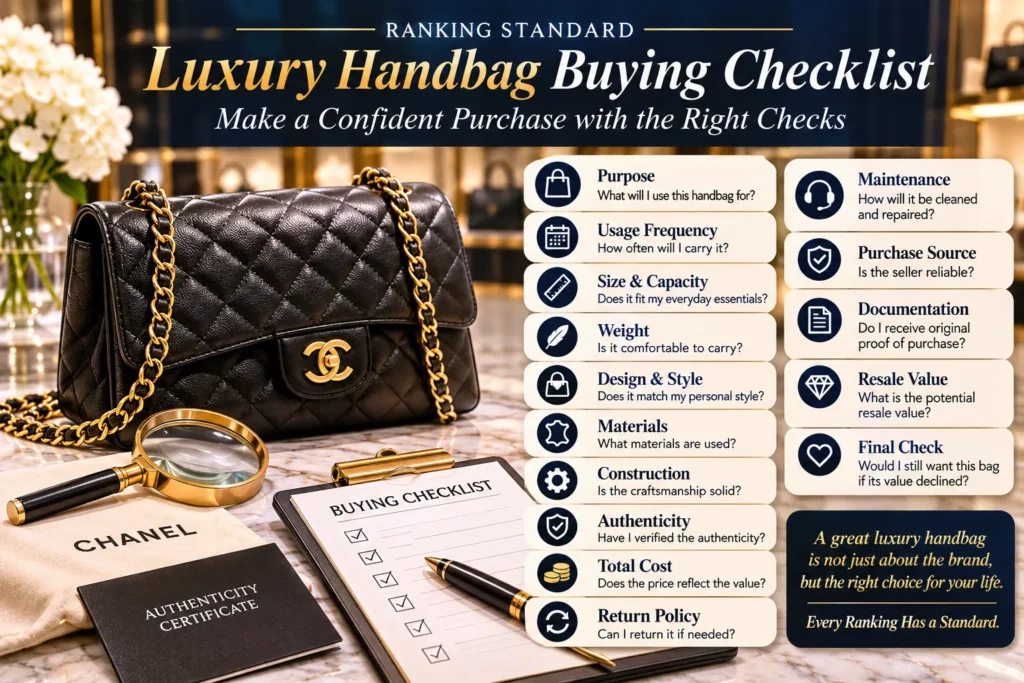
The Final Luxury Handbag Buying Checklist
Before purchasing, answer the following questions:
- What will I use this handbag for?
- How often will I carry it?
- Does it fit my everyday essentials?
- Is the weight comfortable?
- Are the handles and straps practical?
- What materials are used?
- How is the bag constructed?
- Are the closures secure?
- Does the interior provide sufficient organization?
- How much maintenance will it require?
- Is repair service available?
- What is the total purchase cost?
- What are the return conditions?
- If pre-owned, how will authenticity be assessed?
- Would I still want this handbag if its resale value declined?
The final question is especially important.
A luxury handbag should provide personal satisfaction and practical value independent of speculative resale expectations.
Frequently Asked Questions
What Is the Best Luxury Handbag Brand?
There is no universal winner.
Hermès, Chanel, Louis Vuitton, Dior, Gucci, Prada, Saint Laurent, Bottega Veneta, Celine, and Loewe offer different strengths.
The best choice depends on the specific handbag and the buyer’s priorities.
Is Hermès Better Than Chanel?
Neither brand is universally superior.
Hermès and Chanel offer different design traditions, materials, construction approaches, and purchasing experiences.
Buyers should compare individual products rather than relying solely on brand prestige.
Is Louis Vuitton Worth Buying?
Louis Vuitton offers a broad range of recognizable handbags.
Its products use different materials and constructions.
Value depends on the specific model, functionality, and price.
Which Luxury Handbag Is Best for Everyday Use?
A practical everyday bag should offer suitable capacity, comfortable carrying, manageable maintenance, and secure storage.
Selected tote, shoulder, and crossbody designs may meet these requirements.
Which Designer Bag Holds Its Value Best?
Resale performance varies by model, condition, market, and time period.
No handbag offers guaranteed value retention.
Buyers should rely on completed transaction data rather than advertised asking prices.
Are Luxury Handbags Good Investments?
They are generally better understood as consumer goods than guaranteed financial investments.
Some models may appreciate, but fees, maintenance, and market changes can reduce or eliminate profits.
Is Full-Grain Leather Always Better?
No.
Leather quality depends on tanning, finishing, construction, and intended use.
Other leather types may be more suitable for particular handbags.
Is Coated Canvas Considered Luxury?
Yes, a luxury handbag may use coated canvas.
However, buyers should understand the material composition and evaluate the product accordingly.
Are Pre-Owned Luxury Handbags Safe to Buy?
They can be purchased with appropriate precautions.
Seller reliability, authentication, condition, secure payment, and return protection are important.
Can a Fake Handbag Have a Real-Looking Serial Number?
Yes.
Identification details can be copied or misrepresented.
A serial number alone does not prove authenticity.
Should I Buy a Mini Designer Bag?
A mini bag may be appropriate for occasional use or fashion-focused styling.
However, buyers should verify that it fits the items they need to carry.
How Should I Store a Luxury Handbag?
Follow the manufacturer’s guidance.
Appropriate storage generally involves avoiding excessive heat, sunlight, moisture, and pressure on the bag’s structure.
Can Luxury Handbags Be Repaired?
Some damage can be repaired, depending on the material, construction, and available services.
Buyers should check manufacturer repair policies before using third-party services.
Should I Buy a Classic or Trendy Handbag?
Classic designs may offer long-term styling versatility.
Trend-focused designs may provide greater personal excitement.
The right choice depends on the buyer’s preferences and intended use.
Final Thoughts
Choosing a luxury handbag requires more than comparing prestigious names.
The most important decisions involve materials, construction, size, comfort, functionality, maintenance, and purchasing value.
Hermès and Chanel may appeal to buyers seeking iconic luxury designs.
Louis Vuitton offers a broad selection of recognizable handbag formats.
Dior and Gucci emphasize distinctive fashion identities.
Prada, Saint Laurent, Bottega Veneta, Celine, and Loewe provide different approaches to materials, silhouettes, and design.
However, no brand is universally superior for every buyer.
A practical coated-canvas tote may be more useful than an expensive structured leather handbag.
A compact crossbody may be better suited to travel than a large designer tote.
And a handbag with limited resale demand may still provide excellent personal value.
The strongest purchase is the one that matches the buyer’s actual priorities.
Buy the handbag you want to own and use—not simply the logo you want to display or the resale price you hope to achieve.
Editor’s Note
At Ranking Standard, we believe luxury purchases deserve the same careful evaluation as any other major buying decision.
Luxury handbags are often presented through beautiful imagery, brand heritage, and exclusivity.
Those qualities can be meaningful.
However, they should not obscure practical questions.
Is the handbag comfortable to carry?
Does it hold the items you need?
Are the materials appropriate for your lifestyle?
Can it be maintained or repaired?
And does the price make sense for the value you expect to receive?
These are the questions that should guide a luxury handbag purchase.
This guide is based on general product characteristics, publicly available brand information, and editorial analysis.
Ranking Standard has not independently tested every handbag or conducted standardized durability comparisons across the brands discussed.
We therefore avoid presenting subjective preferences as scientifically established quality rankings.
For readers interested in the broader luxury industry, our Luxury Fashion Houses Ranked (2026) article explores the positioning and influence of major fashion houses.
This guide addresses a more specific question: how should buyers evaluate a luxury handbag before spending their money?
Together, these resources support Ranking Standard’s central mission.
Understand the materials. Compare the brands. Evaluate the products. Buy with confidence.
Because a ranking should do more than declare a winner.
Every Ranking Has a Standard.