
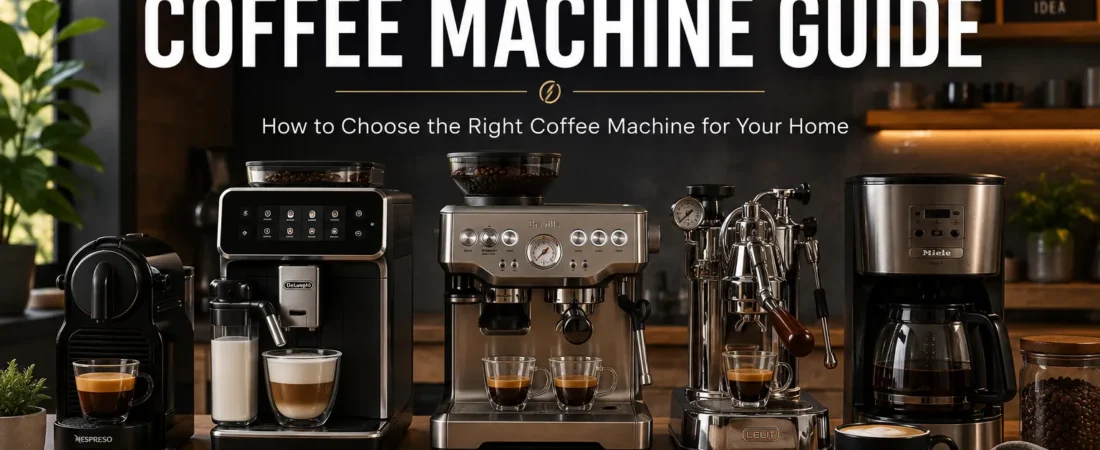
“The best coffee machine isn’t the most expensive one. It’s the one that fits the way you drink coffee every day.”
Buying a coffee machine should be simple.
Yet for many people, it quickly becomes overwhelming.
Should you buy a fully automatic machine?
Is a manual espresso machine worth learning?
Do capsule machines really save time?
Why do some machines cost a few hundred dollars while others cost several thousand?
The truth is that today’s coffee machine market is more diverse than ever.
Manufacturers now build machines for completely different lifestyles—from busy professionals who want coffee in under a minute to passionate home baristas who enjoy dialing in every shot.
That’s why there is no single “best” coffee machine.
The right choice depends on how you drink coffee, how much time you want to spend making it, your available space, your budget, and even how many people use the machine each day.
This guide is designed to answer those questions before you spend your money.
Rather than recommending one winner, we’ll help you understand the entire market so you can confidently choose the machine that fits your own lifestyle.
Why Buying the Right Coffee Machine Matters
For many people, coffee is part of their daily routine.
Whether it’s a quick cup before work or a carefully prepared espresso on a quiet weekend morning, the machine you use affects that experience every single day.
Unlike smartphones or televisions that are replaced every few years, many coffee machines remain in kitchens for five to ten years—or even longer.
That makes them one of the most frequently used appliances in the home.
Choosing the wrong machine can lead to daily frustration.
Common complaints include:
- Cleaning takes too long.
- The coffee isn’t hot enough.
- The grinder is too noisy.
- Milk frothing is difficult.
- Capsules become expensive over time.
- Maintenance is more complicated than expected.
These issues rarely appear in advertisements, yet they have the biggest impact on long-term ownership.
That’s why evaluating a coffee machine means looking beyond the first cup of coffee.
Coffee Machines Have Changed Dramatically
A decade ago, most buyers had only a few basic choices.
Today, modern coffee machines offer features that were once available only in commercial cafés.
Many premium machines now include:
- Automatic grinders
- One-touch milk systems
- Smart connectivity
- Personalized user profiles
- Adjustable brewing pressure
- Automatic cleaning programs
- Bean recognition technology
- Cold coffee functions
Some machines focus on convenience.
Others prioritize espresso quality.
Some are designed for entertaining guests, while others are perfect for a single person living in a small apartment.
The market has evolved from making coffee to creating personalized coffee experiences.
The Biggest Mistake Buyers Make
One of the most common questions people ask is:
“What’s the best coffee machine?”
Just like running shoes, the answer is surprisingly simple.
There isn’t one.
A machine that produces exceptional espresso may be frustrating for someone who simply wants a quick morning coffee.
Likewise, a capsule machine may be perfect for convenience but disappointing for someone who enjoys experimenting with different coffee beans.
Instead of asking,
“Which machine is the best?”
Ask yourself:
- What coffee do I drink most often?
- How much time do I want to spend making it?
- How much maintenance am I willing to do?
- How many cups do I make every day?
- Am I buying for myself or for my family?
These questions matter far more than choosing the most expensive machine on the shelf.
The Ranking Standard Philosophy
At Ranking Standard, we believe every buying decision should begin with purpose.
We don’t rank products simply by price, popularity, or marketing claims.
Instead, we ask a more useful question:
Who is this machine actually built for?
A compact capsule machine may be the perfect choice for a busy professional.
A fully automatic bean-to-cup machine may be ideal for a family.
A manual espresso machine may be exactly what a coffee enthusiast is looking for.
None of these choices are universally “better.”
They’re simply better for different people.
That’s why every recommendation throughout this guide will be based on real-world use cases, not hype.
What You’ll Learn in This Guide
By the end of this guide, you’ll understand:
- The different types of coffee machines
- Which machine fits your lifestyle
- The strengths and weaknesses of each category
- Which features actually matter
- Common buying mistakes to avoid
- How Ranking Standard evaluates coffee machines objectively
Most importantly, you’ll learn how to make a confident buying decision without being overwhelmed by marketing or technical jargon.
Understanding the Coffee Machine Market
Walk into an electronics store or browse an online retailer, and you’ll quickly notice that “coffee machine” is a broad term.
Some machines make espresso.
Others brew drip coffee.
Some grind fresh beans automatically.
Others require capsules or pods.
Many buyers assume these machines all do the same job.
They don’t.
Each category is designed for a different type of coffee drinker, and understanding those differences is far more important than comparing brand names.
Before looking at individual models, it’s essential to understand how today’s coffee machine market is organized.
The Five Main Types of Coffee Machines
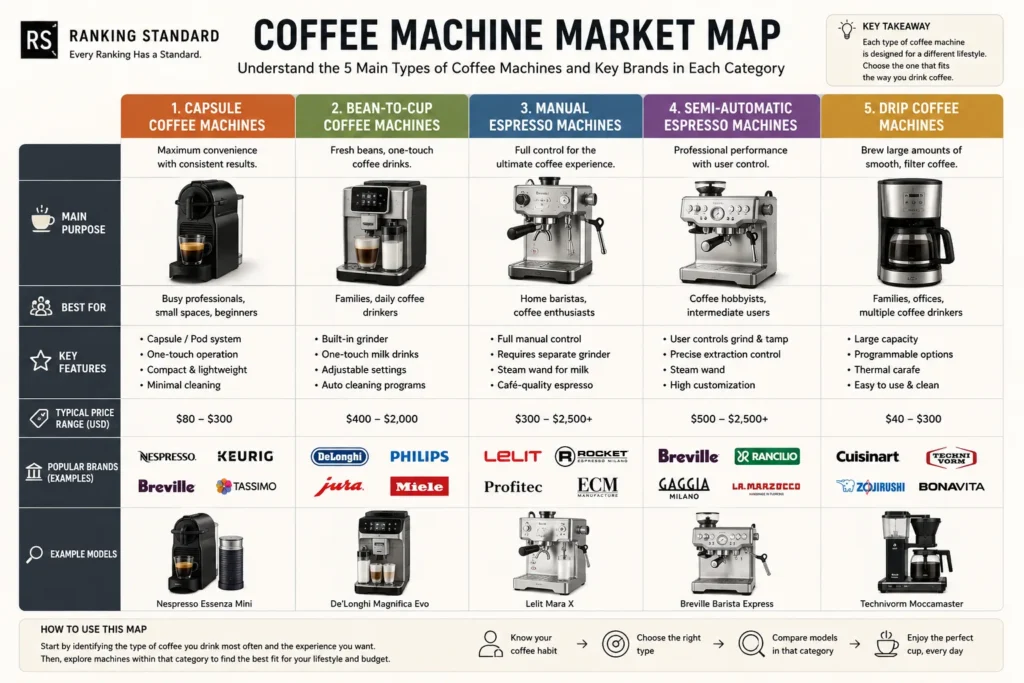
Instead of comparing hundreds of individual products, start by understanding the five major categories that dominate the market.
Once you know which category fits your lifestyle, choosing a specific model becomes much easier.
1. Capsule Coffee Machines
Capsule machines are built around one idea:
Maximum convenience.
Insert a capsule, press a button, and your coffee is ready in less than a minute.
Advantages include:
- Extremely easy to use
- Consistent coffee quality
- Minimal cleaning
- Compact size
However, convenience comes with trade-offs.
Coffee capsules are more expensive than whole beans over time, and users are limited to compatible capsule systems.
Best for:
- Busy professionals
- Small apartments
- Casual coffee drinkers
2. Bean-to-Cup Coffee Machines
Bean-to-cup machines automatically grind fresh coffee beans before every cup.
They’re often considered the best balance between convenience and coffee quality.
Most machines can prepare:
- Espresso
- Americano
- Cappuccino
- Latte
- Flat White
with the touch of a button.
Although they’re more expensive than capsule machines, they usually become more economical over the long term because whole beans cost significantly less than capsules.
Best for:
- Families
- Daily coffee drinkers
- Convenience without sacrificing quality
3. Manual Espresso Machines
Manual espresso machines offer the highest level of control.
Unlike automatic machines, they require the user to:
- Grind coffee
- Measure the dose
- Tamp the grounds
- Control extraction
- Steam milk manually
The learning curve is steeper, but many coffee enthusiasts believe they produce the most rewarding coffee experience.
Best for:
- Home baristas
- Espresso enthusiasts
- People who enjoy learning coffee skills
4. Semi-Automatic Espresso Machines
Semi-automatic machines combine professional-level brewing with easier operation.
The machine controls pressure and temperature, while the user controls grinding, dosing, and extraction time.
This category is extremely popular among experienced home coffee lovers because it offers flexibility without requiring commercial equipment.
Best for:
- Coffee hobbyists
- Intermediate users
- Espresso-focused households
5. Drip Coffee Machines
Drip coffee makers remain one of the world’s most popular brewing methods.
Rather than producing espresso, they brew larger quantities of filtered coffee.
They’re ideal for:
- Large families
- Offices
- People who drink multiple cups throughout the day
Modern drip machines now include programmable timers, thermal carafes, and precise brewing controls that significantly improve coffee quality.
Why Comparing Different Categories Doesn’t Work
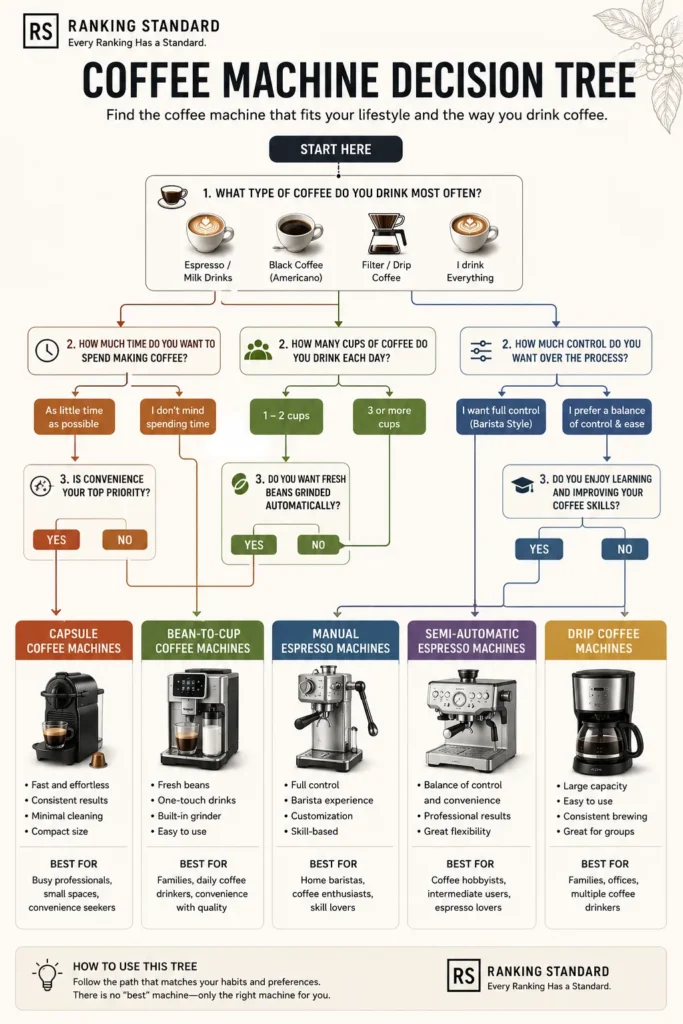
One of the biggest mistakes buyers make is comparing machines that were never designed to compete with each other.
For example:
Should you compare a capsule machine with a professional espresso machine?
Not really.
One prioritizes convenience.
The other prioritizes craftsmanship.
Likewise, comparing a bean-to-cup machine with a simple drip coffee maker ignores the fact that they’re designed for completely different lifestyles.
At Ranking Standard, we believe products should only compete with others designed for the same purpose.
That creates fairer comparisons—and ultimately better buying decisions.
Coffee Machine Market Map
Instead of organizing machines by price or popularity, Ranking Standard groups them by how people actually use them.
A simplified market map looks like this:
| Category | Primary Purpose | Typical User |
|---|---|---|
| Capsule | Maximum Convenience | Busy professionals |
| Bean-to-Cup | Everyday Premium Coffee | Families & daily drinkers |
| Manual Espresso | Full Control | Home baristas |
| Semi-Automatic | Performance & Flexibility | Coffee enthusiasts |
| Drip Coffee | Large Volume Brewing | Families & offices |
Notice something important.
No category is universally better than another.
Each solves a different problem.
That’s why the first question shouldn’t be:
“Which coffee machine is the best?”
Instead, ask:
“Which type of coffee machine fits the way I actually drink coffee?”
Once that answer is clear, choosing the right brand and model becomes much easier.
How Ranking Standard Evaluates Coffee Machines
By now, you’ve probably realized something important.
Buying a coffee machine isn’t about finding the most expensive model.
Nor is it about buying the machine with the longest feature list.
It’s about finding the machine that fits the way you actually drink coffee.
That’s why Ranking Standard doesn’t begin with brands.
We begin with people.
There Is No Universal Winner
Many review websites publish lists such as:
“The 10 Best Coffee Machines.”
While those lists can be useful, they often compare products designed for completely different users.
Imagine comparing:
- A compact city car
- A luxury SUV
- A pickup truck
- A sports car
and asking which one is “best.”
The answer depends entirely on who is buying it.
Coffee machines are no different.
A busy office worker may value speed above everything else.
A home barista may happily spend twenty minutes preparing a single espresso.
Both can make the right decision—even if they buy completely different machines.
The Coffee Machine Positioning Map
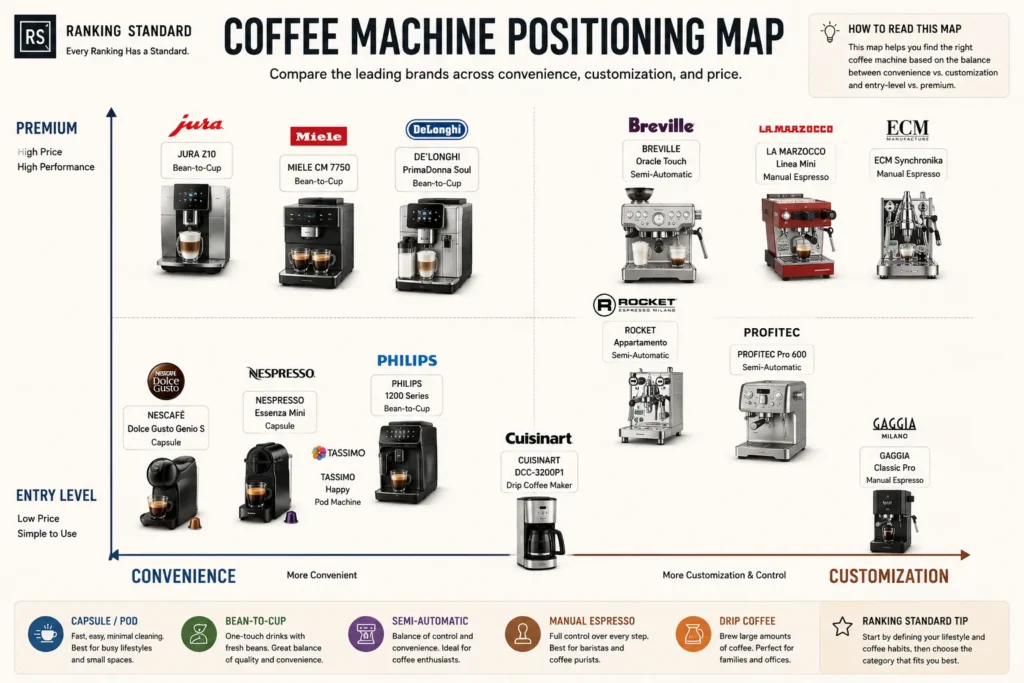
Rather than ranking products from first to last, Ranking Standard first places every coffee machine into its proper position within the market.
A simplified version looks like this.
| Coffee Style | Best Machine Type | Typical User |
|---|---|---|
| Quick Morning Coffee | Capsule | Busy professionals |
| Daily Home Coffee | Bean-to-Cup | Families |
| Espresso Hobby | Semi-Automatic | Coffee enthusiasts |
| Professional-Level Espresso | Manual Espresso | Home baristas |
| Large Volume Brewing | Drip Coffee | Families & Offices |
This is the first decision every buyer should make.
Not:
“Which brand should I buy?”
But:
“Which style of coffee drinker am I?”
Why Brand Reputation Isn’t Enough
It’s easy to assume that buying a premium brand automatically guarantees the best experience.
In reality, that’s not always true.
A high-end espresso machine may produce exceptional coffee, but it also requires more cleaning, maintenance, and skill.
Meanwhile, a simpler bean-to-cup machine may deliver exactly what another household needs every single morning.
That’s why Ranking Standard never ranks brands based on prestige alone.
Instead, we evaluate products according to how well they achieve the purpose they were designed for.
The Ranking Standard Score
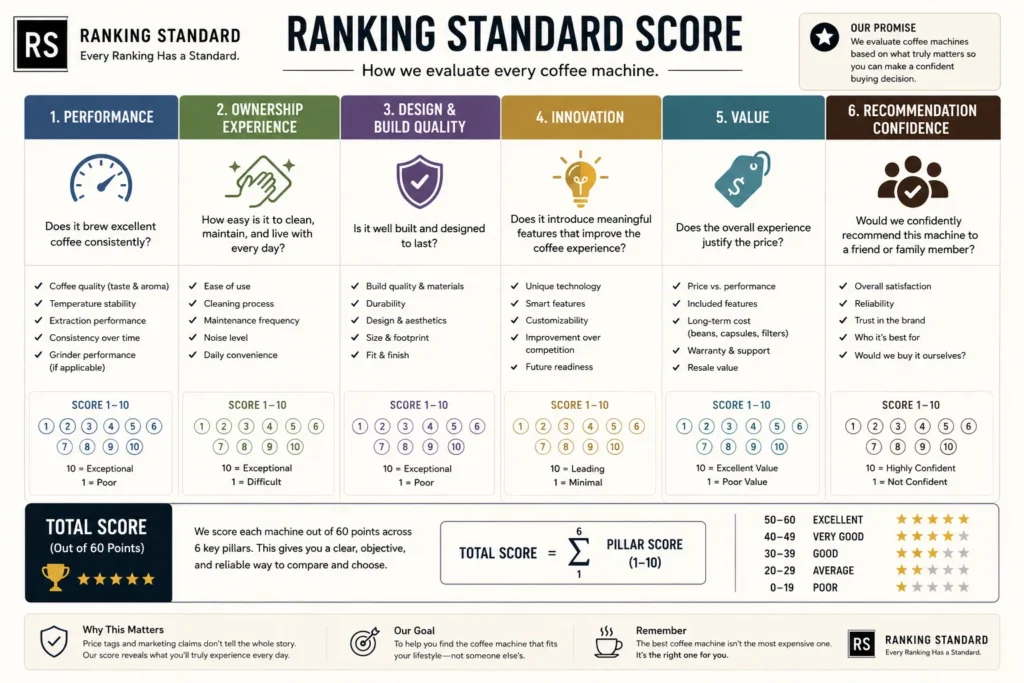
Every coffee machine is evaluated using the same six core principles.
Performance
Does it consistently brew excellent coffee?
Ownership Experience
How easy is it to clean, maintain, and live with every day?
Design & Build Quality
Is it well built?
Will it last for years?
Does it fit naturally into a modern kitchen?
Innovation
Does it introduce meaningful improvements that genuinely benefit users?
Value
Does the overall experience justify the price?
Not simply the cheapest option—but the best value over time.
Recommendation Confidence
The final question we always ask is simple:
If we were spending our own money today, would we confidently recommend this machine to a friend or family member?
That answer becomes one of the most important parts of our evaluation.
Our Philosophy Is Different
Many websites ask:
“Which machine is the most powerful?”
We ask:
“Which machine would we actually enjoy owning for the next five years?”
That difference changes everything.
Owning a coffee machine isn’t a one-time event.
It’s part of your morning routine.
Your weekends.
Your family gatherings.
Your daily life.
That’s why ownership experience matters just as much as brewing performance.
Looking Ahead
Now that you understand how Ranking Standard evaluates coffee machines, you’re ready to explore individual products.
In the following guides, we’ll compare:
- Bean-to-cup coffee machines
- Capsule coffee machines
- Manual espresso machines
- Semi-automatic espresso machines
- Drip coffee makers
using the same objective framework.
Instead of simply asking,
“Which machine is No.1?”
We’ll answer a far more useful question:
“Which coffee machine is the right one for you?”
Because great buying decisions begin with understanding your own needs—not someone else’s preferences.