

“The best golf clubs aren’t the ones played by the world’s best golfers. They’re the ones that make your own game easier.”
Buying golf clubs can be surprisingly intimidating.
Choosing the right golf clubs starts with understanding your game. This Golf Club Guide explains the different types of clubs, how they perform, and how to build a golf bag that matches your skill level, swing characteristics, and playing style.
Driver loft.
Shaft flex.
Forgiveness.
Launch angle.
Cavity backs.
Blades.
Hybrids.
Wedges with different lofts and bounce angles.
And then there is fitting.
For someone buying their first serious set of clubs, the terminology alone can make golf equipment feel unnecessarily complicated.
Even experienced golfers can struggle with the same problem.
Should you replace a long iron with a hybrid?
Do you really need fourteen clubs?
Are expensive forged irons actually better?
Should a beginner buy the same driver used by a tour professional?
And perhaps the biggest question of all:
How much difference can the right golf clubs actually make?
The answer depends far more on the golfer than the logo printed on the clubhead.
That’s exactly why this guide exists.
Rather than immediately ranking individual models, we’re going to explain how the golf club market works—and how different clubs are designed for different swings, skill levels, and situations on the course.
A Golf Bag Is a System
Golf equipment is unusual because you’re rarely buying one product.
You’re building a system.
A typical golf bag can contain several completely different types of clubs, each designed to solve a specific problem.
The driver is designed primarily for distance from the tee.
Fairway woods combine distance with greater versatility.
Hybrids help bridge the gap between woods and irons.
Irons provide progressively greater control as you approach the green.
Wedges specialize in shorter shots and scoring situations.
And the putter performs an entirely different job once you reach the green.
That’s why asking:
“What’s the best golf club?”
doesn’t really make sense.
The better question is:
“What combination of clubs makes the most sense for my game?”
That distinction will guide everything we do in this series.
Golf Clubs Have Become More Specialized
Modern golf equipment is dramatically different from what golfers used several decades ago.
Manufacturers now use:
- Multi-material clubheads
- Adjustable weighting
- Carbon composites
- High-strength face materials
- Sophisticated cavity designs
- Different center-of-gravity positions
- Interchangeable shafts and hosels
- Computer-assisted clubhead engineering
But technological sophistication doesn’t automatically make a club better for every golfer.
A highly workable iron designed for an elite player may actually make golf harder for a beginner.
Likewise, a maximum-forgiveness club may help one golfer enormously while giving another player less control than they want.
The important question isn’t how advanced the technology is.
It’s who the technology was designed to help.
The Biggest Mistake Golfers Make
One mistake appears repeatedly in golf equipment buying.
Players choose clubs based on what better golfers use.
A professional golfer carries a certain iron.
A low-handicap friend recommends a particular driver.
A famous player wins a tournament with a specific putter.
Suddenly that club looks like the obvious choice.
But professional golfers typically have swing speeds, ball-striking consistency, launch conditions, and equipment requirements that are completely different from those of recreational golfers.
A club designed to give an elite player greater control may provide less forgiveness to everyone else.
In golf, more advanced does not necessarily mean more suitable.
The Ranking Standard Philosophy
At Ranking Standard, we begin golf equipment evaluation with one question:
Who was this club designed to help?
A beginner may benefit from:
- Higher launch
- Greater forgiveness
- Larger sweet spots
- Easier distance
An improving golfer may want a balance between forgiveness and feedback.
A low-handicap player may prioritize:
- Shot shaping
- Precise distance control
- Compact clubheads
- Greater feedback
None of these golfers is choosing incorrectly.
They’re simply solving different problems.
That’s why we won’t rank a forgiving game-improvement iron against a demanding player’s blade as though they’re designed to do the same job.
Category first. Golfer second. Model third.
That’s the Ranking Standard approach.
Price Doesn’t Tell You Who a Club Is For
Golf equipment also creates an interesting pricing problem.
A more expensive club isn’t necessarily easier to play.
In some cases, the opposite is true.
Premium materials, forged construction, advanced manufacturing, or professional-level design can increase price while producing a club aimed at highly skilled golfers.
Meanwhile, a less expensive game-improvement club may dramatically improve the experience of an average player.
That’s why value in golf cannot simply mean:
performance ÷ price.
It must also include fit for the intended golfer.
A $1,500 iron set that perfectly matches someone’s swing can represent excellent value.
The same set sitting in the wrong golfer’s bag can be an expensive mistake.
What You’ll Learn in This Guide
By the end of this guide, you’ll understand:
- The major types of golf clubs
- What each club is actually designed to do
- How skill level changes equipment needs
- Why forgiveness matters
- When hybrids make sense
- How golf club fitting changes the buying decision
- Which specifications genuinely matter
- How Ranking Standard evaluates golf equipment
Most importantly, you’ll understand why building the right golf bag isn’t about collecting the most expensive clubs.
It’s about creating a set in which every club has a purpose.
Understanding the Golf Club Market
A golf bag can contain up to 14 clubs under the standard Rules of Golf.
But that doesn’t mean every golfer needs the same 14 clubs.
In fact, one of the biggest changes in modern golf equipment has been the realization that traditional club setups don’t work equally well for everyone.
A golfer who struggles with long irons may benefit from carrying multiple hybrids.
A strong ball striker may prefer traditional long irons.
Someone playing a short course may need a completely different setup from a golfer regularly playing long championship layouts.
Before choosing brands or models, you need to understand the six major club categories—and the specific job each one performs.
The Six Main Types of Golf Clubs
Unlike many product categories, golf clubs aren’t substitutes for one another.
They’re specialists.
Each club is designed to solve a different problem somewhere between the tee box and the hole.
1. Drivers
The driver is usually the longest club in the bag and typically has the lowest loft among a golfer’s full-swing clubs.
Its primary job is simple:
Maximum distance from the tee.
Modern drivers use large clubheads and sophisticated weighting systems designed to combine ball speed with forgiveness.
But choosing a driver based only on distance is a mistake.
Important factors include:
- Loft
- Shaft flex
- Shaft length and weight
- Launch
- Spin
- Forgiveness
- Adjustability
A golfer with moderate swing speed may benefit from a completely different driver setup than a powerful player generating significantly higher clubhead speed.
Best for:
Long tee shots on par 4s and par 5s.
2. Fairway Woods
Fairway woods sit between the driver and the longer irons.
Common examples include:
- 3-wood
- 5-wood
- 7-wood
They can be used from the tee, fairway, and—in the right situation—even the rough.
Traditionally, golfers carried a 3-wood primarily for distance.
But higher-lofted fairway woods have become increasingly popular because they can be easier to launch while still producing substantial distance.
For some golfers, a 5-wood or 7-wood may actually be more useful than a traditional long iron.
Best for:
Long approach shots, controlled tee shots, and golfers who want easier launch from longer distances.
3. Hybrids
Hybrids were created to combine characteristics of woods and irons.
They typically have:
- Larger heads than irons
- Lower centers of gravity
- Wider soles
- More forgiving designs
Their greatest advantage is simple.
They make difficult long shots easier for many golfers.
That’s why hybrids frequently replace traditional 3-, 4-, and sometimes even 5-irons.
This is also where ego can interfere with equipment decisions.
Some golfers insist on carrying long irons because that’s what skilled players traditionally used.
But if a hybrid consistently produces better results, the scorecard doesn’t care what type of club created the shot.
Best for:
Golfers who struggle to launch long irons consistently.
4. Irons
Irons form the core of most golf bags.
A modern set might run from:
5-iron through pitching wedge
although configurations vary considerably.
And this is where golf equipment becomes particularly interesting.
Not all irons are designed for the same golfer.
The market can broadly be divided into categories such as:
Game-Improvement Irons
Designed for forgiveness, easier launch, and distance.
Best suited to many beginners and higher-handicap golfers.
Players-Distance Irons
Combine relatively compact looks with technologies designed to preserve speed and forgiveness.
Often attractive to improving and mid-handicap golfers.
Players Irons
Designed around precision, feedback, and control.
Typically aimed at skilled ball strikers.
Blades / Muscle Backs
Compact, demanding designs that prioritize feedback and shot control over forgiveness.
They’re beautiful.
They’re traditional.
And for most recreational golfers, they’re probably unnecessary.
That’s an important Ranking Standard principle:
The more difficult club isn’t automatically the more advanced purchase.
Sometimes the smarter golfer chooses more forgiveness.
Best for:
Approach shots and controlled distance throughout the middle and shorter parts of the game.
5. Wedges
As golfers get closer to the green, raw distance becomes less important.
Control becomes everything.
That’s where wedges take over.
Common wedge categories include:
- Pitching Wedge
- Gap Wedge
- Sand Wedge
- Lob Wedge
But loft alone doesn’t tell the whole story.
Wedges also vary by:
- Bounce
- Sole grind
- Head shape
- Groove design
Those differences affect how the club interacts with turf, sand, and different playing conditions.
A golfer playing on soft courses may benefit from a different wedge setup than someone regularly playing firm, tight turf.
This is why simply copying a professional golfer’s wedge configuration rarely makes sense.
Best for:
Short approaches, pitching, bunker shots, chips, and scoring around the green.
6. Putters
The putter is completely different from every other club in the bag.
It isn’t designed for distance.
It’s designed for precision.
Yet the putter market is enormous.
Common designs include:
Blade Putters
Traditional, compact designs often preferred by golfers who like greater feedback.
Mallet Putters
Larger heads designed to improve stability and alignment.
High-MOI Putters
Designed to reduce twisting when contact occurs away from the center of the face.
Choosing a putter is highly personal.
Stroke shape, alignment tendencies, feel, head design, and even visual confidence can all influence performance.
That’s why the most expensive putter isn’t necessarily the one that will help you hole more putts.
Best for:
Everything on the green—and occasionally from just off it.
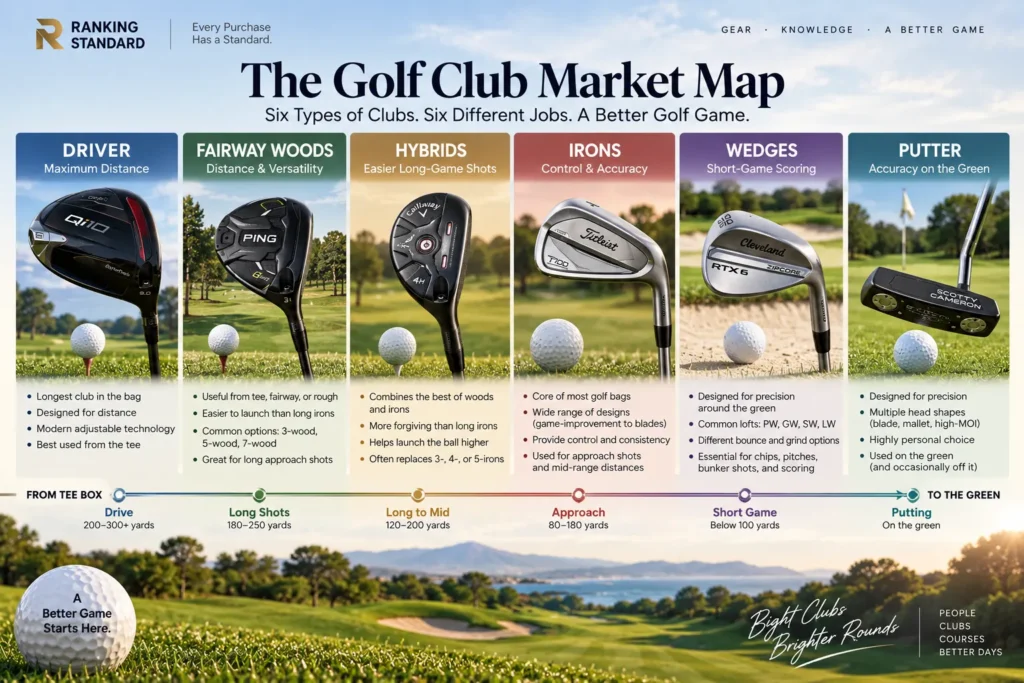
The Golf Club Market Map
Once the categories are separated, the golf equipment market becomes much easier to understand.
| Club Category | Primary Job | Typical Priority |
|---|---|---|
| Driver | Maximum tee distance | Distance + forgiveness |
| Fairway Wood | Long-distance versatility | Launch + distance |
| Hybrid | Easier long-game shots | Forgiveness + launch |
| Irons | Approach control | Distance + accuracy |
| Wedges | Short-game scoring | Control + versatility |
| Putter | Putting | Accuracy + consistency |
This simple map reveals something important.
There is no reason to rank a driver against a wedge.
They’re not competitors.
The meaningful comparisons happen inside each category.
Driver vs driver.
Iron vs iron.
Putter vs putter.
And even then, the intended golfer matters.
The Most Important Golf Club Category Is Not a Club
There is another category that deserves to sit above everything we’ve just discussed:
The Golfer
This is where many equipment rankings fail.
Imagine two golfers.
Golfer A
- Beginner
- Moderate swing speed
- Inconsistent ball striking
- Struggles getting long irons airborne
Golfer B
- Low handicap
- High swing speed
- Consistent center contact
- Prioritizes trajectory and shot shaping
Giving these golfers the same equipment recommendation would make little sense.
Golfer A may benefit from:
- Forgiving driver
- Higher-lofted fairway wood
- Hybrids
- Game-improvement irons
- Forgiving wedges
- High-MOI putter
Golfer B may prefer:
- Lower-spin driver
- Traditional fairway setup
- Long irons
- Players irons
- Specialized wedge grinds
- Putter selected around stroke characteristics
Neither bag is superior.
They’re optimized for different players.
Forgiveness vs Control
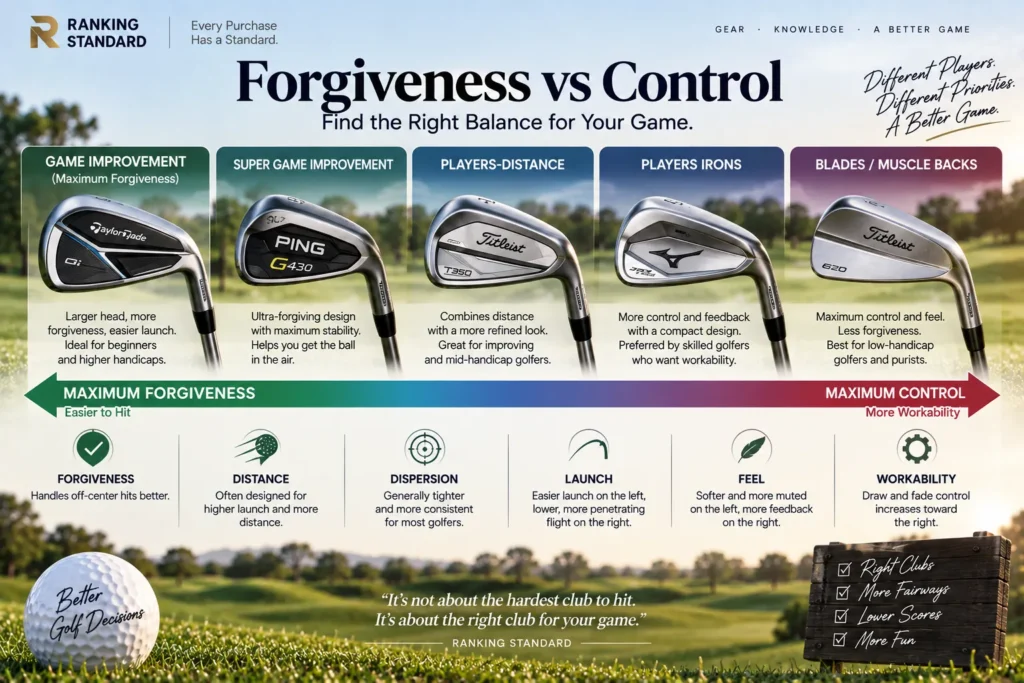
This is one of the most important trade-offs in golf equipment.
As clubs become more forgiving, they generally attempt to reduce the penalty from imperfect contact.
As clubs become more specialized toward skilled players, manufacturers may prioritize feedback, trajectory control, compact shaping, and workability.
That creates a spectrum.
Maximum Forgiveness
→ Beginner / Higher Handicap
→ Improving Golfer
→ Mid Handicap
→ Skilled Ball Striker
→ Low Handicap / Competitive
Maximum Control
The mistake is assuming golfers should always move toward the right side as they improve.
They don’t have to.
Plenty of skilled golfers deliberately choose forgiving equipment.
Why?
Because golf is difficult enough already.
Do You Really Need 14 Clubs?
No.
Fourteen is a maximum, not a shopping list.
Many recreational golfers can play excellent golf with fewer clubs.
A simplified setup might include:
- Driver
- Fairway wood
- Hybrid
- Several irons
- Two or three wedges
- Putter
What matters is distance coverage.
If two clubs consistently travel almost the same distance, carrying both may provide little benefit.
Likewise, if there’s a huge distance gap between two clubs, the bag may need adjustment.
The goal isn’t filling every available slot.
It’s creating a predictable progression of useful distances.
Why Club Fitting Changes Everything
Golf is one category where specifications alone aren’t enough.
Two golfers can swing the same club and produce completely different results.
That’s why fitting matters.
A proper fitting may consider:
- Clubhead speed
- Ball speed
- Launch angle
- Spin rate
- Carry distance
- Dispersion
- Shaft characteristics
- Club length
- Lie angle
This doesn’t mean every beginner needs an expensive professional fitting before buying their first set.
But as equipment becomes more expensive—and the golfer becomes more serious—the value of fitting increases dramatically.
At Ranking Standard, this creates an important rule:
A highly rated club with the wrong specification can be a worse purchase than a lower-ranked club properly fitted to the golfer.
That’s something a simple Top 10 list can never fully explain.
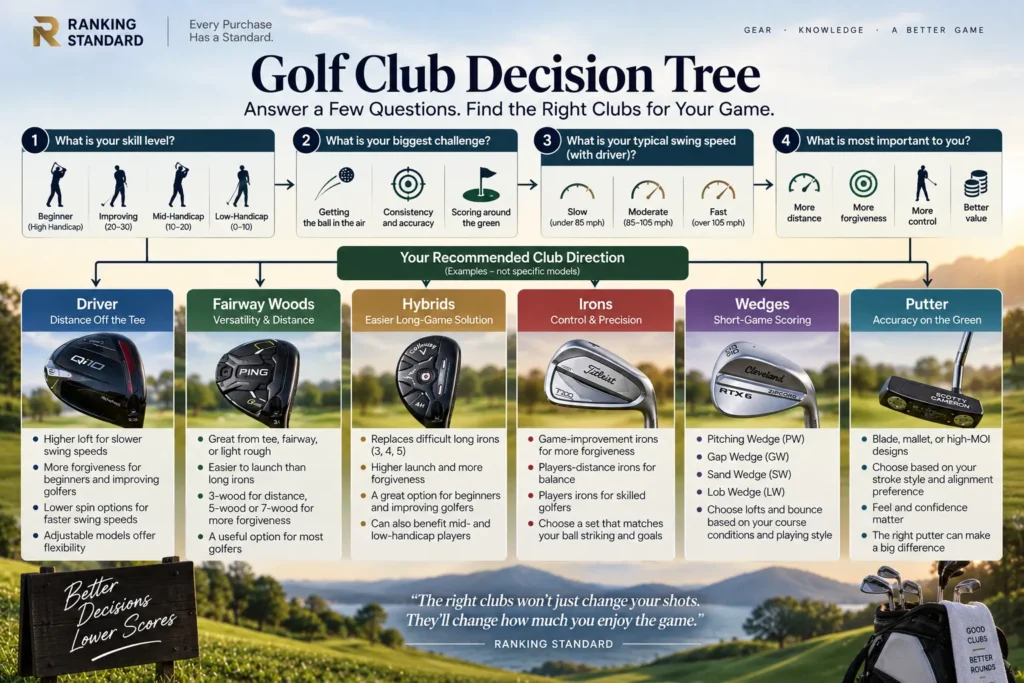
Building a Golf Bag Should Start With Gaps, Not Brands
Many golfers build their bags backward.
They start with brands.
TaylorMade driver.
Callaway woods.
Titleist wedges.
Scotty Cameron putter.
There’s nothing inherently wrong with that.
But the better starting point is:
What shots does my bag need to cover?
Then determine:
- What club performs each job?
- What distances need covering?
- Where do I need more forgiveness?
- Where do I want more control?
- Which clubs do I actually feel confident hitting?
Only after answering those questions should individual brands and models enter the conversation.
That’s how a collection of golf clubs becomes a golf bag designed around the golfer.
The Golf Bag Matrix
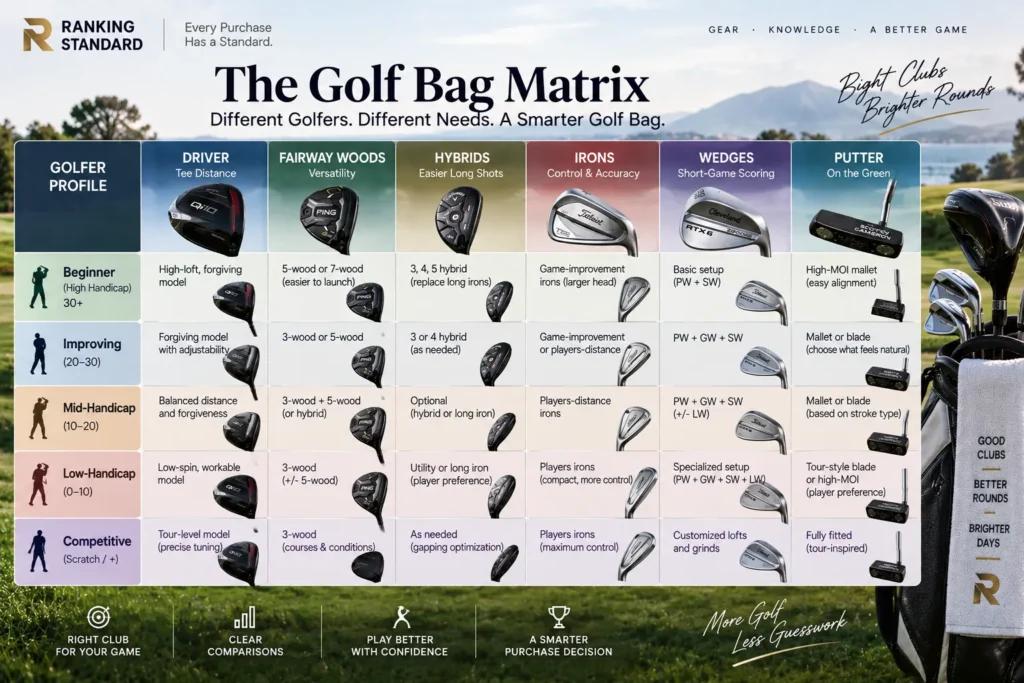
Understanding individual club categories is only half the decision.
The next question is how those clubs should work together.
That’s why Ranking Standard uses the Golf Bag Matrix.
Instead of assuming every golfer should carry the traditional combination of driver, woods, irons, wedges, and putter, the matrix begins with the golfer’s ability and playing needs.
A simplified version looks like this:
| Golfer Profile | Long Game | Irons | Short Game | Main Priority |
|---|---|---|---|---|
| Beginner | Fairway woods + hybrids | Game-improvement | Simple wedge setup | Forgiveness |
| Improving | Woods + hybrids | Game-improvement / players-distance | 2–3 wedges | Consistency |
| Mid-Handicap | Customized mix | Players-distance | Specialized wedges | Balance |
| Low-Handicap | Woods / utility / long irons | Players irons | Specialized wedge setup | Control |
| Competitive | Fully fitted | Player-specific | Course-specific | Precision |
This isn’t a rigid prescription.
It’s a framework.
A skilled golfer can absolutely carry hybrids.
A beginner can prefer an iron.
The purpose of the matrix is not to tell golfers what they’re “allowed” to play.
It’s to show how equipment priorities typically change as skill, consistency, and shot requirements evolve.
Why Beginners Often Buy the Wrong Clubs
Golf has a strange relationship with aspiration.
People naturally want to own the equipment used by the players they admire.
But professional-level equipment can sometimes make an already difficult sport even harder.
A beginner usually benefits more from clubs that help with:
- Launch
- Forgiveness
- Consistent distance
- Larger effective hitting areas
- Confidence at address
That may mean replacing difficult long irons with hybrids.
It may mean choosing a larger iron head.
It may mean using a driver designed to reduce the consequences of imperfect contact rather than one optimized for extremely high swing speeds.
There’s nothing “beginner” about making equipment work in your favor.
In fact, that’s often the smarter decision.
Why Better Golfers Don’t Always Need Harder Clubs
The opposite misconception also exists.
As golfers improve, they often feel they should graduate into smaller, less forgiving clubs.
Not necessarily.
Skill creates options, not obligations.
A low-handicap golfer may prefer a compact player’s iron because it provides the feedback and trajectory control they want.
Another golfer of identical ability may choose a more forgiving players-distance iron because it produces better results across an entire round.
Ranking Standard doesn’t award extra points because a club is difficult to hit.
We reward equipment for performing its intended job exceptionally well.
What Actually Matters When Comparing Golf Clubs
Golf equipment marketing is filled with technology.
New face materials.
New weighting systems.
New carbon structures.
New aerodynamic shapes.
Some of those innovations are meaningful.
Others produce relatively small differences.
For buyers, six areas matter far more.
Forgiveness
What happens when you don’t strike the center of the face?
This matters enormously for most recreational golfers.
Distance
How effectively does the club generate useful distance?
But distance must be considered carefully.
A 7-iron that travels farther isn’t automatically better if its stronger loft simply makes it behave like another manufacturer’s 6-iron.
Useful distance matters more than the number printed on the sole.
Dispersion
How consistently do shots finish near the intended target?
This may be more valuable than maximum distance.
Ten extra yards means very little if the ball is significantly less predictable.
Launch & Trajectory
Can the golfer launch the ball at an appropriate height and produce a useful flight?
The answer depends heavily on swing characteristics.
Feel & Feedback
Some golfers want to clearly feel where contact occurred.
Others prioritize softness or stability.
Feel is subjective, but it still matters because confidence affects how people play.
Fit
Shaft, loft, lie angle, club length, head design, and other specifications can significantly affect results.
This is why golf equipment cannot be evaluated properly using the clubhead alone.
The Ranking Standard Golf Club Score
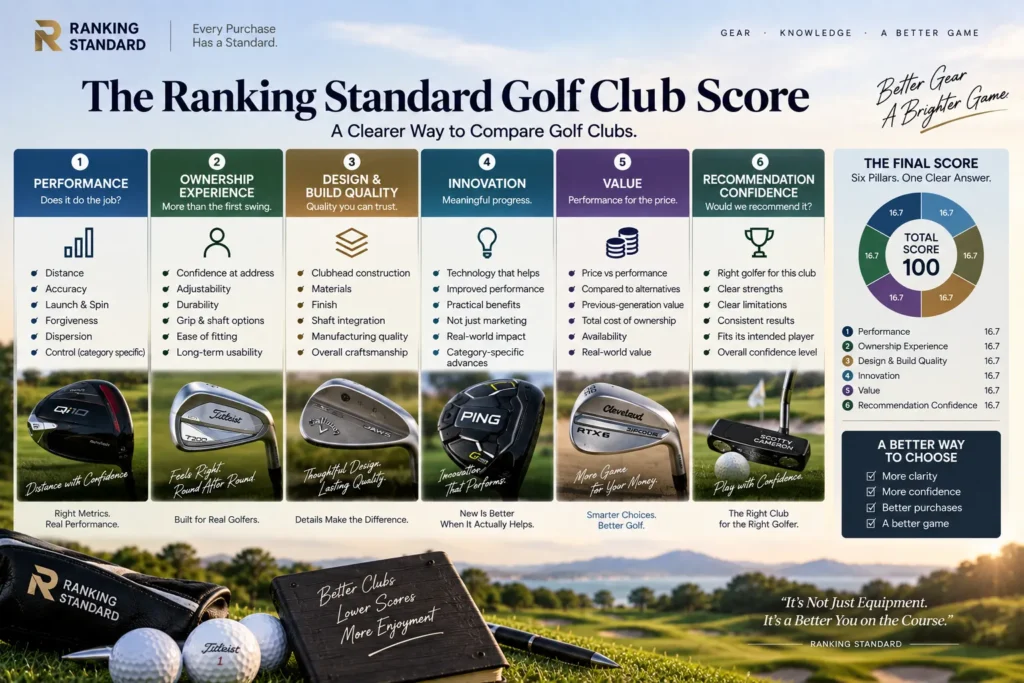
Golf requires a slight evolution of our standard scoring system.
The six core Ranking Standard pillars remain, but their interpretation changes to fit golf equipment.
Performance
Does the club accomplish its intended job?
Depending on the category, we evaluate factors such as:
- Distance
- Accuracy
- Launch
- Spin
- Dispersion
- Forgiveness
- Control
A driver and a putter will therefore be evaluated differently even though both fall under Performance.
Ownership Experience
How does the club perform beyond the first few swings?
We consider:
- Confidence at address
- Adjustability
- Durability
- Grip and shaft options
- Ease of fitting
- Long-term usability
Golf clubs can remain in a bag for years, so ownership matters.
Design & Build Quality
We evaluate:
- Clubhead construction
- Materials
- Finish
- Shaft integration
- Manufacturing quality
- Overall craftsmanship
Premium pricing should be reflected in more than cosmetic differences.
Innovation
Does new technology produce a meaningful advantage?
Adjustable weighting, improved face construction, better center-of-gravity placement, and material innovation can all matter.
But innovation receives credit only when it produces a practical benefit.
New is not automatically better.
Value
Does the performance justify the price?
This is especially important in golf.
A new driver can cost hundreds of dollars while a previous-generation model may deliver remarkably similar performance for significantly less.
Likewise, a premium putter may be beautifully manufactured without necessarily lowering a golfer’s score.
Value considers what the golfer actually receives for the money.
Recommendation Confidence
Finally, we ask:
Would we confidently recommend this club to the golfer it was designed for?
Notice the wording.
Not:
“Would we recommend this club to everyone?”
Golf equipment should never be evaluated that way.
A demanding iron can receive an exceptional score for low-handicap golfers while remaining completely inappropriate for beginners.
Context is part of the score.
Brand Rankings Need Context Too
This will become particularly important when Ranking Standard eventually publishes golf brand rankings.
It’s tempting to create a simple hierarchy:
Titleist vs TaylorMade vs Callaway vs Ping vs Cobra vs Mizuno.
But that alone isn’t enough.
One manufacturer may be particularly strong in drivers.
Another may have an exceptional reputation for irons.
Another may dominate putter conversations.
That’s why we’ll eventually rank both:
Golf Club Brands Overall
and
Brands by Category.
For example:
- Driver Brand Ranking
- Iron Brand Ranking
- Wedge Brand Ranking
- Putter Brand Ranking
This prevents a company’s reputation in one product category from automatically determining its position everywhere else.
Should You Stay With One Brand?
No.
There is no performance requirement that says every club in your bag should carry the same logo.
A golfer might legitimately build a bag with:
- One brand’s driver
- Another brand’s fairway wood
- Different irons
- Specialist wedges
- A completely different putter
That’s normal.
Golf bags aren’t brand collections.
They’re toolkits.
Unless consistency, sponsorship, personal preference, or aesthetics matter strongly to you, there is little reason to force every category into one brand.
New vs Previous-Generation Golf Clubs
Golf is also one of the categories where last year’s product can offer exceptional value.
Manufacturers release new equipment frequently.
But golf technology doesn’t reset every twelve months.
A well-fitted driver from a previous generation doesn’t suddenly stop performing because a newer model appears.
That creates an interesting opportunity for Ranking Standard.
Our future rankings won’t automatically favor the newest equipment.
When appropriate, we’ll ask:
Is the new model actually better enough to justify the price difference?
That question can save golfers a considerable amount of money.
When Professional Fitting Is Worth the Money
Not every golfer needs a full fitting immediately.
Someone trying golf for the first time may be better served by learning the fundamentals with forgiving equipment before optimizing every specification.
But fitting becomes increasingly valuable when:
- You’re playing regularly.
- Your swing has become reasonably repeatable.
- You’re replacing expensive equipment.
- Your current clubs produce obvious distance gaps.
- You’re unsure about shaft characteristics.
- You’re buying a full iron set.
- You’re trying to optimize driver performance.
The more expensive the purchase, the harder it becomes to justify guessing.
Final Thoughts
Golf equipment is one of the easiest categories in which to spend more money without necessarily playing better golf.
That’s because the industry sells technology—but golfers need fit.
The smartest golf bag isn’t the one containing the newest driver, the most expensive irons, or the putter used by the latest tournament winner.
It’s the bag where every club has a clearly defined job.
A driver you trust.
Long-game clubs you can actually launch.
Irons that match your ball striking.
Wedges that cover your scoring distances.
And a putter that gives you confidence when the shot matters.
That’s the standard we’ll use throughout Ranking Standard’s golf coverage.
Because the best golf clubs aren’t necessarily the clubs played by the best golfer in the world.
They’re the clubs that help you play your best golf.
Editor Alter’s Note
Golf is going to become one of Ranking Standard’s strongest categories because it perfectly demonstrates why our platform exists.
Traditional rankings often ask:
“Which club performed best?”
Ranking Standard needs to go one step further:
“Best at what—and for whom?”
That’s why the Golf Bag Matrix will become the signature visual for this category.
As we expand, we’ll be able to map:
Beginner → Improving → Mid-Handicap → Low-Handicap → Competitive
against:
Driver → Woods → Hybrids → Irons → Wedges → Putter
Then we can go deeper into individual product tiers without losing sight of the golfer using them.
And editorially, I would stop golf here after this Pillar for now. Our Coverage First strategy says the next article should move into another major industry rather than immediately publishing Driver Guide, Iron Guide, and Putter Guide.
My current choice for the next new category remains Whisky—not because it has broader utility than golf, but because Ranking Standard now needs another collectible/luxury decision category alongside watches before we return to deeper product coverage.