
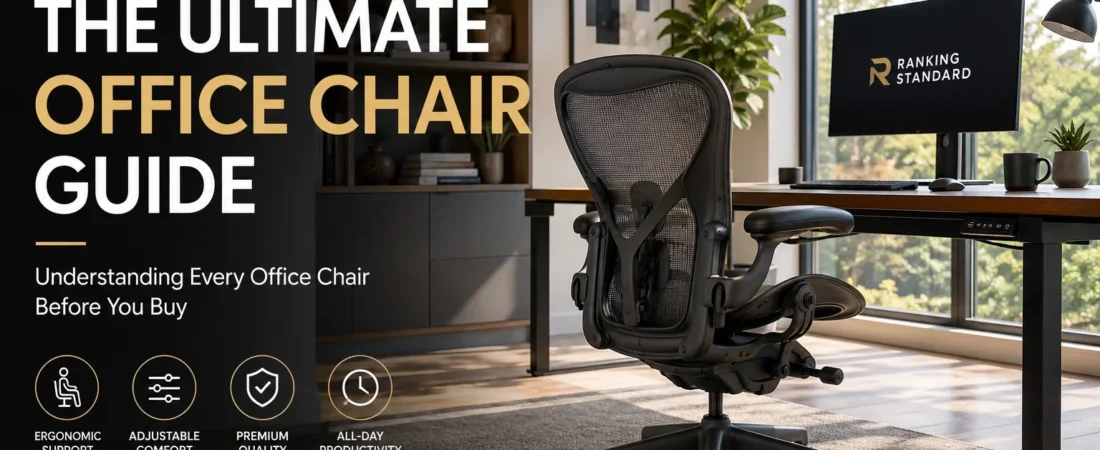
“The best office chair isn’t the one with the highest price tag. It’s the one that still feels comfortable after eight hours of work.”
Buying an office chair sounds simple.
Until you start looking.
Mesh or leather?
Ergonomic or executive?
High-back or mid-back?
Should you spend $200 or $2,000?
Within minutes, what seemed like an easy purchase becomes surprisingly confusing.
The modern office chair market has exploded over the past decade.
Remote work, hybrid offices, gaming setups, and ergonomic research have transformed what was once a simple piece of furniture into one of the most important investments for both productivity and long-term health.
Today, millions of people spend more time sitting in an office chair than sleeping in their beds.
Yet many buyers still choose a chair based on appearance, price, or brand reputation alone.
That’s often where problems begin.
Why Your Office Chair Matters More Than You Think
An office chair isn’t simply another piece of furniture.
It’s something your body interacts with every day.
Whether you’re working from home, studying, designing, programming, gaming, or attending meetings, your chair supports your body for hours at a time.
Poor support can contribute to:
- Lower back discomfort
- Neck and shoulder fatigue
- Reduced concentration
- Poor posture
- Earlier physical fatigue during long work sessions
A good chair won’t solve every health issue.
But the right chair can make long working hours significantly more comfortable and sustainable.
Comfort isn’t a luxury.
For many people, it’s a productivity tool.
The Office Chair Market Has Changed
Twenty years ago, office chairs were often judged by simple features:
- Soft padding
- Armrests
- Wheels
Today’s market is completely different.
Modern office chairs now incorporate years of ergonomic research.
Many premium chairs offer:
- Adjustable lumbar support
- Dynamic backrest movement
- Seat depth adjustment
- Synchronized tilt mechanisms
- 4D armrests
- Breathable mesh materials
- Weight-sensitive recline systems
- Highly customizable seating positions
Rather than forcing users to adapt to the chair, modern ergonomic chairs are designed to adapt to the user.
That shift has completely changed the way office chairs are evaluated.
The Biggest Mistake Buyers Make
One of the most common questions people ask is:
“What’s the best office chair?”
The answer is exactly the same as with running shoes and coffee machines.
There isn’t one.
A software developer working ten hours a day has different needs than someone attending short online meetings.
A designer who frequently leans forward works differently from a manager who spends much of the day reclining during video calls.
Body height, weight, sitting posture, work style, and even room temperature all influence which chair feels most comfortable.
The best office chair is simply the one that fits the way you work.
The Ranking Standard Philosophy
At Ranking Standard, we never evaluate chairs based solely on brand reputation or price.
Instead, we begin with one question:
Who was this chair designed for?
Some chairs prioritize maximum ergonomic support.
Others focus on premium materials.
Some are built for affordability.
Others are designed for executive offices or creative studios.
Each solves a different problem.
That’s why our evaluations always begin with understanding the user before comparing products.
Because buying the right chair isn’t about finding the most expensive option.
It’s about finding the one you’ll still appreciate after thousands of hours of sitting.
What You’ll Learn In This Guide
By the end of this guide, you’ll understand:
- The major types of office chairs
- Which chair matches your work style
- The features that genuinely improve comfort
- Common buying mistakes
- How Ranking Standard evaluates office chairs
- Why expensive doesn’t always mean better
Most importantly, you’ll learn how to choose a chair based on real daily use, not marketing promises.
Understanding the Office Chair Market
Walk into any office furniture showroom or browse online, and you’ll quickly discover that not all office chairs are designed for the same purpose.
Some prioritize ergonomics.
Others focus on appearance.
Some are built for twelve-hour workdays.
Others are intended for occasional use in meeting rooms or home offices.
Unfortunately, many buyers compare chairs without first understanding which category they belong to.
That’s one of the biggest reasons people end up disappointed with their purchase.
Before comparing brands or individual models, it’s important to understand how today’s office chair market is organized.
The Five Main Types of Office Chairs
Rather than comparing hundreds of individual products, start by understanding the five major categories that dominate today’s market.
Once you know which category fits your work style, choosing the right chair becomes much easier.
1. Ergonomic Office Chairs
Ergonomic chairs are designed for people who spend long hours sitting.
Their primary goal is to support healthy posture while reducing fatigue during extended work sessions.
Common features include:
- Adjustable lumbar support
- Seat height adjustment
- Reclining backrest
- Adjustable armrests
- Seat depth adjustment
These chairs are ideal for professionals working six to ten hours each day.
Examples include:
- Herman Miller Aeron
- Steelcase Leap
- Haworth Fern
2. Executive Chairs
Executive chairs prioritize luxury and appearance.
They often feature:
- Thick cushioning
- Leather upholstery
- High backs
- Wide seating areas
While many are comfortable, not every executive chair offers the same ergonomic support found in premium ergonomic models.
They’re best suited for:
- Executive offices
- Conference rooms
- Traditional office environments
3. Task Chairs
Task chairs are simple, practical, and affordable.
They’re designed for shorter working periods rather than full-day sitting.
Most include basic adjustments without advanced ergonomic systems.
They’re commonly used in:
- Small businesses
- Schools
- Shared workspaces
For occasional computer use, a good task chair often provides excellent value.
4. Gaming Chairs
Gaming chairs have become increasingly popular, even outside gaming.
Many feature:
- Racing-inspired designs
- High backs
- Head pillows
- Lumbar cushions
- Deep recline angles
While they offer excellent comfort for some users, their ergonomics vary significantly between manufacturers.
A gaming chair isn’t automatically a better office chair simply because it looks more supportive.
Choosing one should depend on comfort—not appearance.
5. Drafting Chairs
Drafting chairs are designed for elevated workstations.
Unlike standard office chairs, they include:
- Taller gas lifts
- Foot rings
- Higher seating positions
They’re commonly used by:
- Architects
- Designers
- Laboratories
- Reception counters
- Standing desk users with elevated work surfaces
For standard office desks, however, they’re usually unnecessary.
Why Comparing Different Categories Doesn’t Work
One of the biggest mistakes buyers make is comparing chairs designed for completely different purposes.
For example,
should an executive leather chair compete directly with a premium ergonomic mesh chair?
Not really.
Each solves a different problem.
Likewise, comparing a budget task chair with a flagship ergonomic chair often creates unrealistic expectations.
At Ranking Standard, we believe products should first compete within their own category before being compared across the broader market.
Only then can recommendations remain fair and useful.
Office Chair Market Map
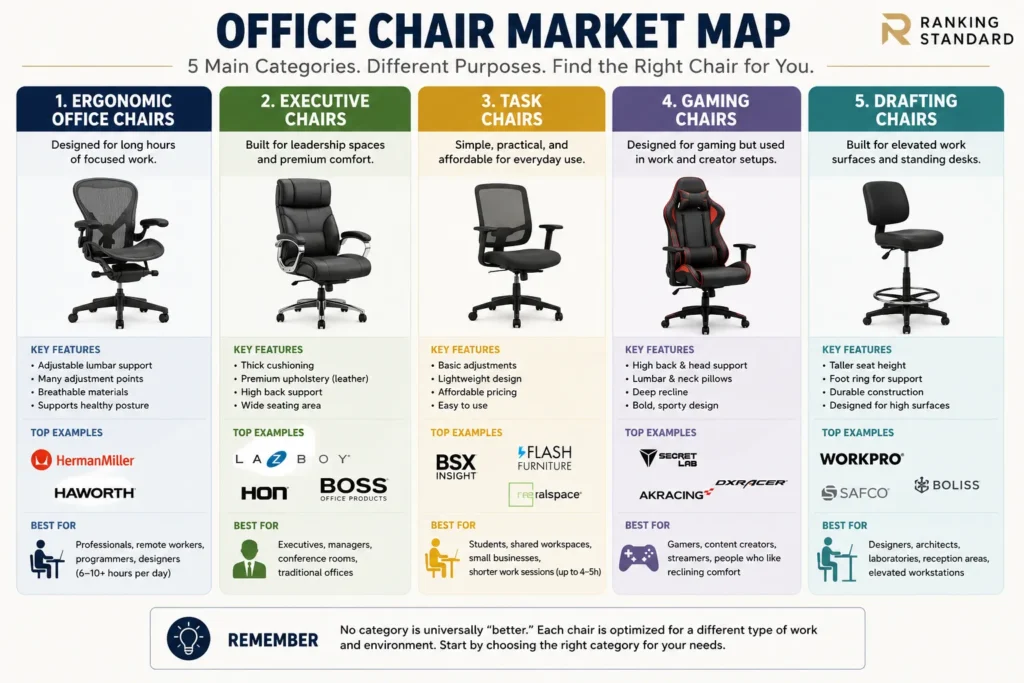
Rather than organizing chairs by price alone, Ranking Standard first organizes the market by primary purpose.
A simplified market map looks like this.
| Category | Primary Purpose | Typical User |
|---|---|---|
| Ergonomic | Long-hour productivity | Professionals & remote workers |
| Executive | Prestige & executive comfort | Managers & executives |
| Task | Everyday affordability | General office users |
| Gaming | Entertainment & hybrid use | Gamers & content creators |
| Drafting | Elevated workstations | Designers & technical professionals |
Notice something important.
No category is universally “better.”
Each is optimized for a different working environment.
The smartest purchase begins by selecting the right category—not the most famous brand.
Choosing the Right Category Comes First
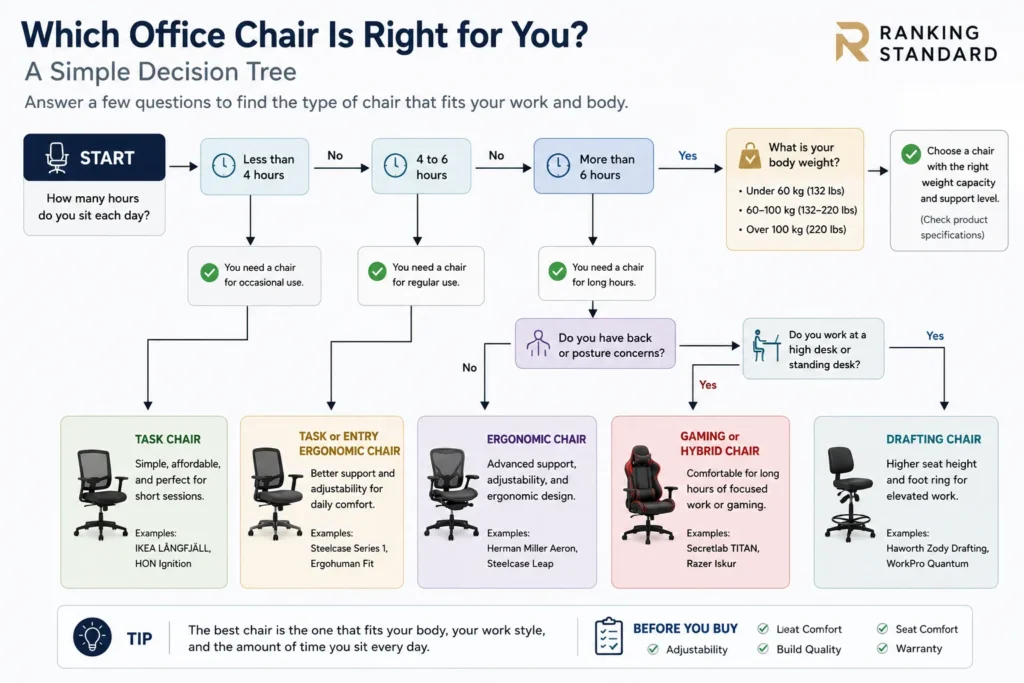
Many buyers immediately ask,
“Should I buy Herman Miller or Steelcase?”
But that’s actually the second question.
The first question should always be:
“What kind of chair do I actually need?”
Once you’ve identified the correct category, comparing brands becomes much easier—and far more meaningful.
This simple change in thinking often leads to better long-term satisfaction than focusing on brand names from the beginning.
How Ranking Standard Evaluates Office Chairs
By now, one thing should be clear.
Not every office chair is built for the same person.
Some are designed for programmers who spend ten hours at a desk.
Others are made for executives who value appearance.
Some prioritize airflow in warm climates.
Others focus on luxurious cushioning for shorter meetings.
That’s why Ranking Standard never asks:
“Which office chair is the best?”
Instead, we ask:
“Which office chair is the best for the way you actually work?”
That simple question changes everything.
The Office Chair Positioning Map
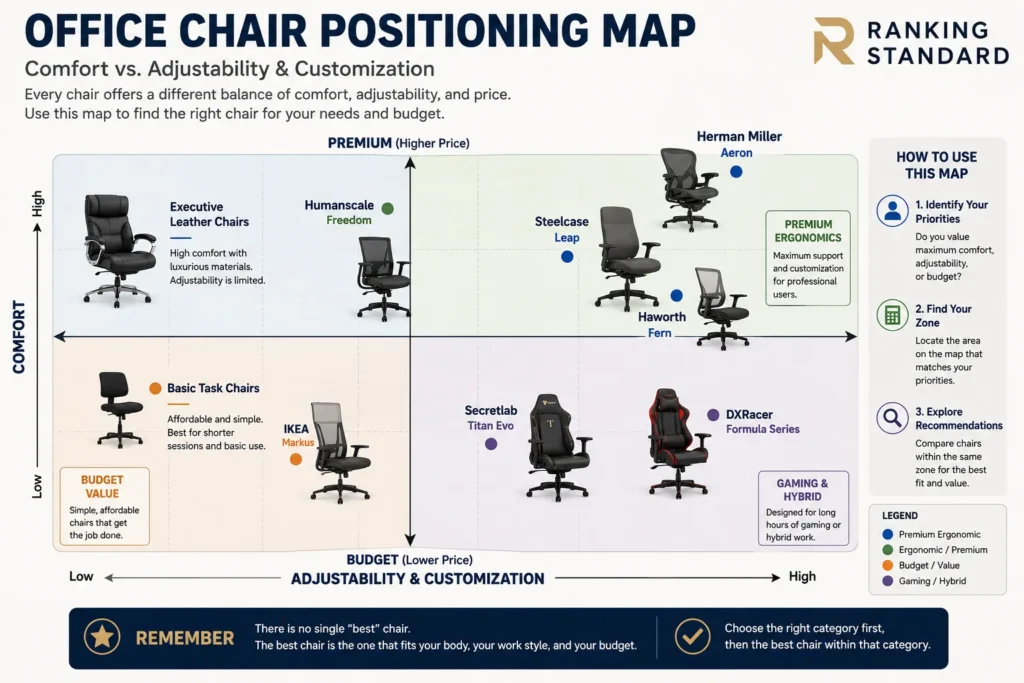
Rather than ranking chairs purely by price, Ranking Standard places every chair according to two factors that influence everyday ownership.
Ergonomic Support
↓
Everyday Comfort
The second dimension compares:
Ease of Use
↓
Level of Customization
Some chairs require almost no adjustments.
Others allow users to fine-tune nearly every component.
Neither approach is automatically superior.
Many people prefer simplicity.
Others enjoy optimizing every detail of their sitting position.
Understanding where a chair sits within this market is often more useful than simply knowing its price.
Why Premium Doesn’t Always Mean Better
One of the biggest misconceptions in the furniture industry is that the most expensive chair must also be the best chair.
In reality, price often reflects:
- Premium materials
- Manufacturing complexity
- Warranty length
- Brand positioning
These are important factors, but they don’t automatically improve your daily experience.
A $1,800 ergonomic chair may be an excellent investment for someone working remotely full-time.
The same chair may be unnecessary for someone using a home office only a few hours each week.
Likewise, a well-designed mid-range chair may deliver outstanding long-term comfort at a fraction of the price.
Value always depends on context.
The Ranking Standard Score
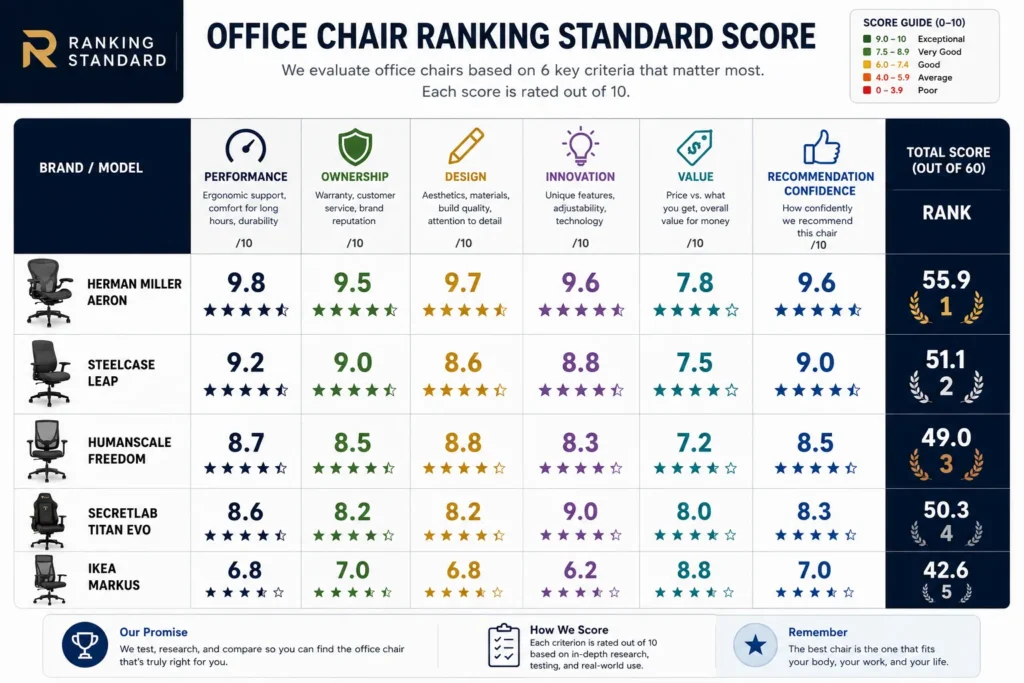
Every office chair is evaluated using the same objective framework.
Performance
Does the chair maintain proper support throughout long working sessions?
Does it encourage healthy posture without creating pressure points?
Ownership Experience
How easy is the chair to adjust?
Does it remain comfortable over months and years?
Is maintenance simple?
How reliable is the warranty?
Design & Build Quality
Materials matter.
Mesh, fabric, foam density, frame construction, wheel quality, and overall craftsmanship all influence long-term ownership.
A chair should feel solid not only on the first day but after thousands of hours of use.
Innovation
True innovation isn’t about adding more controls.
It’s about improving comfort in meaningful ways.
Features such as dynamic lumbar support, synchronized recline systems, and weight-sensitive mechanisms can significantly improve everyday usability when implemented well.
Value
The best value isn’t always the cheapest chair.
Nor is it necessarily the most expensive.
We evaluate whether the overall ownership experience justifies the investment.
Some mid-range chairs outperform premium competitors in this category.
Recommendation Confidence
Finally, we ask one simple question.
If we were furnishing our own office today, would we confidently recommend this chair to a colleague or family member?
That answer carries just as much weight as technical specifications.
Who Should Invest in a Premium Office Chair?
Premium ergonomic chairs are not for everyone.
However, they’re often worth considering if you:
- Work at a desk more than six hours a day.
- Experience back or neck fatigue.
- Plan to keep the chair for many years.
- View your chair as part of your long-term health rather than just another piece of furniture.
For many professionals, the office chair becomes one of the most frequently used products they own.
Choosing wisely can improve comfort every single working day.
Final Thoughts
An office chair isn’t simply something you sit on.
It’s a tool that supports productivity, concentration, and physical well-being.
The smartest purchase isn’t always the chair with the most adjustments or the highest price.
It’s the chair that quietly supports your body day after day without making you think about it.
That’s exactly what Ranking Standard is designed to help you find.
Because the best office chair isn’t the one that impresses your guests.
It’s the one you barely notice after eight hours of work.