
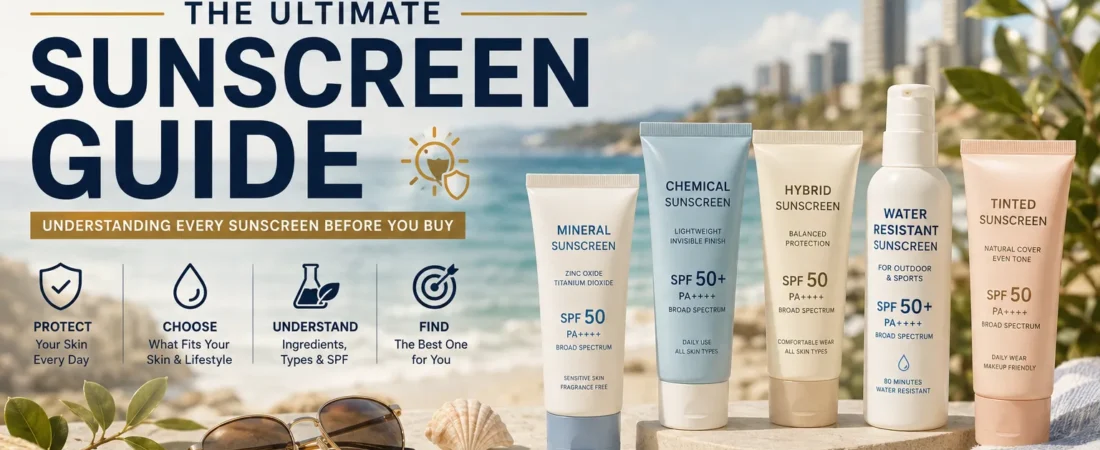
“The best sunscreen isn’t the one with the highest SPF. It’s the one you’ll actually wear every single day.”
Buying sunscreen should be one of the easiest skincare decisions you’ll ever make.
Instead, it has become one of the most confusing.
Mineral or chemical?
SPF 30 or SPF 50?
PA++++?
Broad spectrum?
Water resistant?
Tinted?
Sensitive skin?
With hundreds of products on the market and countless claims about protection, ingredients, and skin benefits, many people simply buy whatever looks popular or happens to be on sale.
Unfortunately, that’s often the wrong approach.
The right sunscreen depends on far more than its SPF number.
Your skin type.
Your lifestyle.
Your daily sun exposure.
Your climate.
Even the texture you enjoy wearing.
All of these influence which sunscreen will actually protect your skin.
That’s exactly why this guide exists.
Rather than recommending one universal “best sunscreen,” we’ll help you understand the sunscreen market so you can confidently choose the product that fits your skin, your lifestyle, and your daily routine.
Why Sunscreen Matters More Than Most People Realize
Sunscreen isn’t simply another skincare product.
It’s one of the most effective ways to protect your skin over the long term.
Daily sun exposure contributes to:
- Premature skin aging
- Hyperpigmentation
- Uneven skin tone
- Fine lines and wrinkles
- Sunburn
- Long-term UV damage
Even on cloudy days, ultraviolet radiation reaches your skin.
For that reason, dermatologists around the world consistently recommend making sunscreen part of your everyday routine—not only during vacations or summer months.
A good sunscreen doesn’t promise perfect skin overnight.
Instead, it helps preserve the healthy skin you already have.
The Sunscreen Market Has Changed
Not long ago, sunscreen was considered something people applied only before going to the beach.
Today’s products are very different.
Modern sunscreens now include:
- Lightweight fluid formulas
- Invisible finishes
- Mineral UV filters
- Chemical UV filters
- Hybrid formulations
- Skin barrier ingredients
- Antioxidants
- Moisturizing benefits
- Tinted protection
- Reef-safe formulations
Manufacturers now design sunscreens for very specific users.
Some prioritize oily skin.
Others focus on dry or sensitive skin.
Some are designed for sports and outdoor activities.
Others are made to wear comfortably under makeup every day.
The sunscreen market has evolved from simple UV protection into a complete skincare category.
The Biggest Mistake Buyers Make
One of the most common questions people ask is:
“What’s the best sunscreen?”
Just like running shoes, coffee machines, office chairs, mattresses, headphones, refrigerators, luxury watches, and SUVs, the answer is surprisingly simple.
There isn’t one.
A sunscreen that feels perfect on oily skin may feel uncomfortable on dry skin.
A water-resistant sunscreen made for outdoor sports may not be the best option for someone spending most of the day indoors.
Likewise, a product with a higher SPF isn’t automatically a better everyday choice if it’s unpleasant to wear consistently.
The best sunscreen is simply the one that you’ll happily apply every single day.
Because the sunscreen you actually use is always better than the one you leave in a drawer.
The Ranking Standard Philosophy
At Ranking Standard, we don’t evaluate sunscreens based on marketing claims, influencer trends, or packaging.
Instead, we begin with one simple question:
Who is this sunscreen actually designed for?
Some formulas prioritize sensitive skin.
Others focus on maximum outdoor protection.
Some are designed for athletes.
Others are created for people who wear sunscreen under makeup every day.
Every sunscreen solves a different problem.
Understanding that purpose comes before comparing brands, SPF numbers, or ingredient lists.
Because the smartest buying decision isn’t choosing the sunscreen with the most impressive label.
It’s choosing the one you’ll trust—and actually use—every day.
What You’ll Learn In This Guide
By the end of this guide, you’ll understand:
- The major types of sunscreens
- Which sunscreen suits different skin types
- The features that genuinely matter
- Common buying mistakes
- How Ranking Standard evaluates sunscreens
- Why the highest SPF isn’t always the best choice
Most importantly, you’ll learn how to choose sunscreen based on your skin, your routine, and your lifestyle, rather than simply following trends.
Understanding the Sunscreen Market
Walk into any pharmacy, skincare store, or online marketplace, and you’ll quickly discover that not all sunscreens are the same.
Some are designed for sensitive skin.
Others prioritize water resistance.
Some leave an invisible finish.
Others provide a natural tint for everyday wear.
The biggest mistake buyers make is assuming that SPF alone determines whether a sunscreen is good.
It doesn’t.
Modern sunscreens differ not only in protection level but also in ingredients, texture, finish, skin compatibility, and intended use.
Understanding these categories is the first step toward choosing the right sunscreen.
The Five Main Types of Sunscreens
Rather than comparing hundreds of individual products, begin by understanding the five major sunscreen categories that dominate today’s market.
Once you identify the category that matches your skin and lifestyle, choosing a specific product becomes much easier.
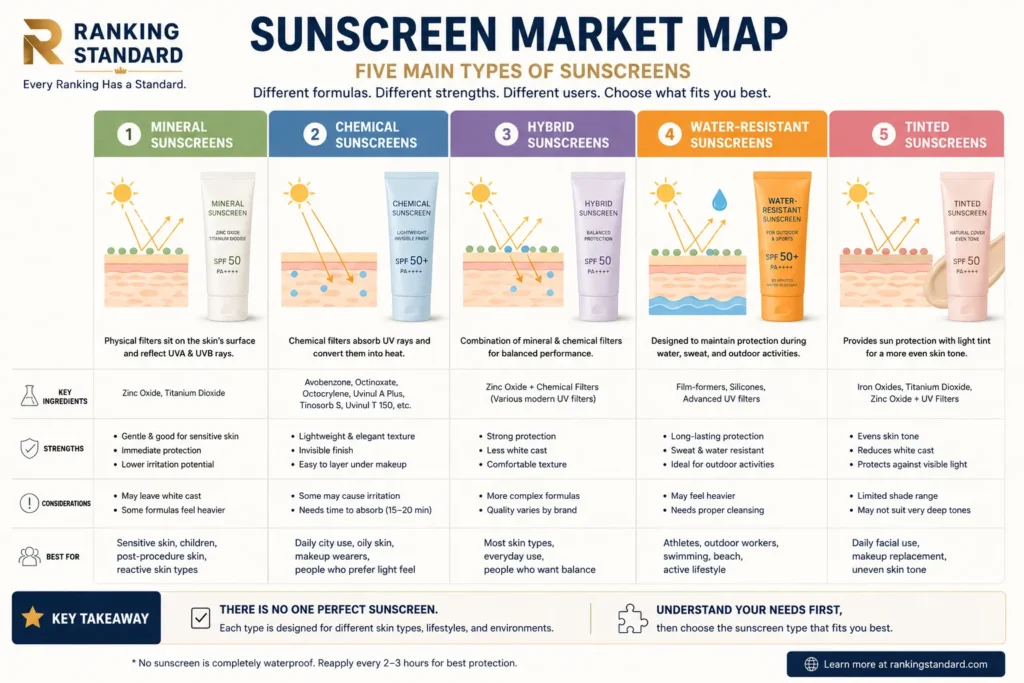
1. Mineral Sunscreens
Mineral sunscreens use physical UV filters, primarily:
- Zinc Oxide
- Titanium Dioxide
These ingredients sit on the skin’s surface and reflect or scatter ultraviolet radiation.
Advantages include:
- Excellent protection for sensitive skin
- Lower irritation potential
- Immediate protection after application
Potential drawbacks:
- May leave a white cast
- Some formulas feel heavier on the skin
Best for:
- Sensitive skin
- Children
- Post-procedure skincare
2. Chemical Sunscreens
Chemical sunscreens absorb UV rays before they damage the skin.
Modern formulations often provide:
- Lightweight textures
- Invisible finishes
- Comfortable everyday wear
- Easy layering under makeup
Potential drawbacks:
- Some people experience irritation from certain UV filters
- Protection usually develops after application rather than instantly
Best for:
- Daily city use
- Oily skin
- Makeup wearers
3. Hybrid Sunscreens
Hybrid sunscreens combine both mineral and chemical UV filters.
Their goal is to balance:
- Strong UV protection
- Cosmetic elegance
- Reduced white cast
- Comfortable texture
Because they combine multiple technologies, hybrid sunscreens have become increasingly popular in recent years.
Best for:
- Most skin types
- Everyday use
- Users seeking balanced performance
4. Water-Resistant Sunscreens
These sunscreens are formulated to maintain protection during:
- Swimming
- Sweating
- Outdoor sports
- Beach activities
Although no sunscreen is completely waterproof, water-resistant formulas remain effective for a specified period after exposure to water.
Best for:
- Athletes
- Outdoor workers
- Summer activities
5. Tinted Sunscreens
Tinted sunscreens combine UV protection with light cosmetic coverage.
Many products also help reduce the visible white cast often associated with mineral sunscreens.
Additional benefits may include protection against visible light, which can contribute to certain types of pigmentation.
Best for:
- Daily facial use
- Makeup replacement
- Uneven skin tone
Why Comparing Different Sunscreens Doesn’t Work
One of the biggest buying mistakes is comparing products designed for completely different users.
Should a mineral sunscreen for highly sensitive skin compete directly with a lightweight chemical sunscreen created for runners?
Not really.
Each solves a different problem.
Likewise, comparing a tinted facial sunscreen with a water-resistant sports sunscreen ignores the fact that they’re intended for different situations.
At Ranking Standard, sunscreens first compete within their own category before being compared across the broader skincare market.
Only then can recommendations remain objective and genuinely useful.
Sunscreen Market Map
Instead of organizing sunscreens by SPF or price alone, Ranking Standard organizes them by primary purpose.
| Category | Primary Strength | Best For |
|---|---|---|
| Mineral | Gentle Protection | Sensitive skin |
| Chemical | Lightweight Finish | Everyday use |
| Hybrid | Balanced Performance | Most users |
| Water-Resistant | Long-Lasting Protection | Sports & outdoor activities |
| Tinted | Protection + Cosmetic Finish | Daily facial wear |
Notice something important.
No sunscreen type is universally superior.
Each is designed for different skin types, lifestyles, and environments.
The smartest buying decision begins with selecting the right category—not simply choosing the highest SPF.
Choosing the Right Sunscreen Starts With Your Skin
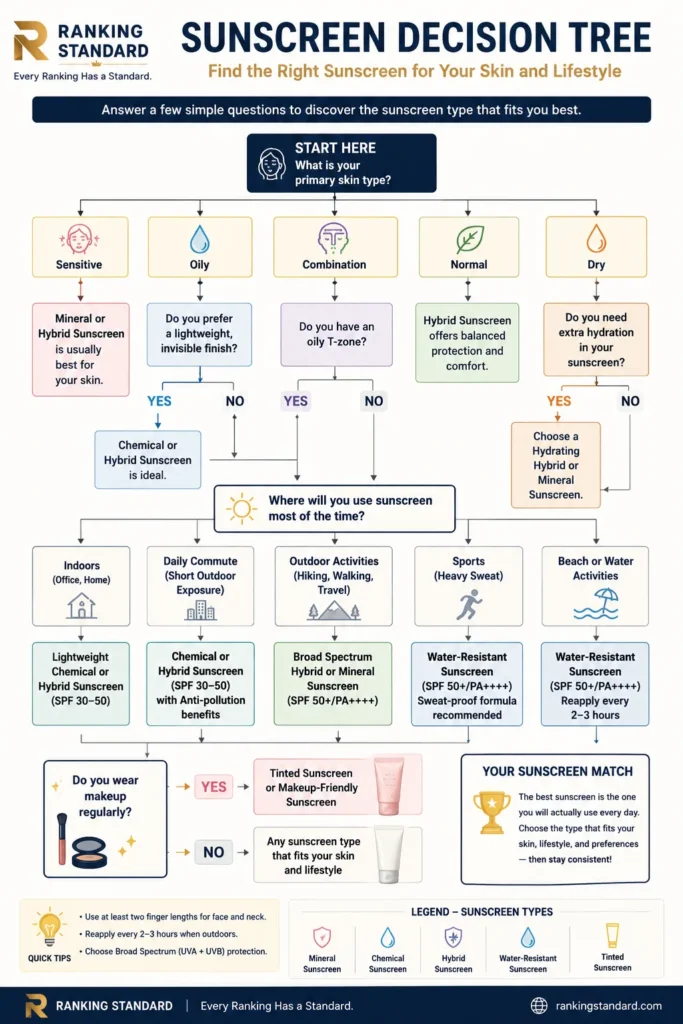
Many buyers immediately ask:
“Which sunscreen brand is the best?”
But that’s actually the second question.
The first question should always be:
“What does my skin actually need?”
Do you have oily skin?
Dry skin?
Sensitive skin?
Do you spend most of your time indoors?
Do you exercise outdoors?
Do you wear makeup every day?
These questions influence your sunscreen choice far more than advertising claims.
Once you’ve identified the right category, comparing brands becomes much easier—and much more meaningful.
How Ranking Standard Evaluates Sunscreens
By now, one thing should be clear.
There is no sunscreen that is perfect for everyone.
Some formulas are designed for oily skin.
Others prioritize hydration for dry skin.
Some focus on outdoor sports.
Others are created to disappear under makeup.
That’s why Ranking Standard never asks:
“Which sunscreen is the best?”
Instead, we ask:
“Which sunscreen is the best for your skin and the way you live?”
That simple question changes how every sunscreen should be evaluated.
The Skin Type Matrix
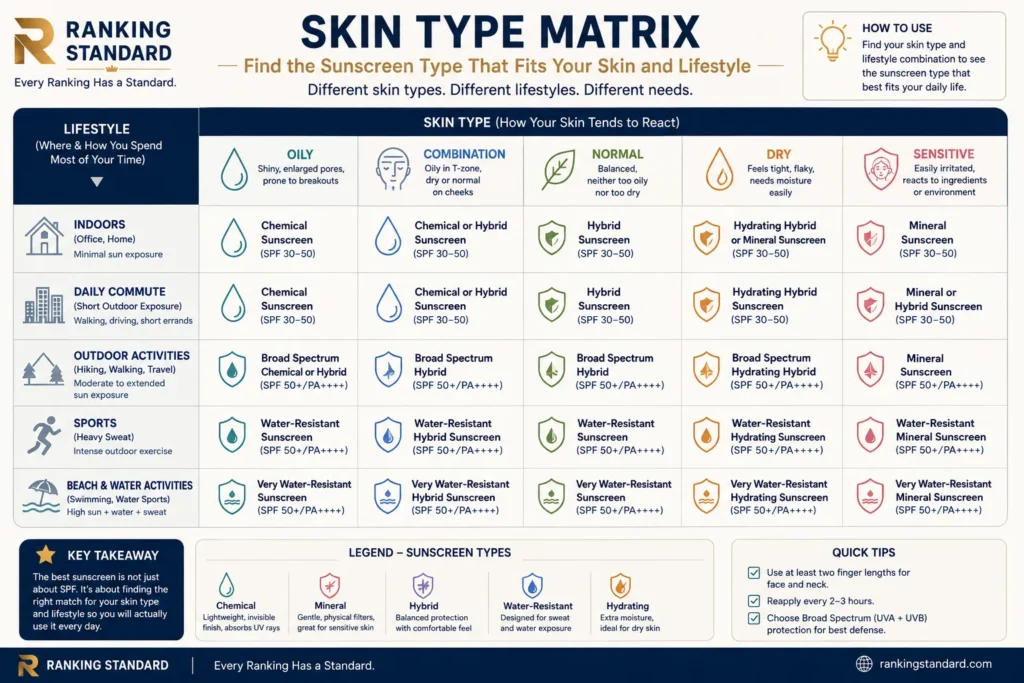
Unlike many skincare products, sunscreen must perform well under real-life conditions.
That’s why Ranking Standard introduces the Skin Type Matrix.
Rather than organizing sunscreens only by SPF or price, we first organize them by skin type and daily lifestyle.
The matrix compares two important dimensions.
Skin Type
↓
Oily
Combination
Normal
Dry
Sensitive
The second dimension evaluates:
Lifestyle
↓
Indoor
Daily Commute
Outdoor Activities
Sports
Beach & Water
A sunscreen that performs brilliantly during a marathon may feel too heavy for someone working in an air-conditioned office.
Likewise, an elegant lightweight sunscreen designed for everyday facial use may not provide the durability needed during long outdoor activities.
Understanding where a sunscreen fits within this matrix is often more valuable than simply comparing SPF numbers.
Why Higher SPF Doesn’t Always Mean Better
One of the biggest misconceptions in skincare is that the highest SPF is automatically the best choice.
In reality, SPF is only one part of sunscreen performance.
Long-term satisfaction also depends on:
- Comfort
- Reapplication
- Finish
- Skin compatibility
- Eye irritation
- Texture
- Everyday wearability
A sunscreen with SPF 50 that feels unpleasant and is rarely applied consistently offers less real-world protection than a comfortable SPF 30 sunscreen that becomes part of your daily routine.
Consistency is one of the most important factors in effective sun protection.
The Ranking Standard Score
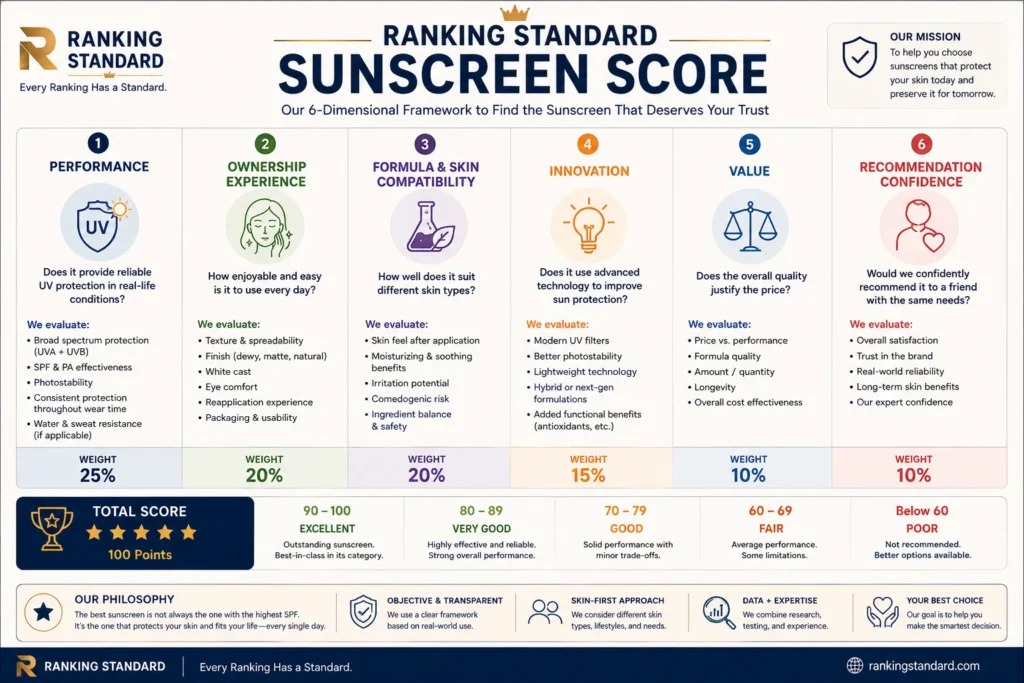
Every sunscreen is evaluated using the same objective framework.
Performance
Does it provide reliable UV protection under everyday conditions?
Does it perform consistently throughout recommended wear time?
Ownership Experience
How enjoyable is daily use?
We evaluate:
- Ease of application
- Finish
- Reapplication experience
- White cast
- Eye comfort
- Packaging usability
A sunscreen should encourage daily use rather than becoming a product people avoid.
Formula & Skin Compatibility
We examine:
- Skin feel
- Cosmetic elegance
- Compatibility with different skin types
- Ingredient balance
- Potential irritation
The best sunscreen is one your skin enjoys wearing every day.
Innovation
Innovation isn’t about adding trendy ingredients.
It’s about improving real-world sun protection.
Examples include:
- Modern UV filters
- Better photostability
- Lightweight textures
- Hybrid formulations
- Improved cosmetic finish
Technology should improve daily use—not simply create marketing claims.
Value
The best sunscreen isn’t necessarily the cheapest.
Nor is it always the most expensive.
We evaluate whether the overall protection, comfort, formula quality, and ownership experience justify the price.
Many affordable sunscreens deliver outstanding long-term value.
Recommendation Confidence
Finally, we ask one simple question.
If we were recommending a sunscreen to a friend with the same skin type and lifestyle, would we confidently choose this product?
That answer often says far more than advertising or influencer reviews.
Who Should Invest in Premium Sunscreens?
Premium sunscreens aren’t necessary for everyone.
However, they often make sense if you:
- Wear sunscreen every day.
- Have sensitive skin.
- Spend long periods outdoors.
- Wear sunscreen under makeup.
- Prefer elegant textures that encourage consistent use.
For many people, sunscreen becomes the most frequently used skincare product they own.
Choosing the right one can protect the skin every single day—not just during summer.
Final Thoughts
Sunscreen is one of the few skincare products that works quietly in the background.
It doesn’t promise overnight results.
Instead, it helps preserve healthy skin year after year.
The smartest buying decision isn’t choosing the sunscreen with the highest SPF or the most expensive packaging.
It’s choosing the one you’ll happily wear every single morning.
That’s exactly what Ranking Standard is designed to help you do.
Because the best sunscreen isn’t the one everyone else recommends.
It’s the one that fits your skin, your lifestyle, and your daily routine.
✍️ Editor Alter’s Note
This guide serves as the foundation of the Sunscreen category within Ranking Standard.
From here, we’ll naturally expand into:
- Best Sunscreen Brands
- Best Mineral Sunscreens
- Best Chemical Sunscreens
- Best Sunscreens for Oily Skin
- Best Sunscreens for Dry Skin
- Best Sunscreens for Sensitive Skin
- Best Korean Sunscreens
- Best Japanese Sunscreens
- SPF 30 vs SPF 50
- Mineral vs Chemical Sunscreen
Each of these articles will link back to this guide, making it the central Pillar of the sunscreen category.