
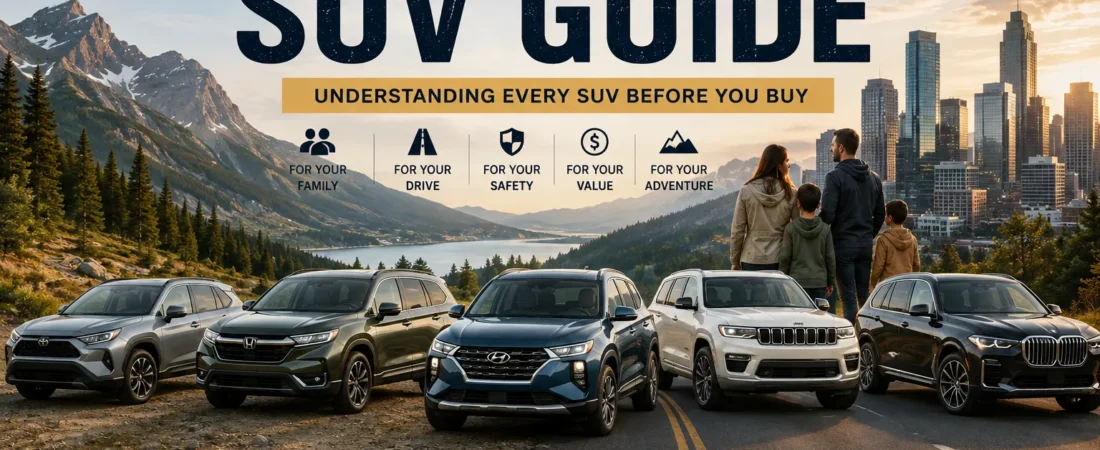
“The best SUV isn’t the biggest, the fastest, or the most expensive. It’s the one that fits the way you actually live.”
SUVs have become one of the most popular vehicle categories in the world.
Families love them for their space.
Commuters appreciate their higher driving position.
Outdoor enthusiasts value their versatility.
Luxury buyers enjoy their comfort and technology.
Today, SUVs dominate new vehicle sales in many countries, with manufacturers offering dozens of models across every size and price range.
But more choice doesn’t necessarily make buying easier.
Should you buy a compact SUV or a mid-size SUV?
Is a hybrid SUV worth the extra cost?
Do you really need all-wheel drive?
What’s the difference between a crossover and a traditional SUV?
Why does one SUV cost $30,000 while another exceeds $120,000?
These questions make SUV shopping surprisingly complicated.
That’s exactly why this guide exists.
Instead of telling you which SUV is “the best,” we’ll help you understand how the SUV market works so you can confidently choose the vehicle that matches your lifestyle, family, and driving needs.
Why SUVs Have Become So Popular
SUVs weren’t always the world’s favorite vehicles.
For decades, sedans dominated the market.
Today, that has changed dramatically.
Modern SUVs combine many advantages that were once difficult to find in a single vehicle.
They offer:
- Higher seating positions
- Flexible cargo space
- Comfortable passenger cabins
- Improved safety technologies
- Available all-wheel drive
- Better visibility
For many buyers, SUVs provide an excellent balance between practicality and comfort.
Whether you’re driving children to school, commuting to work, or heading out on a weekend road trip, an SUV often adapts more easily than many other vehicle types.
The SUV Market Has Changed
Not long ago, most SUVs were large, body-on-frame vehicles built primarily for off-road capability.
Today’s market is very different.
Modern SUVs now include:
- Compact crossovers
- Hybrid SUVs
- Plug-in hybrid SUVs
- Fully electric SUVs
- Luxury SUVs
- Performance SUVs
- Three-row family SUVs
Many buyers never leave paved roads.
Manufacturers have responded by prioritizing comfort, fuel efficiency, technology, and everyday usability over extreme off-road performance.
As a result, today’s SUV market is more diverse—and more confusing—than ever before.
The Biggest Mistake Buyers Make
One of the most common questions people ask is:
“What’s the best SUV?”
Just like running shoes, coffee machines, office chairs, mattresses, headphones, refrigerators, and luxury watches, the answer is surprisingly simple.
There isn’t one.
A compact SUV that’s perfect for a young couple may feel too small for a family of five.
A luxury SUV may provide exceptional comfort but offer capabilities that many owners never actually use.
Likewise, an off-road-focused SUV may be unnecessary for someone who spends almost all of their time driving in cities.
The best SUV is simply the one that fits your family, your driving habits, your budget, and your priorities.
The Ranking Standard Philosophy
At Ranking Standard, we never begin by asking:
“Which SUV is the best?”
Instead, we begin with a different question:
“What kind of driver was this SUV designed for?”
Some SUVs prioritize fuel efficiency.
Others focus on family comfort.
Some are built for towing.
Others emphasize luxury, technology, or off-road capability.
Every SUV is designed to solve a different problem.
Understanding that purpose comes before comparing brands, horsepower, or price.
Because the smartest buying decision isn’t purchasing the SUV with the longest feature list.
It’s choosing the one that will make your everyday driving easier for years to come.
What You’ll Learn In This Guide
By the end of this guide, you’ll understand:
- The major SUV categories
- Which SUV suits different lifestyles
- The features that genuinely matter
- Common buying mistakes
- How Ranking Standard evaluates SUVs
- Why expensive doesn’t always mean better
Most importantly, you’ll learn how to choose an SUV based on how you actually drive, not simply on advertisements or popularity rankings.
Understanding the SUV Market
Walk into any dealership today, and you’ll notice something immediately.
Almost every manufacturer offers multiple SUVs.
Some brands have five.
Others have ten or more.
At first glance they may all look similar.
In reality, they’re built for very different lifestyles.
A compact crossover designed for city commuting should never be compared directly with a full-size SUV built to tow heavy trailers.
Likewise, a luxury SUV isn’t simply a more expensive version of an economy model.
Each segment exists because buyers have different priorities.
Understanding those segments is the first step toward making the right decision.
The Five Main SUV Categories
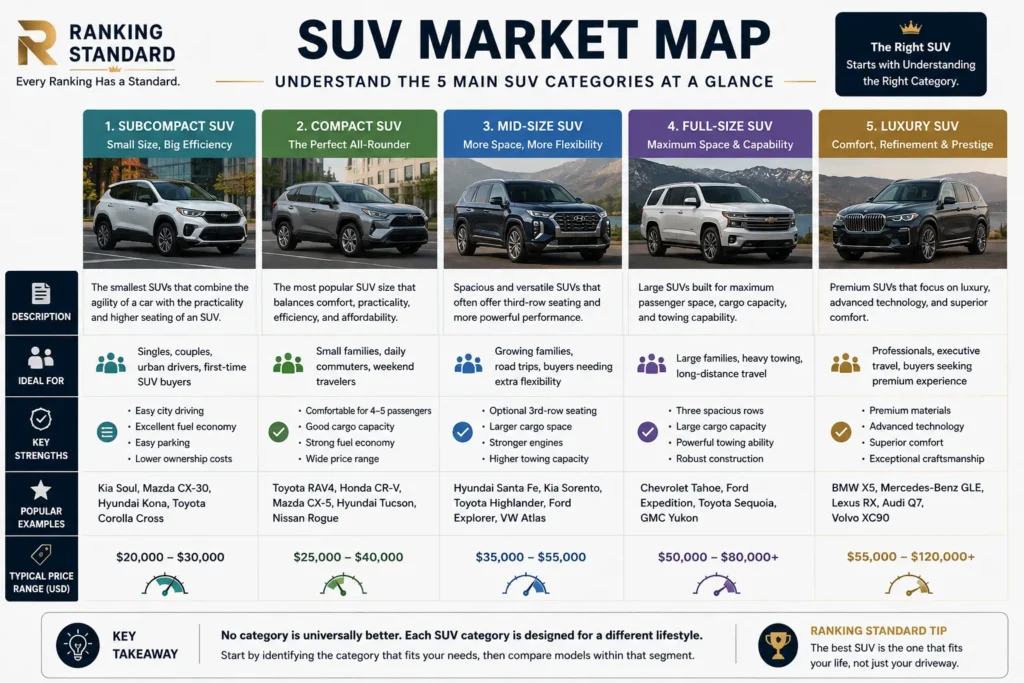
Instead of comparing hundreds of individual vehicles, start by understanding the five major SUV segments.
Once you identify the category that matches your lifestyle, choosing the right model becomes much easier.
1. Subcompact SUVs
The smallest members of the SUV family.
They combine the higher seating position of an SUV with the size and efficiency of a compact car.
Advantages include:
- Easy city driving
- Excellent fuel economy
- Easy parking
- Lower ownership costs
Potential drawbacks:
- Limited rear-seat space
- Smaller cargo area
Best for:
- Singles
- Couples
- Urban drivers
- First-time SUV buyers
2. Compact SUVs
Compact SUVs have become one of the world’s best-selling vehicle categories.
They balance practicality, comfort, efficiency, and affordability.
Most buyers don’t need anything larger.
Typical strengths include:
- Comfortable seating for four or five
- Good cargo capacity
- Strong fuel economy
- Wide price range
Best for:
- Small families
- Daily commuting
- Weekend travel
3. Mid-Size SUVs
For growing families, mid-size SUVs often represent the sweet spot.
They provide noticeably more passenger room while remaining easy to drive.
Many models offer:
- Optional third-row seating
- Larger cargo space
- Stronger engines
- Higher towing capacity
Best for:
- Families with children
- Frequent road trips
- Buyers needing greater flexibility
4. Full-Size SUVs
These vehicles prioritize maximum space and capability.
Common features include:
- Three spacious rows
- Large cargo capacity
- Powerful towing ability
- Robust construction
However, they also require:
- More parking space
- Higher fuel costs
- Larger budgets
Best for:
- Large families
- Heavy towing
- Long-distance travel
5. Luxury SUVs
Luxury SUVs focus on refinement rather than size alone.
Premium models often include:
- High-quality materials
- Advanced driver assistance systems
- Sophisticated suspension
- Premium audio systems
- Exceptional cabin comfort
Luxury isn’t simply about adding more technology.
It’s about improving the ownership experience in meaningful ways.
Best for:
- Professionals
- Executive travel
- Buyers seeking long-term comfort and premium craftsmanship
Why Comparing Different SUV Categories Doesn’t Work
One of the biggest mistakes buyers make is comparing vehicles designed for completely different purposes.
For example:
Should a compact crossover compete directly with a luxury full-size SUV?
Not really.
One emphasizes efficiency.
The other prioritizes comfort, space, and prestige.
Likewise, comparing an off-road-focused SUV with a family crossover often ignores the fact that they solve completely different problems.
At Ranking Standard, SUVs first compete within their own segment before being compared across the broader market.
Only then can recommendations remain objective.
SUV Market Map
Instead of organizing SUVs by price alone, Ranking Standard organizes them by primary purpose.
| Category | Primary Strength | Best For |
|---|---|---|
| Subcompact SUV | Efficiency & City Driving | Urban lifestyles |
| Compact SUV | Everyday Versatility | Most households |
| Mid-Size SUV | Family Flexibility | Growing families |
| Full-Size SUV | Space & Capability | Large families & towing |
| Luxury SUV | Comfort & Refinement | Premium ownership |
Notice something important.
No segment is universally superior.
Each is optimized for a different type of driver.
The smartest buying decision begins by choosing the right segment—not the most expensive badge.
Choosing the Right SUV Starts With Your Lifestyle
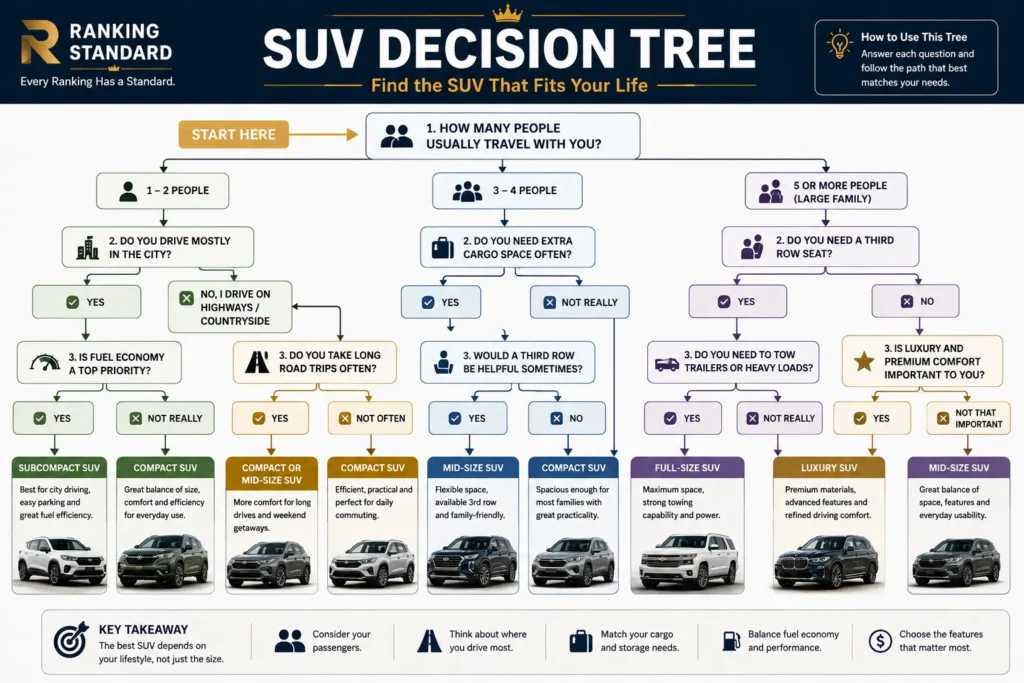
Many buyers immediately ask:
“Should I buy Toyota, Honda, BMW, Hyundai, or Kia?”
But that’s actually the second question.
The first question should always be:
“What kind of SUV do I actually need?”
How many people travel with you?
Do you drive mostly in cities?
Do you tow trailers?
Do you need a third row?
Do you value fuel economy more than performance?
These questions shape your ownership experience far more than the logo on the grille.
Once you’ve identified the correct segment, comparing brands becomes much easier—and much more meaningful.
How Ranking Standard Evaluates SUVs
By now, one thing should be clear.
There is no SUV that is perfect for everyone.
Some SUVs are designed for city commuting.
Others are built for large families.
Some prioritize fuel efficiency.
Others focus on luxury, off-road capability, or towing performance.
That’s why Ranking Standard never asks:
“Which SUV is the best?”
Instead, we ask:
“Which SUV is the best for the way you actually drive?”
That simple question changes how every SUV should be evaluated.
The SUV Segment Matrix
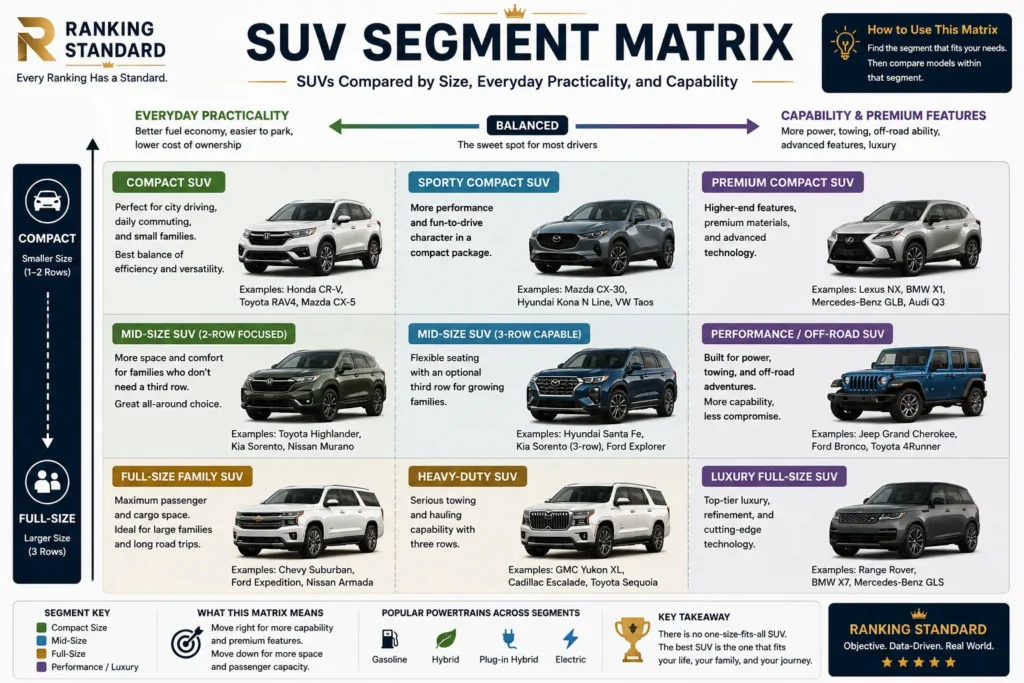
Unlike many product categories, SUVs must balance multiple priorities at the same time.
That’s why Ranking Standard introduces the SUV Segment Matrix.
Instead of comparing vehicles only by price, we evaluate them across two dimensions.
Vehicle Size & Passenger Capacity
↓
Everyday Practicality
The second dimension compares:
Efficiency & Value
↓
Capability & Premium Features
A compact hybrid SUV and a luxury three-row SUV may both receive excellent scores.
They’re simply solving different problems.
Rather than asking which vehicle is “better,” we first identify which segment best matches the buyer’s lifestyle.
Only then do we compare vehicles within that segment.
Why Bigger Doesn’t Always Mean Better
One of the biggest misconceptions in today’s SUV market is that moving up to a larger vehicle automatically means getting a better vehicle.
In reality, larger SUVs often bring trade-offs.
They may require:
- More parking space
- Higher fuel costs
- Higher maintenance expenses
- Larger purchase budgets
Likewise, a compact SUV may deliver a far better ownership experience for someone who spends most of their time driving in cities.
The best SUV isn’t determined by size.
It’s determined by suitability.
The Ranking Standard Score
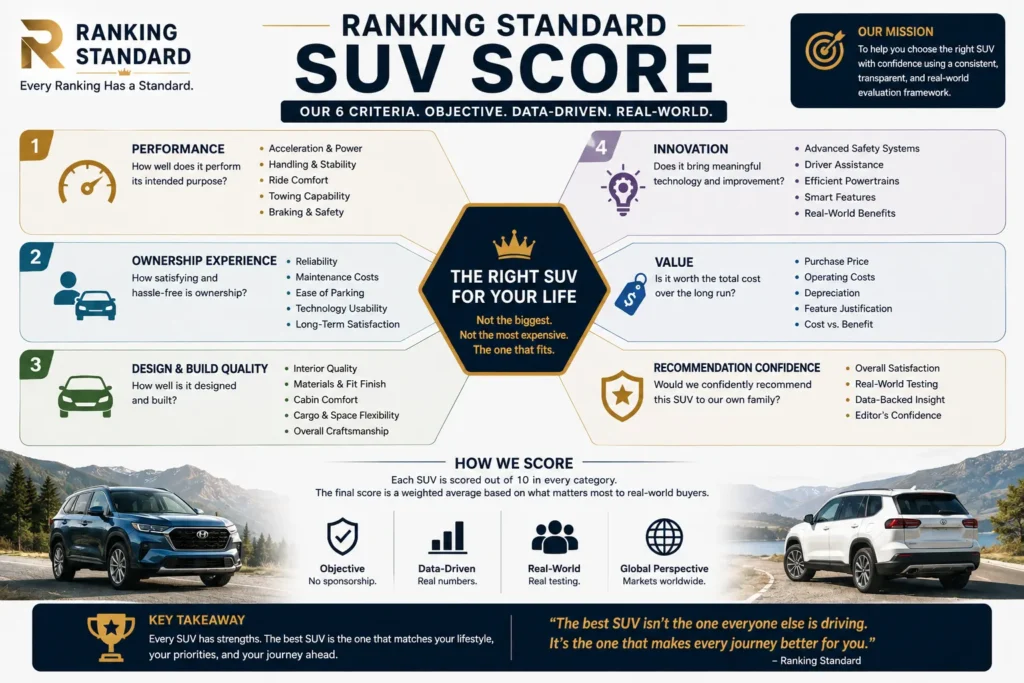
Every SUV is evaluated using the same six objective criteria.
Performance
Does the SUV perform well for its intended purpose?
Acceleration, ride quality, handling, towing capability, and overall driving confidence are all considered.
Ownership Experience
Daily ownership matters just as much as driving performance.
We evaluate:
- Reliability
- Maintenance costs
- Cabin practicality
- Ease of parking
- Technology usability
- Long-term ownership satisfaction
Design & Build Quality
A great SUV should feel well engineered inside and out.
We evaluate:
- Interior quality
- Material selection
- Build precision
- Cargo flexibility
- Seating comfort
- Overall craftsmanship
Innovation
Innovation isn’t measured by the number of screens.
It’s measured by features that genuinely improve ownership.
Examples include:
- Hybrid systems
- Driver assistance technologies
- Advanced safety systems
- Flexible interior layouts
- Efficient powertrains
Technology should improve everyday driving—not simply increase complexity.
Value
The best value isn’t always the cheapest SUV.
Nor is it necessarily the most luxurious.
We evaluate whether the ownership experience justifies the purchase price throughout many years of use.
Recommendation Confidence
Finally, we ask one simple question.
If we were buying an SUV for our own family today, would we confidently recommend this vehicle to someone with similar needs?
That answer often carries more weight than horsepower figures or marketing brochures.
Who Should Invest in a Premium SUV?
Premium SUVs aren’t the right choice for every buyer.
However, they often make sense if you:
- Drive long distances regularly.
- Travel with family frequently.
- Prioritize comfort and refinement.
- Plan to keep the vehicle for many years.
- Value advanced safety and technology.
For many households, an SUV becomes one of the most important purchases they’ll make after buying a home.
Choosing the right one can improve everyday life for the next decade or more.
Final Thoughts
An SUV isn’t simply a larger car.
It’s often the vehicle that carries your family on vacations.
It transports groceries after work.
It drives children to school.
It supports everyday life in ways few other products do.
The smartest buying decision isn’t choosing the SUV with the biggest engine or the most luxury features.
It’s choosing the one that quietly makes every journey easier, safer, and more enjoyable.
That’s exactly what Ranking Standard is designed to help you find.
Because the best SUV isn’t the one everyone else is driving.
It’s the one that fits your family, your lifestyle, and the road ahead.
✍️ Editor Alter’s Note
This guide serves as the foundation of the SUV category within Ranking Standard.
From here, we’ll naturally expand into:
- Best SUV Brands
- Best Compact SUVs
- Best Mid-Size SUVs
- Best Full-Size SUVs
- Best Luxury SUVs
- Best Hybrid SUVs
- Best Electric SUVs
- SUV vs Sedan
- AWD vs 4WD
- Best Family SUVs
Each of these articles will link back to this guide, making it the central Pillar of the SUV category.