

The most expensive whisky is not necessarily the most remarkable. Understanding what is inside the bottle matters far more than the name printed on the label.
Buying whisky can be surprisingly complicated.
This Whisky Guide explores the world’s major whisky styles, from Scotch single malt and American bourbon to Irish and Japanese whisky. Learn how production methods, oak casks, flavor profiles, and distillery reputation influence quality, price, and the buying decision.
Walk into a specialist whisky shop, and you might encounter hundreds of bottles from Scotland, Ireland, Japan, the United States, and other whisky-producing countries.
Some cost less than $40. Others sell for hundreds or thousands of dollars.
Some proudly display a 12-, 18-, or 25-year age statement. Others carry no age statement at all.
Then come the unfamiliar terms.
Single malt. Blended malt. Bourbon. Rye. Single cask. Cask strength. Sherry finish. Peated. Non-chill filtered.
For someone unfamiliar with whisky, these labels can feel like a secret language.
Even experienced enthusiasts sometimes struggle to explain why two bottles from the same distillery can have dramatically different prices, flavors, and reputations.
And perhaps the most important question remains unanswered:
What actually makes one whisky better than another?
At Ranking Standard, we believe the answer begins with understanding what you’re buying—not simply following famous names, age statements, or collector demand.
This Whisky Guide explains how the market is structured, what different whisky styles offer, and how to evaluate a bottle based on production, character, quality, and value.
Why Whisky Is Different From Most Consumer Products
A whisky bottle occupies an unusual position in the consumer market.
It is simultaneously a manufactured product, an agricultural expression, a reflection of regional traditions, and sometimes a collectible object.
Unlike electronics, whisky does not become technically obsolete when a new generation arrives.
Unlike clothing, its value is not determined primarily by seasonal fashion.
And unlike many everyday purchases, two bottles bearing the same distillery name may offer very different experiences.
A distillery’s character can change significantly depending on maturation, cask selection, blending, bottling strength, and production choices.
That makes whisky particularly interesting from a buying perspective.
The challenge isn’t merely finding a reputable producer.
It’s understanding which expression from that producer makes sense for the buyer.
The Whisky Market Is Not One Market
One of the biggest mistakes newcomers make is treating whisky as a single category.
In reality, the global market contains several distinct traditions.
Scotch whisky is closely associated with malt, regional distilling heritage, blending, and oak maturation.
American bourbon is shaped by its grain composition and the use of new charred oak containers.
Irish whiskey encompasses multiple production styles, including its distinctive single pot still tradition.
Japanese whisky draws on its own production history and increasingly defined identity, with producers creating styles ranging from delicate and restrained to rich and complex.
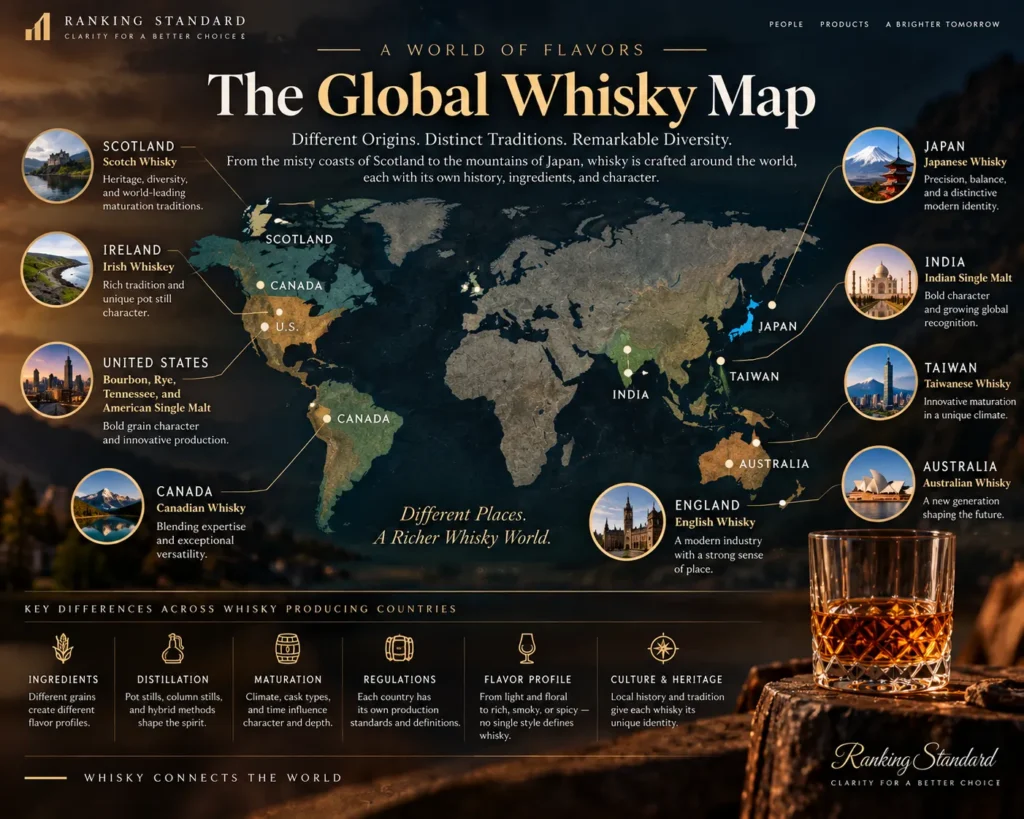
Other countries—including India, Taiwan, Australia, and England—have developed whisky industries with distinctive approaches to climate, maturation, and production.
These differences matter because whisky is not a competition to produce the strongest, oldest, or most expensive bottle.
Different traditions pursue different expressions of quality.
A rich bourbon and a delicate Japanese single malt should not automatically be judged by identical flavor expectations.
Neither should a heavily peated Islay whisky be evaluated as though every drinker is supposed to enjoy intense smoke.
A meaningful comparison begins by understanding the style.
What Makes Whisky Expensive?
The price of whisky is influenced by several factors, but not all of them directly reflect drinking quality.
Production and Maturation
Whisky production requires raw materials, fermentation, distillation, equipment, skilled labor, and time.
Maturation also creates significant costs.
Casks occupy warehouse space for years, capital remains tied up in inventory, and evaporation gradually reduces the amount of spirit available for bottling.
Longer maturation can therefore make whisky more expensive to produce.
However, longer aging does not guarantee a more balanced or enjoyable whisky.
Cask Selection
The type and history of a cask can substantially influence the final spirit.
Ex-bourbon casks often contribute vanilla, caramel, and oak-related notes.
Sherry-seasoned casks may introduce dried fruit, spice, and richer flavors.
Other cask types can create different effects depending on their previous contents and how the whisky is matured or finished.
But a prestigious cask description is not proof of superior quality.
What matters is how successfully the cask complements the underlying spirit.
Scarcity
Some bottles are expensive because relatively few exist.
A discontinued release, single-cask bottling, or limited edition may attract significant demand from collectors.
Scarcity can increase market value without necessarily making the whisky more enjoyable to drink.
Brand Prestige
Established distilleries often command higher prices because of their reputation, heritage, and recognition.
That reputation may be deserved.
But brand prestige and bottle quality are not interchangeable.
An excellent whisky from a lesser-known producer can offer greater value than an ordinary release from a famous name.
The Biggest Mistake Whisky Buyers Make
One of the most persistent assumptions in whisky is that older automatically means better.
An 18-year-old whisky must be better than a 12-year-old whisky.
A 25-year-old bottle must be exceptional.
And a whisky without an age statement must somehow be inferior.
None of these assumptions is universally correct.
Age changes whisky, but it does not improve every spirit in the same way.
Some whiskies develop remarkable depth through extended maturation.
Others lose desirable distillery character when oak influence becomes too dominant.
A carefully selected younger whisky can offer freshness, intensity, and balance that a much older expression may lack.
Age is valuable information.
It is not a universal quality score.
The same principle applies to price.
A $200 bottle is not automatically twice as good as a $100 bottle.
At higher price levels, buyers may be paying increasingly for rarity, packaging, reputation, or collectible appeal rather than proportionate improvements in flavor.
Understanding that distinction is essential to making a satisfying purchase.
The Ranking Standard Philosophy
At Ranking Standard, we separate three questions that whisky rankings frequently combine.
First: How well is the whisky made?
This includes production integrity, balance, complexity, integration, and consistency.
Second: Who is the whisky designed for?
A heavily peated single malt may be outstanding within its category while remaining unsuitable for someone who dislikes smoky flavors.
A sweeter bourbon may appeal to a completely different set of preferences.
Third: Does the bottle justify its price?
A whisky can be excellent yet poor value.
Another can be less complex but offer exceptional satisfaction relative to its cost.
These questions allow us to evaluate whisky without assuming that the most prestigious producer or most expensive bottle must always win.
They also provide the foundation for two distinct Ranking Standard frameworks.
The Whisky Style Map explains the differences between major whisky traditions and flavor profiles.
The Whisky Tier Pyramid examines distilleries and brands through craftsmanship, production heritage, consistency, influence, and market positioning.
The pyramid is an editorial assessment, not an official industry classification or a guarantee that every bottle from a higher-tier producer is superior.
Most importantly, a brand’s position in the pyramid will never replace an individual bottle evaluation.
What You’ll Learn in This Guide
Understanding whisky requires more than memorizing distillery names.
This guide will help you identify the major whisky traditions, distinguish production styles, interpret age statements, understand the influence of casks, and recognize the difference between genuine quality and collectible prestige.
It will also explain how Ranking Standard evaluates whisky brands and individual expressions without reducing a complex market to a popularity contest.
The goal is not to convince every buyer to pursue rare or expensive bottles.
It is to make the whisky market easier to understand—so that each purchase reflects informed priorities rather than confusing labels or reputation alone.
Understanding the Whisky Market: The Major Styles Explained
The word whisky describes a remarkably diverse family of spirits rather than one particular flavor or production method.
A smoky single malt from Scotland, a sweet Kentucky bourbon, and a delicate Japanese blended whisky may share the same broad identity, yet deliver entirely different drinking experiences.
Those differences begin with the raw ingredients and continue through fermentation, distillation, maturation, and blending.
For buyers, the first challenge is understanding three separate characteristics:
- Origin: Where the whisky is produced and which regulations apply.
- Production style: The grains, equipment, and methods used to make it.
- Flavor profile: The aromas, textures, and tastes that define the finished spirit.
These characteristics overlap, but they are not interchangeable.
A whisky’s country of origin does not automatically determine whether it is smoky, sweet, light, or complex.
Similarly, a single malt is not necessarily superior to a blend simply because of its production classification.
Understanding these distinctions is the foundation of intelligent whisky buying.
Scotch Whisky: Understanding the Five Official Categories
Scotch whisky is among the most established and influential traditions in the global spirits industry.
To qualify as Scotch, whisky must be produced in Scotland under specific legal requirements, including maturation in oak casks in Scotland for at least three years.
There are five legally recognized Scotch whisky categories.
1. Single Malt Scotch Whisky
Single malt Scotch is produced at one distillery using water and malted barley, without other cereals, and distilled in pot stills.
The word single refers to one distillery, not one cask.
A single malt can contain whisky from numerous casks and production batches, provided the whisky comes from the same distillery.
Well-known single malt producers include:
- Glenfiddich
- The Glenlivet
- The Macallan
- Glenmorangie
- Ardbeg
- Lagavulin
- Laphroaig
However, these distilleries produce dramatically different flavor profiles.
Glenmorangie is frequently associated with elegant, fruity expressions, while Ardbeg and Laphroaig are especially known for heavily peated styles.
The Macallan is strongly associated with expressions matured in sherry-seasoned oak casks.
Even within one distillery, individual releases may differ significantly in character, strength, maturation, and price.
Ranking Standard principle: Single malt is a production classification, not a guarantee of superior quality.
2. Single Grain Scotch Whisky
Single grain Scotch is produced at one distillery but does not follow the same grain and pot-still requirements as single malt.
It may contain grains such as wheat or corn, alongside malted barley.
Many single grain whiskies are produced using continuous distillation, which can create a lighter spirit.
However, lighter does not mean inferior.
Well-matured single grain whisky can develop attractive vanilla, caramel, cereal, fruit, and oak characteristics.
Some premium expressions demonstrate considerable complexity, especially after extended maturation.
3. Blended Malt Scotch Whisky
Blended malt combines single malt Scotch whiskies from at least two distilleries.
It contains no single grain Scotch.
The purpose is to combine different malt characteristics into a balanced expression.
One component might contribute fruitiness, another richness, and another subtle smoke.
Examples include Monkey Shoulder and selected Compass Box bottlings.
A carefully constructed blended malt can deliver complexity that differs from the character of any individual component.
4. Blended Grain Scotch Whisky
Blended grain Scotch combines single grain whiskies from at least two distilleries.
Although less familiar to many consumers, it is a distinct legal category.
Depending on the components and maturation, these whiskies may emphasize sweetness, vanilla, cereal, fruit, and oak.
The blending process can create consistency and complexity while retaining the lighter character often associated with grain whisky.
5. Blended Scotch Whisky
Blended Scotch combines one or more single malt Scotch whiskies with one or more single grain Scotch whiskies.
This category includes many internationally recognized brands:
- Johnnie Walker
- Chivas Regal
- Ballantine’s
- Dewar’s
- The Famous Grouse
Blended Scotch is sometimes unfairly dismissed as less prestigious than single malt.
But blending requires substantial technical skill.
A master blender may combine many different whiskies to create a consistent house style, balancing aroma, texture, sweetness, smoke, and oak influence.
Premium blends can contain carefully selected, well-matured components and offer sophisticated drinking experiences.
The meaningful question is not whether a whisky is blended.
It is how successfully the final blend achieves balance, complexity, and its intended character.
The Five Scotch Whisky Categories at a Glance
| Category | Production Definition | Main Distinction |
|---|---|---|
| Single Malt | Malted barley, one distillery, pot stills | Individual distillery character |
| Single Grain | One distillery, grain production outside single malt rules | Flexible grain and distillation methods |
| Blended Malt | Single malts from multiple distilleries | Combination of malt characteristics |
| Blended Grain | Single grains from multiple distilleries | Combination of grain whisky characteristics |
| Blended Scotch | Malt and grain Scotch whiskies | Balance across malt and grain components |
These classifications explain how Scotch whisky is produced.
They do not establish a quality hierarchy.
A premium blended Scotch may outperform an entry-level single malt, while an exceptional single malt may display a distinctive character that is difficult to reproduce through blending.
At Ranking Standard, products should first be understood within their actual category before being compared across the wider market.
The Scottish Whisky Regions: Geography Is Not Flavor
Scotch whisky is also associated with five traditional production regions:
- Speyside
- Highlands
- Lowlands
- Islay
- Campbeltown
These regions provide useful historical and geographical context, but they do not define fixed flavor profiles.
A whisky from Speyside is not automatically sweet.
A whisky from Islay is not automatically smoky.
And the Highlands encompass such a diverse collection of distilleries that no single flavor description adequately represents the entire region.
Speyside
Speyside is home to a particularly large concentration of malt whisky distilleries.
Many expressions emphasize orchard fruit, honey, vanilla, malt, and dried fruit.
Representative producers include Glenfiddich, The Glenlivet, Balvenie, Aberlour, and The Macallan.
However, cask selection and production methods create substantial variation.
Highlands
The Highlands cover a large and diverse geographical area.
Distilleries such as Glenmorangie, Dalmore, Oban, and Clynelish demonstrate how varied Highland whisky can be.
Styles range from delicate and floral to rich, waxy, spicy, maritime, or lightly smoky.
Lowlands
Lowland whiskies have traditionally been associated with lighter, grassy, floral, and approachable characteristics.
Auchentoshan and Glenkinchie are familiar examples.
Triple distillation is associated with some Lowland producers, but it is not a universal requirement.
Islay
Islay is particularly famous for heavily peated single malt whisky.
Ardbeg, Laphroaig, and Lagavulin are strongly associated with smoke, earthy notes, and maritime character.
However, Islay also produces unpeated expressions.
Bruichladdich’s Classic Laddie illustrates why geography alone should not determine expectations.
Campbeltown
Campbeltown has a distinctive whisky heritage and a relatively small modern distilling industry.
Springbank, Glen Scotia, and Glengyle are important producers.
The region is frequently associated with oily textures, coastal influences, malt complexity, and occasional smoke.
Individual expressions can vary considerably.
What About the Islands?
Whisky enthusiasts often discuss an informal Islands grouping, including distilleries on Skye, Orkney, Arran, and Jura.
However, Islands is not a separate legally recognized Scotch whisky region.
For official regional classification, these distilleries fall within the Highland region.
This is an important distinction when interpreting whisky maps, regional rankings, and marketing descriptions.
A regional identity can provide useful context, but it should never replace an evaluation of the whisky itself.
American Whiskey: Bourbon, Rye, and a Different Philosophy
If Scotch whisky is strongly associated with malt, regional heritage, and long-established blending traditions, American whiskey is often defined by its grain composition, oak maturation, and distinctive production regulations.
The difference becomes particularly noticeable when comparing Scotch single malt with American bourbon.
Both are whiskies, but they follow different production requirements and often deliver different flavor experiences.
American whiskey is not a single category. It includes bourbon, rye, Tennessee whiskey, American single malt, and several other styles.
Understanding these distinctions helps explain why two American whiskies can taste as different from each other as they do from Scotch.
Bourbon Whiskey: America’s Signature Style
Bourbon is one of the most recognizable American whiskey categories.
To qualify as bourbon, a whiskey must meet several production requirements, including:
- Production in the United States
- A grain mash containing at least 51% corn
- Distillation at no more than 160 proof
- Entry into new charred oak containers at no more than 125 proof
- Bottling at a minimum of 80 proof, or 40% ABV
Contrary to a common misconception, bourbon does not have to come from Kentucky.
Kentucky is historically important to bourbon production, but qualifying bourbon can be made elsewhere in the United States.
Bourbon is frequently associated with flavors such as vanilla, caramel, sweet oak, baking spices, and toasted sugar.
These characteristics are influenced by its grain composition and maturation in new charred oak.
However, bourbon is far from uniform.
Different mash bills, yeast strains, fermentation methods, barrel-entry proofs, warehouse conditions, and maturation periods can produce dramatically different results.
Well-known bourbon brands include:
- Buffalo Trace
- Maker’s Mark
- Wild Turkey
- Four Roses
- Woodford Reserve
- Elijah Craig
A bottle of Maker’s Mark and a bottle of Wild Turkey Rare Breed can offer substantially different experiences despite belonging to the same broad category.
The first may appeal to someone seeking a softer, sweeter profile, while the second offers a more powerful, higher-proof expression.
Neither approach is universally superior.
Ranking Standard perspective: Bourbon should be evaluated according to balance, flavor development, consistency, and value—not simply sweetness, proof, or brand recognition.
Straight Bourbon: What the Label Actually Means
The term straight bourbon carries a specific regulatory meaning.
Straight bourbon must satisfy bourbon production requirements and be aged for at least two years.
If a straight bourbon is less than four years old, its age must generally be stated on the label.
This makes the word straight meaningful rather than merely promotional.
However, straight bourbon is not automatically better than every bourbon without that designation.
It identifies a production standard, not an independent quality score.
Rye Whiskey: Spice, Structure, and Character
American rye whiskey must contain at least 51% rye in its grain mash.
Rye whiskey is often associated with a spicier and more herbal character than bourbon.
Common tasting notes include:
- Black pepper
- Baking spices
- Mint
- Citrus peel
- Herbal notes
- Dry oak
Rye has a particularly important place in American whiskey history and cocktail culture.
It is frequently used in classic cocktails such as the Manhattan and Sazerac, although bourbon can also be used in various recipes.
Representative rye brands and expressions include Bulleit Rye, Wild Turkey 101 Rye, Sazerac Rye, and WhistlePig’s rye whiskey range.
Yet not every rye whiskey is intensely spicy.
Grain composition, distillation, maturation, and blending all influence the finished profile.
For buyers, rye is best understood as a different flavor direction rather than a higher or lower tier of American whiskey.
Tennessee Whiskey: More Than a Geographic Label
Tennessee whiskey is closely associated with brands such as Jack Daniel’s and George Dickel.
Its production requirements generally resemble those of bourbon, with additional Tennessee-specific rules.
One distinctive feature is charcoal mellowing, commonly associated with the Lincoln County Process.
For most qualifying Tennessee whiskey, the spirit is filtered through maple charcoal before barrel aging.
This process is an important part of the category’s traditional identity.
However, it would be inaccurate to claim that charcoal mellowing automatically makes Tennessee whiskey smoother or better than bourbon.
The finished result depends on the entire production process.
American Single Malt: A Growing Premium Category
American single malt has emerged as an important category within the United States.
Under the federal standard established in 2025, American single malt whiskey must meet specific requirements, including production from 100% malted barley at a single U.S. distillery.
Unlike Scotch single malt, American single malt operates under its own production framework.
The category provides producers with opportunities to explore different distillation approaches, maturation environments, and oak influences.
Producers such as Westland, Stranahan’s, and Westward have helped establish its identity.
For whisky enthusiasts familiar with Scotch, American single malt offers an interesting comparison.
The underlying grain may be similar, but production choices and maturation conditions can create distinct results.
Irish Whiskey: Beyond the Reputation for Smoothness
Irish whiskey is often introduced to newcomers as a lighter or smoother alternative to Scotch.
While that description may apply to some popular expressions, it does not capture the full diversity of Irish whiskey.
Ireland has a rich distilling heritage and several distinct production categories.
These include:
- Single Malt Irish Whiskey
- Single Pot Still Irish Whiskey
- Single Grain Irish Whiskey
- Blended Irish Whiskey
Each represents a different approach to production and flavor.
Single Pot Still Irish Whiskey
Single pot still whiskey is one of Ireland’s most distinctive traditions.
It is produced at a single distillery using a mash containing both malted and unmalted barley, subject to the category’s technical requirements.
This creates a different production identity from Scotch single malt.
Single pot still Irish whiskey can display a rich texture, orchard fruit, cereal character, and distinctive spice.
Well-known examples include Redbreast and Green Spot.
For buyers who enjoy complex whisky without pronounced peat smoke, this category can be particularly interesting.
However, individual expressions vary considerably.
Irish Single Malt
Irish single malt is produced at one distillery using malted barley under the applicable Irish whiskey requirements.
It can range from delicate and fruity to rich, oak-driven, or occasionally smoky.
Bushmills is among the most recognized names associated with Irish single malt production.
Blended Irish Whiskey
Blended Irish whiskey combines different Irish whiskey categories.
Jameson is one of the most internationally recognizable examples.
Blending allows producers to create consistent flavor profiles by balancing different components.
A blend may emphasize accessibility, but premium blends can also deliver considerable complexity.
The important point is that blended whiskey should not automatically be treated as inferior to single malt or single pot still whiskey.
Is Irish Whiskey Always Triple Distilled?
No.
Triple distillation is an important part of Irish whiskey tradition, and many Irish producers use it.
However, it is not a universal requirement for every Irish whiskey.
Some producers use double distillation or other permitted approaches.
Triple distillation can influence spirit character, but it is not a guarantee of superior quality.
Ranking Standard perspective: Irish whiskey deserves evaluation through its actual production categories, rather than through the oversimplified assumption that all Irish whiskey is light and smooth.
Japanese Whisky: Precision, Heritage, and Identity
Japanese whisky has developed an international reputation for careful production, blending expertise, and distinctive craftsmanship.
Its modern history was influenced by Scottish whisky traditions, but Japanese producers have developed their own approaches and identities.
Important names include:
- Yamazaki
- Hakushu
- Hibiki
- Yoichi
- Miyagikyo
- Chichibu
These names represent different styles rather than a single Japanese flavor profile.
Yamazaki expressions can display layered fruit, oak, and spice.
Hakushu is frequently associated with fresh, herbal, and sometimes smoky characteristics.
Yoichi is known for a comparatively robust distillery character.
Miyagikyo often emphasizes a more elegant, fruity direction.
Hibiki demonstrates the role of blending in Japanese whisky.
However, these are broad associations rather than descriptions of every release.
Japanese Whisky Labeling Matters
One important issue in the Japanese whisky market has been the historical use of Japanese branding on products containing imported whisky.
To address consumer confusion, the Japan Spirits & Liqueurs Makers Association introduced standards defining products that may be labeled Japanese whisky.
These standards include requirements relating to ingredients, production, distillation, maturation, and bottling in Japan.
The transition period ended in March 2024 for participating association members.
The standards are industry rules rather than a comprehensive national statutory definition governing every producer.
For buyers, this distinction is important.
A bottle with Japanese imagery or a Japanese brand name should not automatically be assumed to contain whisky distilled and matured entirely in Japan.
Product provenance deserves attention, especially when regional authenticity contributes to a premium price.
Why Japanese Whisky Can Be Expensive
Japanese whisky prices can reflect several overlapping factors.
Established brand reputation, limited availability, collector demand, production capacity, and age-stated inventory all influence pricing.
Some releases command substantial secondary-market premiums.
However, high resale prices do not necessarily indicate proportionately better drinking quality.
A rare Japanese whisky may be highly desirable to collectors while a more accessible expression offers better value to someone primarily interested in flavor.
This distinction between drinking quality and collectible demand will be important when Ranking Standard introduces its Whisky Tier Pyramid.
Whisky Beyond the Traditional Four Countries
Scotland, Ireland, the United States, and Japan remain central to many whisky discussions.
But the global whisky market is much broader.
Several other countries have established internationally recognized distilleries and distinctive production approaches.
Taiwan: Kavalan and Warm-Climate Maturation
Taiwanese whisky has attracted attention through producers such as Kavalan.
Taiwan’s warmer climate creates different maturation conditions from those found in Scotland.
Higher temperatures can accelerate certain interactions between spirit and oak.
However, faster maturation does not mean that whisky automatically becomes equivalent to a much older Scotch.
Maturation involves multiple chemical processes, and climate affects those processes in different ways.
Taiwanese whisky should be evaluated on its finished character rather than assumptions about accelerated aging.
India: Amrut, Paul John, and a Distinct Identity
Indian single malt whisky has gained international recognition through producers such as Amrut and Paul John.
India’s climate, raw materials, and maturation conditions contribute to distinctive production possibilities.
Indian single malt can offer considerable intensity, fruit, spice, and oak influence.
But these characteristics vary by producer and expression.
The broader lesson is that high-quality single malt whisky is not limited to Scotland or Japan.
Australia: Experimentation and Local Character
Australia has developed a growing whisky industry with producers such as Starward and Lark.
Australian distilleries have explored different grains, cask types, and maturation approaches.
Some expressions use wine-influenced maturation, reflecting the country’s established wine industry.
However, no single cask style defines Australian whisky as a whole.
England: A Modern Whisky Industry
England’s contemporary whisky industry has expanded through producers such as The English Whisky Co. and The Lakes Distillery.
These producers demonstrate that established whisky traditions can coexist with new regional approaches.
The quality of a whisky should be assessed through production and sensory performance, not simply the historical prestige of its country.
Country of Origin Is Not a Quality Ranking
The global whisky market creates a temptation to establish a simple national hierarchy.
Scotland first.
Japan second.
Ireland third.
America fourth.
But such a ranking would ignore the enormous diversity within each country’s production.
An exceptional bourbon may offer greater complexity and satisfaction than an ordinary Scotch single malt.
A carefully produced Indian single malt may outperform a more expensive whisky from an established Scottish distillery.
And a premium Irish single pot still whiskey may offer a completely different experience from both.
At Ranking Standard, country of origin is a classification, not a quality score.
Geography helps explain tradition, production requirements, and stylistic tendencies.
It does not determine which bottle a buyer should purchase.
The next step is to move beyond geography and examine whisky through the characteristics that matter most in the glass: flavor, peat, oak maturation, age statements, and bottling strength.
The Whisky Style Map: Understanding Flavor Before Prestige
Knowing where a whisky comes from is useful. Knowing how it tastes is often more useful when deciding what to buy.
A single malt from Scotland, a bourbon from Kentucky, and a Japanese blended whisky may belong to different production traditions, but their flavor profiles can sometimes overlap.
Two whiskies from the same distillery can also taste remarkably different depending on maturation, cask selection, bottling strength, and production choices.
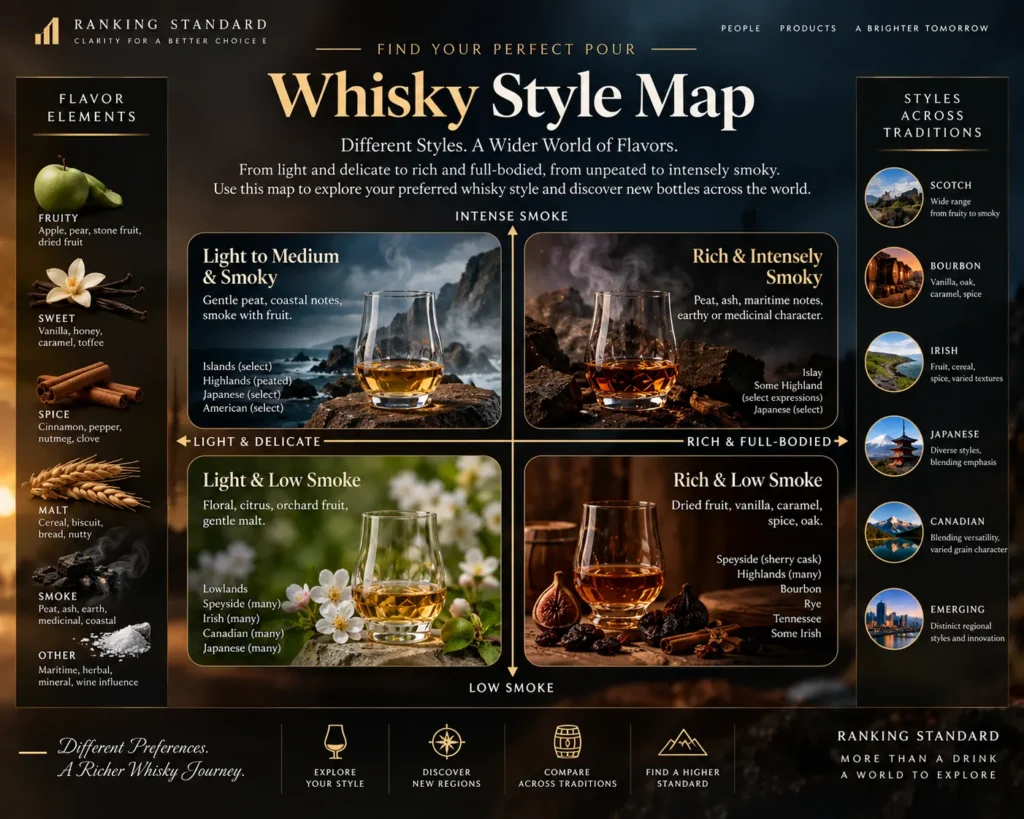
This is why Ranking Standard introduces the Whisky Style Map.
Rather than arranging bottles by price, age, or brand reputation, the map organizes whisky according to two broad sensory dimensions:
Horizontal axis: Light & Delicate → Rich & Full-Bodied
Vertical axis: Low Smoke → Intense Smoke
Together, these dimensions create four general flavor territories.
| Flavor Territory | Typical Characteristics | Illustrative Styles |
|---|---|---|
| Light & Low Smoke | Floral, citrus, orchard fruit, gentle malt | Many approachable Speyside, Lowland, and Irish expressions |
| Rich & Low Smoke | Dried fruit, vanilla, caramel, spice, oak | Sherry-influenced single malts, rich bourbon, some pot still whiskies |
| Light to Medium & Smoky | Gentle peat, coastal character, smoke with fruit | Selected lightly peated single malts |
| Rich & Intensely Smoky | Peat, ash, maritime notes, earthy or medicinal character | Many heavily peated Islay expressions |
This is not a formal industry classification.
It is an editorial framework designed to help buyers recognize flavor differences before comparing individual bottles.
The map also has limitations. Sweetness, acidity, texture, bitterness, fruit character, and oak influence cannot all be represented accurately on two axes.
A whisky may therefore occupy different positions depending on which characteristics are emphasized.
Nevertheless, the framework provides a useful starting point.
Someone who enjoys light, fruity whisky can explore similar flavor territories across different countries rather than restricting themselves to one famous region.
Likewise, someone who prefers rich, smoky whisky can identify suitable styles without assuming that every expensive bottle will satisfy that preference.
The Whisky Style Map answers a different question from the Whisky Tier Pyramid.
The Style Map asks: What kind of whisky might I enjoy?
The Tier Pyramid asks: How should we evaluate the standing and capabilities of different producers?
Both are useful, but they should never be confused.
Understanding Peat: Why Some Whiskies Taste Smoky
Peat is one of the most distinctive characteristics associated with certain Scotch whiskies.
It is partially decomposed organic material that accumulates in wetland environments over long periods.
In traditional whisky production, peat may be burned during the drying of malted barley.
The resulting smoke introduces phenolic compounds that can influence the aroma and flavor of the finished spirit.
Depending on production methods and maturation, these compounds may contribute impressions such as:
- Wood smoke
- Ash
- Earth
- Medicinal notes
- Maritime or seaweed-like aromas
- Smoked meat
- Tar or iodine-like character
Not every peated whisky displays all these characteristics.
Some expressions are intensely smoky and medicinal. Others combine gentle smoke with citrus, vanilla, fruit, or sweetness.
Peated vs Unpeated Whisky
An unpeated whisky is not automatically lighter, sweeter, or less complex.
Similarly, a peated whisky is not necessarily stronger or more sophisticated.
Peat is a stylistic choice.
A well-balanced unpeated single malt may offer remarkable complexity through fermentation character, distillation, and oak maturation.
A heavily peated expression may deliver a completely different kind of complexity through smoke, fruit, texture, and cask integration.
The question is not whether peat is present.
It is whether the peat contributes positively to the whisky’s intended character.
What Does PPM Mean?
Some distilleries describe peating levels using PPM, or parts per million, generally referring to phenolic content measured in malted barley.
Higher PPM figures can indicate more heavily peated malt.
However, these measurements should not be interpreted as a direct scale of how smoky the bottled whisky will taste.
Several factors influence perceived smokiness, including:
- Distillation cuts
- Still design
- Maturation
- Cask selection
- Bottling strength
- Interaction between smoke and other flavors
A whisky made from highly peated malt may not necessarily taste proportionately smokier than another expression with a lower stated PPM.
For Ranking Standard, the important evaluation is smoke integration and balance, not simply the highest number.
The Role of Oak Casks in Whisky Quality
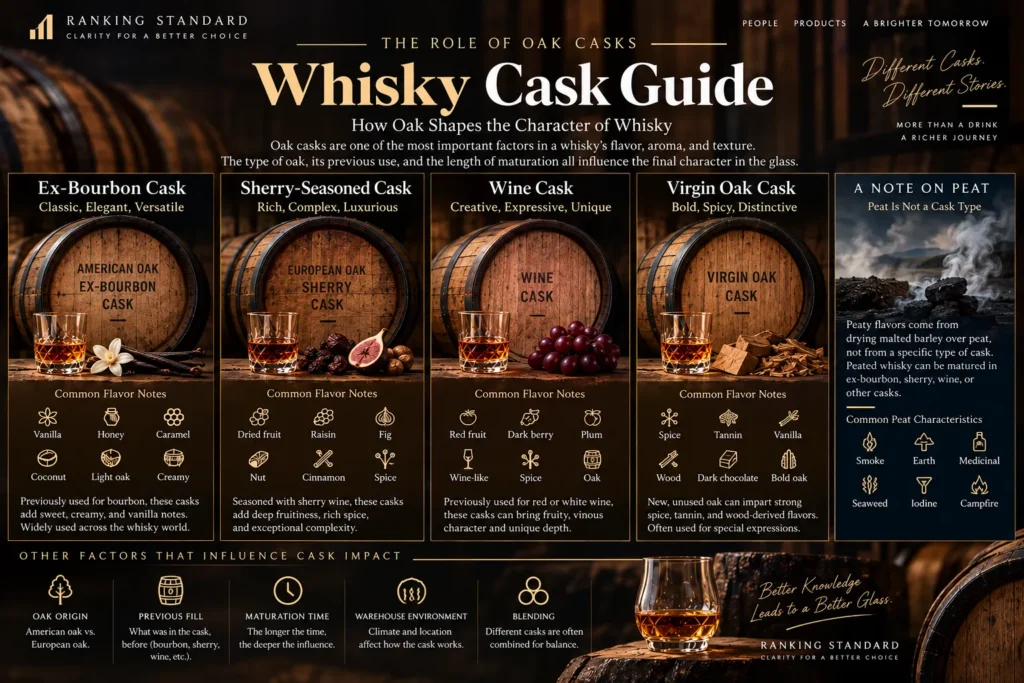
Few production decisions influence mature whisky as significantly as cask selection.
During maturation, whisky interacts with oak through extraction, oxidation, evaporation, and other chemical processes.
The wood can contribute aroma, color, texture, and flavor.
But the result depends on far more than the label attached to the cask.
Oak species, previous use, preparation, size, maturation duration, warehouse conditions, and the character of the original spirit all matter.
Ex-Bourbon Casks
Ex-bourbon casks are widely used in Scotch and other whisky traditions.
Because bourbon must be matured in new charred oak containers, previously used bourbon barrels become available for maturation elsewhere.
These casks are often associated with:
- Vanilla
- Honey
- Coconut
- Caramel
- Light oak spice
- Creamy or sweet impressions
However, the finished whisky may also retain substantial fruit, floral, malt, or smoky character from the distillate.
Sherry-Seasoned Casks
Sherry-seasoned oak casks play an important role in many premium whisky expressions.
They may contribute characteristics associated with:
- Dried fruit
- Raisins
- Figs
- Nuts
- Cinnamon
- Cloves
- Rich oak spice
The precise influence depends on the cask’s construction, seasoning, previous contents, and maturation history.
A whisky labeled sherry cask is not automatically superior to one matured in ex-bourbon oak.
A successful sherry-influenced whisky should balance cask richness with the underlying distillery character.
Wine Casks and Finishing
Some producers use casks associated with port, red wine, Madeira, or other wines.
Others transfer whisky from its primary maturation cask into another cask for an additional period, a practice commonly called finishing.
Finishing can introduce new flavor dimensions.
It can also create imbalance if the secondary cask overwhelms the original spirit.
A successful finish should feel integrated rather than artificially dominant.
Virgin Oak
Virgin oak refers to oak that has not previously been used for maturing another alcoholic beverage.
It can impart pronounced vanilla, spice, tannin, and wood-derived characteristics.
Because fresh oak can exert a strong influence, careful maturation and cask management are especially important.
Ranking Standard principle: A prestigious cask description earns no automatic quality advantage. The final whisky must demonstrate balance, complexity, and appropriate oak integration.
Age Statements: Does Older Whisky Really Taste Better?
Age statements are among the most recognizable features of premium whisky packaging.
Twelve years.
Fifteen years.
Eighteen years.
Twenty-five years.
The numbers are easy to understand, which makes them powerful marketing tools.
But whisky maturation is not a simple process in which every additional year guarantees an improvement.
What an Age Statement Means
For Scotch whisky, an age statement indicates the age of the youngest whisky used in the bottle.
A Scotch labeled 18 years old cannot contain a component younger than 18 years.
It may contain older components, but the label must reflect the youngest.
This distinction is especially important for blended whisky and single malt releases assembled from multiple casks.
Why Longer Maturation Can Help
Over time, maturation can develop or transform flavors through interactions between spirit, wood, and the surrounding environment.
Depending on the whisky, extended maturation may contribute:
- Greater oak complexity
- Softer integration of certain flavors
- Developed fruit and spice characteristics
- Additional texture
- More layered aromas
These effects can be desirable.
But they are not guaranteed.
Why Older Can Also Be Worse
Excessive oak influence may introduce bitterness, dryness, or dominant tannins.
A whisky can lose some of its fresh distillery character if maturation becomes unbalanced.
The ideal maturation period depends on the spirit, cask, climate, and intended style.
This means a carefully matured 12-year-old whisky can be more enjoyable than a poorly balanced 21-year-old expression.
Age tells you how long a whisky has matured.
It does not tell you whether that maturation was successful.
What About No Age Statement Whisky?
A no-age-statement whisky, often abbreviated NAS, does not display a conventional numerical age declaration.
This does not mean it is automatically young or low quality.
Producers may use NAS releases to combine components of different ages or maintain a particular flavor profile.
However, the absence of an age statement also provides less direct information about maturation duration.
Buyers should therefore judge NAS whisky through its actual character, production information, and price rather than assuming either superiority or inferiority.
Alcohol Strength: Understanding ABV and Cask Strength
Alcohol by volume, or ABV, indicates the proportion of alcohol in the finished whisky.
Common bottling strengths include 40%, 43%, 46%, and higher levels.
Cask-strength releases may be considerably stronger.
Standard Bottling Strength
Many widely distributed whiskies are bottled at 40% or 43% ABV.
These strengths can provide approachable drinking experiences, depending on the spirit.
A lower ABV does not automatically indicate poor quality.
However, dilution can influence texture, aroma intensity, and flavor concentration.
Higher-Strength Bottlings
Some producers bottle whisky at 46%, 48%, or other elevated strengths.
Higher ABV can preserve a more concentrated sensory experience, although it may also make alcohol intensity more noticeable.
A higher number is not an independent measure of quality.
The important question is whether the strength complements the whisky.
Cask Strength
Cask-strength whisky is generally bottled at or near the alcoholic strength at which it leaves the cask, without the substantial dilution commonly used for standard-strength bottlings.
Because maturation conditions and evaporation vary, cask-strength releases do not all have the same ABV.
Some may be relatively moderate, while others are very strong.
Cask strength can offer enthusiasts the flexibility to experience the whisky at its bottled concentration or explore how a small amount of water changes its aroma and flavor.
But greater strength does not guarantee greater complexity.
For Ranking Standard, alcohol integration matters more than raw proof.
Chill Filtration and Natural Color: Do They Matter?
Two additional terms frequently appear on premium whisky labels:
Non-Chill Filtered
and
Natural Color
Both deserve explanation, but neither should be treated as an automatic guarantee of quality.
Chill Filtration
Chill filtration is a process used to reduce certain compounds that may cause whisky to become cloudy when cooled or diluted.
Some producers choose not to chill filter because they want to retain more of the original composition.
However, the sensory impact of chill filtration depends on the whisky and process.
A non-chill-filtered label is useful production information, not proof that the whisky must taste better.
Natural Color
Some whisky producers use permitted coloring to maintain a consistent appearance across batches.
Others bottle without added coloring.
Natural color can provide information about production choices, but whisky color alone is an unreliable indicator of age, richness, or quality.
A dark whisky is not necessarily older.
A pale whisky is not necessarily less mature.
Cask history and production methods can produce substantial differences in appearance.
Ranking Standard evaluates what these choices contribute to the final product, not how attractive the terminology looks on the packaging.
How to Compare Two Whiskies Fairly
Imagine two bottles offered at similar prices.
One is a 12-year-old single malt matured primarily in ex-bourbon casks.
The other is a no-age-statement whisky with significant sherry-cask influence.
Which is better?
The answer cannot be determined from those descriptions alone.
A useful comparison should examine several dimensions.
| Evaluation Factor | What to Consider |
|---|---|
| Production Integrity | Authenticity, transparency, and appropriate production standards |
| Aroma & Flavor | Complexity, clarity, integration, and development |
| Balance | How successfully alcohol, oak, sweetness, spice, and other elements work together |
| Style Execution | Whether the whisky achieves its intended character |
| Consistency | Reliability across releases or batches where evidence is available |
| Value | Quality and suitability relative to the purchase price |
This framework is more informative than simply comparing age statements or bottle prices.
It also prevents a common ranking mistake: awarding higher scores to whiskies merely because they are more intense.
A delicate whisky can be exceptional.
A powerful whisky can be poorly balanced.
Intensity and quality are not synonyms.
Why the Best Whisky Depends on the Buyer
The global whisky market contains an enormous range of styles.
Some buyers enjoy delicate fruit and floral aromas.
Others prefer rich sherry influence, spicy rye, sweet bourbon, or intense peat smoke.
Some prioritize craftsmanship and traditional production.
Others value collectability, rarity, or historical significance.
These preferences cannot be reduced to one universal ranking.
A bottle that receives widespread critical acclaim may still be a poor purchase for someone who dislikes its dominant flavor profile.
Likewise, a relatively affordable whisky may provide exactly the experience a buyer wants.
This is why Ranking Standard separates three distinct decisions:
Style Suitability: Does the whisky match the buyer’s preferences?
Quality Assessment: How successfully is the whisky produced and balanced within its intended style?
Value Assessment: Does the experience justify the price?
A whisky should not receive an exceptional overall recommendation merely because it performs strongly in one of these areas.
A rare collectible can be desirable without offering outstanding drinking value.
A highly enjoyable everyday whisky can represent excellent value without possessing exceptional rarity or prestige.
The smartest purchase begins by knowing which qualities matter most to the buyer.
That distinction forms the foundation of Ranking Standard’s approach to whisky evaluation—and the basis for comparing individual bottles, distilleries, and brands without confusing reputation with quality.
The Whisky Tier Pyramid: Understanding Prestige, Craftsmanship, and Value
Whisky is one of the few consumer markets where reputation can become almost as influential as the product itself.
A distillery may command extraordinary respect because of its history, production methods, limited releases, or influence on the wider industry.
Another producer may deliver exceptional whisky at a far more accessible price while receiving significantly less attention.
This creates an important challenge.
How do we distinguish genuine production excellence from brand prestige, collector demand, and marketing?
At Ranking Standard, we believe the answer requires more than a conventional list of the world’s most expensive or famous whisky brands.
It requires a structured evaluation of what each producer contributes to the whisky industry.
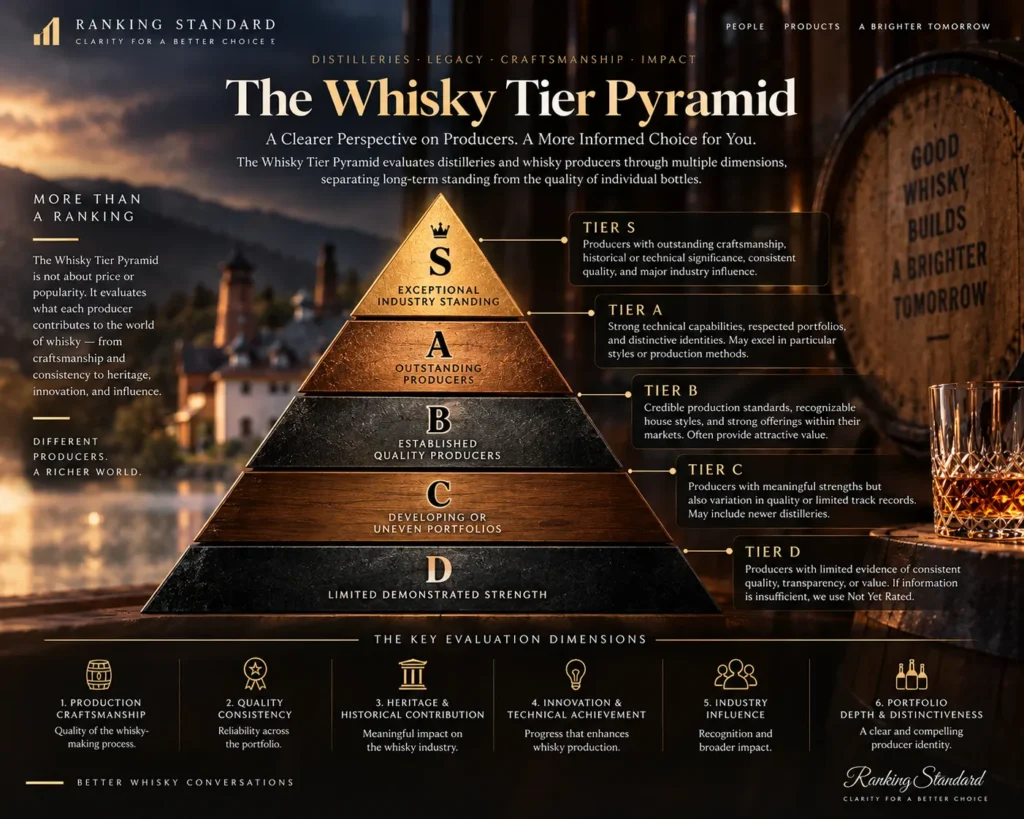
That is the purpose of the Whisky Tier Pyramid.
Unlike the Whisky Style Map, which organizes bottles according to flavor characteristics, the Whisky Tier Pyramid examines the broader standing of distilleries and whisky producers.
It considers craftsmanship, heritage, consistency, innovation, influence, and the quality of their portfolios.
Most importantly, it separates the reputation of a producer from the quality of an individual bottle.
A distillery can occupy a prestigious position while producing an entry-level expression that offers disappointing value.
Likewise, a relatively unfamiliar producer can release an exceptional whisky that competes with bottles from the industry’s most celebrated names.
The pyramid is designed to make these distinctions clearer—not to eliminate them.
How the Whisky Tier Pyramid Works
Ranking Standard organizes whisky producers into five editorial tiers.
These tiers are not official industry classifications, and they do not imply that every product from one tier is superior to every product from another.
Instead, they provide a framework for evaluating producers across multiple dimensions.
Tier S — Exceptional Industry Standing
This tier is reserved for producers that demonstrate an unusually strong combination of craftsmanship, historical or technical significance, consistent quality, and industry influence.
Prestige alone is insufficient.
A producer must demonstrate substantive achievements beyond marketing reputation or secondary-market prices.
Exceptional releases can strengthen a producer’s standing, but one famous bottle cannot establish an entire distillery’s position.
Tier A — Outstanding Producers
Tier A recognizes producers with strong technical capabilities, respected portfolios, and distinctive identities.
These producers may excel in particular styles or production methods without necessarily possessing the broader influence associated with the highest tier.
A Tier A distillery may produce individual whiskies that outperform bottles from Tier S producers.
Tier B — Established Quality Producers
Tier B includes producers with credible production standards, recognizable house styles, and strong offerings within their respective markets.
They may provide particularly attractive value or perform exceptionally well in selected product categories.
A producer’s position here should not be interpreted as a negative judgment.
It simply reflects its standing under the complete evaluation framework.
Tier C — Developing or Uneven Portfolios
This tier covers producers whose portfolios show meaningful strengths but also substantial variation in quality, consistency, or demonstrated capabilities.
It may include younger distilleries that have not yet established a sufficiently long performance record.
A limited history should not automatically imply poor craftsmanship.
It may simply reduce the confidence with which broader conclusions can be drawn.
Tier D — Limited Demonstrated Strength
Tier D is reserved for producers whose available evidence does not support a stronger position under the evaluation framework.
This could reflect persistent weaknesses in quality, consistency, transparency, or value.
However, insufficient information should not automatically result in a low tier.
Where evidence is inadequate, Ranking Standard should classify the producer as Not Yet Rated rather than assign an unsupported judgment.
What Actually Determines a Whisky Producer’s Tier?
A credible pyramid cannot be built around personal favorites.
Nor should it simply reproduce the preferences of collectors, influencers, or auction buyers.
Ranking Standard evaluates producers through six dimensions.
1. Production Craftsmanship
The first question is whether a producer demonstrates exceptional control over the whisky-making process.
Relevant considerations include fermentation practices, distillation quality, maturation management, cask selection, and blending expertise.
These processes should be assessed through documented production information and evidence from the finished whisky.
Traditional production methods may deserve recognition when they contribute meaningfully to quality.
However, tradition is not automatically superior to modern technology.
The purpose is to evaluate production excellence, not romanticize older methods.
2. Quality Consistency
A distillery should not achieve a high ranking solely because it released one extraordinary bottle.
Its broader portfolio matters.
Ranking Standard considers whether a producer demonstrates quality across core expressions, premium releases, and different production styles.
Batch variation is particularly important in whisky.
Some variation is expected, especially in single-cask and small-batch products.
The question is whether the producer consistently delivers the quality and character it promises.
3. Heritage and Historical Contribution
History matters in whisky, but age alone is not enough.
A distillery founded centuries ago does not automatically deserve a higher ranking than a newer producer.
Heritage should reflect meaningful contributions to production, regional traditions, technical development, or the industry’s identity.
A younger distillery can achieve substantial recognition through exceptional craftsmanship and innovation.
Ranking Standard therefore evaluates historical contribution rather than simply counting years since establishment.
4. Innovation and Technical Achievement
Innovation can take many forms.
A producer may develop new maturation approaches, improve production consistency, explore unusual grains, or refine blending techniques.
However, novelty should not be confused with progress.
An experimental cask finish is not automatically innovative in a meaningful sense merely because it is unusual.
The result must demonstrate a clear contribution to the whisky’s character, production quality, or consumer experience.
5. Industry Influence and Recognition
Some distilleries have shaped the global whisky industry.
Their production philosophies, signature styles, or technical achievements may influence other producers.
Independent critical recognition can provide useful evidence, especially when supported by multiple credible assessments.
However, awards should be interpreted carefully.
Competition results depend on judging panels, categories, submission practices, and evaluation conditions.
One award does not establish universal superiority.
6. Portfolio Depth and Distinctiveness
A strong whisky producer should demonstrate a recognizable identity.
This does not mean every release must taste similar.
It means the portfolio should reflect coherent production capabilities and a clear sense of purpose.
Some distilleries excel through a relatively focused range.
Others demonstrate versatility across multiple styles.
Neither approach is inherently superior.
What matters is whether the producer consistently delivers compelling whisky within its chosen direction.
The Whisky Pyramid Is Not a Price Pyramid
One of the most important principles behind the Ranking Standard framework is that expensive whisky does not automatically belong at the top.
Consider two hypothetical distilleries.
The first produces a small number of highly sought-after bottles that command extraordinary auction prices.
The second maintains an extensive portfolio of consistently excellent whiskies at more accessible retail prices.
Which deserves the higher tier?
The answer depends on production quality, historical contribution, consistency, and industry influence—not simply market value.
Auction prices can reflect rarity, speculation, collector demand, and prestige.
These factors may be relevant to collectability, but they should not determine drinking-quality rankings.
A collectible whisky is not necessarily an exceptional drinking whisky.
That distinction is essential to preserving the credibility of the pyramid.
Distillery Rankings and Bottle Rankings Must Remain Separate
Imagine a respected distillery that produces three different expressions.
One is an accessible 12-year-old single malt.
Another is a carefully selected cask-strength release.
The third is an extremely rare 30-year-old bottling.
All three share the same producer.
But they should not automatically receive similar scores.
The 12-year-old might offer exceptional value.
The cask-strength release might demonstrate greater intensity and complexity.
The 30-year-old might provide remarkable maturation character but command a price driven partly by scarcity.
Each bottle deserves an independent evaluation.
This leads to a fundamental Ranking Standard distinction.
Producer Tier: How strong is the distillery’s overall standing?
Bottle Score: How successfully does this specific whisky perform?
Buyer Fit: How appropriate is the bottle for a particular buyer’s preferences and priorities?
These three assessments answer different questions.
A Tier S producer can release a bottle with mediocre value.
A Tier B producer can create a whisky that receives an exceptional bottle score.
And even a highly rated bottle may be unsuitable for someone who dislikes its flavor profile.
This is not a weakness in the ranking system.
It is the reason the system can remain useful.
The Ranking Standard Whisky Score
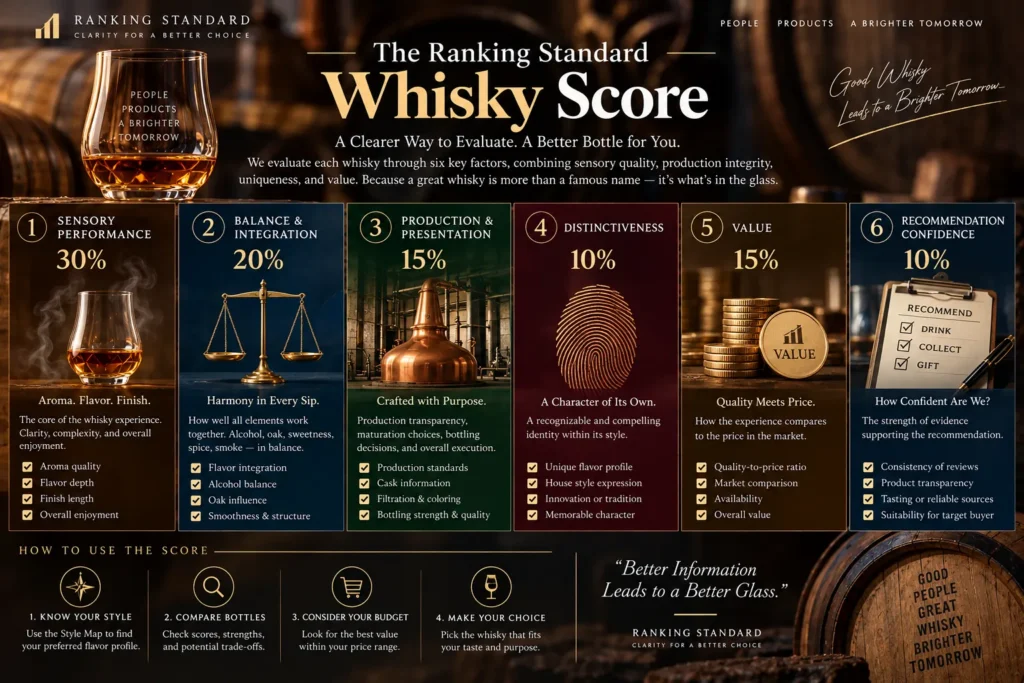
Individual whisky evaluations require a different emphasis from producer rankings.
While heritage and influence matter when assessing distilleries, the quality of a specific bottle should depend primarily on the whisky itself.
Ranking Standard therefore uses a proposed six-factor framework for bottle evaluations.
| Evaluation Factor | Weight |
|---|---|
| Sensory Performance | 30% |
| Balance & Integration | 20% |
| Production & Presentation | 15% |
| Distinctiveness | 10% |
| Value | 15% |
| Recommendation Confidence | 10% |
| Total | 100% |
These weights are the editorial framework for future reviews, not scores derived from a completed testing program.
Sensory Performance — 30%
This category considers the whisky’s aroma, flavor, texture, finish, and overall development.
Complexity matters, but complexity alone is not sufficient.
A whisky should deliver a coherent and satisfying sensory experience.
A relatively simple whisky can perform well when it expresses its intended character exceptionally clearly.
Balance & Integration — 20%
Balance is one of the most important characteristics of well-made whisky.
Alcohol, oak, sweetness, bitterness, smoke, spice, and other flavor elements should complement rather than overwhelm one another.
A high-strength whisky can score exceptionally well when its alcohol is integrated.
A heavily peated whisky can also achieve excellent balance without sacrificing its smoky identity.
The objective is not mildness.
It is harmony within the intended style.
Production & Presentation — 15%
This category considers production transparency, maturation information, bottling decisions, and the quality of execution.
Relevant details may include cask selection, filtration, coloring disclosures, bottling strength, and consistency.
Packaging can contribute to usability and product presentation, but elaborate boxes and expensive bottles should not outweigh the whisky’s intrinsic quality.
Distinctiveness — 10%
Does the whisky offer a recognizable and compelling character?
Distinctiveness can come from fermentation, distillation, maturation, blending, or regional traditions.
However, unusual flavor is not automatically desirable.
A distinctive whisky must still demonstrate successful execution.
Value — 15%
Value compares the whisky’s quality and suitability with its purchase price.
A relatively affordable bottle may receive an excellent value score.
A rare and expensive expression may perform poorly if its price is driven mainly by scarcity or reputation.
Because prices vary by country and retailer, value assessments should identify the market and date used for comparison.
Recommendation Confidence — 10%
This category reflects the strength of the evidence supporting a recommendation.
It considers the consistency of available evaluations, transparency of product information, and suitability for the intended buyer.
Where direct tasting or sufficient independent evidence is unavailable, Ranking Standard should clearly disclose the limitation rather than invent a score.
Recommendation confidence is not a substitute for sensory performance.
It is a measure of how confidently the available evidence supports the conclusion.
Why Objective Whisky Rankings Are Difficult
Whisky evaluation combines measurable information with sensory judgment.
Some facts are relatively straightforward to verify.
Alcohol strength, age statements, production category, and declared maturation methods can often be established from official product information.
Flavor quality is different.
Aroma and taste perception vary between individuals.
Even trained tasters can disagree about balance, complexity, and preference.
Environmental conditions, serving temperature, glassware, and tasting order can also influence the experience.
For that reason, Ranking Standard should not present subjective judgments as laboratory facts.
A credible review should distinguish between:
- Verified product specifications
- Documented production information
- Independent sensory assessments
- Editorial interpretation
- Personal preference
Where possible, sensory evaluations should use consistent conditions and multiple assessments.
If a bottle has not been tasted directly, the review must not imply that firsthand testing occurred.
Transparency is more valuable than artificial certainty.
The Whisky Buying Decision Framework
Understanding whisky styles and rankings is useful, but buyers still need a practical way to narrow their choices.
Ranking Standard approaches the decision through four questions.
What Flavor Profile Are You Looking For?
The first decision is sensory.
Do you prefer light and fruity whisky?
Rich oak and dried fruit?
Sweet bourbon?
Spicy rye?
Or pronounced peat smoke?
Flavor preference should guide the initial shortlist.
A highly ranked bottle outside your preferred style may not be the right purchase.
What Is Your Budget?
Price should be established before comparing prestige.
A buyer seeking an accessible everyday whisky has different priorities from someone considering a rare collectible.
Within each price range, the goal is to identify bottles offering strong quality and suitability.
A higher budget creates more options, but it does not guarantee greater satisfaction.
How Important Is Production Transparency?
Some buyers care deeply about cask information, bottling strength, filtration, and distillery practices.
Others primarily want a recognizable flavor profile and reliable quality.
Both approaches are reasonable.
However, production transparency becomes increasingly important when a bottle commands a premium price based on claims of craftsmanship or rarity.
Are You Buying for Drinking or Collecting?
This distinction changes the entire evaluation.
A whisky purchased primarily for drinking should be assessed through sensory quality, suitability, and value.
A bottle purchased for collecting requires additional consideration of authenticity, provenance, storage, rarity, market liquidity, and resale risks.
The two purposes can overlap, but they should not be treated as identical.
Whisky as a Collectible: Why Investment Claims Require Caution
Rare whisky has attracted attention from collectors and investors.
Certain bottles have achieved extraordinary auction results.
However, highly publicized sales represent a small and unusual segment of the market.
They do not establish that whisky generally appreciates in value.
Collectible whisky carries substantial risks.
These include:
- Counterfeit bottles and fraudulent provenance
- Storage and condition problems
- Auction and transaction fees
- Changing collector preferences
- Limited resale liquidity
- Market volatility
- Insurance and transportation costs
Even a genuine rare bottle may be difficult to sell at an attractive price.
Ranking Standard therefore treats collectability as a separate analytical dimension.
A high producer tier is not an investment recommendation.
Likewise, a high bottle score does not imply future price appreciation.
Whisky should not be presented as a predictable financial asset simply because certain bottles have historically sold for large sums.
Common Mistakes Whisky Buyers Should Avoid
Several mistakes repeatedly appear in whisky purchasing decisions.
Assuming Older Always Means Better
Age provides information about maturation duration, not guaranteed quality.
Paying for Prestige Without Understanding the Bottle
A famous distillery name may justify interest, but the specific expression still matters.
Treating Single Malt as Automatically Superior
Production categories describe how whisky is made. They do not establish universal quality rankings.
Confusing Intensity With Complexity
Higher alcohol strength, heavier peat, or stronger oak influence does not automatically create a better whisky.
Ignoring Regional Price Differences
A bottle that offers excellent value in one country may be overpriced in another.
Buying Collectibles Based on Future Price Expectations
Scarcity and past auction performance do not guarantee future returns.
Following Rankings Without Considering Flavor Preference
An exceptional whisky can still be the wrong choice for a particular buyer.
How Ranking Standard Will Build Its Whisky Rankings
The Whisky Tier Pyramid is only the beginning.
A complete decision platform should eventually provide several complementary ranking systems.
Distillery Tier Rankings will evaluate producers through craftsmanship, consistency, heritage, innovation, and industry influence.
Bottle Rankings will compare individual expressions within appropriate production and price categories.
Style Maps will help buyers understand flavor differences without treating preference as universal quality.
Value Rankings will identify bottles offering compelling quality relative to market prices.
Collectibility Analysis will examine rarity, provenance, and market characteristics separately from drinking quality.
These systems should work together.
A reader might begin with the Whisky Style Map to identify a preferred flavor profile.
They could then explore distilleries known for producing that style.
Finally, they could compare individual bottles according to quality, price, and availability.
This creates a more useful journey than simply reading a list of expensive whiskies ranked from first to last.
Final Thoughts
Whisky is a product of time, craftsmanship, tradition, and countless production decisions.
But it is also a market shaped by branding, reputation, scarcity, and personal preference.
Those influences make whisky fascinating.
They also make buying it more complicated than it first appears.
The most famous distillery is not automatically the best producer for every buyer.
The oldest bottle is not necessarily the most balanced.
The rarest release is not necessarily the most enjoyable.
And the most expensive whisky is certainly not guaranteed to offer the greatest value.
A better decision begins with understanding what is inside the bottle.
Where it comes from.
How it was produced.
What character it was intended to express.
And whether its quality and price make sense for the buyer.
That is the foundation of Ranking Standard’s approach to whisky.
Not a popularity contest.
Not a luxury price list.
But a structured way to distinguish craftsmanship, prestige, flavor, and value.
Because understanding whisky should make the market clearer—not more intimidating.
Editor Alter’s Note
Whisky represents an important step in Ranking Standard’s development.
Unlike many practical consumer products, whisky cannot be evaluated primarily through technical specifications or functional performance.
It requires an understanding of sensory quality, production heritage, brand positioning, and the distinction between drinking enjoyment and collectibility.
That is why this category needs two complementary visual frameworks.
The Whisky Style Map helps readers understand the different experiences available across the market.
The Whisky Tier Pyramid evaluates the standing of producers through a transparent editorial methodology.
Neither should replace the other.
And neither should imply that a higher price or greater prestige guarantees a better purchase.
As Ranking Standard expands into individual distilleries, bottle comparisons, and value rankings, this distinction will remain central.
Our goal is not to tell readers that one whisky is universally superior.
It is to help them understand what makes a whisky exceptional, what makes it expensive, and when those two things are not the same.